Taxonomy & naming
The species was described by the Austrian ichthyologist Franz Steindachner in 1909 as Lamprologus attenuatus, from Lake Tanganyika material; the unique holotype (NMW 42500) is held in Vienna. Eschmeyer's Catalog of Fishes records the current valid combination as Lepidiolamprologus attenuatus (Steindachner, 1909), following the generic placement of Maréchal & Poll (1991) and subsequent revisions of the lamprologine cichlids, including the work of Schelly and colleagues in the 2000s. Lamprologus pleurostigma Boulenger, 1914 — described from Tulo and Kilewa Bay — is treated as a junior synonym.
The genus name is a compound of Greek roots: lepis (scale) and lampros (bright), prefixed to the older Lamprologus, while the epithet attenuatus is simply Latin for "thinned" or "tapered," a fitting label for one of the most slender fish in its tribe. It belongs to the Lamprologini, the large flock of substrate-brooding, mostly cave- and shell-associated cichlids that dominate the rocky and intermediate zones of Tanganyika, and sits in a tight cluster of elongate, predatory Lepidiolamprologus alongside L. elongatus, L. profundicola, L. kendalli (nkambae) and the open-water L. mimicus. In the hobby it is usually sold under its scientific name, sometimes with a collection-locality tag such as 'Kipili' or 'Cape Chaitika'.
Appearance
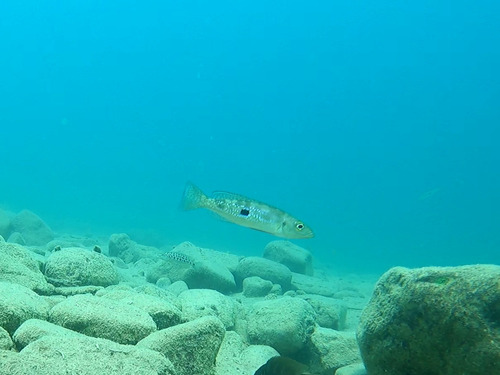
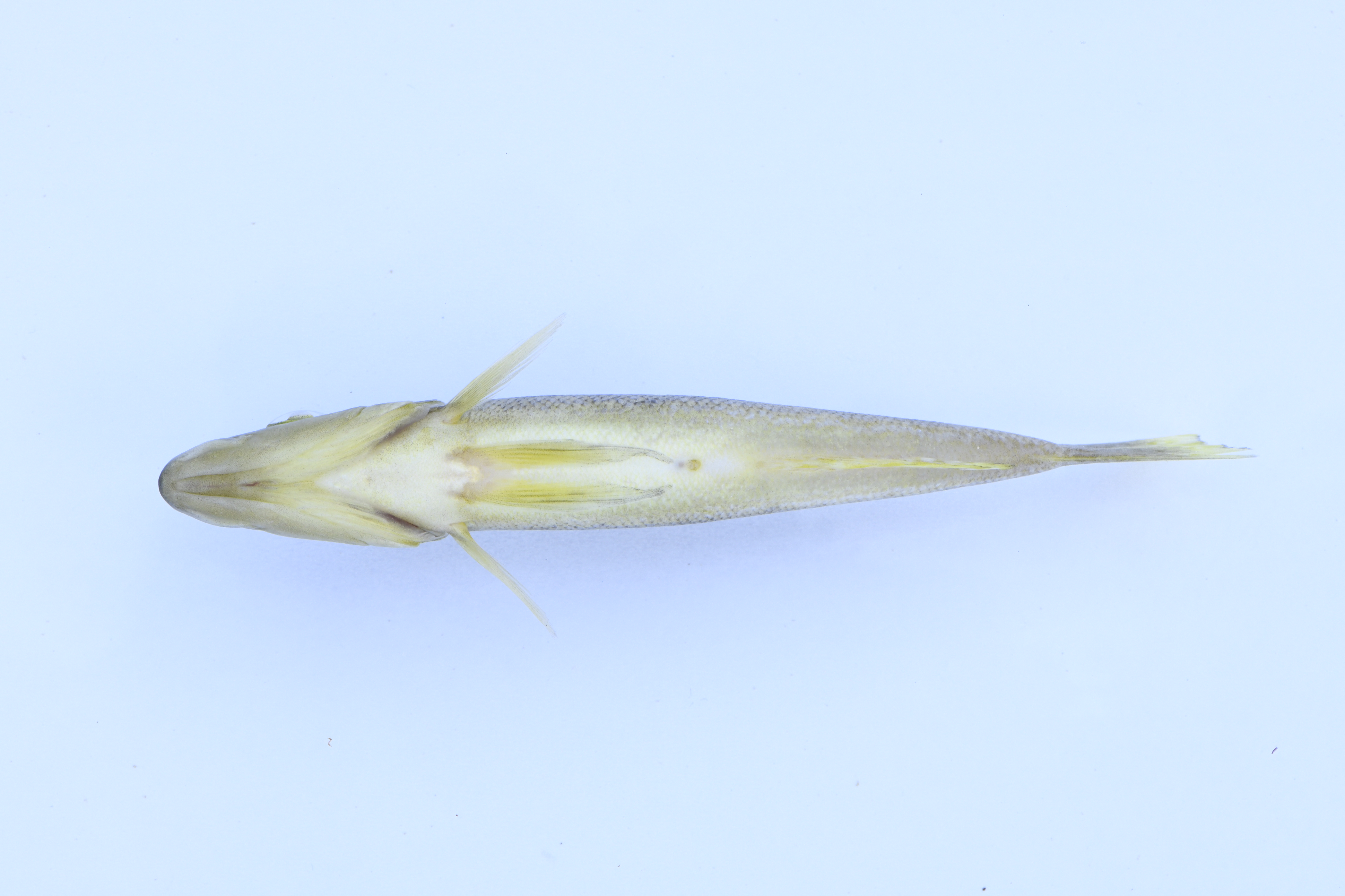
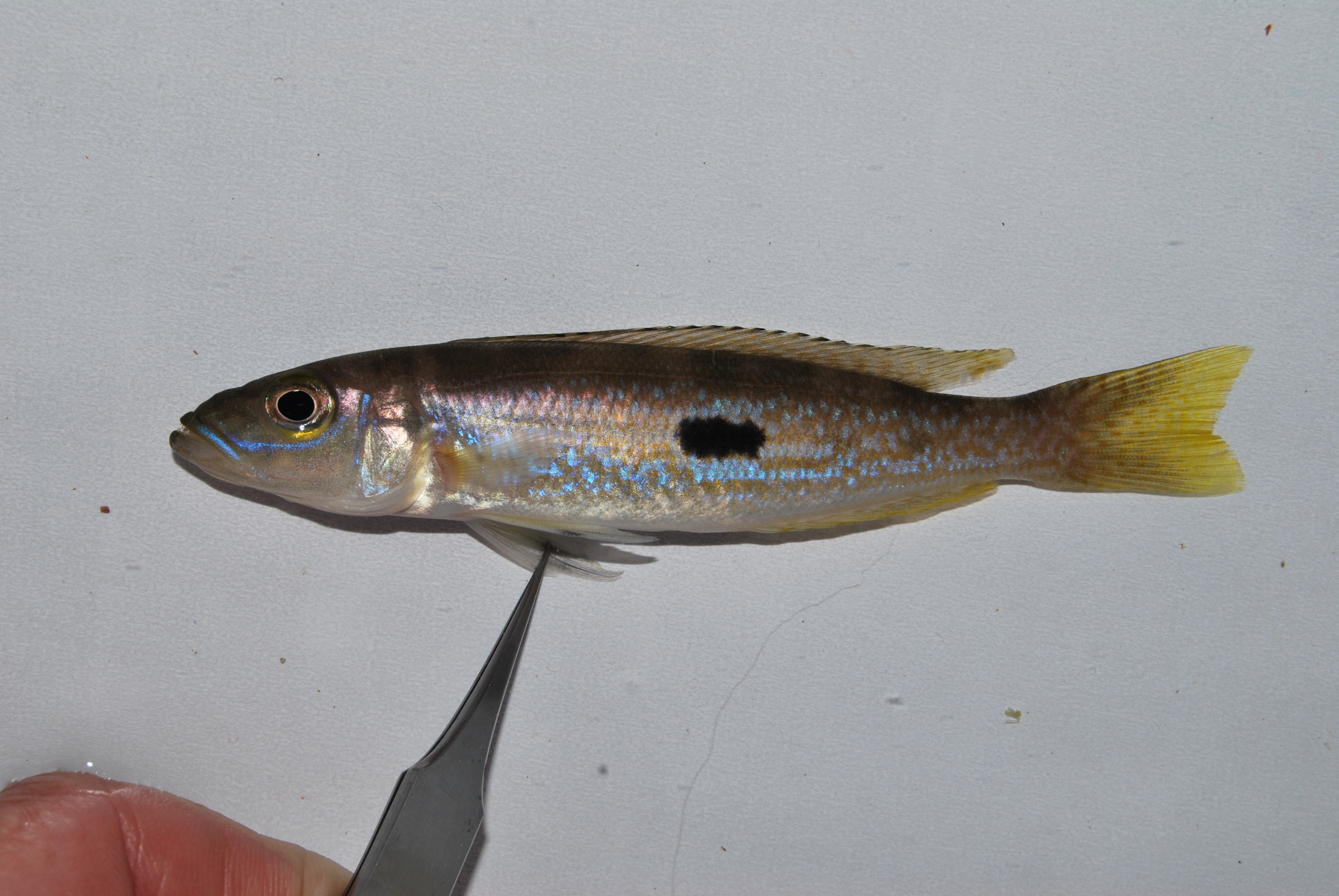
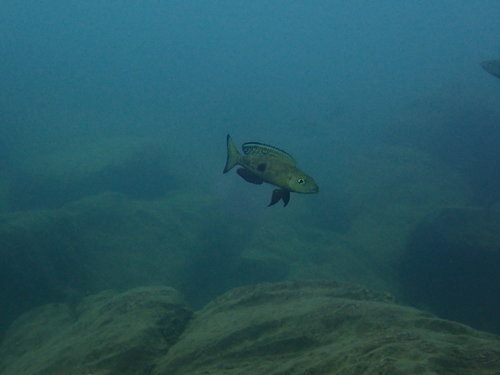
This is a conspicuously long, low-bodied fish — pike-like in silhouette, with a pointed head, a large mouth, and a body that ichthyologists describe as carrying more than sixty scales along the lateral line, a count that underscores just how stretched-out it is. Adults are pale silvery-tan to a warm yellowish ground, marked by a row of dark blotches along the flank that often merge into a broken lateral stripe, with the most prominent blotch sitting on the mid-body and the caudal peduncle; fins can take on subtle blue or yellow tints depending on the population. Color varies geographically across the lake's many local forms.
Reported sizes are reasonably consistent: FishBase gives a maximum of about 6 in (15 cm) total length, and field summaries put males at roughly 5.5–6 in (14–15 cm) with females distinctly smaller, commonly around 4 in (10 cm). Sexual dimorphism is otherwise muted — males simply grow larger, and the sexes share the same pattern and shape, which makes sexing immature fish difficult and is part of why keepers usually raise a group and let a pair form on its own. The slender build and flank blotching are the quickest way to separate it from heavier congeners like L. elongatus.
Range & habitat
Lepidiolamprologus attenuatus is endemic to Lake Tanganyika, the ancient rift lake shared by Tanzania, the Democratic Republic of the Congo, Zambia and Burundi. Sources differ on how far it ranges: FishBase characterizes it as distributed in the southern part of the lake, while field references describe a more nearly circum-lacustrine distribution, noting that it drops out north of the Ubwari Peninsula, where the closely allied L. pleuromaculatus appears to replace it. Either way it is a widespread, frequently encountered fish rather than a narrow-range endemic.
Its home is the lake's "intermediate" habitat — the transition zone where rocky outcrops give way to open sand — typically in shallow water but recorded down to about 25 m (80 ft). It is not a rock-hugger; FishBase notes that individuals usually hover well above the bottom and that the fish actually prefers sand, digging large crater-shaped nests there even when rocky shelter is close at hand, a habit Konings highlighted as telling of the species' true ecology. In-situ conditions are those of the lake at large: hard, alkaline water with a pH band of roughly 7.4–8.4, high carbonate hardness, and stable tropical temperatures near 73–81°F (23–27°C).
Ecology & diet
Attenuatus is a piscivore. FishBase places it at a trophic level around 4.1 — essentially a top-tier predator within its guild — and its natural diet is dominated by small fish, supplemented by aquatic invertebrates. Its whole body plan reads as a hunting tool: the elongate form, large mouth and habit of hovering motionless above the sand let it close on prey with a quick lunge, the open-water ambush style that recurs across the predatory Lepidiolamprologus.
Within the Tanganyikan community it occupies the role of a mid-sized sand-and-intermediate-zone predator, sharing those flats with other Lepidiolamprologus and with the smaller cichlids and fry that make up much of its prey base. Aquarium and trade observations echo the field data: it readily takes meaty foods — fish flesh, krill, shrimp and quality frozen fare — and, like many predators, is remarkably indifferent to tankmates too large to swallow while treating anything smaller as a meal.
Behavior & breeding
Outside of breeding, attenuatus is often described as solitary or loosely social, encountered singly or in small dispersed groups rather than in dense colonies. It is a substrate spawner with biparental care, not a mouthbrooder. A pair excavates a nest in the sand, frequently tucked against rock, and the female deposits her eggs — field accounts put a clutch at roughly 150–250 — on a hard vertical surface such as a rock face or the wall of the excavation, where they remain in view. Both parents then guard the eggs and the resulting fry: the young become free-swimming after about five days, and parental defense can continue for two to three months until the juveniles reach an inch or so.
The defining behavioral note, repeated by keepers and field observers alike, is how the fish changes when it spawns. A normally manageable predator becomes intensely territorial; pairs that previously tolerated company will clear a wide radius around the nest and harass — sometimes kill — anything that strays in, including their own kind. Experienced Tanganyika hobbyists report that once a pair settles in to breed, even robust tankmates become untenable, and that conspecific aggression during pairing can be severe enough that fish eliminate one another before a stable pair forms.
In the aquarium
Attenuatus is a rewarding but emphatically not a community fish, and the honest framing is that you are keeping a predator that becomes a tyrant when it breeds. Experienced keepers converge on a single breeding pair as the realistic long-term goal, housed in a tank of at least 55 gallons (about 200 L) with a six-foot footprint preferred if you want any tankmates at all; the species is generally judged too large and too aggressive for a 29-gallon. A common path is to start with a small group of juveniles in a roomy tank, let a pair form, and be prepared to remove the losers, because rivals are rough on each other during pairing.
Provide a deep bed of fine sand — they are diggers — over a base of rockwork that creates caves and broken sightlines, and the lake's hard, alkaline water (pH comfortably above 7.5, high hardness, mid-70s to low-80s °F / 24–27°C). Tankmates, if any, must be fast, open-water Tanganyikans large enough not to read as food; small or slow bottom-dwellers will be hunted. Keepers flag two recurring mistakes: underestimating how completely a spawning pair will dominate a tank, and mixing attenuatus with other Lepidiolamprologus, which not only stokes aggression but risks hybridization. It is best regarded as an intermediate-level fish — undemanding on water quality and feeding, but demanding on space and on the keeper's willingness to manage its aggression.
Conservation
The IUCN Red List assessed Lepidiolamprologus attenuatus as Least Concern, most recently dated 18 February 2025, with the population trend listed as unknown; this is a step down in concern from an earlier evaluation that had flagged it as Near Threatened (2006), the status still echoed on some hobby pages. The current assessment notes that although localized threats — sedimentation from deforestation on the steep rift-valley slopes, and general fishing pressure from seine and ring nets — have been identified, they are not judged severe enough across the species' wide range to warrant a threatened category. There is no targeted aquarium-trade pressure of note; the fish is collected and also captive-bred for the hobby, but only modestly.
That species-level security sits inside a lake under real strain, and as a shallow, sand-and-intermediate-zone fish, attenuatus is exposed to exactly the basin pressures now best documented. O'Reilly et al. (2003, Nature, doi:10.1038/nature01833) showed that climate warming has strengthened the lake's stratification and reduced deep mixing, cutting primary productivity by roughly 20% over the late 20th century, with proportionate losses implied for fish yields. Cohen et al. (2016, PNAS, doi:10.1073/pnas.1603237113) used sediment records to show that warming has shrunk the oxygenated, habitable lake floor by about 38% since 1946, squeezing the shallow coastal band where most of Tanganyika's endemics — this species among them — actually live. Layered on top are sedimentation that degrades the rocky littoral (Cohen et al. 1993) and an intense pelagic fishery for the endemic clupeids Stolothrissa and Limnothrissa and the predatory Lates that feeds millions across the four basin states. Governance of those shared pressures falls to the Lake Tanganyika Authority, the intergovernmental body charged with coordinating the four nations. The fair summary is the cautious one: attenuatus itself is Least Concern and still common, but its habitat lies squarely in the part of the lake most affected by warming, sedimentation and fishing, so its long-term fate is tied to the health of Tanganyika as a whole.
Sources
- Eschmeyer's Catalog of Fishes — species record for Lamprologus/Lepidiolamprologus attenuatus
- FishBase — Lepidiolamprologus attenuatus summary
- GBIF — Lepidiolamprologus mimicus (sympatric congener record citing L. attenuatus)
- Cichlid Room Companion — Lepidiolamprologus attenuatus species profile (Patrick Tawil)
- Schelly, Takahashi, Bills & Hori (2007) — first case of aggressive mimicry in Lepidiolamprologus, Zootaxa (genus context)
- Evolutionary history of the Lake Tanganyika cichlid tribe Lamprologini (mtDNA/nuclear DNA) — PMC
- tanganyika.si — Lepidiolamprologus attenuatus 'Kipili' biotope, breeding and morphology data sheet
- Aquarium Glaser — Lepidiolamprologus attenuatus (trade/keeping notes)
- Fishipedia — Lepidiolamprologus attenuatus fish sheet
- IUCN Red List — Lepidiolamprologus attenuatus (Least Concern, assessed 2025)
- O'Reilly et al. (2003) — Climate change decreases aquatic ecosystem productivity of Lake Tanganyika, Nature
- Cohen et al. (2016) — Climate warming reduces fish production and benthic habitat in Lake Tanganyika, PNAS
- Lake Tanganyika: Status, challenges, and opportunities for research (basin review)
- African Center for Aquatic Research and Education — Lake Tanganyika fishery overview
- Cichlid-Forum — Lepidiolamprologus attenuatus tank-mate stocking (community/anecdotal) — community/anecdotal
- Cichlid-Forum — 55-gallon Tanganyika tank: Lepidiolamprologus stocking/breeding (community/anecdotal) — community/anecdotal
- MonsterFishKeepers — aggression in Lepidiolamprologus (genus keeping experience, community/anecdotal) — community/anecdotal