
Taxonomy & naming
George Albert Boulenger described this fish in 1906 as Lamprologus cunningtoni, working from syntypes collected at Moliro and Mbete on Lake Tanganyika during W. A. Cunnington's 1904–1905 expedition to the lake. The species epithet honors Cunnington (1877–1958), the British zoologist who led that survey and brought back much of the material on which early Tanganyikan ichthyology was built.
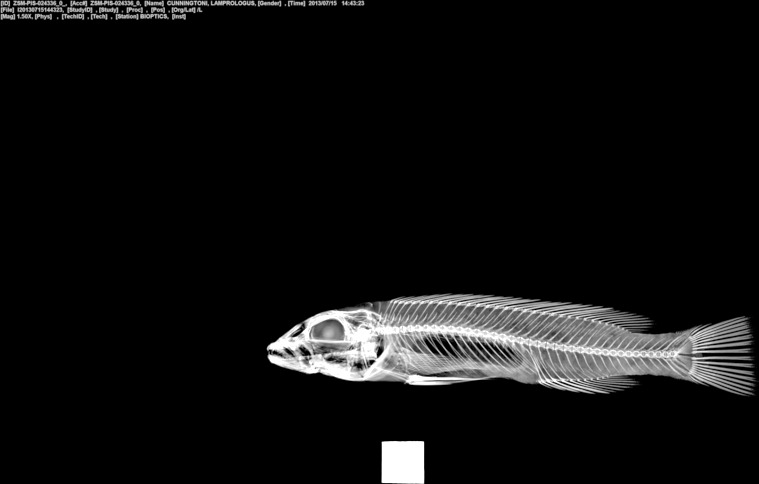
Where the fish sits at the genus level has never fully settled. Boulenger's broad genus Lamprologus was later split apart, and Maréchal & Poll (1991), in the CLOFFA checklist, placed cunningtoni in Lepidiolamprologus — the "scaly" lamprologines — a placement echoed (though flagged as questionable) by Schelly and colleagues in their 2007 work on the group. Its scaled, elongate body and truncate tail fit that genus on the surface. But it lacks the ossified labial ligament that helps diagnose true Lepidiolamprologus, and Ad Konings (2015, 2019) moved it back to Neolamprologus on that and related characters. Eschmeyer's Catalog of Fishes currently lists the valid name as Neolamprologus cunningtoni while recording both placements; the hobby trade still widely uses Lepidiolamprologus cunningtoni, and the two names refer to one and the same fish. In practice it reads as an intermediate form straddling the two genera, which is exactly why it keeps getting shuffled between them.
Appearance
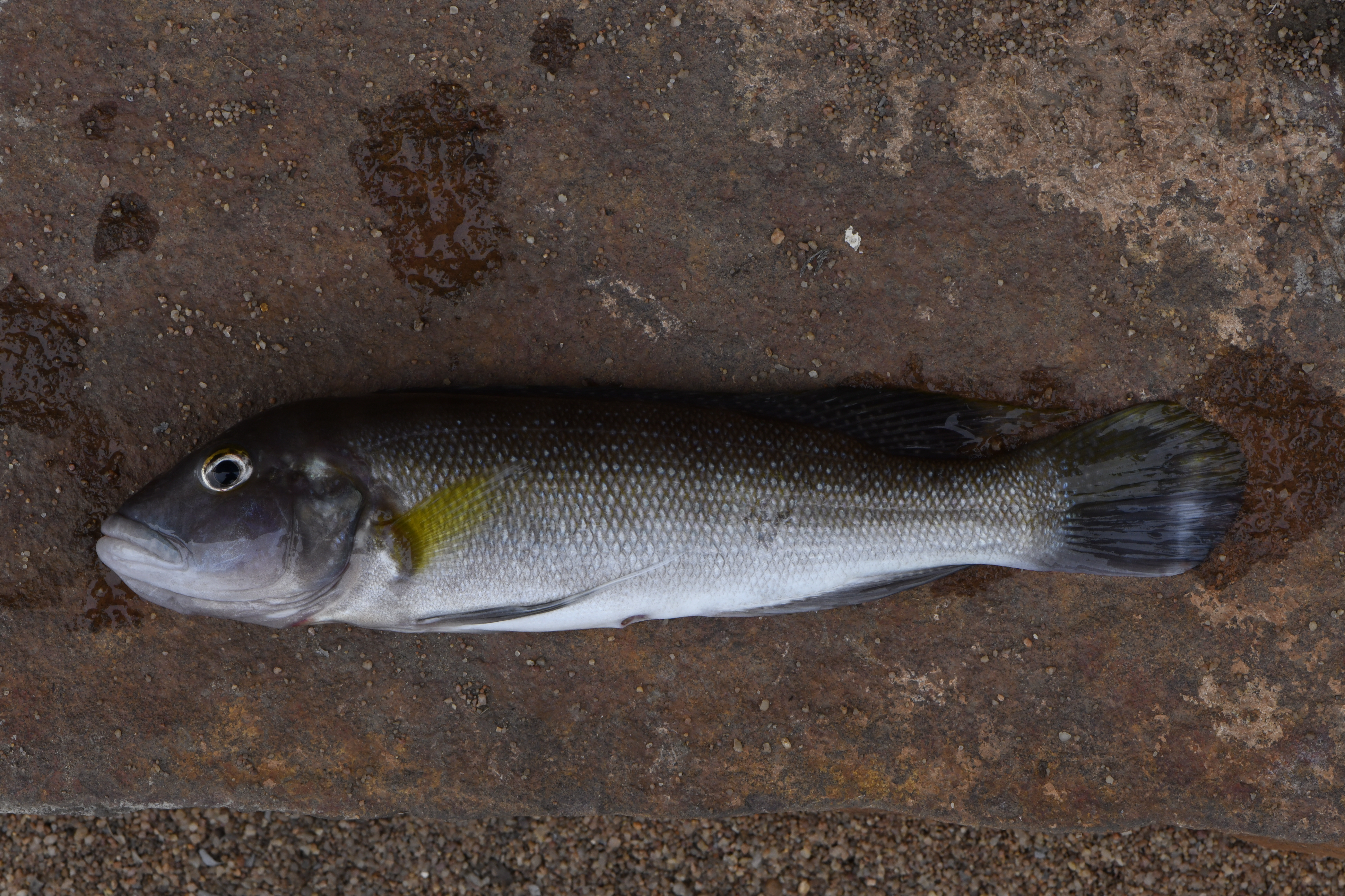
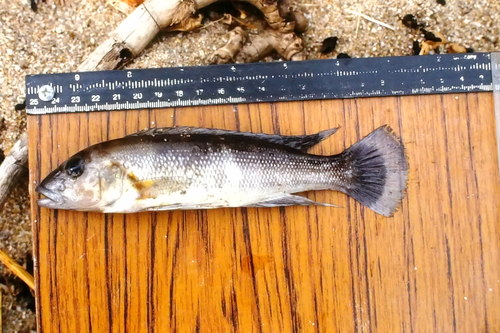
This is a big, sleek, business-end-of-the-lake predator. FishBase records a maximum of about 11.5 in (29.1 cm) total length, and field workers describe it as one of the largest lamprologines in Tanganyika — specialist accounts rank it as the biggest of its genus and roughly the second-largest member of the entire tribe Lamprologini. Size is sharply sex-linked: males may reach close to 12 in (30 cm), while females rarely exceed 8 in (20 cm). Apart from that size gap the sexes look much alike.
The body is strongly elongated and torpedo-like, built for cruising open water just off the bottom, and carries a high lateral-line scale count. Coloration is understated — a silvery-tan to grayish ground broken by rows of small pale spots along the flanks. Those spots recall Neolamprologus tetracanthus but are smaller, and cunningtoni differs further in its shorter, plainer fins, which lack the bright edging of some relatives, and in a caudal fin that is truncate rather than rounded. Some local populations carry an attractive lemon-yellow wash over the upper body; breeding adults darken dramatically, turning a near-black brown that makes a paired fish easy to pick out from the crowd.
Range & habitat
The species is endemic to Lake Tanganyika and widely distributed around its shores, from the northern basin down to the southern end — it is genuinely common, not a narrow-range form. Type material came from Moliro and Mbete in what is now the Democratic Republic of the Congo, and lake-wide photo records span localities from Cape Chaitika to Chituta Bay and Jakobsen's Beach.
It favors the intermediate and sandy habitats of relatively shallow water — the transition zone where rock gives way to open sand rather than the rock faces themselves. A typical adult is seen hovering or cruising just above the sand bottom, which is also its hunting posture. FishBase reports in-situ conditions consistent with the wider lake: hard, alkaline water around pH 7.5–8.0 with high carbonate hardness, at tropical temperatures of roughly 24–27°C (75–81°F). Tying it to the water body, cunningtoni is a creature of Tanganyika's sand and intermediate littoral, not its deep pelagic open water nor its surf-washed rocky reefs.
Ecology & diet
Lepidiolamprologus cunningtoni is a true piscivore and sits near the top of the benthic food web; FishBase places it at a trophic level of about 4.2, squarely predatory. Adults hunt smaller fishes over the sand — sand-dwelling Xenotilapia, shell-dwelling lamprologines, and effectively anything they can fit in the mouth — and will also take crustaceans. Juveniles begin life on a humbler diet of planktonic organisms before graduating to fish as they grow.
Its most-cited behavioral quirk is ecological rather than dietary: it digs large crater-shaped nests in the sand even where rocks offering ready-made shelter sit nearby. Researchers have read that habit as a window onto the species' ecology — a sand-oriented fish that constructs its own structure rather than borrowing the reef's. In a lake whose littoral zone is famously dense with predators, cunningtoni is one of the larger ambush-and-pursuit hunters working the open sand flats, a role distinct from the rock-dwelling lurkers and the open-water chasers.
Behavior & breeding
Adults are usually solitary or paired and can be markedly aggressive toward their own kind; in the wild they hold territory as singles or pairs rather than gathering in groups. Breeding is substrate spawning, not mouthbrooding — a key distinction from the lake's many Haplochromine-style mouthbrooders. Pairs spawn in a cave excavated among rocks or at the edge of the intermediate zone near rocks or shell beds, which is why nests tend to sit at the boundary of the sand and structure.
Clutches are large for a cichlid, on the order of 500 eggs, and both parents guard the nest and the resulting fry — a biparental substrate-spawning strategy. Spawning adults take on the dark, near-black nuptial color noted above, an unmistakable signal that a pair is in breeding mode. Once the fry are free-swimming they hover above the nest feeding on plankton, occasionally drifting several meters off in the company of their parents. The juveniles are prettier than the adults, with a yellowish dorsal fin, a bluish anal fin, and a caudal fin that is yellow above and blue below.
In the aquarium
This is an honest "only if you have the room and intend to keep a pair of predators" fish, and it is rare in the hobby precisely because it asks a lot and gives back subdued color. Its size and need for space argue for a tank of at least roughly 160 US gal (600 L) and on the order of 6.5 ft (about 2 m) of length; cramped quarters defeat both the fish and its natural crater-nesting behavior, and keepers report that in undersized tanks pairs abandon the sand and simply lay eggs on glass or rock. Provide a sandy bottom with several large and small rocks arranged into caves, which are needed for breeding, and maintain the hard, alkaline, warm water of the lake with good filtration and generous water changes.
Tankmates must be cichlids too large to swallow — anything that fits in the mouth is food, which rules out the dwarf shell-dwellers and small Xenotilapia it eats in the wild. Intraspecific aggression is the main pitfall: keep it as a single pair, not a group. Experienced Tanganyikan keepers consistently flag the broader Lepidiolamprologus/large-Neolamprologus predators as genuinely tough customers — fish that grow into imposing, toothy adults and can dominate or kill smaller tankmates — so this is a species for someone deliberately setting up a predator tank, not a peaceful community. It will take live food readily and, once settled, frozen fare.
Conservation
On its own account the species is in good shape: the IUCN Red List assessed Lepidiolamprologus cunningtoni (as Neolamprologus cunningtoni) as Least Concern on 19 February 2025, reflecting its wide distribution and commonness throughout Lake Tanganyika. It carries no special trade or collection pressure — its size and plain coloration keep aquarium demand modest, and it is taken only incidentally in local fisheries rather than targeted.
That reassuring status sits inside a lake under real strain, and the honest framing is exactly that: the fish is fine, the basin is not. Lake Tanganyika is warming and mixing less, and the consequences reach the whole food web. O'Reilly et al. (2003, Nature, doi:10.1038/nature01833) inferred from sediment records that primary productivity may have fallen by around 20%, implying roughly 30% lower fish yields, as stronger thermal stratification chokes off the nutrient upwelling that feeds the lake. Cohen et al. (2016, PNAS, doi:10.1073/pnas.1603237113) found that warming has reduced fish production and shrunk oxygenated benthic habitat — on the order of a 38% loss of the oxygenated lake-floor zone — while sedimentation from deforested catchments continues to smother the rocky and intermediate littoral (Cohen et al. 1993). For a sand-and-intermediate-zone predator like cunningtoni, the most direct threats are that creeping loss of oxygenated bottom habitat and the siltation degrading its shallow hunting grounds, alongside the productivity squeeze that thins the prey base. The lake's great commercial fishery — the pelagic clupeids Stolothrissa and Limnothrissa together with their Lates predators — feeds millions across Burundi, the DRC, Tanzania, and Zambia, and managing that shared resource under warming falls to the four-nation Lake Tanganyika Authority. cunningtoni is not itself endangered, but its long-term security is bound up with whether that basin-wide pressure can be held in check.
Sources
- Eschmeyer's Catalog of Fishes — cunningtoni, Lamprologus (Boulenger 1906)
- FishBase — Neolamprologus cunningtoni summary
- GBIF — Lepidiolamprologus cunningtoni (Boulenger, 1906)
- IUCN Red List — Neolamprologus cunningtoni (Least Concern, assessed 2025)
- Stiassny (1997) — A Phylogenetic Overview of the Lamprologine Cichlids of Africa, S. Afr. J. Sci. 93:513–523
- Evolutionary history of the Lake Tanganyika cichlid tribe Lamprologini (Mol. Phylogenet. Evol.)
- O'Reilly et al. 2003 — Climate change decreases aquatic ecosystem productivity of Lake Tanganyika (Nature; PubMed record)
- Cohen et al. 2016 — Climate warming reduces fish production and benthic habitat in Lake Tanganyika (PNAS)
- tanganyika.si — Neolamprologus / Lepidiolamprologus cunningtoni species profile
- AquaInfo — Neolamprologus cunningtoni
- Fishipedia — Lepidiolamprologus cunningtoni
- African Diving Blog — Lamprologini (part 1): cunningtoni size and ecology
- UKNow — Lake Tanganyika fisheries declining from global warming (Cohen et al. summary)
- ACE Forums (Australian Cichlid Enthusiasts) — Larger Tanganyikan Predators (community/anecdotal) — community/anecdotal
- Cichlid Room Companion forum — "Lamprologus" cunningtoni thread (public listing; community/anecdotal) — community/anecdotal
- Cichlid-Forum — Lake Tanganyika Species board (community/anecdotal) — community/anecdotal