Taxonomy & naming
George Albert Boulenger described this fish in 1898 as Lamprologus elongatus, working from specimens collected on the southern shores of Lake Tanganyika; the syntypes, now in the Natural History Museum in London, came from Mbity Rocks and the old station of Kinyamkolo. It was later transferred to the genus Lepidiolamprologus by Maréchal and Poll (1991) and confirmed there by Schelly and colleagues, who revised the genus in the mid-2000s. Today the Catalog of Fishes and FishBase agree on Lepidiolamprologus elongatus (Boulenger, 1898) as the valid name; older trade and aquarium literature still uses the original Lamprologus combination, and the synonym Lamprologus cunningtoni nyassae turns up in historical lists.
The genus name is a small piece of zoological wordplay: lepis (scale) and lampros (bright) attached to Lamprologus, the genus it was thought to resemble. The species epithet is the plain part — elongatus, elongated — and it is earned, the body running roughly four times as long as it is deep. The genus Lepidiolamprologus gathers the lake's large piscivorous lamprologines, a handful of spindle-bodied hunters (among them L. attenuatus, L. cunningtoni, L. profundicola and L. kendalli) within the tribe Lamprologini, the great substrate-spawning lineage that dominates Tanganyika's rocky shores. Several of these are easily confused on a quick look, which is part of what makes the genus interesting and what trips up casual identification.
Appearance
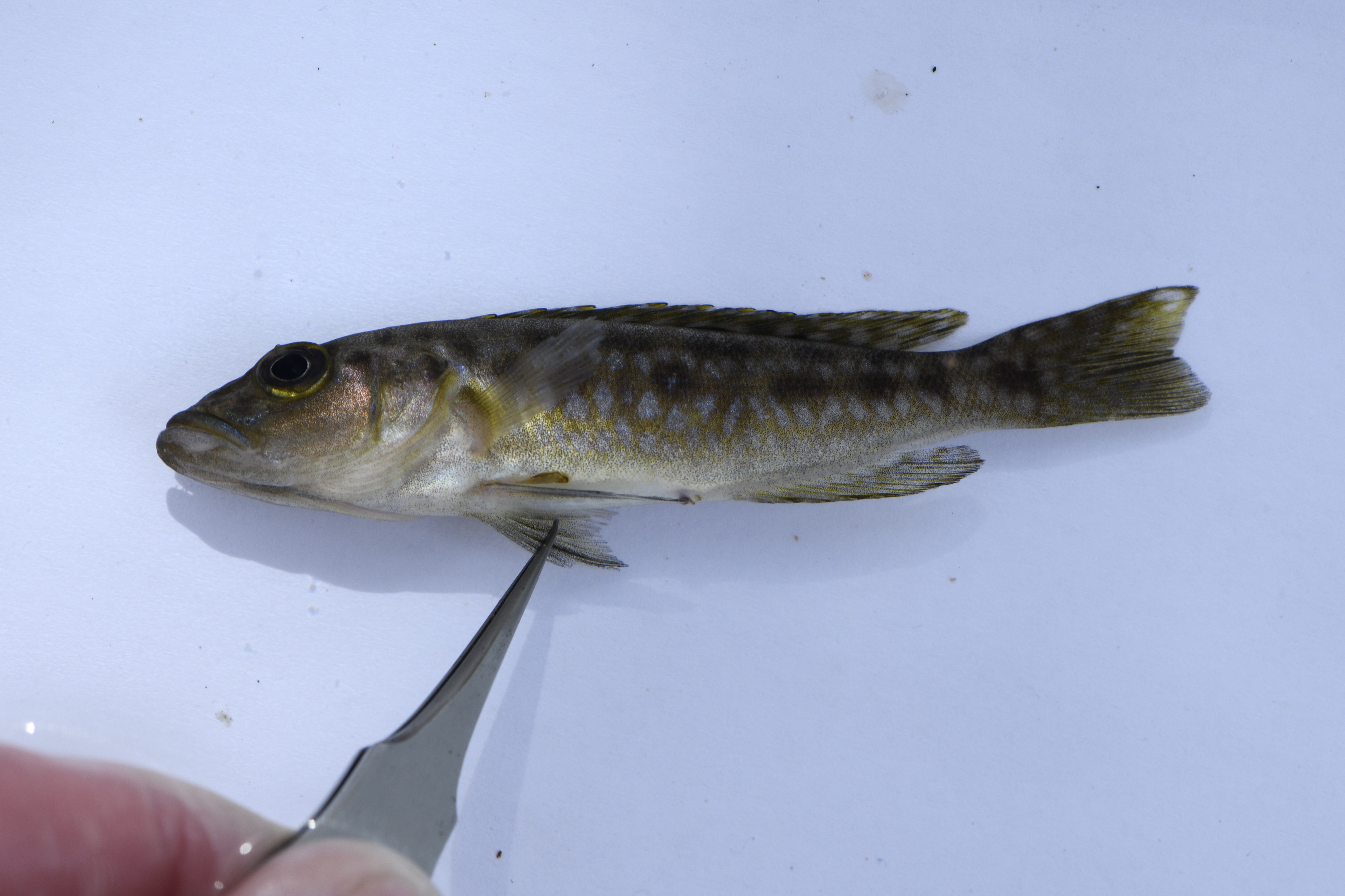

Everything about the fish reads as 'fast.' The body is long and laterally compressed into a near-cylindrical torpedo, the head pointed, the jaws lined with fine recurved teeth suited to seizing slippery prey rather than crushing it. Ground color is a pale silvery to pewter-grey, overlaid with a scattering of small pearly or pale spangles along the flanks and a dark lateral marking that runs back toward a black blotch on the caudal peduncle; the fins are usually clear to faintly marked. When a fish is guarding eggs the contrast sharpens dramatically — keepers describe brooding females going almost charcoal-dark, which makes the white spotting glow.
Reported maximum size is one of the genuine points of disagreement in the literature, and it is worth being honest about. FishBase lists a maximum of about 32.5 in total length — roughly 12.8 in (32.5 cm) — and several hobby profiles push that to 30–35 cm for dominant males. Experienced keepers, however, consistently report smaller wild adults: males around 8–10 in (20–25 cm) and females noticeably smaller, often 6–7 in (15–18 cm), with the larger figures reached mainly by well-fed aquarium fish. The safe reading is that this is a mid-sized, strongly dimorphic cichlid in which males outgrow females, that 8–10 in (20–25 cm) is a realistic adult male in a tank, and that the headline 'up to 32 cm' represents the upper bound rather than the norm.
Range & habitat
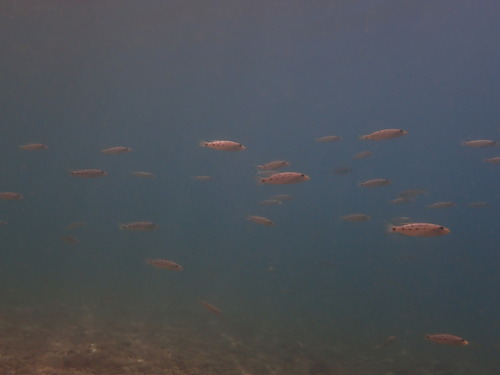
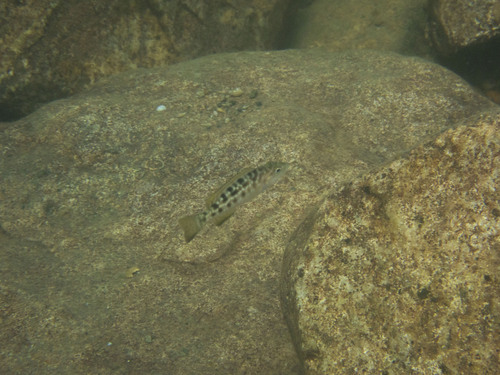
Lepidiolamprologus elongatus is endemic to Lake Tanganyika and is one of the more widely distributed members of its genus, recorded around much of the lake's shoreline across all four riparian nations — Burundi, the Democratic Republic of the Congo, Tanzania and Zambia. It is a creature of the rocky littoral. FishBase characterizes it bluntly as a rock-dweller that does not roam the open sandy bottoms, and that captures the ecology well: this is a fish of boulder fields, broken rubble and the reef-and-sand interface, where structure gives it both ambush cover and a steady supply of smaller fish to hunt.
Behaviorally it is benthopelagic — it lives in association with the bottom but spends much of its time holding in the water column just above the rocks rather than tucked into a crevice. The in-situ water it inhabits is the famously hard, alkaline water of the rift lake: pH on the order of 8 to 9 and warm, stable temperatures around 23–25 °C (73–77 °F) in the surface and upper-littoral zone, where this species mainly occurs. Tanganyika's clarity and that thermal stability matter to a visual, structure-oriented predator; it is a fish adapted to clear water over hard substrate, not to the silt-laden margins.
Ecology & diet
This is, first and last, a fish-eater. FishBase places it at a trophic level around 4.2 — squarely among the top piscivores of the rocky community — and field accounts describe a predator that preys principally on small fishes, taking the abundant juvenile cichlids and other small-bodied species that throng the reef. Its hunting style fits its body: rather than a sustained open-water pursuit, it works the structure, holding above the rocks and rushing down on prey, then using bursts of speed and the fine gripping teeth to secure a slippery target. Smaller invertebrates are taken opportunistically, but fish are the core of the diet.
Its most remarkable ecological footnote is that other animals exploit its reputation. In 2007 Schelly, Takahashi, Bills and Hori described a new congener, Lepidiolamprologus mimicus, from the Zambian coast and documented it as the first known case of aggressive mimicry among the lake's lamprologines — a predator that blends into schools of its yellow-finned cyprichromine prey using matching coloration. L. elongatus itself sits at the other end of that story as the better-known model these look-alike predators resemble, a reminder that in Tanganyika's densely packed reef community the line between predator, prey and impostor is unusually blurred, and that the elongate lamprologines are a textbook example of a single body plan tuned for ambush piscivory.
Behavior & breeding
Away from breeding, L. elongatus is largely solitary and territorial, patrolling a stretch of reef and tolerating little intrusion from other large rock-dwellers — and almost none from its own kind. The intolerance is sharpest within the genus: keepers repeatedly report that this fish and its Lepidiolamprologus relatives will fight viciously among themselves while being comparatively indifferent to unrelated species too large to swallow. That nuance matters, and it cuts against the simple 'extremely aggressive' label many care sheets attach to the species.
Reproductively it is a substrate spawner that nests in the shelter of rock — FishBase records it spawning in small caves, and aquarium accounts describe a cave or sheltered crevice as the chosen site, with both parents sharing guard duty over the eggs and free-swimming fry. This biparental defense is fierce; a guarding pair will hold a sizeable territory and drive off intruders hard, and the female in brooding dress darkens strikingly. Clutches can be large — keepers report up to several hundred eggs, with figures around 800 cited for well-matched pairs — and the eggs hatch in roughly three to four days, the fry becoming free-swimming a few days after that. The catch, well documented by breeders, is pair formation: this is not a fish that pairs reliably on demand. Two adults thrown together frequently end in one killing the other, and the dependable route is to raise a small group of five to seven youngsters and let a pair sort itself out, removing the rest once it has.
In the aquarium
This is a specialist's Tanganyikan, not a beginner's fish, and most of what goes wrong with it traces back to underestimating either its temperament or its predatory diet. Give it room: a single fish wants a tank on the order of 5–6 ft (about 150 cm) or more, and a breeding pair benefits from more space still, because the aggression that flares during spawning needs somewhere to dissipate. The setup should echo the rocky littoral — plenty of stacked stone for territory and broken sightlines over a fine sand base — and the water should be hard and alkaline, pH roughly 8.5–9.0 at around 75–79 °F (24–26 °C), matching the lake.
Feeding and stocking are where honesty saves fish. It is a piscivore, and anything small enough to fit in its mouth is food, so the classic mistake is mixing it with small dither fish or fry and being surprised when they vanish. Suitable companions are robust, similarly sized Tanganyikans that occupy different niches — featherfins, larger Cyprichromis, Synodontis catfish — kept in a tank big enough that nobody is cornered. Diet should lean on meaty foods that resemble natural prey (frozen and live items such as mysis and similar), since many specimens accept dry food only grudgingly; relying on flake alone tends to leave them poorly conditioned. Worth flagging too: stock is usually wild-caught rather than tank-bred, so freshly imported fish can be skittish and slow to settle. The community reality, drawn from keepers across multiple forums, is more interesting than the care-sheet caricature — some report a fish that, kept singly with appropriately large tankmates, is surprisingly placid and only retaliates when provoked, while the within-genus and within-pair violence is consistently described as genuine. Keep one, give it the space and the right neighbors, and it is a manageable and characterful predator; crowd it or pair it carelessly and it earns its reputation.
Conservation
On its own account the species is not currently of concern. The IUCN Red List assessed Lepidiolamprologus elongatus as Least Concern (assessment dated 18 February 2025, Red List version 2025-2), reflecting its wide distribution around the lake and the absence of any identified species-specific threat; the population trend is listed as unknown. It carries no CITES listing, and while it appears in the aquarium trade, collection pressure on this particular fish is not flagged as a conservation problem. So the straightforward statement is that the species itself looks secure even as the water body it depends on does not.
That lake-level context is the real story, and it bears directly on a rocky-shore piscivore like this one. Lake Tanganyika has been warming measurably for roughly a century, and the consequences run deeper than temperature: O'Reilly and colleagues (2003, Nature) used sediment-core isotope records to argue that warming has strengthened thermal stratification, weakened the seasonal mixing that lifts nutrients into the sunlit surface, and cut primary productivity by something like 20% — with a correspondingly large implied decline in fish yield. Cohen and colleagues (2016, PNAS) extended that picture with paleoecological evidence that lake warming has tracked declines in commercially important fishes and endemic molluscs and a loss of suitable benthic habitat. Layered onto the climate signal are local pressures synthesized in recent basin reviews (e.g. the 2023 status assessment in the Journal of Great Lakes Research): heavy fishing of the pelagic clupeid sardines and their Lates predators, growing shoreline populations, and sedimentation and nutrient loading from deforestation and agriculture along the catchment.
For L. elongatus, sedimentation is the pressure to watch. A visual hunter that lives among clear-water boulders depends on the structure and water clarity of the rocky littoral; silt washing off developed and deforested shorelines smothers reef interstices, reduces visibility, and degrades exactly the habitat its ambush style requires. It sits near the top of the rocky food web, so it is also exposed to anything that thins the small-fish prey base beneath it, including the productivity decline working its way up from the plankton. Governance of these basin-wide threats is shared among the four lakeside countries through the Lake Tanganyika Authority under the Convention on the Sustainable Management of Lake Tanganyika — a recognition that no single nation can manage the lake alone. The honest summary is the one the skill asks for: this species is Least Concern today, but it is an endemic with nowhere else to go, tied to a shoreline habitat under real and accelerating strain.
Sources
- FishBase — Lepidiolamprologus elongatus (Boulenger, 1898)
- Eschmeyer's Catalog of Fishes — elongatus, Lamprologus (species record)
- IUCN Red List — Lepidiolamprologus elongatus assessment (LC, 2025)
- GBIF — Lepidiolamprologus elongatus
- Schelly, Takahashi, Bills & Hori (2007), Zootaxa 1638 — first case of aggressive mimicry among lamprologines (L. mimicus n. sp.)
- Sturmbauer et al. (2010), Mol. Phylogenet. Evol. — evolutionary history of the Lamprologini (genus Lepidiolamprologus as revised by Schelly et al. 2006)
- Ronco, Büscher, Indermaur & Salzburger (2020), J. Great Lakes Res. — taxonomic diversity of the Tanganyika cichlid fauna
- O'Reilly, Alin, Plisnier, Cohen & McKee (2003), Nature — climate change decreases productivity of Lake Tanganyika
- Cohen et al. (2016), PNAS — climate warming reduces fish production and benthic habitat in Lake Tanganyika
- Lake Tanganyika: status, challenges, and opportunities for research (2023), J. Great Lakes Res.
- FAO — Lake Tanganyika Authority (four-nation governance)
- AquaInfo — Lepidiolamprologus elongatus (care, breeding, biotope)
- Fishipedia — Lepidiolamprologus elongatus
- Cichlid Fish Forum — 'Who keeps Lepidiolamprologus elongatus' (keeper accounts; anecdotal) — community/anecdotal
- MonsterFishKeepers — Lepidiolamprologus thread (keeper accounts of size & temperament; anecdotal) — community/anecdotal