Taxonomy & naming
The species was described in 1977 by the Belgian ichthyologist Max Poll and the American Donald J. Stewart as Lamprologus kendalli, from a holotype collected northwest of Mutondwe Island, Zambia, in roughly 40 m of water. It was later moved into the genus Lepidiolamprologus, a 1991 split (Maréchal & Poll) for the elongate, scale-bearing lamprologine predators of Tanganyika. The genus name stitches together the Greek lepis (scale) and lampros (bright) onto Lamprologus; the species epithet honors Robert L. Kendall, an editor with the American Fisheries Society, rather than anything about the fish itself.
The name is inseparable from a decades-old muddle. In 1978 Wolfgang Staeck described a near-identical fish from Nkamba Bay as Lamprologus nkambae, and for years the two circulated as separate species. Following Konings and Dieckhoff (1992) and Konings (1998), L. nkambae is now treated as a junior synonym of L. kendalli, and the Catalog of Fishes and IUCN both list it that way. Genetic work has turned up only small differences between the two forms, and some aquarists still argue the point — so "nkambae" persists as a trade name for a particular population. Muddying things further, Kullander and colleagues split off a genuinely distinct look-alike, L. kamambae, in 2012. L. kendalli sits within a compact genus of large piscivores (alongside L. elongatus, L. attenuatus, L. profundicola, L. cunningtoni and the aggressive-mimic L. mimicus described by Schelly et al. in 2007), all sharing the same hunter's build.
Appearance
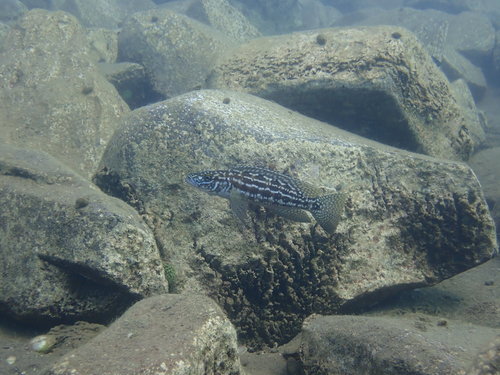
This is a fish built for the chase: a long, cylindrical body, a slightly upturned predatory mouth, and — in mature animals — canine teeth visible without prying the jaws open. The ground color is a dark brown to bronze overlain by roughly four irregular pale (cream to yellowish) bands running the flank from gill cover to tail, with a mottled spot pattern scattered across the head, back, dorsal and caudal fins. The head can flush an iridescent electric blue, a detail keepers single out as the species' best feature. In silhouette and barring it recalls a scaled-up, heavier-headed Julidochromis.
Reported maximum size varies enough to be worth flagging. FishBase lists 16 cm (6.3 in) total length; the IUCN assessment cites a rock-dweller reaching about 18 cm (7 in); aquarium accounts commonly describe males to around 20 cm (8 in) with females a touch smaller at 16–17 cm (6.5 in), while a UK magazine profile of imported stock quoted just 14 cm (5.5 in). The honest read is a fish of roughly 6–8 in (15–20 cm), males running larger. Sexual dimorphism is otherwise slight: there is no reliable color difference, and short of examining the genital papilla, size is the only outward clue — which is exactly why pairing them is a chore.
Range & habitat
L. kendalli is a Lake Tanganyika endemic with a notably restricted range: the southern end of the lake, between Nkamba Bay in Zambia and Kala in Tanzania, spanning the Zambian and Tanzanian shores. It is a creature of the rocky and rubble-strewn littoral and the transition to muddy bottoms — emphatically not a fish of the wide open sand flats, which it declines to cross.
Depth records bracket a wide band. Konings found it from the shallows down to deeper than 40 m, and the IUCN assessment gives upper and lower limits of 20 and 60 m. In situ, this is hard, alkaline, well-oxygenated water: FishBase logs a pH range of about 7.4–8.4 and temperatures around 23–27 °C (73–81 °F), typical of Tanganyika's stable, mineral-rich offshore reefs. The species' attachment to rock is structural — the crevices are both its hunting ground and, at breeding time, its nursery.
Ecology & diet
Within the lake's community this is an apex small-fish predator, assigned a high trophic level (around 4.2 in FishBase's estimate) — about as carnivorous as a Tanganyikan cichlid gets. It is usually solitary and roams widely, cruising the reef and its margins in search of prey rather than holding a fixed feeding station. Its method is ambush punctuated by pursuit: it will hang quietly among the rocks, then accelerate to take a fish hiding in a gap, and it has been observed driving prey toward the surface, where the chase can break the waterline.
The diet is essentially fish — including, the literature notes, the fry of other cichlids — which makes L. kendalli an unusually effective natural check on the recruitment of smaller species sharing its rocky habitat. Its slender body is the tool that sets it apart from chunkier rock-dwelling predators: it can follow prey into narrow crevices that a deeper-bodied hunter cannot enter.
Behavior & breeding
Unlike Tanganyika's mouthbrooders, L. kendalli is a biparental cave or crevice substrate-spawner. Adults are largely solitary and outside of breeding do not hold rigid territories so much as claim a comfortable resting spot, which lets them coexist with territorial neighbors by simply staying out of the way. Toward their own kind they are far less forgiving: conspecific aggression is high, and a group will sort itself out with a dominant individual leaning hard on the rest.
Because the sexes look alike, the practical route to a pair is to raise a group and let one form, then remove the surplus — once bonded, a pair is tight and durable, separating only briefly after a squabble. They spawn in a dark, enclosed cavity, laying olive-colored eggs in clutches commonly cited at 70–150 and reaching 300 in large, experienced pairs. The female tends the eggs while the male patrols the perimeter. Brichard noted that the young do not stay hidden for long: as soon as they are free-swimming — at only 3–4 mm — they leave the natal hole. Aquarium accounts put hatching at roughly 2–5 days and free-swimming at 7–14, with maturity reached around 10 cm (4 in).
In the aquarium
L. kendalli reaches the hobby with some regularity (often as tank-bred "nkambae" stock), and it is a rewarding fish for a keeper who respects what it is. Give a single adult at least a 4-foot tank; for a pair and any hope of breeding, experienced keepers consistently recommend stepping up to 6 feet. Set it up as a standard hard-water Tanganyikan biotope — fine sand, generous rockwork with caves and crevices for hunting, refuge and spawning, excellent filtration and high dissolved oxygen, pH on the alkaline side and temperatures in the mid-70s °F (around 24–26 °C).
Two cautions come up again and again from keepers. First, it is an accomplished escape artist that lunges and chases at the surface; the tank needs a tight, fully sealed lid with no gaps. Second, do not house it with anything small enough to swallow — it will eat tankmates and is a more committed fry-predator than Altolamprologus calvus or compressiceps, a trait some breeders actually exploit for fry control in community tanks. Keeping multiples is the hard part: conspecific aggression means most people end up with a single fish or a single pair after rehoming the rest, and a too-small tank turns that aggression dangerous. It is generally a calm, even shy tankmate toward dissimilar species, but it is not a beginner's community fish.
Conservation
The IUCN Red List assessed Lepidiolamprologus kendalli as Least Concern in 2025 (assessor L. Haambiya), an upgrade in confidence from its 2006 status of Data Deficient. The justification is straightforward: the species is endemic to Lake Tanganyika but widely distributed across the southern basin, with no major widespread threats identified. The population trend is listed as unknown. The one threat flagged specifically is sedimentation from soil erosion and agricultural runoff, which can degrade the rocky habitat it depends on in certain areas. In trade it appears in the commercial aquarium market nationally and internationally and is taken locally for food only incidentally, not as a targeted fishery.
That "Least Concern" verdict should be read against a lake under real strain. Lake Tanganyika is warming, and the warming suppresses the seasonal mixing that lifts nutrients into sunlit surface waters: O'Reilly et al. (2003, Nature) inferred a roughly 20% decline in primary productivity over the late 20th century, implying on the order of a 30% drop in fish yields. Cohen et al. (2016, PNAS) added paleoecological evidence that warming has shrunk the oxygenated benthic habitat and tracked declines in commercially important fishes and endemic molluscs. These pressures bear most heavily on the deep and pelagic communities — the clupeid sardine-and-Lates fishery that feeds four nations — and on the lake's governance through the four-country Lake Tanganyika Authority. For a shallow-to-moderate-depth rocky-shore predator like L. kendalli, the sharper edge is the local one the IUCN names: shoreline sedimentation silting the reef structure it hunts and breeds in. The species itself is not currently threatened, but its habitat sits inside a basin whose long-term productivity is trending the wrong way.
Sources
- Eschmeyer's Catalog of Fishes — Lepidiolamprologus kendalli (Poll & Stewart 1977)
- FishBase — Lepidiolamprologus kendalli summary
- FishBase — Lepidiolamprologus kendalli occurrence records (GBIF-sourced)
- IUCN Red List — Lepidiolamprologus kendalli (e.T60555A47198186, 2025)
- Schelly, Takahashi, Bills & Hori (2007) — aggressive mimicry in a new Lepidiolamprologus (Zootaxa 1638)
- O'Reilly et al. (2003) — Climate change decreases aquatic ecosystem productivity of Lake Tanganyika (Nature)
- Cohen et al. (2016) — Climate warming reduces fish production and benthic habitat in Lake Tanganyika (PNAS)
- University of Kentucky — Lake Tanganyika fisheries declining from global warming (summary of Cohen et al. 2016)
- AquaInfo — Lepidiolamprologus kendalli (care, breeding, biotope)
- Practical Fishkeeping — Lepidiolamprologus nkambae profile
- Fishipedia — Lepidiolamprologus kendalli fish sheet
- tanganyika.si — Lepidiolamprologus kendalli / nkambae locality population
- Cichlid-Forum — Lepidiolamprologus kendalli (nkambae) keeping & aggression thread — community/anecdotal
- Cichlid-Forum — Lepidiolamprologus kendalli (Kasanga) temperament thread — community/anecdotal
- Reddit r/Cichlid — Lepidiolamprologus kendalli from Lake Tanganyika (keeper discussion) — community/anecdotal