
Taxonomy & naming
Max Poll described this fish in 1948 as Lamprologus meeli, working from material the Belgian Hydrobiological Mission to Lake Tanganyika collected in 1946–47. The holotype came from the Bay of Katibili on the lake's Congolese shore (now MRAC 114116). The species epithet honors Ludo van Meel (1908–1990), a Belgian botanist on that expedition who also collected in Burundi, Tanzania and Zambia.
The name has migrated across genera as lamprologine systematics matured. The fish was long listed as Neolamprologus meeli, the combination used by Maréchal & Poll in the 1991 CLOFFA checklist and still echoed in older aquarium literature. Schelly and coworkers' 2006 revision of Lepidiolamprologus reassigned the small "two-pore" shell-breeders — meeli, hecqui, boulengeri and variostigma — to Lepidiolamprologus, and Eschmeyer's Catalog of Fishes today lists Lepidiolamprologus meeli (Poll, 1948) as the valid name, following Konings (2015, 2019). The genus Lepidiolamprologus otherwise contains larger, elongate sand-and-rock predators such as L. elongatus and L. attenuatus; meeli sits at the dwarf, shell-breeding end of that lineage.
Nomenclature aside, the bigger taxonomic story is identification. Phylogenetic and aquarium work has repeatedly found that fish labeled "N. meeli" are something else — for example a form recognized as Lepidiolamprologus sp. "meeli-boulengeri," and a separate Kipili-coast fish Ad Konings calls L. sp. "meeli Kipili." The practical upshot, flagged on specialist sites such as tanganyika.si, is that the true L. meeli is uncommon in the hobby and much of what is traded under the name is a related, often undescribed species.
Appearance
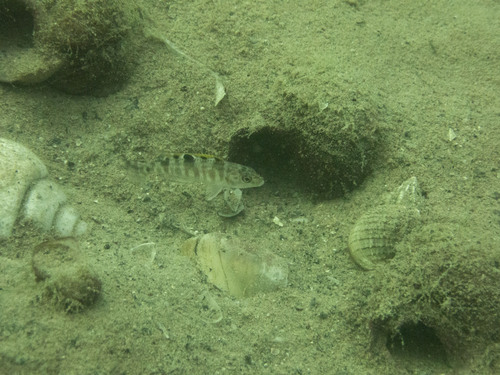
This is a small cichlid. Reported maximum total length is about 2.75 in (7 cm) for males, with females distinctly smaller at roughly 1.5 in (4 cm); the size gap is functional, since adult males generally grow too large to fit inside the snail shells the females occupy. Sexual dimorphism is otherwise subtle — the sexes look alike apart from the male's greater size — though a guarding female often darkens dramatically, and in some populations her pelvic fins turn black while brooding.
The body is the moderately elongate, sandy-toned form typical of the smaller Lepidiolamprologus, marked with a row of dark blotches or a broken bar pattern along the flank that the fish can intensify or fade with mood. That camouflaged, blotchy patterning is a real source of confusion with similar shell-breeders: hobbyists routinely struggle to separate meeli from L. hecqui and L. boulengeri, and from the L. attenuatus look-alikes, on coloration alone. As a rule, the genuine shell-breeding meeli-type fish carry a heavier scatter of black blotches than the cleaner-flanked, larger attenuatus.
Range & habitat
Lepidiolamprologus meeli is endemic to Lake Tanganyika — like the great majority of the lake's cichlids, it is found nowhere else on Earth. How widely it ranges within the lake is genuinely unsettled. Poll's type series and FishBase treat it as a narrow endemic of Katibili Bay on the Congolese coast, and the trade has long regarded the true Congo fish as nearly unobtainable because that area was effectively closed to collection. The 2025 IUCN assessment, by contrast, maps a near lake-wide distribution: from the Malagarasi River delta south through Tanzania and Zambia and west to the Ubwari Peninsula in the Democratic Republic of the Congo. Much of that discrepancy traces back to identification — broad range maps likely fold in the southern and Kipili forms that closer study now treats as separate species, so the honest statement is that the true L. meeli's extent is uncertain and probably narrower than the lake-wide maps imply.
The habitat itself is consistent across sources. This is a littoral, sand-dwelling fish of the shallow shelf, recorded between about 16 and 66 ft (5–20 m) over fine sand bottoms with sparse, scattered snail shells rather than the dense shell beds favored by some shellies. Lake Tanganyika's water suits the genus well: warm at roughly 73–77 °F (23–25 °C) in the surface layers it inhabits, highly alkaline (pH around 8.2–9), hard, and mineral-rich — the same high-calcium chemistry that lets empty gastropod shells accumulate on the bottom instead of dissolving, supplying the breeding sites these fish depend on.
Ecology & diet
Functionally, meeli is a small predator. FishBase places it at a trophic level near 3.6, and field and assessment notes describe a diet of invertebrates and the fry and juveniles of other fishes — the carnivorous, ambush-and-pursue feeding style that runs through the genus Lepidiolamprologus. Larger congeners like L. elongatus are open-water piscivores; the dwarf shell-breeders hunt smaller prey close to the substrate, picking through sand and around shells.
The ecological texture of these fish was captured nicely by behavioral fieldwork along the lakeshore, where Lepidiolamprologus meeli has been observed pushing into the territories of other cichlids, disturbing and foraging on them — a small disruptor working the sand flats. Hobbyist accounts add a useful caveat about overstated ferocity: keepers who watched their fish closely report them taking far more invertebrate prey than fish, and not reliably hunting down fry even when fry were available. So "predator" is accurate, but "opportunistic micro-predator of invertebrates and small fish" is closer to the truth than "dedicated piscivore."
Behavior & breeding
Breeding follows the classic Tanganyikan shell-dweller template with a predatory twist. A male establishes a territory over sand and excavates a pit near one or more empty snail shells; a female takes up residence in a shell, lays her eggs inside it, and the male fertilizes from the entrance. After spawning the female does the close brood care — guarding the shell and tending fry, often turning very dark — while the male patrols the wider perimeter and chases off intruders. Both monogamy and polygyny are reported: depending on density and sex ratio, a male may guard a single female or hold a small harem of females in separate shells.
Field study of a population first taken for N. meeli, but later recognized as the distinct L. sp. "meeli-boulengeri," found it organized into monogamous pairs — a reminder that mating-system reports for "meeli" may belong to several different fish. Aggression is principally intraspecific and territorial: males are intolerant of rival males, and a breeding female defends her shell zealously against all comers, but aggression toward unrelated species is usually limited to evicting them from the immediate territory rather than active hunting. Keeper anecdotes line up with this — outside of spawning, groups can be relatively peaceable, but a shift in the sex ratio (one keeper accidentally went from two males to one among ten females) can touch off a spawning frenzy and a week of shell-squabbling before territories settle.
In the aquarium
The first aquarium task is buying the right fish: confirm what you actually have, because "meeli" in shops is frequently a southern form (often mislabeled L. hecqui) or the undescribed Kipili fish, each with slightly different adult size and temperament. Whatever the exact identity, husbandry is similar. A pair needs surprisingly little room — roughly 25–30 gallons (about 100 L) suffices — set up as a sand-bottomed tank with several empty snail shells (escargot or apple-snail shells work) so each fish has a home and spawning site. Footprint matters more than height; these are bottom-oriented fish that aquascape the sand themselves.
Match the water to the lake: hard and alkaline, pH about 8.0–8.5, with stable temperatures in the mid-70s °F (around 24 °C). The fish are otherwise hardy and undemanding feeders, taking quality flake and pellet alongside frozen and live foods such as brine shrimp, cyclops, daphnia, mysis and bloodworms; one well-regarded breeder deliberately skips a feeding day each week to mirror the lean foraging of the wild. The honest cautions are about behavior and scale, not difficulty. Keep one male per tank unless the footprint is large, since males will not tolerate rivals; expect a breeding female to bully tankmates away from her shell; and don't house them with anything small enough to read as prey. They are also noted jumpers, so a tight-fitting lid is not optional. None of this makes them hard to keep — a single male with a few females in a species tank is genuinely beginner-friendly — but they are best treated as a small, territorial Tanganyikan biotope fish rather than a community generalist.
Conservation
The IUCN Red List assesses Lepidiolamprologus meeli as Least Concern, most recently on 27 February 2025 (assessor Y. Fermon; published 2025), reaffirming a status it has held since 2006. The justification is straightforward: it is a Tanganyika endemic recorded across much of the lake with no known major widespread threats. Its population trend is recorded as unknown, the assessment lists no species-specific conservation actions, and the fish enters trade both as a national/international aquarium export and as local food — pressures judged minor at present. The IUCN does flag sedimentation and agricultural-effluent pollution of its littoral sand habitat as ongoing, low-severity threats. One caveat carries over from the taxonomy: if the true Katibili-Bay fish is genuinely narrow-ranging and much of the "widespread" range belongs to other species, the species itself may be less buffered than a lake-wide map suggests — a reason the assessors call for better population monitoring.
That individually relaxed status sits inside a lake under real strain. Lake Tanganyika is warming, and reduced vertical mixing has cut primary productivity: O'Reilly and colleagues (2003, Nature, doi:10.1038/nature01833) linked climate-driven warming to roughly a 20% decline in productivity and an estimated ~30% drop in fish yields. Cohen and colleagues (2016, PNAS, doi:10.1073/pnas.1603237113) found that warming has shrunk the oxygenated benthic habitat available to lake animals by on the order of 38% since the early 20th century, squeezing the deeper littoral and sublittoral zones from below. Closer to this fish's home, shoreline deforestation and erosion deliver sediment that smothers the sandy and rocky littoral (Cohen et al. 1993), the very shallow shelf where meeli lives and shells accumulate. Overlying all of this is the great pelagic fishery — the clupeids Stolothrissa and Limnothrissa and their Lates predators — that feeds four nations and is coordinated, however imperfectly, through the four-country Lake Tanganyika Authority. Lepidiolamprologus meeli is not a target of that fishery, but as a shallow, sand-and-shell littoral specialist it is directly exposed to the sedimentation and nearshore degradation that the basin-wide assessments identify. The accurate summary is the modest one: the species is Least Concern today, but its habitat guild is among the more exposed to the slow, compounding pressures reshaping Lake Tanganyika.
Sources
- Eschmeyer's Catalog of Fishes — Lepidiolamprologus meeli (Poll, 1948)
- FishBase — Lepidiolamprologus meeli summary
- FishBase — Lepidiolamprologus boulengeri (genus shell-breeding comparison)
- IUCN Red List — Lepidiolamprologus meeli (Fermon 2025, Least Concern)
- Schelly et al. & Lamprologini phylogeny — evolutionary history of the tribe (ScienceDirect)
- Reticulate phylogeny of gastropod-shell-breeding cichlids of Lake Tanganyika (PMC)
- Evolutionary history of Lamprologini (PMC full text)
- Mating and Parental Care in Lake Tanganyika's Cichlids (review, 'meeli-boulengeri')
- tanganyika.si — Lepidiolamprologus cf. meeli 'Congo' species sheet
- Tropical Fish Hobbyist — 'The Mysterious Meeli Kipili' (Mike Hellweg)
- The Cichlid Stage — Dr. Alex Jordan interview (field behavior)
- Cichlidaholics forum — shell-dweller identification thread — community/anecdotal
- Cichlid-Forum — 'Meanest shell dweller' (aggression comparison) — community/anecdotal
- ACE Forums (Australia) — 'hecqui vs meeli' identification/harem breeding — community/anecdotal
- Reddit r/TanganyikanCichlid — Lepidiolamprologus meeli species-tank thread — community/anecdotal
- O'Reilly et al. 2003, Nature — climate change and Lake Tanganyika productivity
- Cohen et al. 2016, PNAS — climate warming and habitat loss in Lake Tanganyika