Taxonomy & naming
Lepidiolamprologus mimicus was formally described in 2007 by Robert Schelly, Tetsumi Takahashi, Roger Bills and Michio Hori, in the journal Zootaxa (1638: 39–49), from material collected along the Zambian coast of Lake Tanganyika. The holotype was netted on the rocky slopes of Chituta Bay. The specific epithet is taken from the Latin mimicus, a direct nod to the imitative coloration the fish deploys while hunting — the discovery that gave the paper its title.
The genus name Lepidiolamprologus combines Greek roots (roughly "scale" plus "bright"), and the genus belongs to the tribe Lamprologini, the substrate-spawning lineage that dominates Tanganyika's rocky littoral and accounts for a large share of the lake's cichlid diversity. Within the genus, L. mimicus sits among the large, elongate piscivores — L. elongatus, L. attenuatus, L. profundicola, L. kendalli and L. nkambae — that Max Poll grouped together in 1986. The describers placed it with those five (to the exclusion of L. cunningtoni) on the strength of shared neurocranial and gill-arch characters, including an ossification in the labial ligament and three rows of dark spots along the body. The genus has continued to yield new forms from the same southern shoreline: Kullander and Karlsson described the closely allied L. kamambae from Kamamba Island in 2012, comparing it directly to L. mimicus and L. elongatus. There is no widely used common name; in the hobby it travels under its scientific name.
Appearance
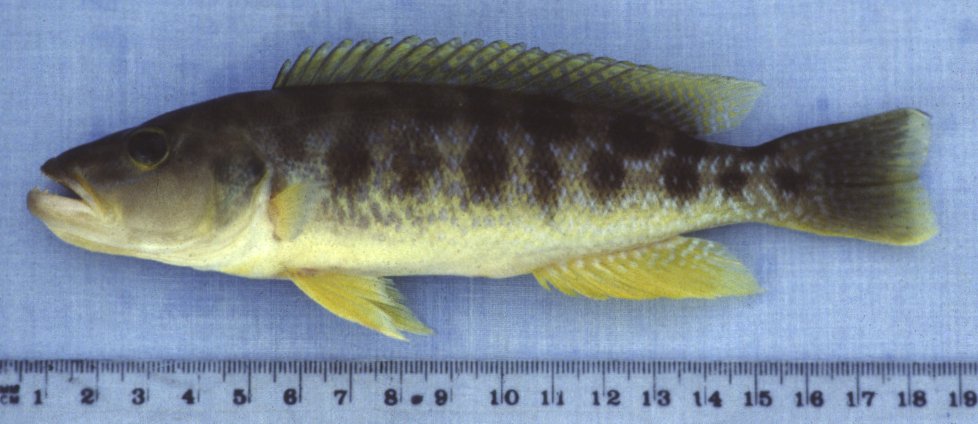
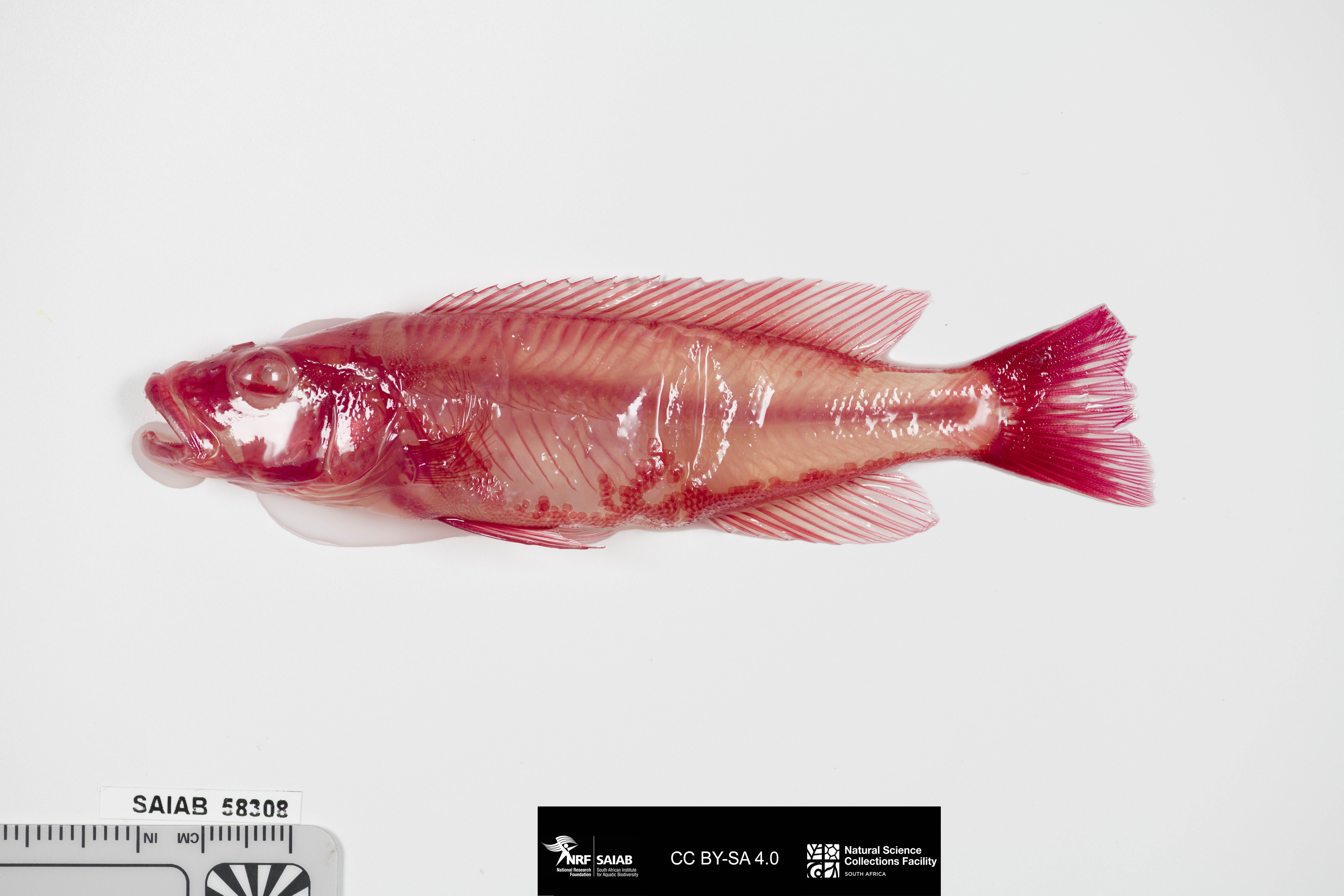
This is a sleek, moderately shallow-bodied fish built like the open-water hunter it is — body depth about a quarter of standard length, a relatively long head, a large mouth, and an emarginate (slightly forked) caudal fin. The original description records a maximum of about 6.3 in (16 cm) standard length, modest for one of the "big" Lepidiolamprologus but still a substantial predator. The jaws carry a row of enlarged, recurved canine teeth at the front, the classic dentition of a fish-eater.
The resting coloration is distinctive: a brownish-tan ground crossed by three broken, silvery-blue lines of blotchy spots, over which sit three rows of seven to nine large, dark-brown blotches running from behind the gill cover to the tail. The fins are bright yellow, broken into rows of yellow patches and bands, and the eye is rimmed above and below in yellow with a thin bluish line beneath it. The describers found no sexual dimorphism in color. The yellow fins and bold, large flank spots — without the finer spotting or the complex "worm-line" head markings of look-alikes such as L. nkambae and L. kendalli — are the quickest way to separate it from its congeners; meristic details (typically 34 vertebrae and around 73–79 longitudinal-line scales, slightly more than its relatives) seal the identification.
Range & habitat
Lepidiolamprologus mimicus is endemic to Lake Tanganyika and, as far as records go, confined to its southern basin. The type series came from the Zambian coast between Kasenga and Kapembwa; FishBase and later surveys add records from the central Tanzanian coast (Konings reported it there) and from Bulumba Island on the Congolese side, so its true range likely spans the southern third of the lake rather than a single shoreline.
It is a fish of the steep, rocky littoral — the boulder-and-slab slopes that plunge quickly into deep water. At the type locality in Chituta Bay, the rocky slope drops from the surface to roughly 165 ft (50 m) within a short distance, and individuals were collected as solitary wanderers across that terrain. The recorded depth range runs from about 6 ft to 165 ft (2–50 m), but the fish concentrates its hunting at 33 ft (10 m) and deeper, where the cyprichromine schools it preys on hover a meter or two above the rocks. It shares this habitat with most of its large congeners — L. cunningtoni, L. kendalli, L. elongatus, L. attenuatus and L. profundicola all occur alongside it in Chituta Bay — making the southern rocky coast an unusually crowded arena for elongate lamprologine predators.
Ecology & diet
L. mimicus is an exclusive piscivore, and its prey is narrow: young and sub-adult cyprichromine cichlids, the small, slender plankton-pickers that form large mixed-species schools in open water above the rocks. At Kasenga, where Hori and colleagues studied it across more than a decade, those schools were built from Cyprichromis leptosoma, C. zonatus, C. coloratus and Paracyprichromis brieni, and the predator concentrated on the youngest fish in them — especially juvenile Paracyprichromis brieni. FishBase places its trophic level near the top, around 4.1, consistent with a specialist hunter of other fishes.
The hunting method is the fish's claim to fame. Rather than ambush from cover, L. mimicus stalks solitarily near the school or mingles directly into it, then strikes. As it does so it transforms: the dark-brown flank spots vanish, the silver flank dots fade, and the body pales from dark brown to beige, leaving mainly the yellow anal fin and a dotted line at the dorsal tip. In that altered dress it closely resembles a female cyprichromine — particularly female Paracyprichromis brieni — letting it close the distance before the prey reacts. The describers logged at least thirty to forty hunts and noted the disguise was most convincing in the predator's own young and sub-adults. It is the first case of aggressive mimicry reported in the lamprologines, and it gives Tanganyika's cyprichromine schools the odd distinction of being exploited by two unrelated mimics at once: yellow-finned color morphs of the scale-eater Perissodus microlepis sneak in to steal scales, while L. mimicus slips in to take whole fish.
Behavior & breeding
Away from the school, L. mimicus is a roaming solitary predator rather than a tightly territorial rock-dweller. Its breeding has never actually been witnessed, despite an underwater survey at Kasenga that ran from 1993 to 2006 — a telling gap that the describers attribute to the fish spawning deeper than divers can reach. On two occasions, pairs were seen wandering together for several days along the boundary between rock and sand at 65–80 ft (20–25 m), inspecting holes and crevices among boulders while doing little feeding, behavior consistent with prospecting for a spawning site.
From that, plus the fact that gravid males and females were routinely gill-netted between roughly 65 and 165 ft (20–50 m), the authors infer that L. mimicus is a monogamous, deep-water substrate spawner — like L. elongatus and L. attenuatus, and unlike the harem-forming L. profundicola. As a lamprologine it is, by family pattern, a biparental cave or crevice spawner that guards eggs and fry rather than a mouthbrooder, but the specifics of its parental care remain unobserved in the wild. This is an honest gap in the record, not a settled fact.
In the aquarium
L. mimicus is genuinely uncommon in the trade. It is rarely exported, seldom bred in captivity, and reliable first-hand keeping accounts are scarce — so most of what can be said responsibly is extrapolated from its biology and from experience with its larger, better-known relatives such as L. elongatus, which Tanganyikan keepers treat as demanding, space-hungry predators. Take any "care sheet" specific to L. mimicus with skepticism; the firsthand data simply isn't deep.
What the biology dictates is clear enough. This is a roaming open-water piscivore that reaches around 6 in (16 cm), so it needs a long tank with a big open swimming lane over a rock-and-sand layout, not a small rock cube — a 4-foot tank is a sensible floor and a 6-foot tank is better for a pair. It needs Tanganyika water: hard and alkaline, pH around 8.0–9.0 with high mineral content, and stable warmth in the mid-70s Fahrenheit (about 24–26 C). Anything small enough to be read as a cyprichromine — including the dither fish many keepers reach for — will eventually be eaten, so tankmates should be robust, similarly sized Tanganyikans rather than the small open-water schoolers this fish evolved to hunt. Among large lamprologine predators it can be territorial toward conspecifics, so give it room and don't crowd it. The usual mistakes are the predictable ones: too small a footprint, soft or acidic water, and stocking it with bite-sized companions.
Conservation
The IUCN Red List assessed Lepidiolamprologus mimicus as Least Concern (assessment by Fermon, published in 2025; last assessed 28 February 2025), with the population trend listed as unknown. There is no targeted fishery or meaningful aquarium-trade pressure on it — it is too uncommon in export channels to be collected at scale — and no species-specific threat has been identified. In short, the fish itself is not currently considered at risk.
That verdict, however, sits inside a lake under real strain, and an honest account has to hold both ideas at once. Lake Tanganyika is warming, and the warming has consequences for productivity: O'Reilly and colleagues (2003, Nature, DOI 10.1038/nature01833) found that reduced mixing has cut primary productivity by roughly 20%, implying on the order of a 30% drop in fish yields. Cohen and colleagues (2016, PNAS, DOI 10.1073/pnas.1603237113) used sediment records to show declines in commercially important fishes and endemic molluscs tracking the warming, alongside a substantial loss of oxygenated benthic habitat as deep water loses oxygen. Layered on top of that are localized pressures on the rocky littoral itself — sedimentation from deforested catchments smothering the rocks (Cohen et al. 1993) — and the heavy basin-wide commercial fishery for pelagic clupeids (Stolothrissa and Limnothrissa) and their Lates predators that feeds four nations, governed jointly through the Lake Tanganyika Authority.
For L. mimicus, the relevant link is its habitat guild. It is a southern, rocky-shore predator tied to a specific prey base — cyprichromine schools over boulder slopes — so the threats that bear on it are not the offshore fishery but shoreline sedimentation degrading the rocky habitat and, more diffusely, any warming-driven reshuffling of the littoral fish community that its prey belongs to. A 20-year census of a Tanganyika rocky-littoral fish community (Takeuchi et al. 2010) documented exactly that kind of gradual compositional change over time. None of this places the species in immediate danger today, and it would be wrong to imply otherwise — but a narrow-range specialist on a strained lake has little margin, and its fate is bound to the health of the rocky coast it hunts.
Sources
- Lepidiolamprologus mimicus — FishBase summary
- Lepidiolamprologus mimicus — GBIF (with reproduced original description)
- Eschmeyer's Catalog of Fishes — Lepidiolamprologus mimicus (species)
- Schelly, Takahashi, Bills & Hori (2007), Zootaxa 1638:39–49 — original description (PDF)
- The first case of aggressive mimicry among lamprologines… (abstract), Semantic Scholar / DOI 10.11646/zootaxa.1638.1.3
- Kullander & Karlsson (2012) — Lepidiolamprologus kamambae, a new species from Lake Tanganyika
- Sturmbauer et al. (2010) — Evolutionary history of the cichlid tribe Lamprologini
- Hori & Watanabe (2004) — Aggressive mimicry in the scale-eater Perissodus microlepis
- Ronco et al. (2020) — Taxonomic diversity of the cichlid fauna of Lake Tanganyika
- Takeuchi et al. (2010) — A 20-year census of a rocky littoral fish community in Lake Tanganyika
- Cichlid Room Companion — Lepidiolamprologus mimicus species profile
- Fishipedia — Lepidiolamprologus elongatus (congener care reference)
- IUCN Red List — Lepidiolamprologus mimicus (Fermon 2025, Least Concern)
- O'Reilly et al. (2003), Nature — Climate change decreases productivity of Lake Tanganyika
- Cohen et al. (2016), PNAS — Climate warming reduces fish production and benthic habitat in Lake Tanganyika
- Cichlid Fish Forum (cichlid-forum.com) — community keeping discussion — community/anecdotal