
Taxonomy & naming
Max Poll described this fish in 1949 as Lamprologus profundicola, working up material collected by the Belgian hydrobiological mission to Lake Tanganyika of 1946-47. The type locality is a bay immediately south of Cape Tembwe on the lake's western (then Belgian Congo, now DR Congo) shore. It was later moved into Lepidiolamprologus, a genus erected for the larger, elongate piscivorous lamprologines; the generic name strings together Greek roots — lepis (scale), lampros (bright or shining), and lagos (hare) — while the species epithet profundicola simply marks it as a dweller of the deep.
The genus sits in the tribe Lamprologini, the substrate-brooding radiation that dominates Tanganyika's rocky and shell habitats. A broad molecular study of the tribe (Sturmbauer et al. 2010, Molecular Phylogenetics and Evolution) places the lamprologine radiation at roughly 5 million years ago, plausibly triggered by the onset of deep-water conditions in the lake — a fitting backdrop for a lineage that pushed into the depths. Within Lepidiolamprologus, profundicola belongs to a knot of similar large predators. It is most often confused with L. elongatus, and a closely allied form long circulated in the hobby as "L. sp. profundicola Tanzania" before being formally described as L. mimicus; that species grows to resemble profundicola with age, which has fueled the idea that it derived from it. Catalog of Fishes and FishBase both list profundicola as valid under Poll's authorship.
Appearance
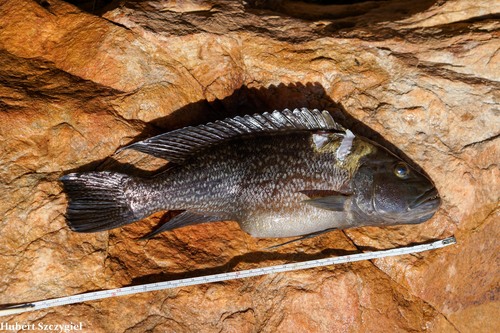
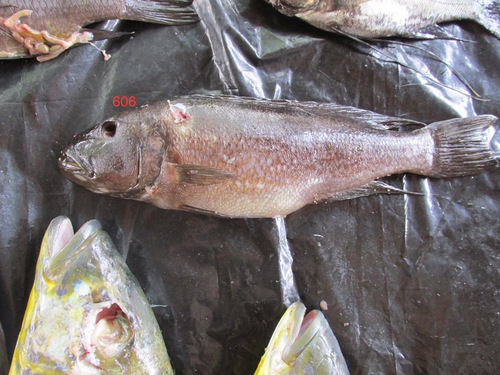
This is a long, muscular, torpedo-shaped cichlid built for ambush. Maximum recorded length is about 12 in (30.5 cm) total length, and Ad Konings notes that males regularly exceed that; females run noticeably smaller, by perhaps a quarter to 40 percent, and seldom pass 8 in (20 cm). The body color is understated — beige to grayish, often with faint darker mottling — which, combined with proportionally small eyes set in a large head, gives the fish a plain, almost businesslike look next to Tanganyika's jewel-toned mouthbrooders.
The practical identification problem is telling it apart from L. elongatus, and hobbyists tie themselves in knots over it. Both are slender, spotted predators of similar build, and stock sold as "profundicola yellow" has repeatedly turned out, in keepers' own back-and-forth on forums, to be elongatus instead. As a rough guide, true profundicola tends to be heavier-bodied with smaller eyes relative to its bulk, while elongatus carries more metallic speckling. Sexes look alike apart from size; there is no strong color difference between males and females.
Range & habitat
Lepidiolamprologus profundicola is endemic to Lake Tanganyika and occurs essentially all the way around its shoreline, with no clearly recognized geographic races — only local population labels (Namansi, Kanoni, Mvuna Island, Ifala, and so on) used by collectors. FishBase records it between about 3 degrees and 9 degrees south, across the lake's length.
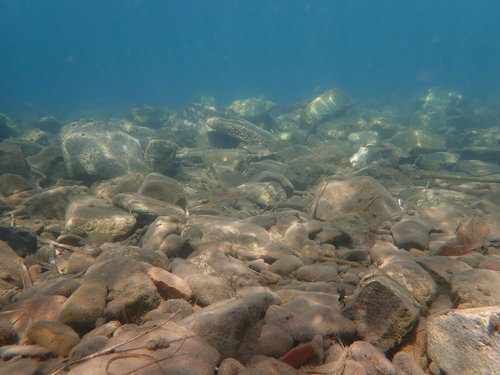
Its preferred ground is deep, sediment-covered rocky habitat. Reported depths span roughly 16 to 330 ft (5 to 100 m), but the species' defining trait is that it lives deeper than its relatives: it ranges below L. elongatus and L. kendalli and is seldom seen near the surface. It is benthopelagic, hugging the rocky bottom rather than roaming the open sandy flats. Where it overlaps with elongatus, profundicola usually occupies the deeper water and sits at lower population density. In-situ temperatures in its band run a stable tropical 75-79 degrees F (24-26 degrees C), with the alkaline, mineral-rich, well-buffered water typical of Tanganyika.
Ecology & diet
This is a committed piscivore — FishBase places it at trophic level 4.2, near the top of the fish-eating guild. In the wild it preys mainly on the young of other cichlids, with the planktivorous, open-water Cyprichromis singled out as a staple; in the aquarium it readily takes fish and crustacean foods. Keepers consistently describe the same thing divers report: it is startlingly fast over short distances, striking quicker than the pike cichlids it superficially resembles.
It is not at the very top of the food chain, though. Large lates perch, especially Lates angustifrons, are common predators of the rocky zone and will take even a big lamprologine given the chance, which is part of why profundicola stays close to cover among the rocks despite its size. In a lake whose littoral food web is anchored by algae-grazing and plankton-feeding cichlids, profundicola fills the role of a mid-to-upper predator that converts those smaller fish into its own biomass — a quiet but important link in the deeper rocky community.
Behavior & breeding
Lepidiolamprologus profundicola is an open-substrate spawner with a distinctive, lunar-cued reproductive cycle. Spawning typically occurs a few days before the full moon — a timing that is thought to improve the parents' ability to defend eggs against nocturnal predators. Eggs are laid out in the open on a large rock face, vertical or horizontal, rather than hidden away. What sets it apart from the pair-bonding L. elongatus is its mating system: it is a harem breeder. Only the female guards the clutch; the male commonly departs after a day or two and may spawn with other females within the same lunar cycle, with harems running to as many as four females. After three or four days the female shifts the developing eggs into a narrow cave entrance, which she blocks and guards with her body.
It is, by reputation, an aggressive fish — especially toward its own kind, and not gentle toward other species either. That said, keeper experience varies. One detailed account on MonsterFishKeepers described a group as unusually mellow, with males that did not pick fights even with each other, and females that were if anything the more combative sex; the writer flagged this as atypical for the genus. Treat such reports as the individual variation they are, and assume the conventional picture — territorial and predatory — when planning around the fish.
In the aquarium
Honestly, this is a fish few aquarists keep, and the reasons are sensible: it gets large, it eats tankmates, and its muted beige coloring offers little of the visual payoff that draws people to Tanganyikans in the first place. If you do take it on, think big. The realistic minimum is a tank around 185 gal (700 L) and at least 6.5 ft (2 m) long, aquascaped with a substantial rockwork backdrop arranged into caves and passages over a fine sand foreground — a setup that mirrors the deep rocky slopes it occupies in the lake.
Water should be hard and alkaline, in the high-pH, well-buffered range Tanganyika cichlids require, and kept clean: a predator of this size produces a heavy load and benefits from generous filtration and regular water changes. Tankmates must be other large, robust Tanganyikans — anything small enough to fit in its mouth is food, full stop. The most common rookie mistakes are underestimating adult size (online debate over whether it tops out near 8 or 12 in reflects genuine confusion, much of it driven by mislabeled elongatus) and buying it as the wrong species entirely. Confirm the identification before you commit a tank to it. This is not a beginner fish and not a community fish in the casual sense; it is a specialist's predator that wants space and appropriate company.
Conservation
The IUCN Red List assesses Lepidiolamprologus profundicola as Least Concern, most recently re-evaluated on 18 February 2025 (Red List version 2025-2), consistent with an earlier Least Concern listing. As a widespread, lake-wide species with no recognized restricted-range populations, it is not considered threatened in its own right, and there is no evidence that aquarium collection — modest, given how rarely it is kept — exerts meaningful pressure on wild stocks. It is harvested locally as a food and aquarium fish but ranks low for fishing vulnerability.
That species-level security sits, however, inside a lake under real strain, and the honest framing is that profundicola is fine for now while its habitat is not trending well. Long-term warming of Lake Tanganyika has reduced the vertical mixing that lifts nutrients from the depths; O'Reilly et al. (2003, Nature, doi:10.1038/nature01833) linked this to a roughly 20 percent decline in primary productivity, with knock-on losses to fish yields of comparable magnitude. Cohen et al. (2016, PNAS, doi:10.1073/pnas.1603237113) reconstructed an even starker change at depth — on the order of a 38 percent loss of oxygenated benthic habitat as the oxygenated layer has thinned. Because profundicola is a deep-living, benthic rocky-slope predator, it is precisely the guild most exposed to a shrinking oxygenated zone, and it depends on the small cichlids whose own numbers track the lake's declining productivity. Add the sedimentation that smothers near-shore rocky habitat (Cohen et al. 1993) and the heavy pelagic clupeid-and-Lates fishery that feeds four bordering nations, and the broader picture is of a system whose littoral and benthic communities are being squeezed even where individual species remain common. Management is coordinated across Burundi, DR Congo, Tanzania, and Zambia through the Lake Tanganyika Authority. In short: Least Concern is the correct label for the fish, but it is not a clean bill of health for the water it lives in.
Sources
- FishBase: Lepidiolamprologus profundicola (Poll, 1949)
- Eschmeyer's Catalog of Fishes — species record (CAS)
- Cichlid Room Companion: Lepidiolamprologus profundicola (curator Patrick Tawil)
- tanganyika.si: Lepidiolamprologus profundicola 'Kanoni' (data after Ad Konings)
- tanganyika.si: Lepidiolamprologus profundicola distribution map
- Practical Fishkeeping: 'When childcare proves fatal' (Ad Konings, on Tanganyika substrate brooders)
- Sturmbauer et al. 2010, Evolutionary history of the cichlid tribe Lamprologini (Mol. Phylogenet. Evol.)
- Kullander & Karlsson: Lepidiolamprologus kamambae, a new species (genus context)
- IUCN Red List: Lepidiolamprologus profundicola (Least Concern, 2025-2)
- O'Reilly et al. 2003, Climate change decreases aquatic ecosystem productivity of Lake Tanganyika (Nature)
- Cohen et al. 2016, Climate warming reduces fish production and benthic habitat in Lake Tanganyika (PNAS)
- MonsterFishKeepers forum: keeping Lepidiolamprologus profundicola (behavior/ID) — community/anecdotal
- Cichlid Fish Forum: predatory Lepidiolamprologus species — community/anecdotal
- Cichlid Room Companion forum: Lepidiolamprologus profundicola ID discussion — community/anecdotal