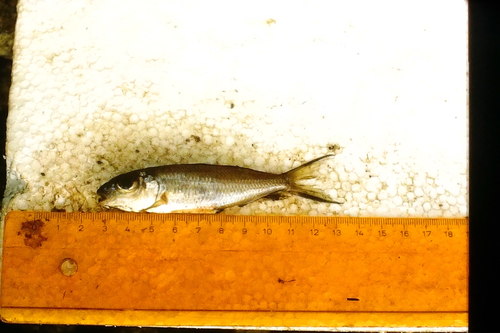

Taxonomy & naming
Lestradea perspicax was described by the Belgian ichthyologist Max Poll in 1943, from a holotype collected at Rumonge on the Burundian shore of Lake Tanganyika (holotype MRAC 42673, in the Royal Museum for Central Africa). Eschmeyer's Catalog of Fishes lists it as the valid name, placing the genus in the cichlid subfamily Pseudocrenilabrinae; in the finer tribal classification of Tanganyikan cichlids it sits within the Ectodini, the lineage of sand- and open-water specialists that also includes Xenotilapia, Callochromis and Ophthalmotilapia.
The genus name derives from the Greek lestris, "bandit" — a nod that has nothing to do with the fish's gentle habits — while the species epithet perspicax means "sharp-sighted" or "perspicacious," and the genus itself honors Arthur Lestrade, a Belgian administrator and ethnographer in the colonial Rwanda of Poll's era.
There are only two species in the genus, and their relationship has been muddled. The congener Lestradea stappersii was originally treated as a subspecies of perspicax and is still sometimes listed that way; the IUCN assessment even carries L. stappersii among the synonyms, though Catalog of Fishes and most current workers treat the two as distinct species, with stappersii confined to the southern lake. In the hobby the fish is sold simply as "perspicax," often tagged with a collection locality (e.g. 'Kigoma', 'Congo'). Be warned that an unrelated Lake Malawi mbuna is also marketed under a "Perspicax" trade name — a different fish entirely, and a common source of confusion.
Appearance
This is a streamlined, fusiform cichlid built for cruising over open sand rather than wedging into rock. Reported maxima cluster tightly: FishBase gives a maximum of about 13.8 cm (5.4 in) total length, Seriously Fish a maximum standard length of 13.5 cm (5.3 in), and field observations put lake males at roughly 12 cm (4.7 in) with captive males occasionally reaching about 14 cm (5.5 in). Females run a touch smaller — typically 1–2 cm (about half an inch) shorter than males.
For most of its life the fish is deliberately nondescript: a polished silver flank that mirrors the pale lakebed, with only the upper half of the iris picked out in yellow. That plainness is the point — a silver fish over silver sand is hard for a hunting predator to lock onto. Breeding males abandon the disguise. They flush a clean blue across the body and dorsal fin, blacken the throat, and light up the pelvic fins in yellow. Sexing quiet fish is genuinely tricky; keepers lean on the dorsal fin, where males tend to show two distinct submarginal lines against the female's single line, alongside the male's slightly greater size.
Range & habitat
Lestradea perspicax is endemic to Lake Tanganyika — it lives nowhere else on Earth. Sources disagree on how much of the lake it occupies: FishBase and Seriously Fish describe it as restricted to the northern basin, while the 2025 IUCN assessment and field-survey sites report a lake-wide distribution spanning all four riparian countries (Burundi, the Democratic Republic of the Congo, Tanzania and Zambia). The likeliest reconciliation is that the species is genuinely lake-wide but broken into regional populations, which is why locality names attach to aquarium stock.
The habitat is consistent across every source: sand. These are fish of shallow, open sandy bottoms, where they gather in loose aggregations rather than defending rock crevices. Depth figures vary with method — the IUCN lists a band of 0–30 m (0–100 ft), while collection records compiled by Tanganyikan specialists extend the species down sandy slopes to roughly 75 m (about 245 ft). Either way, this is a creature of the lake's sandy littoral and sublittoral floor, the same stable, oxygen-rich, highly alkaline water (pH well above 8) that defines the upper Tanganyika water column.
Ecology & diet
Lestradea perspicax is best described as an omnivorous microphage — a sifter of the very small. It feeds mainly on microorganisms gathered from the sand and the water just above it: diatoms, blue-green algae (cyanobacteria), bacteria and assorted detritus. Stomach-content analyses are telling, returning mostly sand grains intermixed with this microscopic crop, which is exactly what you'd expect from an animal that processes mouthfuls of substrate to extract the living film coating each grain. FishBase places it at a trophic level of about 3.4, reflecting a diet that is largely primary-producer and microbe based but not strictly herbivorous.
In the lake's economy this is a grazer-processor of the sand flats, a role distinct from the algae-scraping rock dwellers and the plankton-pickers of open water. Its habit of feeding and resting in aggregations — semi-pelagic roamers, in FishBase's phrasing — and its instant burial response together describe a fish that has traded territorial cover for safety in numbers and a vanishing act, the classic strategy of an exposed sand-flat species.
Behavior & breeding
Out of breeding condition these are social, roaming fish that move over the sand in groups, and their most remarkable behavior is defensive: when threatened, an individual can dive into the substrate and bury itself entirely, sitting out the danger for several minutes before re-emerging. Combined with the mirror-silver camouflage, it makes a hunted fish very hard to single out.
Reproduction follows the maternal-mouthbrooding pattern typical of many Tanganyikan ectodines. Males turn blue and build a bower — a shallow sand crater ringed by a raised wall, often around 40–50 cm (16–20 in) across — scraped out of the open substrate. Spawning happens at the center of the crater: eggs are laid and fertilized on the sand, then the female gathers them into her mouth and broods the developing young there. FishBase records larvae of up to about 1.38 cm (0.5 in) being mouthbrooded by a female only 6.4 cm (2.5 in) standard length. Reported captive broods are modest, on the order of 60–70 fry, which are released after the brooding period and — unlike some mouthbrooders — are not taken back up again.
A note on temperament, because the hobby record is genuinely split. In the wild, observers consistently describe L. perspicax as peaceful, and that is the natural-history consensus reflected in the specialist references. As with many open-water cichlids, though, a breeding male confined to a tank can become a persistent chaser, so the prudent reading is that "peaceful in a vast lake" and "peaceful in a glass box" are not the same claim.
In the aquarium
This is an uncommon import — sold as "rare" by hobby references — and it is a specialist's fish rather than a beginner's. The non-negotiable is a deep bed of fine sand, because the fish both feeds by sifting it and uses it to bury itself and to build spawning craters; a bare or gravel bottom denies it half of its natural behavior. Give it open swimming room with only a few scattered rocks: published guidance is a tank of at least 150 L (about 40 US gal) and, more to the point, around 120–125 cm (48–50 in) of length to suit an active swimmer, with a small group of six or more so social structure can develop.
Water should match the lake: hard and alkaline, roughly pH 7.8–9.0, hardness around 8–25 dGH, and a temperature near 24–27 C (75–81 F). In nature it sifts microfauna from sand; in the aquarium it readily takes prepared and frozen foods, with small live and frozen items a sensible staple. For tankmates, keep it away from boisterous Lake Malawi mbuna and other pugnacious cichlids; calmer Tanganyikans such as Julidochromis, Neolamprologus and the related sand-dwelling Xenotilapia are the usual recommendations. The honest caveat is the one above: dominant males can turn surprisingly pushy in close quarters, particularly in spawning mode, so plan for enough footprint and enough females to spread the attention rather than trusting the "very peaceful" label at face value.
Conservation
The IUCN Red List assessed Lestradea perspicax as Least Concern in its 2025-2 update (assessment by Fermon, dated 28 February 2025), on the grounds that the species is widespread across Lake Tanganyika with no major lake-wide threat. That headline, though, sits on top of a more uncomfortable assessment text. The population trend is listed as unknown, and the assessors flag a sharp local decline in Zambian waters — and likely in Congolese waters — driven by illegal beach-seine fishing, noting that the species has been virtually extirpated from the Zambian shoreline except along sandy stretches frequented by crocodiles, where fishers do not seine. Sedimentation and agricultural runoff are listed as secondary threats. The fish is taken locally for food and is also a national- and international-trade aquarium species, so collection pressure is real even if it is not the dominant risk.
Those threats land squarely on this fish's biology. As a shallow sand-flat specialist, it is exactly the kind of species exposed to shoreline sedimentation — deforestation and farming in the catchment wash silt onto the littoral, smothering the sandy and rocky substrates that structure inshore life (Cohen et al. 1993) — and to the inshore seine fisheries that work those same shallow margins. The wider lake is under documented strain: O'Reilly et al. (2003, Nature, doi:10.1038/nature01833) linked sustained warming and reduced vertical mixing to roughly a 20% drop in primary productivity, with knock-on declines of around 30% in fish yields, and Cohen et al. (2016, PNAS, doi:10.1073/pnas.1603237113) estimated the loss of about 38% of the lake's oxygenated benthic habitat as the warm, oxygen-poor layer expands upward. A nearshore species like L. perspicax is more immediately squeezed by sediment and seines than by deep-water deoxygenation, but it shares a single, four-nation lake whose pelagic clupeid (Stolothrissa and Limnothrissa) and Lates fishery feeds millions and whose management is coordinated across Burundi, the DRC, Tanzania and Zambia through the Lake Tanganyika Authority. In short: the species itself is judged secure for now, but "Least Concern" is a basin-wide average that the Red List's own text shows already failing at the southern end of the lake.
Sources
- Eschmeyer's Catalog of Fishes: Lestradea perspicax (species record)
- FishBase: Lestradea perspicax summary
- FishBase: Lestradea perspicax occurrence records
- IUCN Red List: Lestradea perspicax (Fermon 2025, e.T272434943A272435153)
- Seriously Fish: Lestradea perspicax profile
- tanganyika.si: Lestradea perspicax (species, locality & habitat notes)
- The Aquarium Wiki: Perspicax Cichlid (Lestradea perspicax)
- tanganyika.si: Lake Tanganyika Habitats (sand-dweller feeding niches)
- Koblmuller et al., evolutionary relationships in the sand-dwelling (Ectodini) cichlid lineage of Lake Tanganyika
- Konings, Tanganyika Cichlids in their Natural Habitat (publisher overview)
- O'Reilly et al. 2003, Climate change decreases aquatic ecosystem productivity of Lake Tanganyika (Nature)
- Cohen et al. 2016, Climate warming reduces fish production and benthic habitat in Lake Tanganyika (PNAS)
- cichlidae.com forum: Tanganyika sand-dweller section (Lestradea perspicax vs. L. stappersii) — community/anecdotal
- Cichlid Forum: keeper thread on confined-male 'perspicax' temperament (note: discusses a Malawi 'Perspicax' namesake; used only to flag captive-aggression reports, not as ID for Lestradea) — community/anecdotal
- Aquatic Community: Feeding Lake Tanganyika cichlids (diatom/microphage feeders) — community/anecdotal