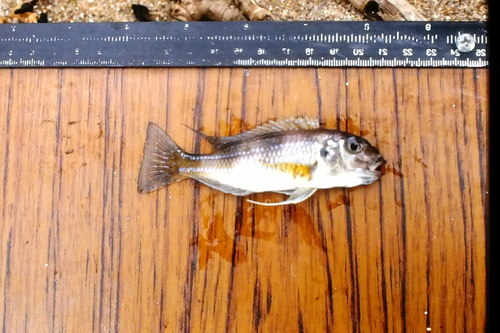


Taxonomy & naming
George Albert Boulenger described this fish in 1901 as Paratilapia aurita, working from specimens that the explorer J. E. S. Moore had collected at Msambu in Lake Tanganyika during his expeditions to the African Rift lakes. The surviving syntypes are held at the Natural History Museum in London (BMNH), with material also at the Paris museum. Regan erected the genus Limnochromis in 1920, and the species has been treated as Limnochromis auritus (Boulenger, 1901) by every modern authority — Maréchal & Poll's CLOFFA checklist (1991), De Vos et al. (2001), and Konings' habitat guides — so the older name is now only of historical interest. Eschmeyer's Catalog of Fishes lists it as the valid combination.
The genus name pairs the Greek limne, a lake or marsh, with chromis, an old word for a perch-like fish; the species epithet auritus means "eared," a nod to the dark opercular blotch many specimens carry. In the hobby it goes by the spangled cichlid, after the fine reflective speckling scattered across its flanks. Within Lake Tanganyika's cichlid flock it belongs to the tribe Limnochromini, a small assemblage of benthic, mostly deep-water species — among them Reganochromis calliurus and Triglachromis otostigma — that together occupy the lake's muddy offshore floor.
Appearance
The spangled cichlid is an elongate, silvery-tan fish with a gently rounded forehead and a small, distinctly protruding snout and upper lip — a profile that ichthyologists treat as a useful field mark separating it from its Limnochromini relatives. Its common name comes from the scattering of pale, iridescent spots that catch the light along the body, brightest on the lower flanks and the unpaired fins. A dark smudge sits on the gill cover, and the fins are often washed with subtle yellow or blue.
Reported maximum size is one of the few points where sources genuinely disagree. FishBase lists a maximum of about 13 cm (5 in) total length, drawn from the older checklist literature, and that figure is widely repeated. Hobby references that track lake forms, such as tanganyika.si, put well-grown males nearer 19 cm (7.5 in) and females around 16 cm (6 in), while noting that fish over 14 cm (5.5 in) are uncommon. The honest read is that most individuals are modest, hand-sized fish, with occasional large males pushing past the textbook figure. Sexual dimorphism is weak: males average slightly larger, but there is no dramatic difference in color or finnage, which makes confident sexing difficult outside of breeding behavior.
Range & habitat
Limnochromis auritus is endemic to Lake Tanganyika and occurs lake-wide, recorded along all four of the lake's national coastlines wherever suitable bottom exists. It is not a rock-dweller. This is a soft-substrate specialist that lives close to the floor over mud and fine sediment, and FishBase characterizes its distribution simply as endemic "at great depths." Field and hobby records describe a broad depth band running roughly from a few meters down to over 100 m (around 15 to 400 ft), with the bulk of observations in the dim deeper zones where little light penetrates.
That habitat choice matters for understanding the fish. Lake Tanganyika's offshore deep-water cichlids tend to have lake-wide ranges with very little genetic structure between distant populations — there are simply few barriers on the open mud floor, unlike the patchwork of isolated rocky reefs that drives explosive speciation in the shallows (Kirchberger et al. 2012). In situ the species sits in warm, hard, alkaline water typical of the lake: FishBase gives a tolerance around pH 7 and up, moderate to high hardness, and temperatures of roughly 24-26 C (75-79 F).
Ecology & diet
The spangled cichlid is a benthic invertebrate-feeder, and the structure that defines its ecology is in its throat. Like others of its tribe it carries enlarged, blunt molariform pharyngeal teeth — a built-in nutcracker — and uses them to crush the shells of small snails and other hard-bodied invertebrates it picks and sifts from the mud. The Cichlid Room Companion classes the genus outright as molluscivorous, and habitat references describe the same: a fish that works the substrate, scavenging and digging for buried prey. FishBase places it at a trophic level of about 3.3, squarely in the carnivore range but not at the top of the food web.
Ecologically it is a foraging predator of the lake's offshore soft floor, a zone far less studied than the famous rocky littoral. It shares that benthic deep-water guild with the rest of the Limnochromini and with larger predators that hunt the same depths, and it forms part of the prey and competitor web that connects the lake's quiet mud bottom to the productive open water above.
Behavior & breeding
Reproduction is where Limnochromis auritus earns its reputation. It is one of relatively few Lake Tanganyika cichlids that practice biparental mouthbrooding: rather than the female alone carrying the brood, a bonded male and female share incubation, which implies a monogamous pairing that holds at least as long as the young are in the mouth. Comparative reviews of Tanganyikan parental care list it alongside Reganochromis calliurus and Triglachromis otostigma as the classic biparental mouthbrooders of the lake.
Spawning takes place out of sight, in a tunnel or cave the pair excavates in the soft bottom. The reported sequence is unusual: the male enters the burrow, releases milt, and withdraws; the female then enters alone and lays her eggs into the sperm-charged water, immediately taking them up into her mouth, and the pair repeats this until the clutch is complete. Both parents then take turns brooding, passing the developing eggs and larvae between their mouths for about two weeks before the fry are free-swimming. Clutches are large for a mouthbrooder — often around 300 eggs, with figures from roughly 100 upward reported. Away from breeding the fish is calm and only moderately territorial, a notable contrast to the high-strung rock-dwelling Tanganyikans.
In the aquarium
The spangled cichlid has a long, quiet history in the hobby as an adaptable, even-tempered Tanganyikan — FishBase calls it "easygoing and adaptable... of long standing with aquarists." That said, it is a specialist's fish rather than a beginner's centerpiece, and getting it right means honoring where it lives. Give a group a tank of at least 300 L (about 80 US gal), floor space over flash, and a deep bed of fine sand they can dig and sift. Because it is a low-light, deep-water animal, subdued lighting and shaded retreats — caves, lengths of pipe, rockwork forming tunnels — suit it far better than a brightly lit reef setup. Water should follow lake conditions: hard, alkaline, and warm.
Temperament is the main thing keepers get wrong in both directions. It is not the placid "community" fish a quick care sheet might imply — keepers describe it as moderately aggressive, especially around spawning, when a pair will defend its burrow. But it is also not a brawler, and it does poorly housed with boisterous, hyper-aggressive mbuna-style cichlids that will bully it off its food. The reliable approach, echoed across Tanganyika-focused forums and clubs, is calm tankmates of similar disposition and a tank long enough to give a breeding pair its own corner. Match the diet to the molariform jaws: meaty frozen and live foods, with small snails a natural fit; it readily accepts prepared foods in captivity.
Conservation
The IUCN Red List assesses Limnochromis auritus as Least Concern, most recently on 2 March 2025. As a lake-wide, deep-water generalist with a broad range and no narrow rocky-reef dependence, it is not currently considered at risk, and it faces little targeted pressure: it appears in artisanal catches and the ornamental trade but is not a high-value fishery or aquarium target. On its own, then, the species looks secure.
The lake it depends on is not. Lake Tanganyika is warming, and that warming is the central conservation story for everything living in it. O'Reilly et al. (2003) documented that rising surface temperatures have strengthened density stratification and weakened the seasonal mixing that lifts nutrients from the depths, contributing to an estimated ~20% decline in primary productivity and correspondingly lower fish yields. Cohen et al. (2016) found that warming has shrunk the oxygenated benthic habitat available to lake animals — on the order of a 38% loss — squeezing the very deep-floor zone this species occupies. Shoreline development and erosion add sediment to nearshore waters (Cohen et al. 1993), and a heavily exploited pelagic fishery for clupeids (Stolothrissa and Limnothrissa) and Lates feeds millions across the four riparian nations, with management coordinated through the four-country Lake Tanganyika Authority. For a soft-bottom, deep-living fish like the spangled cichlid, the most relevant of these threats is the contraction of cool, oxygenated benthic habitat as the lake warms. So the honest framing is the careful one: the species itself is Least Concern, but it lives in a basin under real and intensifying strain, and its long-term outlook is tied to the lake's.
Sources
- Eschmeyer's Catalog of Fishes: Paratilapia aurita / Limnochromis auritus (Boulenger 1901)
- FishBase: Limnochromis auritus (Spangled cichlid)
- Cichlid Room Companion: Limnochromis auritus species profile (Thomas Andersen)
- Cichlid Room Companion: genus Limnochromis (Regan, 1920)
- IUCN Red List: Limnochromis auritus (Least Concern, assessed 2025)
- Sefc (2011), Mating and Parental Care in Lake Tanganyika's Cichlids
- Kirchberger et al. (2012), Evolutionary History of Lake Tanganyika's Predatory Deepwater Cichlids
- tanganyika.si: Limnochromis auritus — habitat, diet, breeding, care
- Add-my-pet (AmP): Limnochromis auritus DEB entry (life-history data)
- FishBase family checklist (Cichlidae): synonymy Paratilapia aurita / Pelmatochromis
- Natural History Museum (London): syntype Limnochromis auritus 1906.9.6.67-70
- GBIF Hosted IPT: Fisheries of Lake Tanganyika (Limnochromis auritus occurrences)
- O'Reilly et al. (2003), Climate change decreases aquatic ecosystem productivity of Lake Tanganyika, Nature
- Cohen et al. (2016), Climate warming reduces fish production and benthic habitat in Lake Tanganyika, PNAS
- Cichlid Room Companion forum: Limnochromis auritus thread (community keeping notes) — community/anecdotal
- Cichlid-Forum: Tanganyikan community tankmate discussion including L. auritus — community/anecdotal
- Fish Lore forum: 'Spangled cichlid' identification and behavior thread — community/anecdotal