Taxonomy & naming
George Albert Boulenger described this fish in 1899 as Tilapia dardennii, working from material collected during the Congo Free State expedition led by Lieutenant Lemaire, with a type locality at Moliro on the lake's southwestern (then Congolese) shore. In 1920 Charles Tate Regan moved it into a genus of its own, Limnotilapia, and that combination — Limnotilapia dardennii (Boulenger, 1899) — is the valid name recognized today by Eschmeyer's Catalog of Fishes, FishBase, and the IUCN. The genus remains monotypic: dardennii is its only species. A second name, Pelmatochromis loveridgei, was coined by Borodin in 1931 from a specimen taken at Ujiji near Kigoma, but Trewavas synonymized it with dardennii in 1946, and it survives only in the older literature.
The genus name is a small piece of nineteenth-century word-borrowing: the Greek limne, "swamp" or "lake," fused to thiape (or tilapia), a southern-African Bantu word for fish — literally a "lake tilapia." The species epithet honors Léon-Louis Dardenne, a Belgian artist attached to the Katanga scientific mission of 1898–1900, rather than any feature of the fish. Around the lake it carries local names — Kungura in Swahili, Nkungula and Inkungura in neighboring tongues. Phylogenetically it sits in the tribe Tropheini, the radiation of mostly herbivorous, mouthbrooding cichlids nested within the broader Haplochromini, which makes it a relative of Tropheus, Simochromis, and Petrochromis. Among those grazers it is the plainest specialist of the bunch, and in body shape and the red-and-yellow wash on its throat it is easily mistaken in the field for Simochromis diagramma or Ctenochromis (Shuja) horei.
Appearance
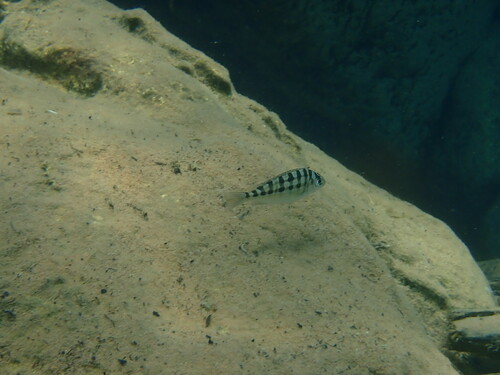
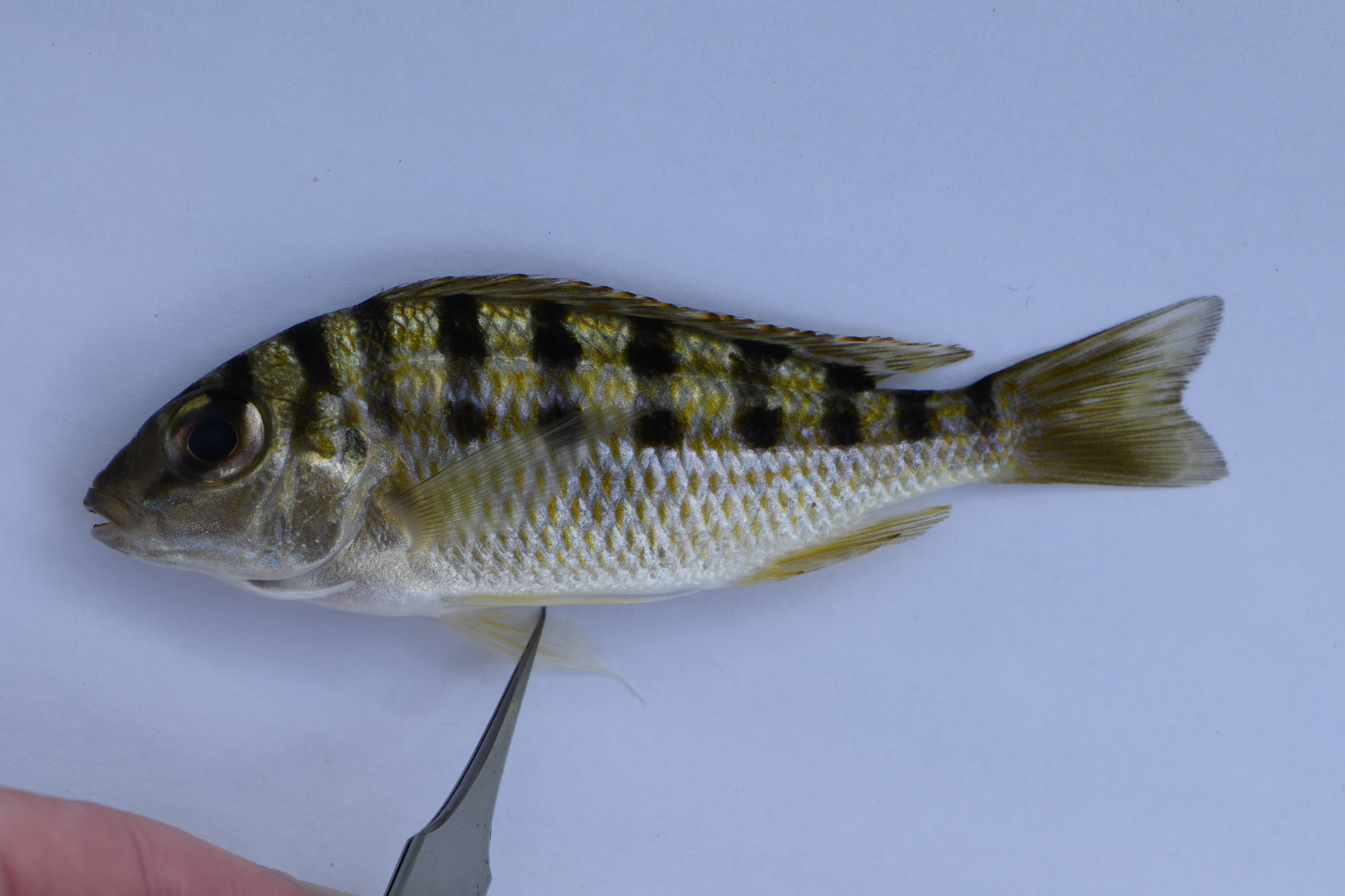
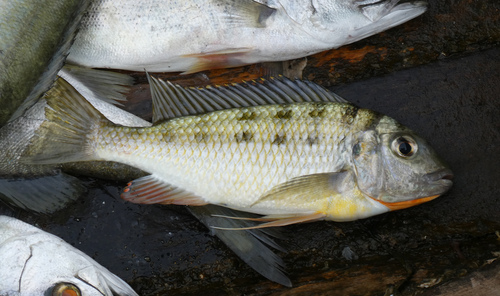
This is a moderately large, deep-bodied cichlid with a short, blunt head and a laterally compressed profile that recalls a scaled-up Tropheus. FishBase gives a maximum of about 10 in (26 cm) total length, and field references put males at that upper end with females noticeably smaller, roughly 7 to 8 in (18–20 cm) — a real but not extreme sexual size difference. Coloration is unremarkable in a stressed or subordinate fish, a muddy grey-green, but a dominant, in-color male transforms: an iridescent greenish flank over a belly and throat flushed red and yellow, with dark vertical barring that gives the fish its English book-name, the latticed cichlid. The sexes are otherwise similar enough that immature fish are hard to tell apart until males begin to color and outgrow the females.
One honest wrinkle on size: aquarists who have kept the fish for years consistently report males larger than the literature, on the order of 8 to 10 in (20–25 cm) and occasionally pushing toward a foot in well-fed tanks. Several independent keepers describe "10-inch monsters" and even an 11-inch male. Treat the museum figure as the documented maximum and the bigger captive reports as a credible signal that this fish grows large when fed hard — either way, plan for a substantial cichlid, not a midsized one.
Range & habitat
Limnotilapia dardennii is a lacustrine endemic — restricted to Lake Tanganyika — but unlike the rock-bound specialists that fragment into a different color form on every headland, it is distributed continuously around essentially the whole lake, with populations recorded in all four bordering nations (Burundi, the Democratic Republic of the Congo, Tanzania, and Zambia) and into the delta of the Malagarasi, the lake's largest inflowing river. There are no recognized geographic races, which itself marks it as an unusually mobile generalist by Tanganyikan standards.
It is a shallow-water, inshore fish. The IUCN assessment records it over rocky or sandy bottoms to a maximum of about 100 ft (30 m) but with an average depth nearer 20 ft (6 m), and FishBase notes that it occurs over sand more than rock. Juveniles keep to shallow water over sand and muddy flats; adults move a little deeper and gather near rocky slopes, but the species as a whole favors sediment-rich, vegetated bays and intermediate sand-and-rubble zones rather than clear rocky reefs — the kind of weedy, grassy shallows other tropheines avoid. Field observers in Tanzania have found it in grassy areas and sand as shallow as a few meters; in the Congo and Burundi it is seen within a few meters of shore where the water is clearer. The water it lives in is the hard, alkaline, thermally stable medium of the open lake: FishBase lists pH around 7.0 to 8.5 and temperatures of roughly 73 to 79 °F (23–26 °C), conditions worth matching for anyone keeping it.
Ecology & diet
Functionally, dardennii is a grazing omnivore that leans heavily vegetarian. FishBase summarizes its diet as mainly plant-based — phytoplankton, filamentous algae, and aquatic plants — and the IUCN account describes it grazing filamentous algae and aquatic vegetation and taking worms and fish eggs only occasionally. Stomach-content work has turned up plant material, filamentous algae, and a minority fraction of animal matter, consistent with a fish that scrapes and crops the algal turf and weed of shallow biotopes but is not a strict, dentition-locked specialist the way Tropheus or Petrochromis are. FishBase places it at a trophic level of about 3.2 — squarely an omnivore rather than a pure herbivore or a predator.
That lack of specialization is the ecological point of the species. In a lake where the herbivorous tropheines have split the algae-grazing niche into dozens of finely partitioned forms, dardennii is the broad-spectrum exception: the least rock-dependent and least specialized of the plant-eating tropheines, and precisely because of that flexibility, one of the most widespread and commercially abundant cichlids in the lake. It is taken in quantity by local fisheries all around the shoreline, where it goes to market as food.
Behavior & breeding
Like the rest of the tribe, Limnotilapia dardennii is a maternal mouthbrooder. Males establish and defend spawning territories and construct shallow nests in the sand, into which a receptive female lays; after fertilization she takes the eggs into her mouth and incubates them there through hatching and the early free-swimming stage. Clutches are sizeable for a mouthbrooder — reported to exceed 100 eggs, each on the order of 6 mm across — and because the lake is thermally stable, breeding males and brooding females can be found at any time of year rather than in a tight season. Field observers in Tanzania have noted nests in sand and rocky areas and seen the parents guarding fry, particularly when threatened.
Socially, the fish carries the classic tropheine temperament: intensely aggressive toward its own kind, especially among rival males over territory, yet comparatively tolerant of other species. That combination is the heart of how aquarists use it. Keepers describe it as extraordinarily robust — a fish that "can take a pounding like no other," absorbing harassment from notoriously rough tankmates without lasting harm while rarely dishing out serious damage itself. It is also relentlessly active and a voracious, almost comically eager feeder, with keepers reporting fish that lunge clear of the water at feeding time. These behaviors are anecdotal in the sense that they come from hobby experience rather than published study, but they are reported consistently enough across independent keepers to be treated as real.
In the aquarium
This is a hardy, undemanding Tanganyikan with one non-negotiable demand: space. Given that males reach 10 in (26 cm) or more and that the species is both large and frantically active, a serious tank is required — keepers and biotope references converge on something on the order of 150 gallons (about 600 L) or larger, with a footprint around 6 feet (roughly 2 m) of length for fully grown fish. The wild biotope translates directly to the setup: a fine sand substrate for the male to work into a nest, some open swimming room, and robust filtration to keep pace with a big, messy grazer's appetite. Water should mirror the lake — hard, alkaline (pH ~8), warm, and clean, which in practice means generous, regular water changes. A largely vegetable-based diet suits its grazing physiology better than a heavy meat ration; protein-rich foods can cause digestive trouble in tropheines, so spirulina-based and vegetable preparations are the sensible staple.
Where dardennii earns its keep is compatibility. Because it shrugs off aggression without retaliating much, experienced keepers prize it as a dither and target fish for genuinely hard company — it has been run successfully alongside Tropheus, Simochromis, Petrochromis, gobies, and predatory Lepidiolamprologus, holding its own where gentler fish would be shredded. The real mistakes are predictable ones: underestimating the adult size and crowding it into a tank meant for a midsized cichlid; keeping too few and letting a dominant male monopolize the others (conspecific aggression is the species' genuine danger, not interspecific bullying); and over-feeding protein. It is not a delicate or beginner-defeating fish, but it is emphatically a big-tank fish.
Conservation
On its own, Limnotilapia dardennii is in no immediate danger. The IUCN Red List most recently assessed it on 2 March 2025 (assessor C. Sibomana; reviewed by the Tanganyika specialist Ad Konings) as Least Concern, citing its endemism to the lake, its presence in all four riparian countries, and its abundance in inshore waters over rock and sand, with no known widespread major threat. That said, the same assessment is unusually candid about local strain. Drawing on traditional knowledge gathered from lakeside fishing communities, it records the species as still abundant in Tanzania but undergoing local declines in Zambia over roughly the last decade, and in the Congo it notes catches that have fallen by half since 1980–2000. The threats it flags are specific and local: over-fishing — beach seining above all — and destructive fishing methods that can even drive guarding adults to abandon their young, compounded by sedimentation in the inshore zone from erosion in the watershed. No part of its range lies within a protected area, and its population trend is formally unknown.
Those local pressures are the species-scale edge of a lake-wide problem, and dardennii's ecology places it squarely in the path of it. As a shallow, inshore grazer of sandy and weedy bays, it depends on exactly the nearshore zone most exposed to two converging forces. The first is sedimentation: deforestation, farming, and road-building across the catchment send eroded soil into the littoral, and in-lake studies have linked these sediment plumes to reduced species richness in the very nearshore communities a fish like this grazes and breeds in (Alin et al.; Cohen and colleagues). The second is climate warming. Long-term work led by O'Reilly and colleagues (2003, Nature) showed that a warming surface has stabilized Tanganyika's water column and weakened the wind-driven mixing that lifts deep nutrients into the sunlit zone, with sediment-core evidence pointing to roughly a 20 percent decline in primary productivity and an inferred ~30 percent drop in fish yields over the twentieth century; subsequent paleoecological work (Cohen et al., 2016, PNAS) tied continued warming to measurable declines in both commercially important fishes and endemic benthic habitat. These basin-scale forces fall hardest on the pelagic clupeid-and-Lates fishery that feeds millions, and they complicate the coordinated, four-nation management the lake's future requires — but a productivity decline at the base of the food web and a degrading, silt-laden littoral also quietly erode the algal-grazing, shallow-water guild to which dardennii belongs. The honest summary is the one the Red List implies: the species itself is secure and widespread today, in a lake whose nearshore zone is being degraded faster than its open water, and whose long-term trajectory under continued warming and shoreline development is the real reason for vigilance.
Sources
- Eschmeyer's Catalog of Fishes — Limnotilapia dardennii (Boulenger, 1899)
- Eschmeyer's Catalog of Fishes — Pelmatochromis loveridgei (synonym entry)
- FishBase — Limnotilapia dardennii (Boulenger, 1899)
- FishBase — Diet composition, Limnotilapia dardennii
- GBIF — Limnotilapia dardennii (Boulenger, 1899)
- Cichlid Room Companion — Limnotilapia dardennii (curated by Patrick Tawil)
- Cichlid Room Companion — Limnotilapia genus / tribe placement
- tanganyika.si — Limnotilapia dardennii species page (biotope, size, breeding)
- Fishipedia — Limnotilapia dardennii
- IUCN Red List — Limnotilapia dardennii (Sibomana 2025, Least Concern, v2025-2)
- O'Reilly et al. 2003 — Climate change decreases aquatic ecosystem productivity of Lake Tanganyika (Nature)
- Cohen et al. 2016 — Climate warming reduces fish production and benthic habitat in Lake Tanganyika (PNAS)
- Phiri et al. 2023 — Lake Tanganyika: Status, challenges, and opportunities (J. Great Lakes Research)
- Effects of Landscape Disturbance on Animal Communities in Lake Tanganyika (Conservation Biology)
- Spatial variability in nearshore sediment pollution in Lake Tanganyika (Anthropocene)
- Cichlid Fish Forum — Limnotilapia dardennii keeping thread (size, aggression, dither use) — community/anecdotal