Taxonomy & naming
The species was described by the Belgian-British ichthyologist George Albert Boulenger in 1898, originally as Tilapia labiata, from specimens collected at Kinyamkolo (modern Mpulungu) on the Zambian shore of Lake Tanganyika; the syntypes are held at the Natural History Museum in London. It was soon recognized as distinctive enough to warrant its own genus, and Eschmeyer's Catalog of Fishes records the current valid combination as Lobochilotes labiatus (Boulenger, 1898), the sole species in the genus — a monotypic lineage.
There is a small but genuine nomenclatural wrinkle worth flagging, because the two leading databases spell the name differently. The Catalog of Fishes lists the current status as Lobochilotes labiatus (masculine ending), while FishBase and the IUCN Red List render it Lobochilotes labiata (feminine), reflecting a recent reassessment of the genus's grammatical gender. Both refer to the same fish; we follow the Catalog of Fishes here and note labiata as the form a reader will encounter on FishBase and IUCN. The genus name is descriptive — from the Latin lobus, "lobe," and the Greek cheilos, "lip" — and the epithet labiatus likewise simply means "lipped." In the rift-lake species flock, L. labiatus belongs to the subfamily Pseudocrenilabrinae and is placed by Konings and recent molecular work in the tribe Tropheini, the largely rock-dwelling group that includes Tropheus, Petrochromis and Simochromis; it is one of the largest tropheines known. Hobbyists generally just use the scientific name, sometimes shortened to "lobo," and label wild populations by collection locality ("Magara," "Kekese," "Ulwile," and so on).
Appearance
This is a large, deep-bodied cichlid, and the reported sizes line up reasonably well across sources. FishBase gives a maximum of about 14.5 in (36.8 cm) total length; the Tanganyikan reference site tanganyika.si puts males at up to roughly 14.5 in (37 cm) and females smaller, near 10 in (25 cm); and hobby sources sometimes cite individuals "upwards of 16 in," likely the largest aquarium specimens. The honest summary is that males commonly reach around 14–15 in (35–37 cm) and females stay noticeably smaller. Either way it is among the largest cichlids in the lake and comfortably the among the largest of the tropheines.
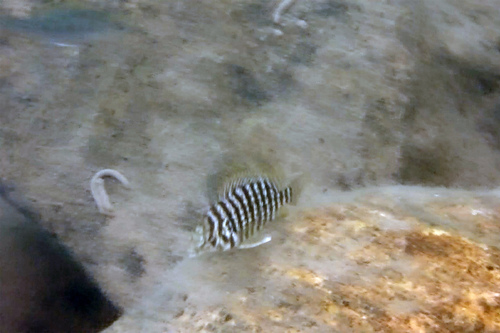
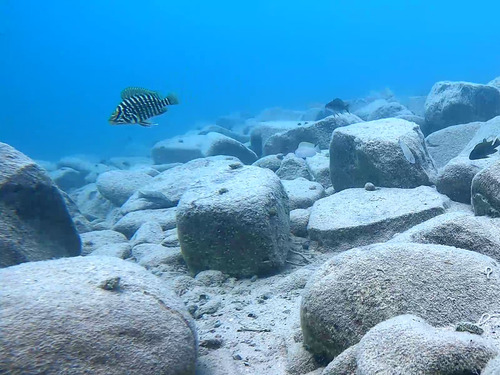
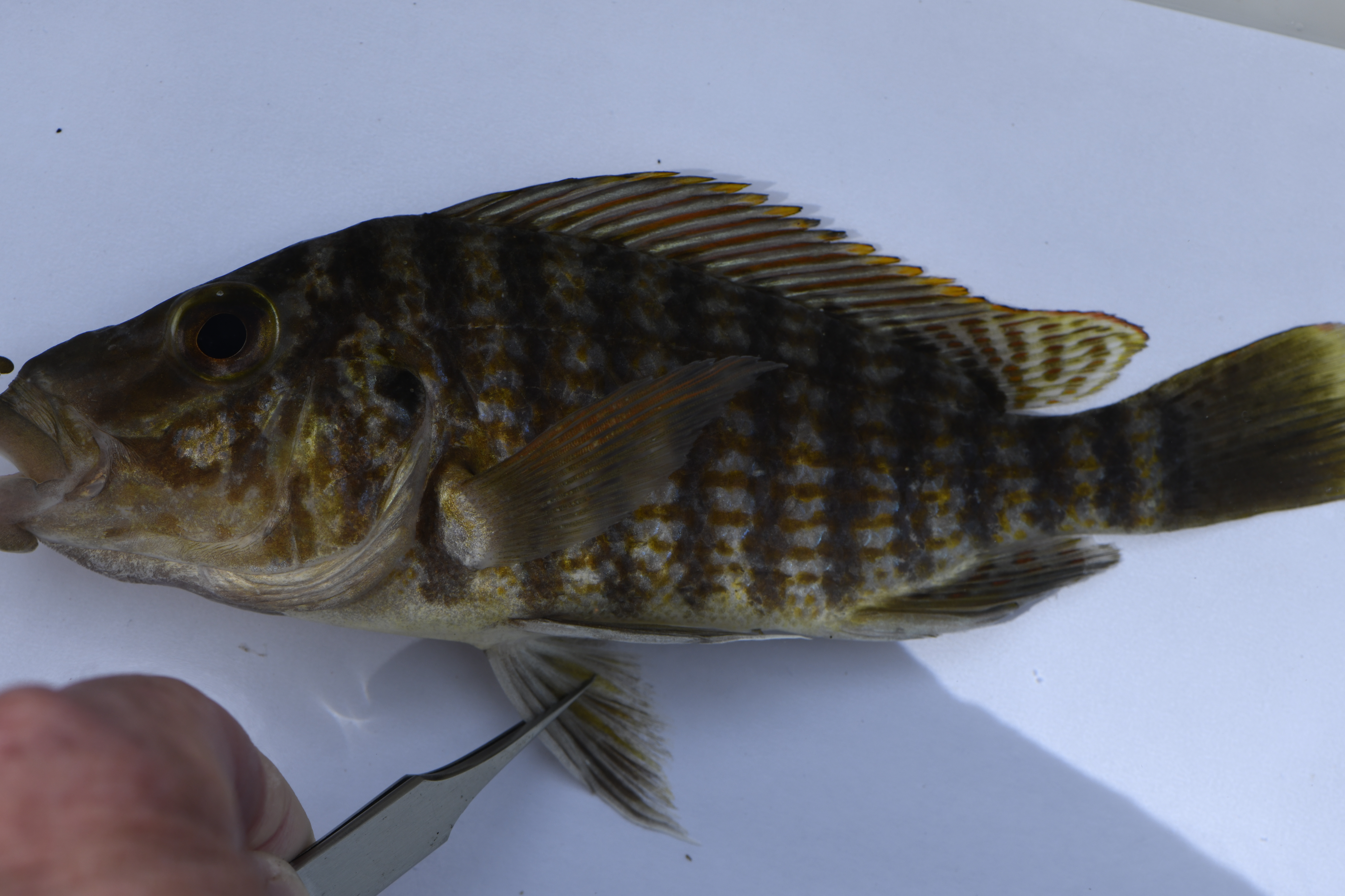
The body is a fairly plain light beige to grayish ground crossed by a series of dark vertical bars — a barred pattern reminiscent of Simochromis or Limnotilapia rather than the gaudy coloring of many of its lakemates. The fish's defining feature is its mouth. Adults develop hypertrophied, lobed, triangular lips that look almost comically swollen, and the jaw teeth are conical in adults (bi- and tricuspid in juveniles), backed by a heavy pharyngeal mill with molar-like teeth for crushing shelled prey. The lips themselves are not present at full size in young fish; they enlarge with age, so juveniles look far more ordinary than the rubber-lipped adults. The sexes are otherwise similar in pattern — the species is essentially monomorphic in color — which means size, and breeding behavior, are the most reliable cues to telling males from females.
Range & habitat
Lobochilotes labiatus is endemic to Lake Tanganyika, the ancient rift lake shared by Tanzania, the Democratic Republic of the Congo, Zambia and Burundi, and it is found essentially all the way around the lake; it also extends into the Malagarasi River delta and the Lukuga outflow basin. This is a site about the water body first, and L. labiatus is very much a creature of the lake's littoral fringe rather than its open water.
The IUCN assessment places it from the surface down to about 100 ft (30 m), but most commonly shallower than 33 ft (10 m), on rocky and sandy-rocky bottoms — what aquarists call the "intermediate" zone, where boulders give way to open sand. That rubble-and-sand interface is the key: the rocks provide the crevices it feeds in, while the adjacent sand flats are where it is suspected to forage for buried bivalves and crabs. In-situ conditions are those of Tanganyika generally — hard, alkaline water with a pH around 7.5–8.5, high carbonate hardness (roughly 13–17 dH on FishBase's figures), and stable tropical temperatures near 75–81°F (24–27°C). Field surveys confirm it is widespread but not superabundant: in standardized sampling at Kalambo (the Tanzania–Zambia border) and Kasakalawe in Zambia it ranked as about the tenth most common rock-associated species.
Ecology & diet
Lobochilotes labiatus is a benthophagous invertebrate specialist, and its biology is built around prying food out of the rocky substrate. FishBase places it at a trophic level of about 3.3 — a carnivore-leaning omnivore — and the diet recorded across sources is broad: aquatic insect larvae, crustaceans including crabs, bivalve and other molluscs, plus incidental diatoms and plant debris. The IUCN assessment describes it as omnivorous, taking varied invertebrates with some algae and detritus.
The famous lips are the mechanism. The most often-cited function of cichlid hypertrophied lips, supported by functional studies of lobe-lipped species, is that the fleshy lips form a gasket: the fish presses its mouth over a crack in the rock, seals the opening with the soft lips, and uses suction to draw out the invertebrates sheltering inside — a feeding mode that has earned the fish the field nickname "crevice sucker." Comparative work on hypertrophied-lipped cichlids found that the big-lipped forms are measurably better at extracting prey from narrow crevices than their thin-lipped relatives, which is exactly the niche L. labiatus exploits. A detailed field study of feeding territories by Kohda and Tanida added a neat ecological twist: in a single shoreline plot, large and small individuals ate the same kinds of benthic prey but worked crevices of different sizes — big fish at big cracks, small fish at small ones — so that animals of very different size could overlap on the same ground without competing directly. As a large, locally common predator on hard-shelled and crevice-dwelling invertebrates, it occupies a distinctive slot in the rocky-littoral food web.
Behavior & breeding
For a fish often seen loosely aggregated, L. labiatus is strongly territorial at the level of the individual. The Kohda and Tanida study documented 44 fish, from about 2.4 to 12 in (6–31 cm), holding feeding territories packed into a plot only about 21 by 25 meters. Territories of similarly sized owners did not overlap, but those of differently sized fish overlapped widely, with aggression concentrated between size-matched rivals — the foraging-site partitioning described above is what lets that crowding work. Konings reports that mature males can hold and patrol territories exceeding 300 m², large by cichlid standards, and the species is frequently observed in aggregations over suitable ground.
Reproduction is maternal mouthbrooding: after spawning, the female takes the eggs into her mouth and incubates the developing young there, releasing and continuing to guard the fry once they can swim. Published field data record females of roughly 6–7.5 in (14.8–19.0 cm standard length) brooding larvae up to about 0.8 in (2 cm); hobby reports describe brooding periods on the order of 25–30 days and clutches that can run to several hundred eggs, with the female sheltering the fry for some time after release. As in many Tanganyikan mouthbrooders, the mating system is best described as polygynous, with a dominant male spawning with multiple females over his territory.
In the aquarium
This is emphatically not a beginner's cichlid, and the honest hobby consensus is that it is kept by people who have the space and the appetite for a big, belligerent fish. Two facts drive everything else: it grows to well over a foot, and it is intensely aggressive — especially toward its own kind. Keepers and references consistently recommend a tank no shorter than 6 ft (about 180 cm), and 500 L (roughly 130 US gallons) is a sensible floor rather than a generous ceiling. Multiple males will fight, often to the death, so the standard advice is a single male with several females. Anything small enough to be regarded as food — broadly, tankmates under about 4 in (10 cm) — is at risk, so suitable companions are limited to large, robust Tanganyikans such as Cyphotilapia frontosa.
Water should match the lake: hard and alkaline, pH on the high side of neutral (commonly kept around 8), warm and very stable, with strong filtration to handle the bioload of a fish this size. The aquascape that suits it mirrors its natural habitat — open swimming space for an active fish, plus a structure of rocks arranged into passages and caves over a medium-grain sand bed it can sift. It is not a fussy eater in captivity; it readily takes quality pellets, flakes, and frozen and live foods, and a varied invertebrate-leaning diet (snails, shrimp, and similar) plays to its natural feeding biology. The recurring mistakes keepers make are predictable: underestimating the adult size, housing more than one male, and pairing it with anything bite-sized. Treated as the large, predatory, territorial fish it is, it is a striking and long-lived aquarium subject; treated as a community cichlid, it is a problem.
Conservation
On its own account, Lobochilotes labiatus is in reasonable shape. The IUCN Red List assessed it as Least Concern in 2025 (assessment e.T60572A47200025), with a population trend judged stable; it is endemic to Lake Tanganyika but widely distributed and common around the lake, which is what keeps it out of a threatened category. The assessment does name specific pressures: over-fishing, particularly the use of non-selective monofilament gillnets, and sedimentation of the inshore zone driven by erosion in the watershed. It is taken locally as a food fish and appears in the ornamental trade, but neither is currently thought to be driving declines.
The more important story is the state of the lake itself, because a shallow, rock-associated invertebrate feeder is exposed to exactly the changes now underway in Tanganyika. Two strands of research frame the risk. O'Reilly and colleagues (Nature, 2003) showed that a warming climate has increased the thermal stability of the water column and weakened the wind-driven mixing that carries nutrients up from the depths, and they linked this to a substantial — on the order of 20% — decline in the lake's primary productivity over the late twentieth century. Cohen and colleagues (PNAS, 2016) extended the picture using sediment cores, finding that warming-driven reductions in mixing have shrunk the oxygenated benthic habitat in their study areas by roughly 38% and tracked declines in commercially important fishes and endemic molluscs — the very kind of shelled benthic invertebrates this fish eats. Layered on top of climate are local stressors catalogued in basin status reviews (Phiri et al., 2023): heavy shoreline erosion and sedimentation that smother the rocky crevices L. labiatus forages in, and a fishery, historically built around the pelagic clupeids ("dagaa") and their Lates predators, that is straining under rising effort. Governance is complicated by the lake being shared among four nations, coordinated through the Lake Tanganyika Authority; a seasonal fishing ban trialled from roughly May to August is one measure from which this species would benefit. None of this presently threatens L. labiatus directly — it remains Least Concern — but its long-term security is tied to whether the rocky littoral it depends on stays clear, oxygenated and unsmothered.
Sources
- Eschmeyer's Catalog of Fishes — species record for Tilapia labiata / Lobochilotes labiatus
- FishBase — Lobochilotes labiata summary
- GBIF — Lobochilotes labiatus (Boulenger, 1898)
- Kohda, M. & Tanida, K. (1996). Overlapping territory of the benthophagous cichlid fish Lobochilotes labiatus in Lake Tanganyika. Environmental Biology of Fishes 45:13–20
- Baumgarten et al. — What big lips are good for: on the adaptive function of repeatedly evolved hypertrophied lips of cichlid fishes (ResearchGate)
- New three-spotted cichlid species with hypertrophied lips (Copeia, 2001) — function of lobed lips in crevice feeding
- Metagenomic insights into the dietary diversity of the adaptive radiation of Lake Tanganyika cichlids (Molecular Ecology) — places Lobochilotes labiatus in Tropheini
- tanganyika.si — Lobochilotes labiatus species, locality and care notes
- Konings, A. — Tanganyika Cichlids in their Natural Habitat (cited via IUCN assessment for territory size and behavior)
- IUCN Red List — Lobochilotes labiata (Ndava), Least Concern, assessed 2025 (e.T60572A47200025)
- O'Reilly, C.M. et al. (2003). Climate change decreases aquatic ecosystem productivity of Lake Tanganyika, Africa. Nature 424:766–768 (PubMed record)
- Cohen, A.S. et al. (2016). Climate warming reduces fish production and benthic habitat in Lake Tanganyika. PNAS 113(34):9563–9568
- Phiri, H. et al. (2023). Lake Tanganyika: Status, challenges, and opportunities for research collaborations. Journal of Great Lakes Research (open-access PDF)
- Sturmbauer, C. et al. (2008). Abundance, distribution, and territory areas of rock-dwelling Lake Tanganyika cichlid fish species. Hydrobiologia 615:57–68 (via IUCN bibliography)
- Cichlid-Forum — Lobochilotes labiatus from Lake Tanganyika (community profile: size, aggression, tank requirements) — community/anecdotal
- Cichlid-Forum — Lobochilotes labiatus species data thread (temperament, breeding, habitat) — community/anecdotal
- Cichlid-Forum — Lake Tanganyika undergoing changes (community discussion of lake-level pressures) — community/anecdotal