
Taxonomy & naming
George Albert Boulenger described this fish in 1899 as Tilapia livingstonii, from material collected during the Zambezi Expedition; the holotype (BMNH 1863.11.12.22) is a single 56 mm specimen. The species epithet honors David Livingstone, the Scottish missionary-explorer whose travels first brought Lake Malawi (then Lake Nyasa) to wide European attention.
The genus assignment has been a moving target. Over the twentieth century the fish was shuffled through Pseudotropheus, then into Metriaclima (Stauffer et al. 1997) and its proposed synonym Maylandia, before the most recent literature returned it to Pseudotropheus. Eschmeyer's Catalog of Fishes and FishBase both now treat Pseudotropheus livingstonii as the valid combination, with Maylandia livingstonii and Metriaclima livingstonii listed as synonyms — so the name at the top of this profile is a widely used synonym rather than the currently preferred binomial.
The deeper tangle is one of mistaken identity. In a 2016 Zootaxa redescription, Stauffer, Konings and Ryan re-examined the holotypes and concluded that Pseudotropheus livingstonii, P. elegans, and the shell-dwelling Metriaclima lanisticola are three distinct species. They resurrected P. elegans — which Konings had synonymized under livingstonii in 2007 — as valid, and confirmed that the genuinely shell-bound fish long muddled with livingstonii is M. lanisticola (treated as a junior synonym of livingstonii by Ribbink et al. 1983, but distinguished here). It is a textbook case of why a name alone is not an identification.
Appearance
This is a medium-sized, stockily built mbuna with an ovoid body, reaching roughly 6 in (15 cm) total length as an aquarium maximum; in the wild, reports put males at about 5.5 in (14 cm) and females near 4.3 in (11 cm). Fin counts run to 17–19 dorsal spines with 9–10 soft rays and three anal spines with 8–9 rays — a fairly typical mbuna meristic profile.
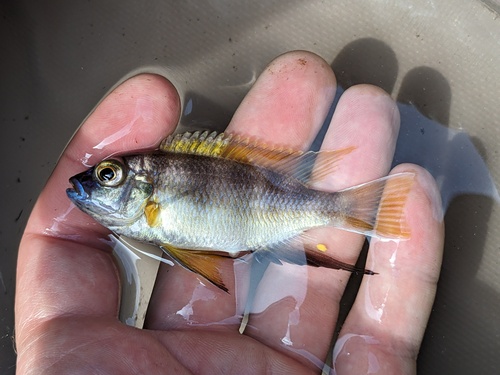
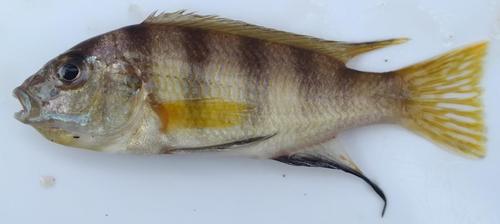
Color is muted rather than gaudy. Freshly caught fish are brown along the flanks, crossed by about four dark vertical bars, with a dark head, a blue-highlighted black blotch on the gill cover, and yellow rays running through clear membranes in the caudal and pectoral fins. The diagnostic detail that separates it from its closest Pseudotropheus relatives (P. crabro, P. demasoni and P. saulosi) is the dorsal fin: pale yellow to nearly transparent here, versus heavily black-pigmented in those three. It also carries five or fewer bars below the dorsal, where most Pseudotropheus species have either none or more than five. Sexual dimorphism is subtle — males tend to be slightly brighter and higher-contrast, and the soft rays of the dorsal and anal fins run longer, giving moving males a trailing, undulating finnage — but the most reliable field sexing is by the genital pore, which is larger in females. Both sexes show a distinct black band in the anal fin.
Range & habitat
Pseudotropheus livingstonii is endemic to the Lake Malawi system, occurring in Lake Malawi proper and throughout the smaller, shallower Lake Malombe to its south. Within the main lake it is recorded along the western shore from around Usisya southward, around the southern arms below Monkey Bay, along the eastern (Mozambican and Tanzanian) shore including Liuli, and around Likoma Island — effectively an almost lake-wide distribution rather than a single-reef endemic.
Despite being grouped with the mbuna, this is a sand specialist, not a rock fish. It lives over open sandy bottoms in shallow water, most often within the top 2–15 m (about 7–50 ft), occasionally straying into intermediate or rocky ground where cover is better. FishBase records it from the inshore zone down to roughly 50 m. The water it inhabits is the hard, alkaline, thermally stable medium typical of Lake Malawi's surface layer: pH around 8–9, moderate-to-high hardness, and temperatures of about 22–26 °C (72–79 °F). Tying it to the lake itself, this is a fish of the sunlit sand flats — the productive, wave-worked shallows where light reaches the bottom and benthic algae grow.
Ecology & diet
P. livingstonii makes its living off the sand. It feeds by picking and scooping epipelic algae — the thin algal and microbial film coating sand grains and small objects lying on the bottom — rather than rasping the dense "Aufwuchs" mat off rocks the way classic mbuna do. FishBase places its trophic level at about 3.7, reflecting a diet that, alongside algae, likely takes in associated micro-invertebrates and detritus swept up with each mouthful of substrate.
That feeding mode shapes its ecology. As a shallow-water sand-sifter it is part of the inshore benthic community that recycles algal production on the lake's sand flats, and it is abundant enough at many localities to be a routine presence rather than a rarity. Its low fishing vulnerability and short generation time mark it as a resilient, fast-turnover species rather than a slow-growing specialist.
Behavior & breeding
Socially, this is a schooling fish. Over open sand it commonly aggregates in groups, and large schools form at some sites; away from these aggregations, individuals — males in particular — tend to forage solitarily or in small clusters. Aggression is described as moderate by mbuna standards, with males not especially belligerent toward one another given enough room.
Like all Lake Malawi cichlids in this lineage, P. livingstonii is a maternal mouthbrooder: the female collects the fertilized eggs into her mouth and broods the developing young there, and mouthbrooding females are frequently seen mixed into the open-water schools. The shell connection that gave the fish its old common name is real but limited — at sites such as Chembe Beach and Likoma Island, small juveniles have been observed sheltering inside the empty shells of the large endemic apple snail Lanistes nyassanus. Adults, however, simply outgrow the shells and cannot use them, which is precisely the distinction that separates this true sand-dweller from the genuinely shell-bound Metriaclima lanisticola with which it was long confused.
In the aquarium
P. livingstonii is a niche fish in the hobby, traded irregularly and often under the wrong name, so the first practical step is simply confirming what you actually have. The true species is a sand-dweller that will largely ignore a pile of shells; if your fish lives inside shells, you most likely have M. lanisticola instead.
Give it a tank with a long footprint and plenty of open bottom — specialists recommend a minimum length around 120 cm (about 48 in), i.e. a four-foot or larger tank — floored with fine sand it can sift and scoop. Standard Malawi parameters apply: hard, alkaline water (pH roughly 8–8.5), good filtration and the brisk maintenance these messy, algae-grazing cichlids demand. With adequate space a group of six to eight can be kept, including more than one male; the species' relatively mild temperament makes that feasible where it would not be for a hot-tempered mbuna. Breeding follows the familiar mouthbrooder pattern: a sex ratio of roughly three or more females per male is suggested, conditioning on quality flake supplemented with frozen krill, plankton or Daphnia, with single-pair spawning also workable. The honest caveats are that it is plain-colored next to flashier mbuna, needs real swimming room rather than a rockpile, and — because of the persistent name confusion — is easy to mix up or accidentally hybridize with look-alikes if you are careless about source stock.
Conservation
The IUCN Red List assesses Pseudotropheus livingstonii as Least Concern (assessment dated 20 June 2018; Konings & Kazembe, amended version published 2019), with a stable population. The reasoning is straightforward: it is endemic to Lakes Malawi and Malombe but widespread across that range and common to abundant at most localities, with no major lake-wide threat identified. The pressures specific to it are minor — it is caught only incidentally in subsistence beach seines rather than targeted, and is collected for the aquarium trade only irregularly — and part of its range falls within Lake Malawi National Park, which affords some protection.
That species-level security sits inside a lake under real strain. The basin review by Chavula and colleagues (2023, Journal of Great Lakes Research 49(6):102241) catalogues the Lake Malawi/Niassa/Nyasa system's mounting stressors: heavy fishing pressure and the well-documented collapse of the chambo (Oreochromis) fishery, rising sediment and nutrient loading washing off deforested and cultivated catchments, climate-driven warming of the shallow water that strengthens stratification and can suppress productivity, and the looming risk of invasive species. For a shallow sand-flat fish like P. livingstonii, the most relevant of these is the inshore zone it depends on: sedimentation and nutrient runoff degrade exactly the sunlit, sandy shallows where it feeds and breeds, and intensifying artisanal fishing crowds the same nearshore band. None of that has yet moved the needle on its Red List status — the accurate statement is that the species itself remains Least Concern while the lake around it is increasingly pressured, and its continued abundance should not be read as evidence that the system is healthy.
Sources
- Eschmeyer's Catalog of Fishes — Tilapia/Pseudotropheus livingstonii (Boulenger 1899)
- FishBase — Pseudotropheus livingstonii summary
- FishBase (mirror) — Maylandia/Pseudotropheus livingstonii
- IUCN Red List — Pseudotropheus livingstonii (Konings & Kazembe 2019, amended 2018 assessment)
- Stauffer, Konings & Ryan 2016 — Redescription of Pseudotropheus livingstonii and P. elegans, Zootaxa 4154(2):169–178 (Magnolia Press)
- Stauffer, Konings & Ryan 2016 — taxonomic treatment & description (Zenodo/Plazi)
- PubMed record — Redescription of Pseudotropheus livingstonii and P. elegans
- Chavula et al. 2023 — Lake Malawi/Niassa/Nyasa basin: Status, challenges, and research needs, J. Great Lakes Res. 49(6):102241
- malawi.si — Pseudotropheus livingstonii 'Msuli' (Ad Konings / Cichlid Press species page)
- The Cichlid Stage — New Lake Malawi shell dwellers identified (Metriaclima lanisticola context)
- Aqua-fish.net — Malawi shell dweller (Pseudotropheus lanisticola) care profile
- Aquarium Glaser — Shell-dwelling cichlids from Lake Malawi (Maylandia cf. elegans / Likoma)
- MalawiCichlids.com — Maylandia livingstonii, a Lake Malawi shell dweller
- Cichlid-Forum.com — Malawi shell dweller question (livingstonii vs. lanisticola identity thread) — community/anecdotal
- American Cichlid Association — Sand-dwelling cichlids in Lake Malawi (community discussion) — community/anecdotal