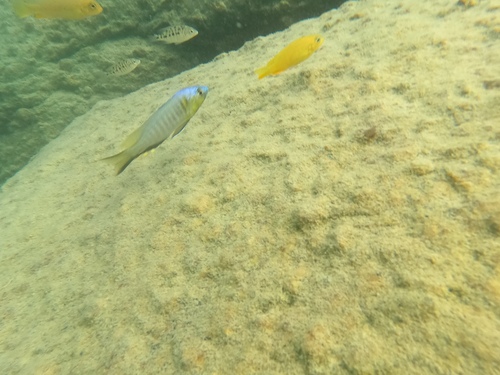
Taxonomy & naming
Mchenga conophoros was described in 1993 by Jay Stauffer Jr., Thomas LoVullo, and Kenneth McKaye, in a Copeia paper that named three new sand-dwelling cichlids from Lake Malawi and reorganized the catch-all genus Copadichromis. They originally placed the fish in Copadichromis as C. conophoros, with the type specimens collected at Cape Maclear (about 14°05'S, 34°54'E) in 2–3 m of water. In 2006, Stauffer and Ad Konings erected the genus Mchenga for several of these bower-building sand specialists, and Eschmeyer's Catalog of Fishes today lists the valid name as Mchenga conophoros (Stauffer, LoVullo & McKaye, 1993). Older hobby and scientific literature uses the synonym Copadichromis conophoros, and some early ecological work — McKaye's foundational studies of the lek — referred to the same fish under the name Cyrtocara eucinostomus before its formal description.
The names themselves are a small lesson in the fish's biology. Mchenga comes from Chichewa, the indigenous language of Malawi, and means "sand," a nod to the bowers its members construct; the genus is treated as feminine. The species epithet conophoros means roughly "cone-bearer," describing the tidy sand cones the males raise. Within the lake's species flock, M. conophoros belongs to the utaka — a loose assemblage of open-water, plankton-feeding haplochromines — rather than to the rock-dwelling mbuna that most aquarists picture when they think of Malawi.
Appearance
This is a modest-sized cichlid. The original type series ran from about 3.6 to 4.4 in (90.5–111 mm) standard length, and FishBase gives a maximum of roughly 4.4 in (11.1 cm) SL; aquarium vendors, measuring total length on well-fed stock, sometimes quote 7–8 in (18–20 cm), so reports vary with how and where the fish is measured. The body is the streamlined, slightly deep-bodied form typical of utaka, built for hovering and maneuvering in open water rather than squeezing among rocks.
Like most Malawi haplochromines, the species is sexually dichromatic. Breeding males take on the bright, light-reflecting nuptial dress that the lek display depends on, and the original description notes black markings in the caudal fin of mature males. Females and non-breeding males are plainer and silvery. A diagnostic detail separates this fish from its look-alikes: it lacks the yellow egg-spots (ocelli) on the anal fin that many related cichlids carry. The describers leaned heavily on counts to pin the species down — 16 to 17 dorsal spines, 10 to 12 dorsal soft rays, and 13 to 15 gill rakers on the outer ceratobranchial — fine distinctions that matter in a lake where dozens of sand-dwelling species look superficially alike.
Range & habitat
Mchenga conophoros is a lacustrine endemic — found only in Lake Malawi and nowhere else on Earth. The well-documented populations cluster around the Nankumba Peninsula in the lake's southern arm, with Cape Maclear and Chembe Beach the classic collecting grounds; the IUCN notes it may be more widespread but that there are currently no data to confirm it, and some aquarium sources loosely list it as occurring "throughout the lake."
The habitat is unambiguous, though: open water over sandy beaches, not rock. Males establish their breeding arenas off sandy shores in water roughly 10 to 33 ft (3–10 m) deep, and the fish forages up in the water column rather than picking at the substrate. McKaye's surveys of the lek found the densest aggregations at intermediate depths around 20–30 ft (6–9 m). Lake Malawi's shallow waters are warm, clear, alkaline, and hard — typically around 75–82°F (24–28°C), pH in the high 7s to low 8s, with moderate hardness — and the clarity of those shallows is part of the story, because the visual splendor of a sand bower only pays off where there is enough light for a female to see it.
Ecology & diet
As an utaka, M. conophoros is a zooplanktivore. It forages in the open water column, feeding mainly on the small drifting crustaceans — copepods and cladocerans — that make up the lake's pelagic plankton, and FishBase places it at a trophic level of about 3.4. This puts it in the broad guild of mid-water plankton-grazers that, collectively, form one of the most important links in Lake Malawi's food web, converting the lake's plankton production into fish biomass that larger predators and people depend on.
What makes the species ecologically distinctive is not its diet, which it shares with many relatives, but how its feeding ecology is tied to its courtship. Comparative work on Malawi's bower-builders found that castle-building species like this one tend to feed and breed at shallower depths — averaging around 15 m across species — where light is good, while their pit-digging cousins occupy deeper, dimmer water. In other words, the fish's place in the water column, its diet, and the elaborate sand cone it builds are all parts of a single, light-dependent way of making a living.
Behavior & breeding
The breeding system is the reason this fish is famous. Males are not territorial in the everyday sense; instead, during the spawning season they gather by the hundreds into communal arenas — leks — and each builds and defends a bower: a smooth cone of sand he carries grain by grain in his mouth. Females visit the arena, move among the cones, and choose. McKaye, Louda, and Stauffer's classic 1990 study (working on this very fish) showed that bower height is the currency of that choice: taller cones drew more visiting females and more spawnings, males with the tallest bowers were the ones who held their sites, and males whose bowers were experimentally flattened were abandoned. The bower itself has no nursery function — it is purely a signal, an honest advertisement of a male's vigor.
Spawning takes place at the cone, after which M. conophoros follows the standard Malawi pattern: it is a maternal mouthbrooder. The female takes the fertilized eggs into her mouth and broods them there for several weeks, not feeding while she carries them, and continues to shelter the fry in her mouth after they hatch. In Lake Malawi the species spawns year-round but peaks twice — roughly January to March and again August to September. Building those cones is metabolically expensive, which helps explain why castle-builders invest less in long swimming displays than pit-digging species do; the architecture does much of the talking.
In the aquarium
Honesty first: this is not a common aquarium fish, and most hobbyists will never encounter it. It is essentially absent from the ornamental trade, surfacing only occasionally through specialist breeders and importers — when offered at all, it is marketed as "very rare" and priced accordingly. So the care guidance here is extrapolated from its biology and from keeping related utaka, not from a deep well of tank-by-tank reports.
What the biology tells you is clear enough. This is an open-water, sand-loving cichlid, so it wants horizontal swimming room and an open sandy bottom far more than it wants rockwork — a long tank in the 6-foot / 125-gallon (about 475 L) class or larger is the realistic minimum if you hope to see any natural behavior, and a deep sand bed is non-negotiable if you ever want a male to attempt a bower. Match the lake: hard, alkaline water, pH around 7.8–8.4, temperatures of roughly 76–82°F (24–28°C), and a diet built around small foods that suit a plankton-feeder, avoiding the protein-heavy or warm-water staples that cause trouble in Malawi cichlids. Temperament reports describe it as only mildly aggressive for a Malawi hap, but it is still a haplochromine and best kept with similarly sized, similarly tempered open-water species rather than mixed with boisterous mbuna. Given its conservation status in the wild, captive-bred stock from responsible breeders is the only ethical way to keep it.
Conservation
Mchenga conophoros is assessed by the IUCN Red List as Critically Endangered (criterion B1ab(v); assessed 22 May 2018, errata version 2019, assessor Ad Konings) — a sharp step up from its earlier Vulnerable listings in 2006 and 2017. The justification is stark: the species is documented from a single location, the Nankumba Peninsula, with an extent of occurrence of just 12 km², and the assessment records an observed, continuing decline in mature individuals. Tellingly, the sand cones that were once a common sight in the shallows at Cape Maclear had largely disappeared during the first fifteen years of the 21st century. The fish is not targeted by the aquarium trade; the threat is the beach-seine fishery, which sweeps the very sandy shallows where the species breeds.
That localized pressure sits inside a lake under broad strain. The basin review by Chavula and colleagues (2023, Journal of Great Lakes Research) describes a Lake Malawi/Niassa/Nyasa system facing over-fishing — including the long collapse of the prized chambo (Oreochromis) — alongside heavy sediment and nutrient loading washing off deforested catchments, roughly 0.7°C of warming in the shallow layer that strengthens stratification and trims the lake's productivity, and a standing risk from invasive species. For a shallow, sand-spawning, near-shore endemic, those forces compound directly: sedimentation degrades the clean sandy arenas the leks depend on, near-shore fishing pressure falls hardest on its habitat, and reduced plankton productivity squeezes the open-water food it eats. It would be wrong to blame this fish's plight on climate alone — the immediate driver is local fishing on a tiny range — but it is exactly the kind of narrow-range, shallow-water specialist that the lake's wider deterioration leaves little room to absorb.
Sources
- Eschmeyer's Catalog of Fishes — Mchenga conophoros
- FishBase — Mchenga conophoros summary
- IUCN Red List — Mchenga conophoros (Critically Endangered, 2018/2019)
- Stauffer, LoVullo & McKaye 1993 — Three new sand-dwelling cichlids from Lake Malawi (Copeia, original description, PDF)
- Three New Sand-Dwelling Cichlids from Lake Malawi (Copeia 1993, JSTOR record)
- McKaye, Louda & Stauffer 1990 — Bower Size and Male Reproductive Success in a Cichlid Fish Lek (PDF)
- York et al. 2015 — Evolution of bower building in Lake Malawi cichlid fish (Frontiers in Ecology and Evolution)
- ScienceDaily — Male fish dig pits and build sand castles at the bottom of Lake Malawi
- EurekAlert! / Frontiers — castle building and courtship in Mchenga conophoros
- Chavula et al. 2023 — Lake Malawi/Niassa/Nyasa basin: Status, challenges, and research needs (J. Great Lakes Research)
- IUCN — Lake Malawi/Nyasa/Niassa Catchment freshwater biodiversity assessment (lists M. conophoros as CR)
- Cichlid Room Companion — Mchenga conophoros species profile (public page)
- ResearchGate — Identification of the Cichlid Fishes of Lake Malawi/Nyasa, Part 1 (Cyrtocarina)
- Ron's Cichlids — Mchenga conophoros trade listing (rarity, size, temperament)
- Imperial Tropicals (Facebook) — utaka feeding ecology, M. conophoros over sandy shores (community) — community/anecdotal
- African Cichlid Breeders group (Facebook) — keeping notes on M. conophoros (community/anecdotal) — community/anecdotal