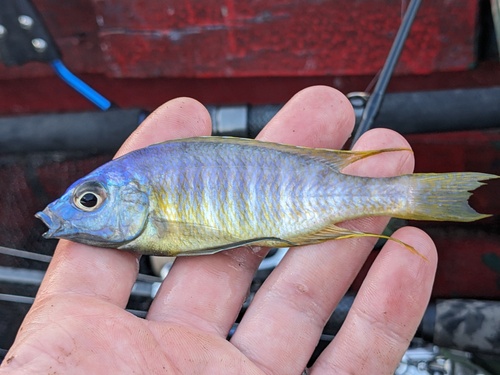
Taxonomy & naming
Mchenga thinos was first described in 1993 by Jay R. Stauffer Jr., Thomas J. LoVullo, and Kenneth R. McKaye, in a Copeia paper that named three new sand-dwelling cichlids from Lake Malawi and reopened the question of how the sprawling genus Copadichromis should be divided. Under that original treatment the fish was Copadichromis thinos. Thirteen years later, Stauffer and Ad Konings revised the group again ("Review of Copadichromis... with the description of a new genus and six new species", Ichthyological Exploration of Freshwaters, 2006) and split off the bower-building, sand-associated species into a new genus, Mchenga. The name is taken straight from Chichewa, the language of Malawi: mchenga means "sand," a nod to the sandy cones the males build. The genus is treated as feminine.
The species sits inside the "utaka" assemblage, the open-water zooplankton feeders of the lake's vast cichlid radiation, and its identity is not entirely settled. The IUCN assessment flags that M. thinos "may be confused with or is conspecific with" the lake-wide M. eucinostomus, an older, sandy-shore species. For now the major authorities, Eschmeyer's Catalog of Fishes and FishBase, list M. thinos as a valid species with Copadichromis thinos as its synonym, and that is the name carried here.
Appearance
This is a modestly sized, fusiform cichlid built for the water column rather than the rocks. Reported maximum size is small and consistent across sources: FishBase lists about 3.1 in (7.8 cm) standard length, in line with the original 1993 description, whose type series ran roughly 2.7 to 3.1 in (67.5 to 78.4 mm) standard length. This is a genuinely small Mchenga, not a large one.
Fin counts are typical of the group: 16 to 17 dorsal spines, 10 to 12 dorsal soft rays, and 9 anal soft rays, over 32 to 34 lateral-line scales. The species lacks the bold black caudal markings seen in some relatives; in breeding males the distal part of the tail is clear, flecked with yellow spots. Females and non-breeding males carry yellow ocelli (egg-spot-like markings) on the anal fin and otherwise mostly hyaline, glassy fins, while juveniles are similarly plain. Mature males have small, bicuspid teeth in the outer rows of the jaws. None of this makes for a showy aquarium fish, and the subtle, pattern-based differences from look-alike congeners like M. eucinostomus are exactly why field identification of utaka is notoriously hard.
Range & habitat
Mchenga thinos is endemic to Lake Malawi and, as far as the records go, distributed lake-wide, with occurrences spanning the Malawian, Mozambican, and Tanzanian shores. The IUCN puts its area of occupancy at roughly 2,700 km2 within an extent of occurrence near 29,600 km2, which for a single lake means it is widespread rather than a narrow-range endemic.
It is a benthopelagic fish of the so-called intermediate habitat, the transitional zone where rocky reef breaks down into open sand. FishBase gives a depth range of about 33 to 49 ft (10 to 15 m) for general occurrence, while breeding males build their bowers a little deeper, at the rock/sand interface around 49 to 82 ft (15 to 25 m). That is a meaningful detail for a lake-first profile: this is not a shallow rock-grazer pinned to a single reef but a sand-flat species that ranges through the upper, well-lit and well-oxygenated water of the lake. Like all of Malawi's cichlids it lives in hard, alkaline water, with the lake typically running a pH around 7.7 to 8.6 and a surface temperature roughly in the mid-70s F (about 24 to 28 C).
Ecology & diet
M. thinos is a zooplanktivore. It forages in the water column, picking out the drifting copepods and other small crustaceans that make up the lake's zooplankton, and FishBase places it at a trophic level of about 3.4, squarely among secondary consumers. This is the defining trait of the utaka guild: where the famous rock-dwelling mbuna scrape algae and aufwuchs off stone, the utaka and their kin hang in open water and feed on plankton, a niche that supports enormous shoals and, not coincidentally, an important food fishery.
That feeding mode shapes the animal. Utaka tend to have protrusible, tube-like mouths for picking individual prey out of the water, fine gill rakers, and excellent vision; M. thinos carries 11 to 13 gill rakers on the outer ceratobranchial, consistent with sieving small prey. Ecologically it is one of many planktivorous links converting the lake's open-water productivity into fish biomass that larger predators, and people, ultimately eat.
Behavior & breeding
Reproduction is where this otherwise plain fish gets interesting. Like other Malawi haplochromines, M. thinos is a maternal mouthbrooder: the female takes the fertilized eggs into her mouth and incubates the developing young there, releasing free-swimming fry only after they have absorbed the yolk. But fertilization happens on a stage the male builds himself. Males gather in breeding arenas, essentially leks, and each constructs a cone-shaped bower out of sand at the rock/sand interface, in the 49-to-82-ft (15-to-25-m) band. He defends and displays from this sand cone, and females visit, assess, and spawn with the males whose bowers and courtship most impress them.
Bower building is a hallmark of this lineage; across the radiation each bower-building species tends to produce a structure with a characteristic shape, and sexual selection on those structures is thought to be a real engine of the group's diversification. Spawning is not tightly seasonal: it occurs sporadically through the year, with reported peaks between January and March. Generation length is short, on the order of one to two years, which gives the species a high intrinsic resilience.
In the aquarium
M. thinos is essentially a wild-lake fish rather than an aquarium staple. It turns up only irregularly in the ornamental trade, and you are far more likely to see its better-known utaka relatives, the Copadichromis and other Mchenga, offered under trade names. If kept, it should be treated like the rest of the utaka group, and that experience is the honest guide here.
These are open-water shoaling fish, not solitary rock-holders, so they want length and swimming room: a four-foot tank is a sensible floor and a six-foot tank is better, stocked with a group rather than a pair so that aggression is diffused. Expect hard, alkaline water (pH well above 7.5) and stable temperatures in the mid-70s F (around 24 C), matching the lake. Utaka are generally less belligerent than mbuna but males still defend spawning space, and in the cramped confines of a tank a dominant male can harass rivals and females; a roomy footprint, sand substrate, and dither in numbers are the usual fixes. They feed readily in captivity, but a caution that applies across the planktivorous Malawi cichlids holds here too: diets too rich in mammalian protein (beef heart, excessive bloodworm) are linked to the bloat that plagues this group, so a varied, more vegetable-leaning diet of quality flake and small frozen foods is wiser. Because wild-caught utaka are hard to identify to species, anyone serious about keeping true M. thinos should be skeptical of labels and verify provenance.
Conservation
On its own account, Mchenga thinos is in reasonable shape. The IUCN Red List assessed it as Least Concern in 2018 (assessors Konings, Kazembe, Makocho and Mailosi), an upgrade from the Vulnerable status it carried in earlier assessments (2006 and 2017). The reasoning is straightforward: it is endemic to Lake Malawi but distributed lake-wide, no widespread major threat to it has been identified, and it occurs within at least one protected area, Lake Malawi National Park. The pressures noted are local rather than catastrophic: it is irregularly collected for the aquarium trade and is taken as a food fish, with overfishing by subsistence fishers using chirimila (open-water seine) nets flagged as a potential, not yet realized, threat. Its short generation time and lake-wide range give it a buffer.
That species-level reassurance has to be read against the state of the lake itself, which is strained. The basin review by Chavula and colleagues (Journal of Great Lakes Research, 2023) catalogs the pressures bearing on Lake Malawi/Niassa/Nyasa: heavy over-fishing and the well-documented collapse of the chambo (Oreochromis) fishery; sediment and nutrient loading washing off deforested catchments; warming of roughly 0.7 C in the shallow waters, which strengthens stratification and tends to suppress the deep-water mixing that fuels the lake's productivity; and the looming risk of invasive species. For a water-column plankton feeder like M. thinos, the most relevant of these is the productivity story: utaka depend on the open-water plankton that the lake's mixing and nutrient cycling sustain, and they themselves are a fishery target, so a future of warmer, more stratified, less productive surface water and intensifying net fisheries is precisely the kind of slow squeeze that could matter to it. None of that is reflected in a Least Concern listing yet, and it would be wrong to overstate the species' peril. The accurate summary is the uncomfortable one: the fish is currently fine, the lake it cannot leave is not.
Sources
- Mchenga thinos — FishBase species summary
- Eschmeyer's Catalog of Fishes (genus Mchenga, species thinos)
- Stauffer, LoVullo & McKaye (1993), Three new sand-dwelling cichlids from Lake Malawi (Copeia, original description)
- Stauffer & Konings (2006), Review of Copadichromis with the description of a new genus and six new species (FishBase reference)
- Stauffer & Konings (2006), Review of Copadichromis... new genus (ResearchGate record)
- Taxonomic investigation of the zooplanktivorous Lake Malawi utaka cichlids (PMC)
- Evolution of bower building in Lake Malawi cichlid fish (Frontiers in Ecology and Evolution, 2015)
- Mchenga thinos — IUCN Red List assessment (Least Concern, 2018)
- Chavula et al. (2023), Lake Malawi/Niassa/Nyasa basin: Status, challenges, and research needs (J. Great Lakes Research)
- Fish and Fisheries in Lake Malawi: an assessment of four decades of management interventions
- Mchenga thinos — Cichlid Room Companion species profile (public page)
- Mchenga genus — Cichlid Room Companion (public page)
- Mchenga eucinostomus — The Cichlid Fishes of Lake Malawi (M. K. Oliver, malawicichlids.com)
- Copadichromis pleurostigma / utaka feeding notes — malawicichlids.com (M. K. Oliver)
- Copadichromis mloto — Practical Fishkeeping (utaka group care)
- Mchenga thinos — Fishipedia species sheet
- Lake Malawi keeping discussion — Cichlid Fish Forum (cichlid-forum.com) — community/anecdotal
- Lake Malawi cichlids — Aquarium Co-Op community forum — community/anecdotal
- "Utaka" (Copadichromis, Otopharynx, etc.) plankton-feeding discussion — hobbyist community thread — community/anecdotal