Taxonomy & naming
George Albert Boulenger described this fish in 1897 as Chromis auratus, from a single specimen collected at Monkey Bay on the southwestern shore of Lake Malawi (the holotype, BMNH 1896.12.1.7, still rests in the Natural History Museum, London). The species epithet auratus is Latin for "golden" or "gilded," a nod to the brassy ground color of females and juveniles. Over the following century it was shuffled through several genera — it spent time as Tilapia aurea and was long traded under Pseudotropheus — before settling in Melanochromis, a genus Ethelwynn Trewavas erected in 1935 whose name fuses Greek melas (black) with chromis, an old word for a perch-like fish.
The genus itself has a tangled history. Konings and Stauffer's 2012 revision in Zootaxa (3258:1–27) pared Melanochromis down, reassigning several former members to other genera and describing a new species, and it is in that revision that the modern circumscription of the group — and the confirmation of M. auratus as a valid Melanochromis — is anchored. Eschmeyer's Catalog of Fishes lists it as currently valid as Melanochromis auratus (Boulenger 1897). In the hobby it answers to golden mbuna, golden cichlid, or simply "auratus"; "mbuna" is the Tonga word for the rock-dwelling cichlids of the lake, and this is one of the archetypal members of that flock.
Appearance
Auratus is a modestly sized mbuna. FishBase gives a maximum of about 4.3 in (11 cm) total length, while Konings and Kasembe report roughly 4 in (10 cm) for males and a bit under that for females in the wild; the hobby figure of 5 in (13 cm) cited by some keepers is at the high end and rarely reached. The body is the typical elongate, torpedo-shaped mbuna form built for darting in and out of rock.
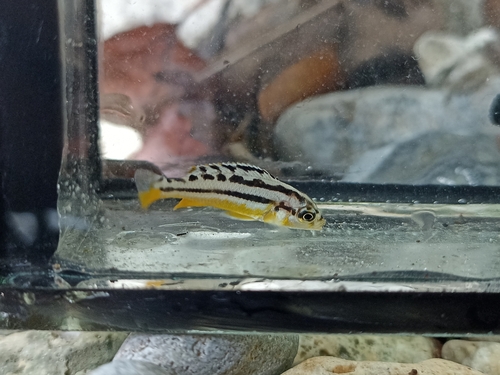
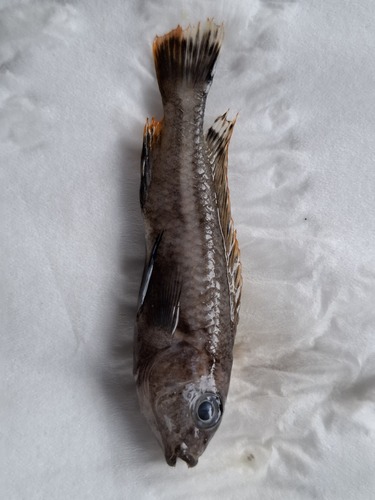
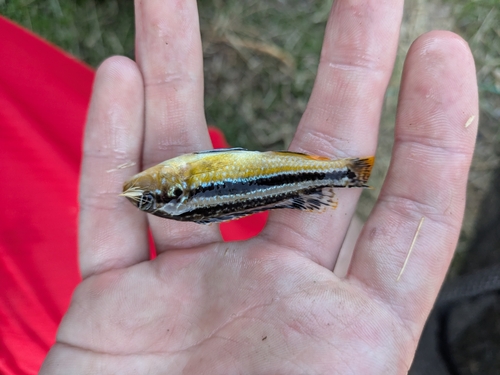
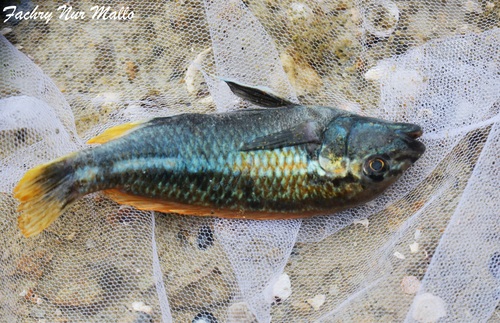
What sets the species apart is its sexual dichromatism, which is among the most striking of any cichlid. Juveniles, females, and subordinate males wear a warm gold to yellow flank crossed by two or three bold black horizontal stripes, with bright bands running into the dorsal fin. A fish that becomes a dominant male inverts the entire scheme: the gold deepens to a sooty purplish-black, and the stripes flip to pale blue or bluish-white — a near photographic negative of the female. The transformation is hormonally driven by social rank rather than a fixed sex difference, and keepers consistently report it happening within a few days. Because a subordinate male holds female colors, the safest way to sex a group is by behavior and venting, not pattern alone.
Range & habitat
Melanochromis auratus is a lacustrine endemic — found naturally nowhere but Lake Malawi (also called Lake Niassa or Nyasa), the long Rift Valley lake bordered by Malawi, Mozambique, and Tanzania. Within the lake its range is mostly the southern basin: the IUCN assessment (Konings and Kasembe 2018) describes it running from Jalo Reef along the entire western coast down to Crocodile Rocks, taking in most islands and reefs but skipping a few (Zimbawe Rock and the Chinyankwazi and Boadzulu islands).
This is a fish of the rocky littoral — the "mbuna" habitat of boulder fields and cobble that fringes the shoreline. It is most abundant among medium-sized rocks but also strays into the intermediate zone where rock gives way to sand. It has been recorded from the surface down to at least 130 ft (40 m), but it is overwhelmingly a shallow-water animal, concentrated in the top 30 ft (10 m) or so where sunlight drives the algal growth it grazes. The water there is warm, hard, and alkaline: FishBase lists a pH around 7.0–8.5 and in-lake temperatures in the low-to-mid 20s °C (roughly 72–79 °F).
Ecology & diet
Like most mbuna, auratus makes its living grazing aufwuchs — the dense felt of algae, diatoms, and the tiny invertebrates living among it that coats sunlit rock. It feeds by nibbling and picking at this biocover, and FishBase places it at a low trophic level (around 2.0), consistent with a largely herbivorous, algae-rasping diet. In the wild it is not a strict specialist, though: field observations summarized in the IUCN account note it also takes plankton, making it more of an opportunistic omnivore that leans heavily on aufwuchs.
That dietary flexibility matters in captivity. A long-standing piece of mbuna husbandry holds that algae-grazers from Malawi do poorly on rich, meaty diets — excess animal protein is linked to the bloat that plagues the group — so a spirulina- and vegetable-based diet best matches the gut this fish evolved. Ecologically, auratus is one of many rock-grazers partitioning the same reef, a textbook example of the trophic crowding that helped Lake Malawi assemble one of the richest vertebrate species flocks on Earth.
Behavior & breeding
In the lake, the social structure is looser than the hobby's reputation suggests: Konings and Kasembe describe males as only weakly territorial, often holding a spot for no more than a few hours, while females and non-territorial males drift singly or in loose groups of eight to ten. The aggression that makes the species notorious is real — but in open water, a loser simply swims away, and the chase ends.
Reproduction follows the classic mbuna template: it is a polygamous maternal mouthbrooder. Spawning happens in or beside a cave or rock face; the female lays a small clutch (FishBase notes up to about 40 eggs, hobby reports cluster around 25–50) and immediately takes them into her mouth. The male's anal fin carries yellowish egg-shaped spots — "egg dummies" — and as the female noses at them to gather what she takes for stray eggs, she draws in the milt that fertilizes the clutch in her buccal cavity. She broods the developing young for roughly three to four weeks, eating little, before releasing free-swimming fry. A genuinely unusual wrinkle, corroborated across cichlid-forum.com, MonsterFishKeepers, and Reddit keepers, is that in an all-female group the dominant female can take on male coloration and behavior — a functional sex change documented often enough by independent hobbyists to be worth noting, though it is anecdotal rather than formally studied here.
In the aquarium
Auratus is cheap, gorgeous, hardy, and one of the worst beginner choices in the African-cichlid section of the store — a combination that produces a steady stream of "why is my tank a bloodbath" posts. The problem is the same one that makes it survive in the wild: a dominant male defends a territory larger than most home tanks, and behind glass his target cannot escape, so the chase ends in death rather than retreat. Tropical Fish Hobbyist's profile is blunt about the outcome — a male will batter and kill rival males as they color up, often the females too, and will harass unrelated fish many times his size into not spawning at all.
The consensus that emerges from specialist keepers is consistent: house auratus as a single-species harem of one male to a large group of females (keepers repeatedly recommend five to a dozen) so the male's aggression is spread thin, and give them a long tank, not a tall one. A 55-gallon (210 L) tank is the bare floor that care sheets quote; experienced breeders on cichlid-forum argue that is too small for females to survive an aggressive male, and push toward 75 gallons (285 L) and up. Aquascape with abundant rockwork and caves over sand, keep the water hard and alkaline (pH ~7.8–8.5), and feed a spirulina-based diet to avoid bloat. Do not mix auratus with other Melanochromis or similarly striped mbuna — they hybridize readily and the male will not distinguish species when fighting or spawning. This is a fish to keep deliberately, with its temperament designed into the tank from the start.
Conservation
The IUCN Red List assessed Melanochromis auratus as Least Concern in 2018 (Konings and Kasembe; assessment e.T61108A148673951). Its range spans a fair stretch of the southern lake, it is locally common on the reefs it occupies, and it faces no species-specific threat from the heavy aquarium trade it supplies — nearly all auratus sold are tank-bred, and FishBase rates its fishing vulnerability as low. On its own, the species is in no immediate trouble.
That verdict, however, sits inside a lake under real strain. The basin review by Chavula and colleagues (Journal of Great Lakes Research, 2023, 49(6):102241) catalogs the pressures on Lake Malawi/Niassa/Nyasa: over-fishing that has driven the collapse of the commercially vital chambo (Oreochromis) tilapias, sediment and nutrient loading washing off deforested catchments, a measured warming of roughly +0.7 °C in the shallow water that strengthens thermal stratification and cuts the mixing that fuels productivity, and the looming risk of invasive species. For a shallow rocky-shore grazer like auratus, sedimentation is the pointed threat: silt smothers the algae-covered rock its whole feeding ecology depends on, and shoreline development and catchment erosion degrade exactly the near-surface reef habitat where it concentrates. So the honest framing is the one the data support — the golden mbuna itself is Least Concern, but the rocky littoral it belongs to is being pressed on several fronts at once, and the species' security is ultimately tied to the health of the lake rather than to anything intrinsic about the fish.
Sources
- FishBase: Melanochromis auratus (Golden mbuna)
- Eschmeyer's Catalog of Fishes: Chromis auratus Boulenger 1897 (valid as Melanochromis auratus)
- GBIF: Melanochromis auratus (Boulenger, 1897)
- USGS Nonindigenous Aquatic Species: golden mbuna (Melanochromis auratus)
- Konings, A.F. & Stauffer, J.R. (2012). Review of the Lake Malawi genus Melanochromis, with description of a new species. Zootaxa 3258:1–27
- U.S. Fish & Wildlife Service Ecological Risk Screening Summary: Golden Mbuna (quotes Konings & Kasembe 2018, Ribbink et al. 1983)
- Chavula, G. et al. (2023). Lake Malawi/Niassa/Nyasa basin: Status, challenges, and research needs. J. Great Lakes Research 49(6):102241
- Konings, A. & Kasembe, J. (2018). Melanochromis auratus. The IUCN Red List of Threatened Species 2018: e.T61108A148673951
- Tropical Fish Hobbyist: Golden Cichlid (Melanochromis auratus)
- AquariumDomain: Auratus Cichlid species profile
- Aqua-Fish.net: Melanochromis auratus (Malawi Golden Cichlid) care
- Cichlid-Forum.com: Breeding Melanochromis auratus (keeper discussion) — community/anecdotal
- Cichlid-Forum.com: Auratus & gender change (keeper discussion) — community/anecdotal
- MonsterFishKeepers.com: Auratus cichlid sex change (keeper discussion) — community/anecdotal
- MonsterFishKeepers.com: The most aggressive African cichlid (keeper discussion) — community/anecdotal
- Reddit r/Cichlid: Auratus cichlid care guide (keeper discussion) — community/anecdotal
- Reddit r/Cichlid: Auratus cichlid stuck color changing? (keeper discussion) — community/anecdotal