Taxonomy & naming
Melanochromis loriae was described by D. S. Johnson in 1975 in the hobbyist periodical Today's Aquarist, one of several Malawi mbuna that entered science through the aquarium literature rather than a museum journal. The genus name combines the Greek melas/melanos (black) with chromis, an old name for a perch-like fish — apt for a group whose breeding males so often go dark. The species epithet loriae is an eponym honoring a person named Lori; the original description is not freely available online, so we leave the fuller story uncited rather than repeat an unverified account.
The more familiar trade name belongs to a junior synonym. In 1976 Burgess and Axelrod described Melanochromis parallelus from Lake Malawi, and that name stuck in the hobby for decades. When Konings and Stauffer revised the genus in 2012 (Zootaxa 3258), they formally synonymized M. parallelus with the older M. loriae, the senior name taking priority. Eschmeyer's Catalog of Fishes follows this: parallelus is now listed as a synonym of M. loriae Johnson, 1975. Melanochromis is a genus of roughly a dozen slender, often striped mbuna; M. loriae sits in a cluster of white-bodied, twin-striped species and is regarded as the northern sister species of M. heterochromis.
Appearance
This is a modest fish by mbuna standards. The type material tops out around 4.5 in (11.4 cm) standard length, and field observers report wild males reaching about 5 in (13 cm) total length, with aquarium specimens occasionally a little larger; females stay roughly 1 in (2–3 cm) shorter, around 3.5–4.3 in (9–11 cm). The body is the fusiform, gently torpedo-shaped form typical of the genus, with a long dorsal fin carrying 18–19 spines.
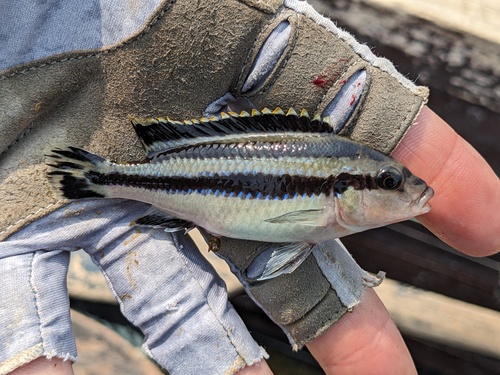
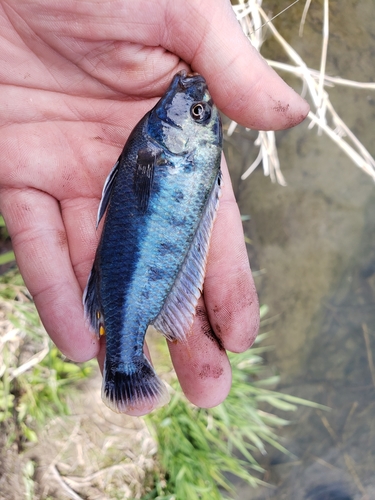
Color is strongly sex- and mood-dependent. Females and juveniles wear a clean white to cream body crossed by two black horizontal stripes, a dark submarginal band in the dorsal fin, and black markings on the lower lobe of the tail — the pattern that earned the trade name "white auratus." Breeding males invert the scheme entirely, turning dark blue to near-black with a solid light-blue midlateral stripe, a fainter blue dorso-lateral stripe, and a broad black band through the spiny part of the dorsal fin. That black dorsal band is a useful field mark: among its close relatives, only a few congeners share it. Konings and Stauffer separate M. loriae from look-alikes such as M. melanopterus and M. kaskazini largely on jaw and tooth-row details — a shorter lower jaw (about 32–35% of head length) and five to seven rows of teeth — distinctions that matter to taxonomists more than to aquarists eyeing a tank.
Range & habitat
Melanochromis loriae is a Lake Malawi endemic, restricted to the rocky shores of the lake's northern half. Its range runs from Mphanga Rocks (Malawi) and Lutara (Tanzania) in the north down to Kande Island (Malawi) and Tumbi Point (Mozambique) in the south, and it also occurs around the offshore islands of Likoma and Chizumulu — though, oddly, not at nearby Taiwanee Reef. A translocated population thrives at Thumbi West Island in Lake Malawi National Park, where it was introduced.
Like most mbuna it is tied to the rocky lakeshore. It favors sediment-free rock but also uses the "intermediate" zone where rock meets sand, and individuals occasionally venture over sandy patches between boulders. FishBase gives a depth range of 3–40 m (10–130 ft), but the great majority of fish sit between about 5 and 20 m (16–66 ft), as documented in the Ribbink et al. (1983) survey of Malawi's rocky-habitat cichlids. The water there is warm, hard, and alkaline — surface temperatures around 24–26 °C (75–79 °F) — the stable, mineral-rich chemistry of the whole rift lake.
Ecology & diet
On paper M. loriae is an aufwuchs grazer, scraping the carpet of algae and the tiny invertebrates living in it from the rock surface — the standard mbuna trade. In practice it is a flexible omnivore with a predatory streak. When Ribbink and colleagues examined the stomach contents of fish collected at Likoma Island, they found not only algae but cichlid fry and catfish eggs. The catfish in question is Bagrus meridionalis (the kampango), whose guarded nests are a rich, seasonal target. M. loriae is also drawn to stirred-up sediment, hinting at opportunistic feeding on whatever a disturbance exposes.
The most unusual behavior is facultative cleaning. Konings (1995) reported watching adult females pick fungus and parasites — including anchor worms, Lernaea — off larger, non-mbuna haplochromines. Unlike the dedicated cleaner fishes of coral reefs, these were not fixed cleaning stations: once the job was done the female simply moved on. It is a reminder that a rift-lake omnivore will exploit any food the rock community offers, from algal film to a wound on a bigger neighbor.
Behavior & breeding
Melanochromis loriae is a maternal mouthbrooder, as the females of the genus generally are. Spawning happens on and beside rocks and, most often, inside caves; the female takes the eggs into her mouth and broods the developing young there. Breeding males are present year-round but are seen relatively infrequently, and they hold territory mainly when rival males in full breeding color are nearby — territoriality that flares with competition rather than running constantly.
Socially the species is usually thinly spread, turning up in small numbers at most sites. The striking exception is Ndumbi Rocks off the northwestern tip of Likoma Island, where it sometimes gathers in foraging groups of more than fifty fish; such aggregations mix females, non-breeding males, and even non-territorial males still in breeding dress — a looser, more gregarious structure than the strict harem one might expect. As with other Melanochromis, intraspecific aggression among males is the dominant social force; the genus as a whole has a reputation for pugnacity, with the notorious M. auratus the textbook example, and M. loriae shares the family tendency toward male-on-male intolerance while staying comparatively tolerant of other species.
In the aquarium
M. loriae reaches the hobby only occasionally — it is collected for export but is far from a staple, and the "white auratus" trade name causes constant confusion with the abundant, unrelated golden mbuna M. auratus. Genuine loriae is an undemanding mbuna in the right setup: hard, alkaline water around pH 7.8–8.6 and 75–82 °F (24–28 °C), a rockwork aquascape riddled with caves and crevices, and the typical mbuna diet built on vegetable matter (spirulina-based foods) rather than rich protein. Despite the wild diet's fry and eggs, keepers should not overfeed protein — bloat is the usual mbuna killer.
The honest caveats are about aggression and sex ratio. This is a male-aggressive fish: the field data and the broader Melanochromis track record both point the same way. Keep one male to a group of five or six females, give them a four-foot tank or larger (a working volume on the order of 100 US gal / 400 L), and avoid housing multiple mature males together unless the footprint is genuinely large. It mixes acceptably with other robust mbuna of similar temperament, but it is not a community fish and not a first cichlid. Because the species is uncommon in the trade, dedicated keepers value clean, locality-true stock — worth seeking out and worth not hybridizing with congeners.
Conservation
The IUCN Red List assesses Melanochromis loriae as Least Concern (assessed 2018, by Ad Konings), an upgrade from its 2006 listing of Vulnerable. The reasoning is straightforward: it is endemic to Lake Malawi but ranges widely across the northern half of the lake, remains common at most sites, and faces no major lake-wide threat. The assessment does flag two species-specific pressures — regular collection for the aquarium trade, and sedimentation — and notes a useful safeguard in the translocated population inside Lake Malawi National Park at Thumbi West Island.
That "Least Concern" verdict sits inside a lake under real strain, and the distinction matters. The basin review by Chavula et al. (2023, Journal of Great Lakes Research 49(6):102241) documents over-fishing and the collapse of the once-abundant chambo (Oreochromis) fishery, heavy sediment and nutrient loading washing off deforested catchments, roughly +0.7 °C of warming in the shallow water that strengthens stratification and trims primary productivity, and a standing risk from invasive species. For a shallow rocky-shore grazer like M. loriae, the sharpest of these is sedimentation: silt smothers the algal aufwuchs it feeds on and blankets the sediment-free rock it prefers, degrading exactly the biotope it depends on. Warming and productivity loss bear on it more diffusely, through the food web. The fair summary is the careful one — the species itself is not currently threatened, but its habitat guild is exposed to the same catchment and climate pressures eroding the wider lake, and its status is worth watching rather than assuming.
Sources
- Eschmeyer's Catalog of Fishes — Melanochromis parallelus (synonym of M. loriae)
- FishBase — Melanochromis loriae summary
- GBIF — Melanochromis Trewavas, 1935
- WoRMS / Marine Species Traits — Melanochromis loriae Johnson, 1975
- Konings & Stauffer (2012), Review of the Lake Malawi genus Melanochromis, Zootaxa 3258:1–27
- FishBase reference summary — Konings & Stauffer 2012 (Ref. 89864)
- Ribbink et al. (1983), Preliminary survey of cichlid fishes of rocky habitats in Lake Malawi (cited via IUCN bibliography)
- malawi.si — Melanochromis loriae 'Chiwi Rocks' (Konings-grade field profile)
- malawi.si — Melanochromis loriae 'Linganjala Reef'
- Cichlid Room Companion — Melanochromis parallelus profile (public page)
- Fishipedia — Melanochromis loriae fish sheet
- IUCN Red List — Melanochromis loriae (Least Concern, 2018; Konings)
- Chavula et al. (2023), Lake Malawi/Niassa/Nyasa basin: Status, challenges, and research needs, J. Great Lakes Research 49(6):102241
- ResearchGate — Chavula et al. (2023) Lake Malawi basin status review (PDF)
- Reddit r/Cichlid — keeper discussion of Melanochromis (auratus) aggression (anecdotal/community) — community/anecdotal
- Cichlid-Forum — mbuna aggression / Melanochromis compatibility threads (anecdotal/community) — community/anecdotal
- FishProfiles.com forums — Mbuna keeping hints, including Melanochromis (anecdotal/community) — community/anecdotal