Taxonomy & naming
Donald S. Johnson described this fish in 1975 in the hobbyist magazine Today's Aquarist (volume 2, issue 1), erecting the monotypic genus Microchromis for it and naming the type species zebroides — "zebra-like," after the dark vertical barring that recalls the zebra mbuna it swims alongside. The holotype was a male of about 63 mm standard length from Lake Malawi.
The genus has not held up. A reexamination of Cynotilapia afra and Microchromis zebroides, and later the broad revision of the Pseudotropheus elongatus species group by Li, Konings and Stauffer (2016, Zootaxa 4168), concluded that zebroides belongs in Cynotilapia: it shares the genus's diagnostic trait of widely spaced, unicuspid (single-cusped) teeth on both jaws, paired with a planktivorous, suction-feeding habit. Major references — FishBase, the Catalog of Fishes, the IUCN, and the Cichlid Room Companion — now list the species as Cynotilapia zebroides (Johnson, 1975), with Microchromis zebroides as the original combination and a senior synonym of the genus name. Hobbyists still encounter both labels, and the fish is widely traded under locality names such as 'Cobwé', 'Hara', and 'Likoma' that flag where a given population was collected. It sits within the mbuna — the rock-dwelling lineage of Malawi's enormous haplochromine species flock — and close to the Cynotilapia afra and Maylandia zebra groups it can be mistaken for.
Appearance
This is a small cichlid. FishBase records a maximum of about 3.7 in (9.3 cm) standard length, while field and aquarium observations put males at roughly 4 in (10 cm) in the lake and occasionally to about 4.7 in (12 cm) in tanks; females stay smaller, around 3 in (8 cm). The body is the typical fusiform mbuna shape, with 17–19 dorsal spines.
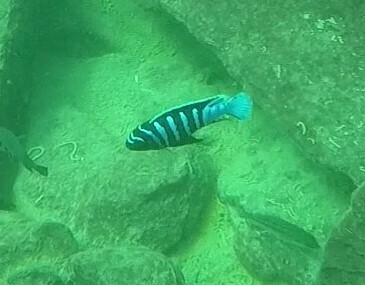
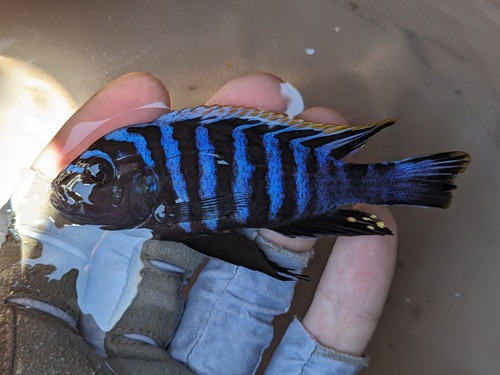
Dominant males are the showpiece: a clean light-blue ground color crossed by five or six bold dark-blue to black vertical bars that strengthen with status and mood, the melanic pattern often bleeding up into the dorsal fin and across the head as interorbital bars. Sub-dominant males and females are far plainer — beige to grey-blue, with faint or absent barring; brooding females can darken considerably but never take on the crisp male pattern. The feature that actually separates it from look-alikes is in the mouth, not the color: the outer teeth are short and conical, decreasing evenly in size from the front of the jaw toward the corners, versus the bicuspid (two-pointed) teeth of Maylandia/Metriaclima zebra-type fish it otherwise mimics. From its close relative Cynotilapia aurifrons it differs by a less heavily black pattern and by the way the head bars join across the brow.
Range & habitat
The fish is a Lake Malawi endemic — found nowhere else on Earth. Sources differ on how widespread it is. The original type locality is off Likoma Island, and some references (including parts of the older literature) treat it as essentially a Likoma-area fish; FishBase, by contrast, describes a circum-lacustrine distribution across the lake's rocky habitats. Specialist accounts following Ad Konings split the difference: a fish of the northern rocky shores that ranges down much of the Tanzanian and Mozambican (eastern) coast to about Makanjila Point and, on the western shore, south to the Mbenji Islands, with introduced populations established around Thumbi West and Otter Islands in the south of the lake.
Its preferred home is the upper rocky zone — shallow, sunlit, and usually free of sediment — at tropical latitudes between roughly 11 and 13 degrees south. Some populations also work the intermediate habitat where rock gives way to sand, with large schools hovering in open water above the substrate. Territorial males stay tethered to caves and crevices among the rocks, which they defend. Like the rest of the rift-lake cichlid fauna it lives in hard, alkaline water, typically around pH 7.7–8.6 and warm temperatures in the mid-70s Fahrenheit (low-to-mid 20s Celsius).
Ecology & diet
Microchromis zebroides is fundamentally a planktivore, and this is what marks it out from the algae-grazing mbuna it resembles. Cynotilapia species are specialized for suction-feeding on particles suspended in the water column, and their reduced, single-cusped dentition reflects that — they are not built to rasp the tough algal turf (the "aufwuchs") off rock faces the way zebra mbuna are. Non-territorial individuals feed several meters up off the bottom, picking zooplankton and drifting matter from open water; territorial males, anchored to their caves, supplement this by grazing the aufwuchs and the small invertebrates living in it near their patch. FishBase places it at a trophic level of about 3.4, consistent with a small invertebrate-and-plankton feeder rather than a strict herbivore.
Within the reef community it is one of countless mbuna partitioning the same rocks by diet and microhabitat — a textbook example of the trophic and spatial niche-splitting that let Malawi's cichlid flock radiate into hundreds of species. Its plankton-feeding mode means it competes less for grazing surface and more for productive open water just off the reef.
Behavior & breeding
Socially this is a polygynous, territorial mbuna. Dominant males hold and defend caves among the rocks, and aggression is high — directed most fiercely at rival males and at similar-looking species that read as competitors. Like essentially all Malawi haplochromines, it is a maternal mouthbrooder: spawning takes place in or beside the male's cave, the female takes the fertilized eggs into her mouth, and she incubates the developing eggs and then the fry there for roughly three weeks before releasing free-swimming young among the rocks. The Cichlid Room Companion characterizes the mating system as polygynandrous — males court multiple females and females may visit more than one male — which is common in lekking and cave-spawning mbuna.
There is no paternal care; once eggs are taken up, the female does all the work, and broods are small as a consequence of the high parental investment per egg. Brooding females often retreat from the colony and may go off food while carrying.
In the aquarium
This is a hardy, brightly colored mbuna that established itself in the hobby decades ago, but it is not a community-tank fish and not really a beginner's first cichlid. Plan on a tank of at least about 65 gallons (250 liters) and ideally a four-foot-plus footprint, aquascaped with abundant rock, multiple caves, and open swimming space above. The standard approach is a harem: one male with three or four females, which spreads his aggression and reduces the chance of a single female being harassed to death. Keeping multiple males is possible only in larger tanks and generally only if they are introduced together from the start.
Water should be hard and alkaline (pH roughly 7.8–8.6) and warm; like other mbuna it is sensitive to the nitrogenous waste of an overstocked, underfiltered tank, so heavy filtration and routine large water changes matter. The recurring honest warning from both the specialist literature and keeper experience is hybridization and mistaken-identity aggression: because Microchromis zebroides looks so much like zebra-type mbuna and will readily cross with Maylandia/Metriaclima zebra, you should not house it alongside those fish — both to keep the bloodline clean and to avoid constant fighting between species that see each other as rivals. Forum consensus among experienced keepers echoes the field accounts: expect real territoriality, give the females cover, and don't crowd the tank with blue-barred look-alikes.
Conservation
The IUCN Red List assesses Cynotilapia zebroides as Least Concern (assessment dated 22 June 2018, with Ad Konings as assessor). That is the current, species-level verdict, and it is the appropriate one: the fish is common, widely distributed across the lake's rocky habitats, and not a meaningful fisheries target. Worth flagging for context: an earlier Cichlid Room Companion note recorded a Vulnerable (2006) listing and observed that, because the species feeds out in the water column, it can be swept up in the scoop-nets used to catch utaka — yet the same account reported no visible dent in this common cichlid's population densities, since most foraging schools hug the rocky shore. The honest reading is a species that is doing fine.
That said, the lake it depends on is under real strain. The basin-scale review by Chavula et al. (2023, Journal of Great Lakes Research 49(6):102241) documents intensifying pressures on Lake Malawi/Niassa/Nyasa: heavy over-fishing and the collapse of the prized chambo (Oreochromis) stocks, rising sediment and nutrient loading washing off deforested catchments, and warming of roughly +0.7 °C in the shallow layers that strengthens thermal stratification and suppresses the nutrient mixing that drives the lake's productivity, alongside the looming risk of invasive species. For a shallow-water, sediment-averse rock-dweller like this one, the sharpest of those threats is sedimentation: silt smothering the clean rock surfaces and the plankton-rich clear water it feeds in degrades exactly the habitat it needs. So the accurate framing is the careful one — the species itself is Least Concern, but it lives in a lake whose nearshore rocky zones are being chipped away, and its long-term security is tied to the health of that habitat rather than to any threat aimed at the fish directly.
Sources
- FishBase: Cynotilapia zebroides (Johnson, 1975)
- Eschmeyer's Catalog of Fishes (species entry, Cynotilapia zebroides)
- FishBase Cichlidae family list (Microchromis zebroides Johnson, 1975, synonym entry)
- Li, S., A.F. Konings & J.R. Stauffer Jr. (2016). A revision of the Pseudotropheus elongatus species group. Zootaxa 4168(2):353-381
- Description of a new cichlid species from Lake Malawi, with reexamination of Cynotilapia afra and Microchromis zebroides Johnson, 1975
- Li, Konings & Stauffer 2016 — Zootaxa treatment (Plazi TreatmentBank, Cynotilapia diagnoses)
- Cichlid Room Companion: Cynotilapia zebroides species profile (Ad Konings)
- malawi.si — Cynotilapia zebroides 'Cobwé' (distribution, biotope, husbandry)
- Fishipedia: Cynotilapia zebroides
- Bibliography of Lake Malawi Biology (malawicichlids.com)
- IUCN Red List: Cynotilapia zebroides (Least Concern, assessed 2018)
- Chavula, G. et al. (2023). Lake Malawi/Niassa/Nyasa basin: Status, challenges, and research needs. J. Great Lakes Research 49(6):102241
- Cichlid Fish Forum (cichlid-forum.com): Cynotilapia / mbuna aggression and stocking threads — community/anecdotal
- Reddit r/Cichlid: mbuna stocking with Cynotilapia 'Cobwe' — community/anecdotal
- MonsterFishKeepers.com: Cynotilapia hara vs afra vs zebroides ID discussion — community/anecdotal