
Taxonomy & naming
Charles Tate Regan described this fish in 1922 as Haplochromis melanotaenia in his monograph on the cichlids of Lake Nyasa (the older name for Lake Malawi), based on material from Domira Bay on the lake's central-western shore. The species epithet melanotaenia joins the Greek roots melano- (black) and taenia (band or ribbon), an apt nod to the oblique dark stripe that runs across its flank.
The fish now sits in Mylochromis, a genus Regan also erected in the 1920s and that Eccles and Trewavas formalised in their 1989 reclassification of the Malawian haplochromines. That revision split a sprawling, catch-all Haplochromis into some ten genera, sorting roughly two dozen oblique-striped species largely on the basis of that diagonal banding pattern and the absence of the specialised features that define other Malawi lineages. The genus name itself fuses Greek mylo- (a mill or millstone) with chromis, a generic old word for a fish — a reference to the heavy, grinding pharyngeal mill these fish carry. Some older hobby literature files the species under the synonym Maravichromis, a name briefly proposed for the group; the taxonomic authorities retain Mylochromis. A note of caution on identity: Eschmeyer's Catalog of Fishes treats some closely allied names in this complex as synonyms of one another, and the oblique-striped Mylochromis remain a taxonomically tangled group, with new species still being described from the lake as recently as 2024.
Appearance
This is a moderately large, elongate hap. Reports of maximum size differ modestly between sources: the CLOFFA checklist compiled by Maréchal gives 20 cm (about 8 in) total length, while Konings and the IUCN assessment cite roughly 18 cm (about 7 in) — a small discrepancy worth flagging rather than papering over, but in either case a fish of real heft.
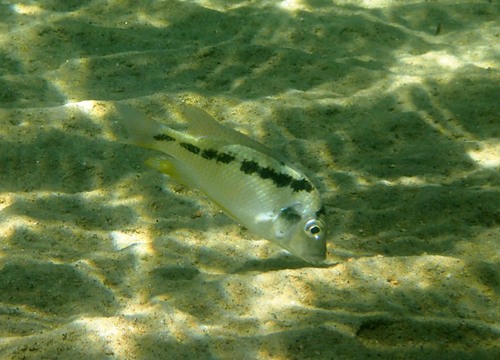
The defining mark is the oblique band — a dark diagonal stripe that crosses the upper flank, the trait that anchors the whole genus. Breeding males turn a clean steel blue with a yellowish tail, an understated livery by the standards of Malawi's gaudier peacocks and mbuna. Two features set M. melanotaenia apart from its lookalikes: a notably large mouth with thick, fleshy lips in which the teeth are embedded, and a relatively large eye. It is most easily confused with M. balteatus, which shares the heavy lips, but in M. melanotaenia the diagonal band sits higher on the body and does not cross the upper lateral line beneath the spiny dorsal fin.
Range & habitat
Mylochromis melanotaenia is endemic to Lake Malawi (also called Niassa or Nyasa), the long rift-valley lake shared by Malawi, Mozambique and Tanzania. Sources disagree on how far it ranges within the lake. Older accounts, including FishBase, describe it as confined to the southern part of the lake; the 2019 IUCN assessment, working from newer point data, treats it as effectively lake-wide, recorded from the south, along the eastern shoreline, and as far north as Makonde — though it appears genuinely rare across much of that range. The IUCN puts its area of occupancy near 2,700 km2 within an extent of occurrence of about 29,600 km2.
Unlike the rock-loving mbuna, this is a fish of the intermediate and soft-bottom zones. The consensus habitat description — from Konings and echoed by the IUCN — is muddy bottoms near river outlets at depths of roughly 15 to 40 m (about 50 to 130 ft). FishBase adds a record of sandy shores with Vallisneria, hinting it also works shallower vegetated sand; the two descriptions are best read as the range of soft-substrate settings this opportunist exploits rather than a contradiction. Lake Malawi's open water is warm, alkaline and hard — broadly around pH 7.7 to 8.6 and 24 to 28 C (75 to 82 F) in the surface layers these fish inhabit, the chemistry any keeper should aim to mirror.
Ecology & diet
M. melanotaenia is a benthic forager that works the soft bottom by continually digging into and filtering the sand for anything edible — the classic sand-sifting strategy shared by many oblique-striped haps. Its anatomy points to a more specialised diet on top of that general sifting: the stout, subconical teeth on its pharyngeal bones, combined with thick muscular lips, are the toolkit of a mollusc crusher, and the suggestion in the literature is that it sucks snails out of their shells and grinds the soft parts. It is important to be honest about the evidence here: this is an inference from morphology, not a measured fact. As the IUCN assessment plainly states, no gut-content analyses have been reported for the species, so its diet remains a well-reasoned hypothesis rather than confirmed natural history. FishBase places it at an estimated trophic level near 3.6, consistent with an invertebrate-leaning carnivore. Within the community, a snail-eating sand-sifter occupies a useful niche, helping convert the molluscs and buried invertebrates of the soft-bottom zone into fish biomass.
Behavior & breeding
Like all of Lake Malawi's haplochromine cichlids, M. melanotaenia is a maternal mouthbrooder: the female takes the fertilised eggs into her mouth and broods the developing young there for several weeks, releasing free-swimming fry only once they can fend for themselves. This is a strategy that trades large clutches for high survival of a few well-protected offspring, and it is the reproductive engine behind Malawi's explosive cichlid diversity.
What sets this species apart behaviourally is what it does not do. Males in full breeding colour — steel blue with a yellow tail — appear not to hold territories, an unusual trait among Malawi haps, where males of most species defend a patch of substrate or build a sand crater to court over. The implication is a more roving, less site-bound courtship, though the fine details of its spawning have not been well documented in the wild. The fish has a short generation length of one to two years and is rated as a high-resilience, fast-reproducing species, both consistent with the opportunistic life history of a soft-bottom forager.
In the aquarium
M. melanotaenia is an occasional rather than a staple import; it shows up sporadically in the hobby, usually under its scientific name or alongside its oblique-striped Mylochromis relatives rather than a settled trade name. Treat it as a fish for an experienced Malawi keeper, not a beginner. As a 7-to-8-inch (18-20 cm) active sand-sifter, it needs a long tank with a generous open footprint — realistically a 5- to 6-foot, 125-gallon-plus aquarium — floored with a deep bed of fine sand it can dig and sift, which is how it forages and how it stays settled. Hard, alkaline water around pH 8 and temperatures in the mid-to-high 70s F (24-27 C) match its lake conditions.
On temperament, hobbyist experience with Mylochromis is consistent: these are not the gentlest haps. Keepers repeatedly report that members of the genus can run a little too aggressive for a relaxed community and are sometimes relegated to all-male display tanks for that reason. The standard haplochromine approach applies — keep one male with several females to spread his attention, give it room and tankmates of similar size and vigour (other large haps rather than dwarf mbuna or timid peacocks), and provide open sand over heavy rockwork. The most common mistakes are a tank that is too short, a substrate too coarse or too shallow to sift, and stocking it with fish small or meek enough to be bullied. Note that genuine, corroborated aquarium documentation specific to M. melanotaenia is thin; most practical guidance here is extrapolated from the broader Mylochromis genus and should be applied with that caveat in mind.
Conservation
The IUCN Red List assesses Mylochromis melanotaenia as Least Concern (Konings & Kazembe, an amended 2019 version of the 2018 assessment), on the grounds that it is endemic to Lake Malawi but has a lake-wide distribution with no major widespread threats identified. The threats the assessment does flag are modest and specific: potential over-fishing, since soft-bottom haps are caught in the lake's small-scale and commercial fisheries, and sporadic collection for the aquarium trade. Part of its range falls within Lake Malawi National Park; otherwise no species-specific measures are in place, and its population trend is simply unknown.
That "Least Concern" verdict, though, sits inside a lake under real and growing pressure, and the two should be read together. The basin-scale review by Chavula and colleagues (2023, Journal of Great Lakes Research) documents a Lake Malawi/Niassa/Nyasa system increasingly stressed by human and climatic forces: over-fishing that has driven the collapse of the prized chambo (Oreochromis) fishery, heavy sediment and nutrient loading washing off deforested catchments and into the very river mouths this species favours, roughly 0.7 C of warming in the shallow waters that strengthens thermal stratification and suppresses the nutrient mixing that drives lake productivity, and the looming risk of invasive species. For a soft-bottom, river-outlet specialist like M. melanotaenia, the sediment and nutrient loading is the most directly relevant of these: it degrades exactly the muddy near-shore habitat the fish forages in and can smother the snail beds it appears to depend on, while any decline in lake productivity ripples up the food web. So the honest framing is this — the species itself is not currently threatened, but it lives in a lake whose long-term health is not guaranteed, and its fortunes are tied to how those basin pressures are managed.
Sources
- FishBase: Mylochromis melanotaenia (Regan, 1922)
- Eschmeyer's Catalog of Fishes (California Academy of Sciences)
- GBIF: Mylochromis (Regan, 1922) backbone taxonomy
- Cichlid Room Companion: Mylochromis melanotaenia profile
- malawi.si: Mylochromis melanotaenia species page
- MalawiCichlids.com: Checklist of the Malawi 'Hap' species flock
- Regan, C.T. 1922. The Cichlid Fishes of Lake Nyassa. Proc. Zool. Soc. London
- Two new species of Mylochromis (Cichlidae) from Lake Malawi (J. Fish Biology, 2024)
- Eccles & Trewavas 1989, Malawian cichlid fishes: classification of Haplochromine genera (via IUCN bibliography)
- IUCN Red List: Mylochromis melanotaenia (Konings & Kazembe 2019, amended)
- Chavula et al. 2023, Lake Malawi/Niassa/Nyasa basin: Status, challenges, and research needs, J. Great Lakes Research 49(6):102241
- Practical Fishkeeping: Basket hap, Mylochromis lateristriga (genus context)
- Cichlid-Forum.com thread: Mylochromis 'Mchuse' keeping notes — community/anecdotal
- Cichlid-Forum.com thread: 120 gallon stocking (Mylochromis aggression) — community/anecdotal
- Cichlid-Forum.com thread: Predator haps advice (Mylochromis sifting/size) — community/anecdotal