

Taxonomy & naming
The species was described by the Belgian-British ichthyologist George Albert Boulenger in 1899 from material collected near Albertville (Mtoa) on the Congolese shore of Lake Tanganyika, originally as Lamprologus brevis. It was later moved to the genus Neolamprologus, one of the large lamprologine genera that dominate the lake's substrate-spawning cichlid radiation. The genus name is built from Greek roots — neos (new) plus the older name Lamprologus, itself from lampros ("torch" or "bright") — while the epithet brevis simply means "short," a nod to its compact body.
Its taxonomy carries an unresolved wrinkle worth flagging. Some authors treat N. brevis as a senior synonym of Neolamprologus calliurus, and the two are frequently confused in both the literature and the trade; the behavioral-ecology study by Ota and colleagues (2012) explicitly works from the position that brevis is a synonym of calliurus. FishBase and Eschmeyer's Catalog of Fishes, by contrast, list N. brevis as a valid species in its own right. We follow the taxonomic authorities here and treat brevis as valid, while noting that names attached to wild-collected stock — and the boundary between brevis and calliurus — are not fully settled. In the hobby the fish is sold simply as the "brevis" or by collection-locality morph names such as "sunspot," "katabe," and "sambia."
Appearance
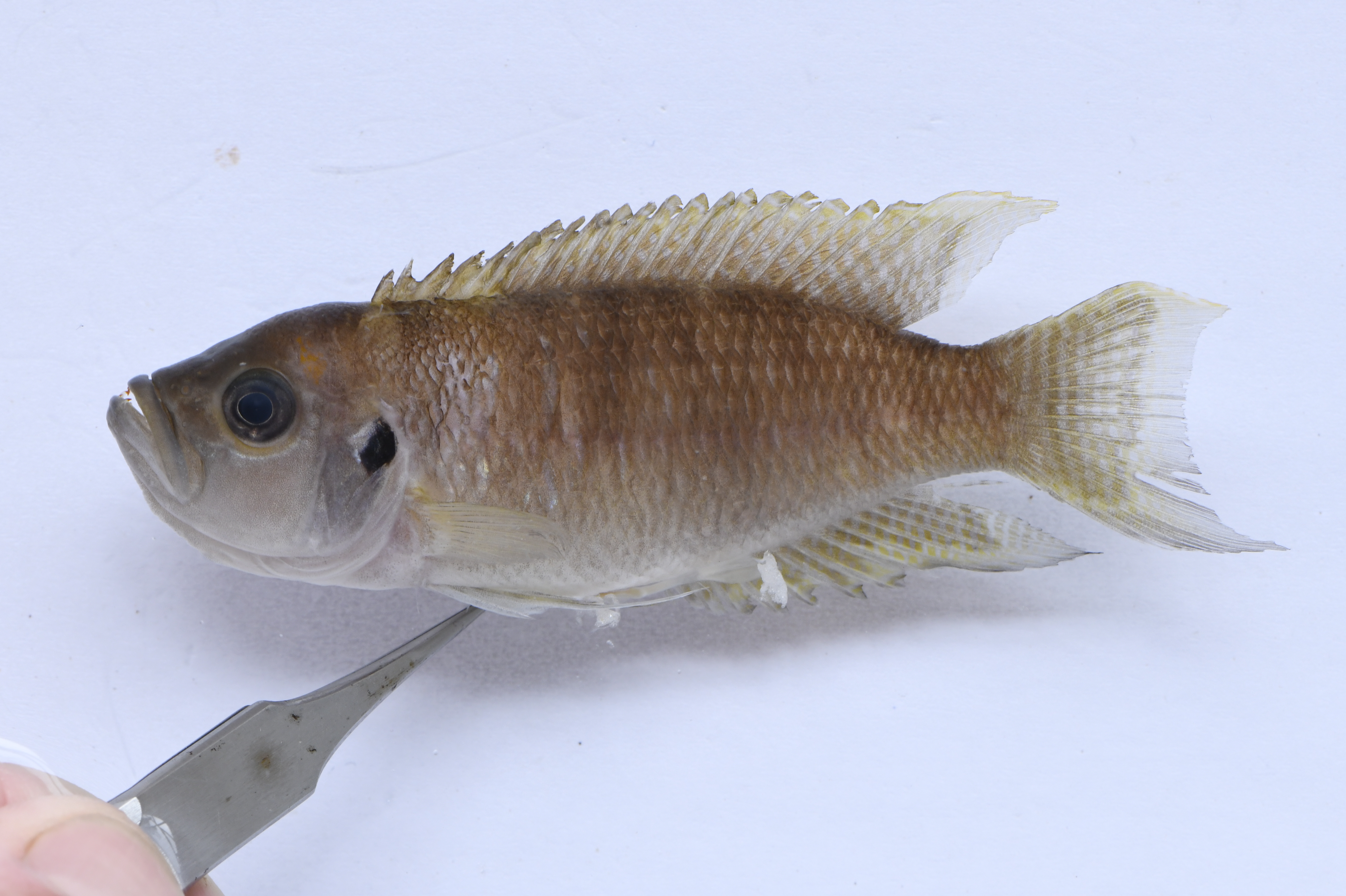
Neolamprologus brevis is a small, thickset cichlid with a blunt, bulbous head that hobbyists affectionately call "frog-faced" or "bulldog"-like. Reported maximum sizes vary modestly across sources: FishBase gives 2.2 in (5.5 cm) total length, while field and hobby references put males at roughly 2 in (5 cm) and females noticeably smaller, rarely past 1.6 in (4 cm). The body is tan to pale brown, overlaid with a series of faint, iridescent vertical bars and rows of light spangles on the flanks and gill cover that catch the light when the fish is displaying.
The sexes are hard to separate in young fish, but adult males run consistently larger at every stage of growth. In some populations mature females develop a yellow to golden cast on the belly, a useful field mark. The vertical barring is also the simplest way to tell brevis from its frequent look-alike Lamprologus ocellatus, another bulbous-headed shell dweller; ocellatus lacks the flank bars and instead carries a distinct eye-spot (ocellus) on the gill cover.
Range & habitat
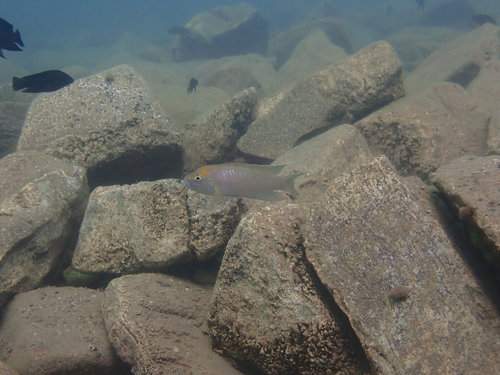
The species is endemic to Lake Tanganyika and occurs essentially lake-wide, recorded from the Congolese, Tanzanian, and Zambian shores. It is a benthic fish of the soft-bottom littoral zone, living over sand or mud where empty gastropod shells — chiefly those of the lake's endemic snail Neothauma — accumulate. It is usually found below about 16 ft (5 m) and has been recorded down to roughly 130 ft (40 m); in the well-studied Wonzye population near Mpulungu, Zambia, it ranges across rocky shallows and offshore sand from about 13 to 36 ft (4–11 m).
Unlike most shell dwellers, which crowd onto dense shell beds, N. brevis specializes in habitats where shells are scarce and widely scattered — a niche its pair-sharing of single shells makes possible. It only rarely settles on thick shell beds. The lake's water is hard and alkaline, and the fish's tolerances reflect that: in-situ and aquarium-derived figures cluster around pH 8–9, a temperature near 73–81°F (23–27°C), and moderate-to-high hardness. The exception in its range is a peculiar one — at Karilani Island, calcium-encrusted shell beds are inhabited almost exclusively by this species together with small shell-dwelling Telmatochromis.
Ecology & diet
Neolamprologus brevis is a micropredator and zooplankton feeder, placed at a trophic level of about 3.4. Rather than grazing the substrate, a fish (or a pair) hovers 4–8 in (10–20 cm) above the mouth of its shell and picks passing zooplankton and small invertebrates out of the water column, dropping back to the shell at any sign of danger. The shell is thus both larder-side perch and bunker: when a predator approaches, the fish bolts inside, and where pairs share a shell the smaller female typically enters first, the male following.
Its ecological story is bound up with another cichlid, Lamprologus callipterus — the only species in the lake that physically transports snail shells and piles them into "shell patches." In rocky habitat, brood-caring brevis females occur almost exclusively in these communal shell patches built and tolerated by callipterus, while immature and non-reproductive fish are found out on open sand. The result is a life history that shifts with reproductive state: fish migrate from sandy feeding grounds to the shell patches to breed, a movement Ota and colleagues documented from differences in size, gonad condition, and behavior between the two settings.
Behavior & breeding
All accounts agree on two things: this is an obligate shell-brooder that spawns and rears young inside an empty snail shell, and it is fiercely territorial in the immediate vicinity of that shell despite being otherwise small and unobtrusive. The defended territory is tiny — often no more than 6 in (15 cm) across — but vigorously held, and keepers report the fish will even nip at a hand that intrudes. Females bury the chosen shell until only the entrance shows, then court by displaying at the opening; the male fertilizes the eggs as the female backs out, the outflow drawing his sperm into the shell. The female alone tends the brood, fanning the eggs, which hatch in roughly a day, with fry free-swimming after about a week and dispersing to find their own shells a couple of weeks later. Broods are small, commonly on the order of 10–25 fry.
The more interesting question is the mating system, and here the sources genuinely diverge. Specialist hobby references (Seriously Fish, tanganyika.si) describe N. brevis as essentially monogamous, with a male and female sharing one shell — behavior they call near-unique among Tanganyikan shellies and the trait that lets the species live where shells are too sparse for harems. The behavioral-ecology literature paints a richer picture: studying brevis (under the calliurus name) in shell patches, Ota and colleagues found a multi-male polygynous system with alternative reproductive tactics, large "bourgeois" males floating above the patch and smaller males residing within the shells, differing in aggression and relative testes investment in the manner typical of sneaker-versus-territorial strategies. The likeliest reconciliation is that the strategy is plastic: pairs share single shells on sparse sand, while denser shell patches support polygyny and sneaking. We present both rather than forcing a single answer.
In the aquarium
Brevis is one of the most accessible Tanganyikan cichlids and a genuinely good first "shellie" or first breeding project. A pair can be kept in something as small as a 10-gallon (40 L) tank — hobby lore about five-gallon pairs exists, but a larger footprint gives the fish room and the keeper more options — with a colony needing more. The essentials are non-negotiable rather than fussy: a deep bed of fine sand the fish can excavate, several empty snail or escargot shells (always more shells than fish), and hard, alkaline water around pH 8–8.5, 73–81°F (23–27°C). They take live and frozen foods readily and accept quality dry foods, especially tank-bred fish.
The common mistakes are about space and arithmetic, not difficulty. Too few shells turns a peaceful tank into a brawl; spacing shells out and skewing the sex ratio toward females reduces male-on-male aggression. Their tiny defended zone means they coexist well with fish that use other parts of the tank — open-water Cyprichromis, small rock dwellers like Neolamprologus brichardi or smaller Julidochromis — but large or boisterous tankmates will bully them off their shells and should be avoided. Keepers also note that brevis dislike unstable water chemistry, so steady parameters matter more than heavy water changes. Whether a given pair shares a shell or claims separate ones varies with the individuals and the number of shells provided, so don't be alarmed by either outcome.
Conservation
Neolamprologus brevis is not flagged as a species of concern: it is widespread across Lake Tanganyika, abundant, and bred in large numbers in the aquarium trade, which takes pressure off wild stocks even though it is also collected commercially for export. (FishBase records both commercial-fishery and commercial-aquarium use.) Its main species-specific exposure is targeted collection of attractive locality morphs and, more broadly, degradation of the soft-bottom littoral it depends on.
That individually secure status sits inside a lake under real strain. Lake Tanganyika is warming, and the warming has biological consequences: O'Reilly and colleagues (2003, Nature, DOI 10.1038/nature01833) inferred from sediment records that stronger thermal stratification has reduced mixing and cut primary productivity by roughly 20%, implying on the order of a 30% drop in fish yields. Cohen and colleagues (2016, PNAS, DOI 10.1073/pnas.1603237113) found that warming has been accompanied by declines in commercially important fishes and endemic molluscs and an estimated loss of around 38% of the lake's oxygenated benthic habitat as deoxygenated water encroaches upward. Sedimentation from shoreline deforestation and development further degrades the littoral substrate (Cohen et al. 1993). The lake's economy leans heavily on the pelagic clupeid fishery — the sardine-like Stolothrissa and Limnothrissa, with predatory Lates — that feeds the four riparian nations (DRC, Tanzania, Zambia, Burundi), whose shared management runs through the Lake Tanganyika Authority.
For a sand-and-shell littoral specialist like N. brevis, the most relevant of these pressures are the shoaling oxygen line and sedimentation: a fish bound to soft-bottom habitat in the upper tens of meters is squeezed if the habitable oxygenated band thins and the substrate it digs in is buried under silt. The honest summary is that brevis itself is doing fine today, but the lake it cannot leave is not, and the species' fortunes are ultimately tied to how the basin's warming, oxygen loss, and shoreline degradation play out.
Sources
- FishBase — Neolamprologus brevis (Boulenger, 1899) summary
- Eschmeyer's Catalog of Fishes — species record (Neolamprologus brevis)
- Eschmeyer's Catalog of Fishes — California Academy of Sciences
- Ota, Aibara, Morita, Awata, Hori & Kohda (2012) — Alternative Reproductive Tactics in the Shell-Brooding Lake Tanganyika Cichlid Neolamprologus brevis, Int. J. Evol. Biol.
- O'Reilly et al. (2003) — Climate change decreases aquatic ecosystem productivity of Lake Tanganyika, Nature
- Cohen et al. (2016) — Climate warming reduces fish production and benthic habitat in Lake Tanganyika, PNAS
- Seriously Fish — Neolamprologus brevis species profile
- tanganyika.si — Neolamprologus brevis (biotope, breeding, distribution)
- Cichlid Room Companion — Kirkelie, 'Neolamprologus brevis (Boulenger, 1899)'
- Cichlid Room Companion — Neolamprologus genus profile
- Practical Fishkeeping — Meet the shell dwellers
- Aquarium Tidings — Neolamprologus brevis care, feeding and breeding
- Aquarium Co-Op — Care Guide for Shell Dwellers
- UKNow — Lake Tanganyika Fisheries Declining from Global Warming (Cohen et al. summary)
- Aquarium Co-Op Forum — Neolamprologus brevis breeding style (keeper thread) — community/anecdotal
- Cichlid Fish Forum (cichlid-forum.com) — Shell Dweller Tank Setup — community/anecdotal
- Cichlid Fish Forum (cichlid-forum.com) — Reducing aggression among shell dwellers — community/anecdotal
- Fish Lore — Neolamprologus brevis ID (shell dweller forum thread) — community/anecdotal
- Reddit r/aquarium — shell dwellers in small tanks (keeper discussion) — community/anecdotal