
Taxonomy & naming
The fish was described by Belgian ichthyologist Max Poll in 1974, with a type locality at Kasoje on the Tanzanian coast. The species epithet honors Pierre Brichard, the Belgian collector and exporter who introduced many Tanganyikan cichlids to the aquarium trade from his base in Burundi. The name brichardi is, technically, a replacement name: the same fish had earlier been called Lamprologus savoryi elongatus by Trewavas and Poll (1952), but that combination was preoccupied by an earlier Lamprologus elongatus, so Poll coined a new name. The genus Neolamprologus ("new" + the older Lamprologus) gathers most of Tanganyika's substrate-spawning lamprologine cichlids.
Whether brichardi is even a valid species is a genuine, unresolved debate, and it is worth stating plainly rather than glossing over. A 2007 mitochondrial-DNA study by Duftner and colleagues found that the genetic tree never matched the traditional split between N. brichardi and the southern, earlier-named N. pulcher, and that the diagnostic gill-cover patterns appeared to have evolved repeatedly. On that basis several authors — including Ad Konings in the most recent edition of his standard field guide — treat brichardi as a junior synonym of N. pulcher, and reference sites such as Seriously Fish file it that way.
The authorities, however, currently disagree with that lumping. Eschmeyer's Catalog of Fishes (the standard nomenclatural reference, updated 2026) lists Neolamprologus brichardi (Poll, 1974) as valid, and a detailed comparative study by Magnus and Mikael Karlsson across more than a hundred lake localities concluded the two are reliably distinct, separable by facial pattern: brichardi shows a horizontal eye-to-operculum stripe forming a "T," patterned cheeks, and no eye-ring, whereas pulcher has a down-turning post-ocular stripe and a yellow ring around the eye. For most practical purposes the upshot is simple — in the hobby, "brichardi" almost always means the northern, lyretail "Princess of Burundi" form, and it belongs to a tight cluster, the "brichardi complex," that also includes pulcher, crassus, falcicula, gracilis, helianthus, savoryi, and splendens. These interbreed freely and should never be mixed.
Appearance
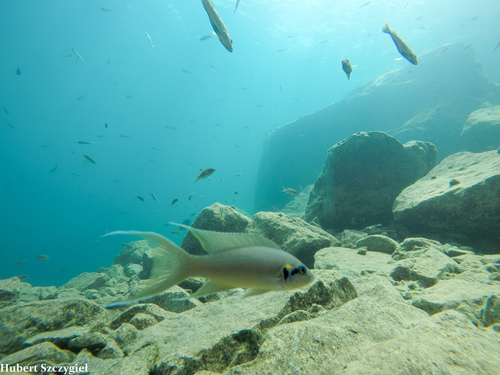
This is a slender, elegant fish rather than a flashy one. Reported maximum size is consistent across sources at roughly 3 to 4 in (about 9–10 cm total length), with the filamentous extensions of the tail adding to that figure; Seriously Fish gives a standard length of 70–90 mm. The body is a soft fawn to pinkish-tan, finely speckled, and the real ornament is at the fins: the dorsal, anal, and lyre-shaped caudal fin trail into fine white-edged rays, and the eye is ringed in an iridescent blue-green that hobbyists single out as the fish's most striking feature up close.
The key field mark is on the gill cover — a black bar running back from the eye that meets a vertical mark along the operculum to form a "T," set off by blue and yellow lines on the cheek. That pattern is exactly what the taxonomic debate turns on, since it is the main visible character separating brichardi from its near-twin pulcher. Sexual dimorphism is subtle: males average slightly larger and develop somewhat longer fin extensions and a less rounded belly, but the sexes are otherwise so similar that keepers generally cannot reliably sex juveniles and instead raise a group until a pair forms. Albino and a few minor color forms circulate in the trade.
Range & habitat
Neolamprologus brichardi is a lacustrine endemic — found naturally only in Lake Tanganyika, the deep Rift Valley lake bordered by Burundi, the Democratic Republic of the Congo, Tanzania, and Zambia. Exactly how far it ranges is one place sources differ. FishBase and Seriously Fish describe it as essentially a northern-lake fish (the "Princess of Burundi" name reflects that), while the IUCN assessment and the biotope literature describe a discontinuous, near lake-wide distribution from Burundi down both shores, with the southern populations grading into, or being replaced by, pulcher-type and gracilis-type forms. The most coherent reading is that brichardi was historically a northern fish that spread south as lake levels changed, hybridizing with pulcher where the two met — which is also why the species limits are contested.
Its home is hard substrate: rocky shorelines and reefs with caves and crevices over sand. Depth reports cluster in the shallow-to-moderate zone — the IUCN gives 3–30 m, biotope surveys put it at 4–20 m and most abundant around 7–15 m (very roughly 25–50 ft). Tanganyika is famously alkaline and stable, and the fish's preferences mirror that: a pH around 8–9 and hard, mineral-rich water, with in-situ temperatures in the low-to-mid 20s °C (low-to-mid 70s °F). These are not negotiable hobby trivia but the actual chemistry of the water this fish evolved in.
Ecology & diet
Functionally, brichardi is a zooplankton picker. FishBase and the IUCN classify it as a plankton feeder; the biotope literature is more specific, describing a diet of small invertebrates — copepods, insect larvae, and other tiny animals — taken both from the "biocover" (the algal and detrital film on the rocks) and, more importantly, from the open water just above the substrate. FishBase places it at a trophic level of about 3.4, squarely a small carnivore rather than an algae grazer, which is why captive specimens relish live and frozen foods like daphnia and brine shrimp.
Its ecological signature is abundance. On suitable reefs the species forms dense aggregations that hover in the water column to feed, and observers have recorded groups exceeding a thousand individuals — a scale not seen in its relative pulcher. That habit of feeding in the open, away from the safety of the rocks, is the ecological pressure that makes its cooperative defense pay off: the rock faces and surrounding water are full of predators, and a crowd of territory-holders that all pitch in to mob intruders can hold a patch of reef that a single pair could not.
Behavior & breeding
Neolamprologus brichardi is a cave-spawning substrate breeder, not a mouthbrooder. A bonded pair claims a rocky crevice, often excavating a pit down to bare rock beneath it, and the female attaches eggs to the cave wall or roof — early clutches of only a couple dozen eggs, building to well over a hundred in established pairs. Eggs hatch in two to three days and fry are free-swimming about a week later; growth is slow. The female tends the eggs and the male patrols the territory's perimeter.
What sets this fish apart is what happens next. Young from earlier spawns do not leave — they remain in the parents' territory as non-breeding "helpers," defending the site and guarding their younger siblings, so that several overlapping generations live and work together. This alloparental care has made the brichardi/pulcher group a model system in behavioral ecology. Field and lab studies (much of it by Michael Taborsky and colleagues) show the system is held together less by simple family loyalty than by economics: under the "pay-to-stay" and ecological-constraints framework, helpers tolerate subordinate status and contribute labor as rent for living in a safe, predator-defended territory, and they disperse to breed on their own when a vacancy or safer option appears. Counterintuitively, experiments by Zöttl, Stiver, and others found that unrelated helpers can provide more care than related ones — direct payback, not kinship, does much of the explanatory work. Helpers also queue: if a breeder dies, the next fish in the size hierarchy can inherit the position.
The flip side of all that cooperation is ferocious territoriality. The group's collective defense, so effective in the wild, becomes a problem in a glass box, and keepers across forums describe pairs that turn lethal once they spawn — one of the more printable nicknames for a breeding colony is "the Death Squad."
In the aquarium
Brichardi has a deserved reputation as a hardy, forgiving, prolific fish that is genuinely easy to keep and breed — and an equally deserved reputation for aggression that newcomers consistently underestimate. Both things are true at once, and the honest version of the care advice has to hold them together. A single fish or a young pair can live in a fairly modest tank, but to keep a natural colony you want base dimensions upward of roughly 4 ft / 120 cm; the realistic recommendation from people who run them is a species-only setup. Provide hard, alkaline water (pH ~8–8.5, high hardness) in the low-to-mid 70s °F (around 24–26 °C), a sand substrate, and a generous rockwork of caves and broken sight-lines. They eat almost anything — quality flake, plus live or frozen daphnia and brine shrimp, which also seem to trigger spawning.
The standard, repeatedly corroborated keeper experience is that brichardi are mellow until they pair off, and then a single pair will systematically drive, injure, or kill tankmates and surplus conspecifics, expanding their territory as the colony grows until they own the tank. Experienced Tanganyikan keepers report a colony dominating tanks of several hundred gallons, pushing far larger cichlids into a corner. That makes most "community" stocking a mistake. In a large enough tank they can sometimes be paired with fish that use different zones — open-water Cyprichromis, or shell-dwellers — but rock-dwelling neighbors like Julidochromis and Altolamprologus are risky and need a lot of space and structure. Two other practical cautions recur: never mix members of the brichardi complex, as they hybridize freely; and in a closed colony, cull and add new bloodlines periodically, because uninterrupted inbreeding produces deformities. One often-repeated myth worth puncturing is that this is purely a "beginner peaceful" fish — it is beginner-friendly to keep alive and breed, but not to house with others.
Conservation
The IUCN Red List assessed Neolamprologus brichardi as Least Concern (assessment dated March 2025), describing it as widespread across much of Lake Tanganyika with no major, lake-wide threats identified; the population trend is listed as unknown. It is heavily traded as an ornamental fish, but the assessment notes a built-in brake on over-collection — fish living in the deeper part of its range can't be brought up quickly without decompression injury, which limits how much of the population is reachable by collectors. It is also eaten locally on a small scale. As with all Tanganyikan endemics, the broader risks are to the lake itself — sedimentation and shoreline degradation, and the lake's sensitivity to climate-driven changes in mixing — rather than to this particular, abundant species in isolation.
Sources
- Eschmeyer's Catalog of Fishes — Neolamprologus brichardi (Poll, 1974)
- FishBase — Neolamprologus brichardi summary
- GBIF — Neolamprologus brichardi (Poll, 1974), accepted taxon (key 2371754)
- IUCN Red List — Neolamprologus brichardi (Least Concern, 2025)
- Duftner et al. 2007 — Parallel evolution of facial stripe patterns in the N. brichardi/pulcher complex (summarized)
- Bergmüller et al. 2005 — Helpers stay and pay or disperse and breed (Proc. R. Soc. B / PMC)
- Zöttl et al. 2013 — Kinship reduces alloparental care in cooperative cichlids (Nature Communications)
- Experimental evidence for helper effects in a cooperatively breeding cichlid (Behavioral Ecology)
- Correlates of group size in cooperatively breeding N. pulcher (ResearchGate)
- Cichlid Room Companion — Neolamprologus brichardi (Greg Steeves)
- Seriously Fish — Neolamprologus brichardi / pulcher profile
- tanganyika.si — Neolamprologus brichardi biotope, distribution & the brichardi/pulcher debate
- Tropical Fish Hobbyist — The Fairy Cichlids of Lake Tanganyika (Mike Hellweg)
- Practical Fishkeeping — N. pulcher: a cichlid with an unusual lifestyle (interview, Alex Jordan)
- Cichlid-Forum — "How aggressive are Brichardi?" (keeper thread) — community/anecdotal
- Cichlid-Forum — Neolamprologus brichardi species tank (keeper thread) — community/anecdotal
- Fishlore — Brichardi advice (colony / community caution) — community/anecdotal
- r/Cichlid — Neolamprologus brichardi questions (colony behavior) — community/anecdotal