Taxonomy & naming
Neolamprologus chitamwebwai was described by Piet Verburg and Roger Bills in 2007, in a Zootaxa paper (No. 1612) that simultaneously named a close relative, N. walteri, from the same corner of Lake Tanganyika. The species honors Deonatus Chitamwebwa, a director of the Tanzania Fisheries Research Institute (TAFIRI) and officer-in-charge of its Kigoma station, in thanks for hospitality and logistical help during the survey work — the describers noted, half in jest, that the fish's slender, low-bodied build made the eponym fitting.
The fish sits within the genus Neolamprologus, a large assemblage of substrate-spawning Lamprologine cichlids endemic to the Tanganyika basin, and more specifically within the N. savoryi complex (often called the N. brichardi complex), a tight cluster of roughly a dozen species marked by a lunate tail with trailing filaments. That close kinship is exactly where the taxonomy gets unsettled. Eschmeyer's Catalog of Fishes records the name as valid, following Kullander and colleagues (2014), but also flags that Ad Konings (2015, 2019) treats chitamwebwai as a junior synonym of N. falcicula (Brichard, 1989). FishBase and GBIF list it as an accepted species; Konings' widely used hobbyist literature does not. The honest position is that this is a genuine, unresolved disagreement among specialists — a species distinguished chiefly by fine body proportions and habitat, the kind of fish whose status can shift with the next revision.
Appearance
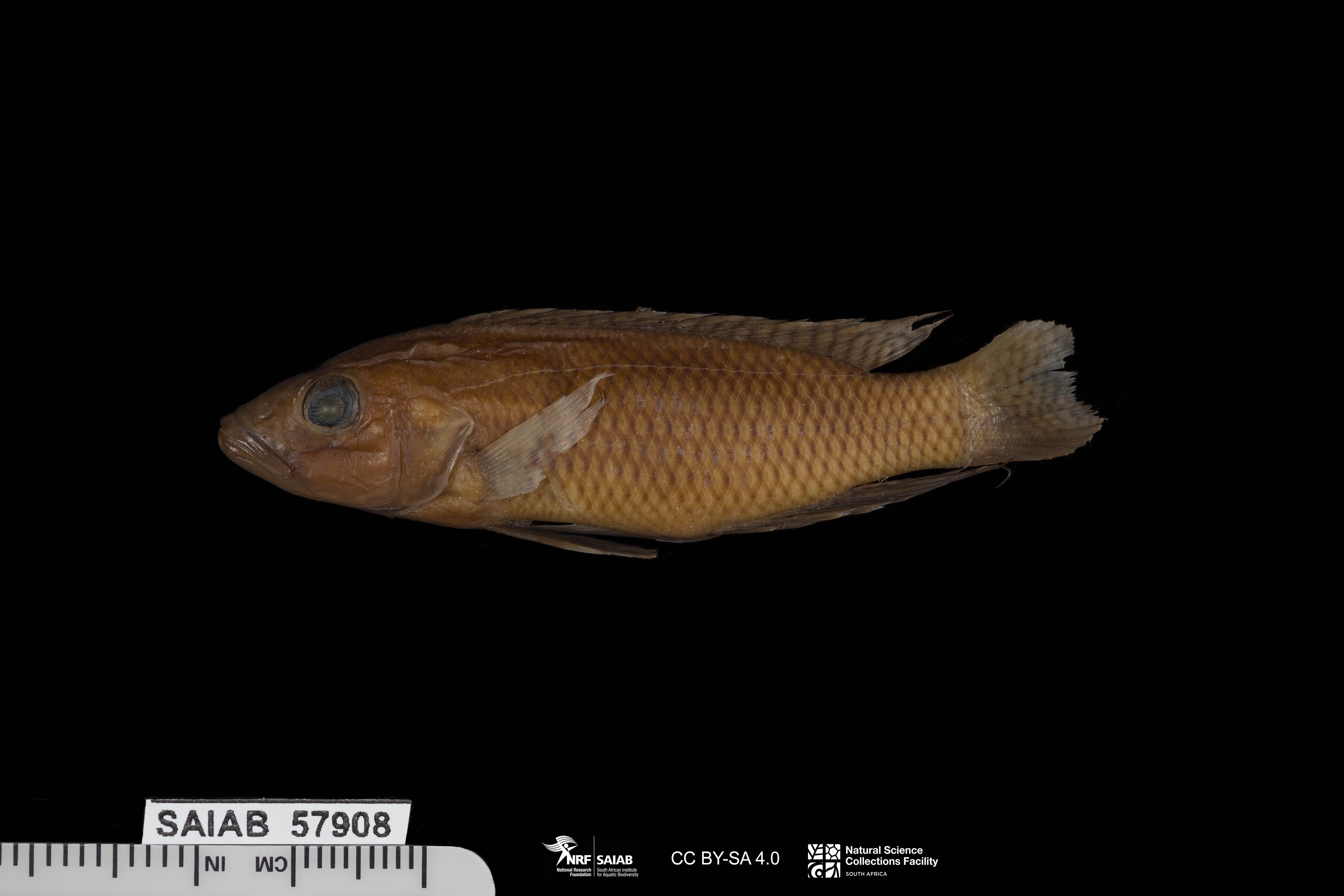
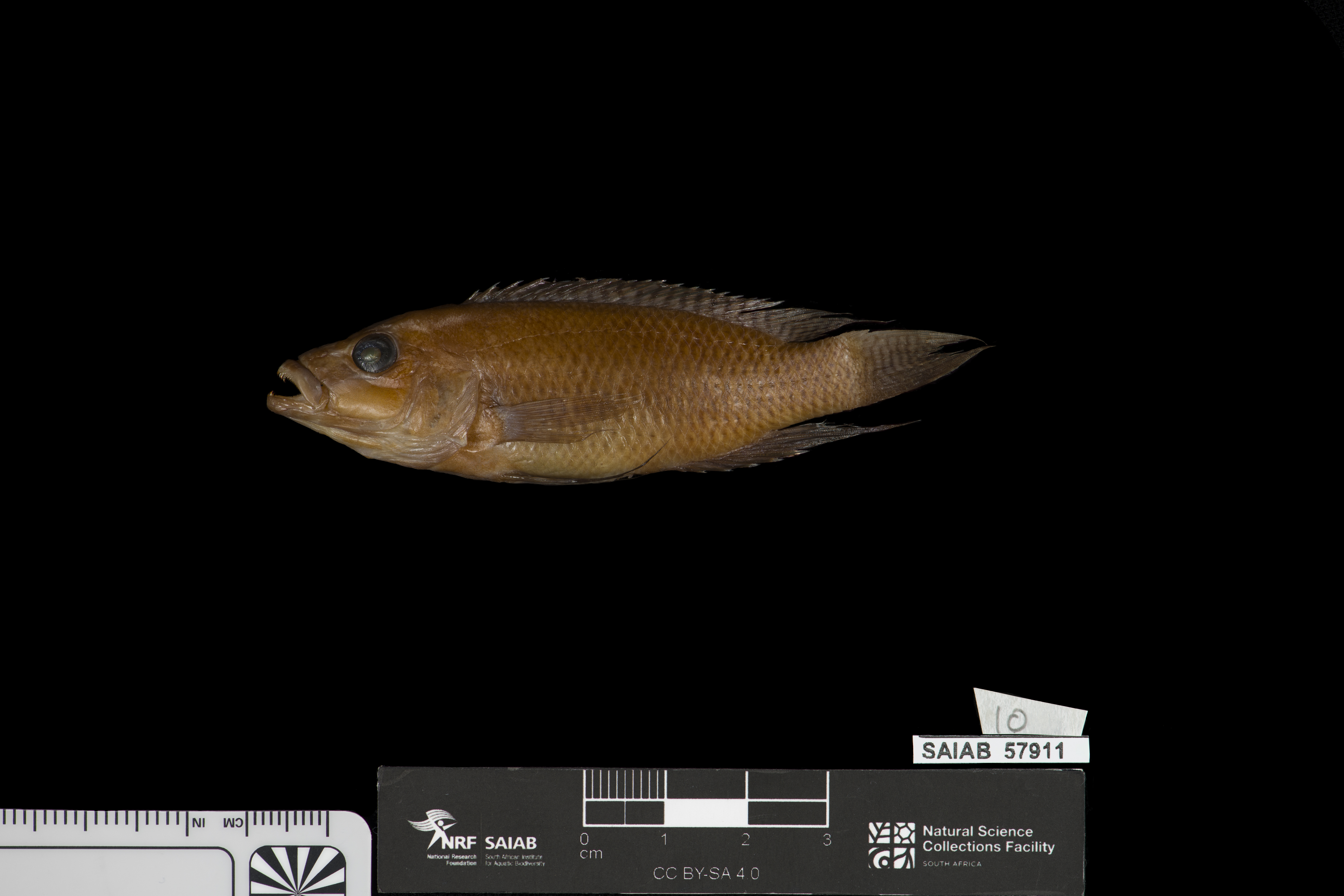
This is a small, pencil-slim cichlid. The type series tops out around 7.3 cm (2.9 in) standard length, with the largest individuals reaching perhaps 9 cm (3.5 in) total length once the tail filaments are counted. Its defining trait is shape: a notably low body depth (roughly 25–29% of standard length) and a shallow caudal peduncle give it a more elongate, streamlined silhouette than most of its plumper relatives.
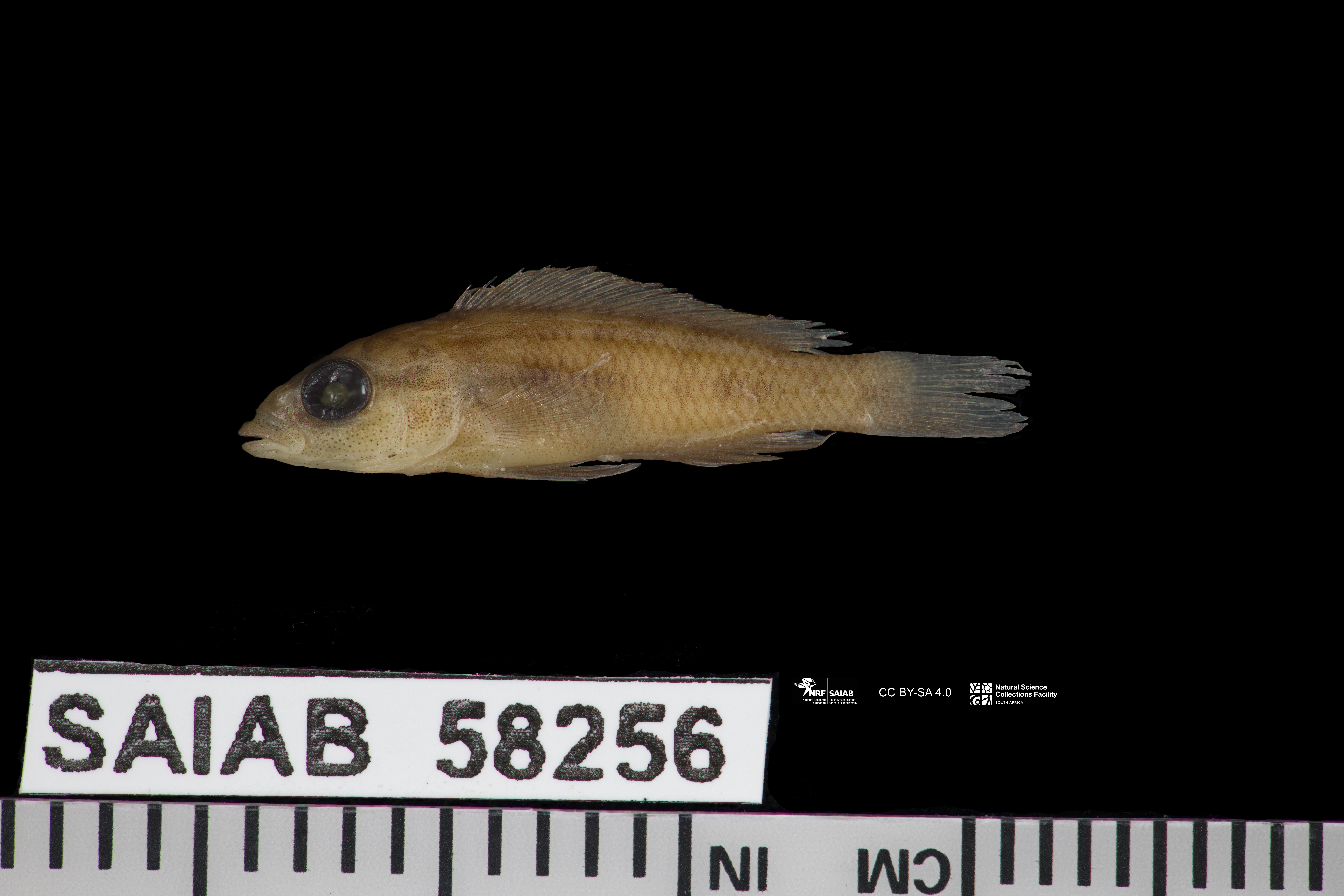
Coloration is understated rather than flashy — a pale fawn-to-grey body, the typical lyre-shaped Neolamprologus tail, and only faint markings on the dorsal and caudal fins. The describers leaned on negative characters to separate it: no markings on the gill cover, no bars on the body, no conspicuous spots on the scales, and juveniles a drab grey-brown. Countable features include 19–20 dorsal spines with 8–10 soft rays, 5–6 anal spines, 13 pectoral rays, 33–35 scales along the lateral series, and 31 vertebrae. Males grow larger than females, but the sexes are otherwise hard to tell apart by eye. In practice, distinguishing it from the nearly identical N. walteri and N. falcicula comes down to subtle proportions and, tellingly, where the fish was caught — the kind of separation that fuels the synonymy debate.
Range & habitat
Neolamprologus chitamwebwai is a Lake Tanganyika endemic with one of the narrowest confirmed ranges in the genus. The type locality is Cape Bangwe, on the Bangwe peninsula about 5 km south of Kigoma on the lake's east (Tanzanian) coast, at roughly 4°54'S, 29°36'E. FishBase and the original description treat it as known with certainty only from this area; the authors allowed it might also occur along the east coast near the lake's center, and hobby sources note that some populations farther south assigned to this name are probably distinct and undescribed. Aquarium-trade variants circulate under collection labels such as "Jakobsen's Beach" and "Mzungu Beach," both in the Kigoma area.
The fish is highly stenotopic — narrowly tied to one habitat type. It lives on exposed parts of rocky shores dominated by very large boulders, one to two meters across, on a steep slope, with sand pooled in the gaps between the stones. That sand is not incidental: the describers considered its presence mandatory for the species, which also favors clear water with low sedimentation. Recorded depths run from about 10 to 30 m (33–98 ft), with the fish most common between 10 and 20 m (33–66 ft). Population density is low and individuals show strong site fidelity, holding small home ranges and rarely straying far — a sedentary, place-bound existence rather than the roving colonies of its kin.
Ecology & diet
Neolamprologus chitamwebwai is a carnivore that gleans small invertebrates from the rocky substrate, the biofilm coating the stones, and the water just above the bottom; FishBase places its estimated trophic level near 3.5. A characteristic behavior is sediment processing — the fish takes mouthfuls of substrate and spits them back out, a winnowing action that sorts edible morsels from grit, common among benthic-feeding lamprologines.
The more interesting ecological story is one of niche partitioning. Verburg and Bills documented that chitamwebwai and its sibling N. walteri share much of the same coastline yet split the habitat finely: walteri lives in large numbers in sheltered areas with rubble, while chitamwebwai occurs in much lower numbers on exposed boulder slopes with coarser sediment and higher visibility. Stable-isotope data pointed to a correspondingly more benthic diet in chitamwebwai. That fine-grained division of resources between closely related, co-occurring species is part of why the Tanganyika cichlid flock is such a touchstone for studying how ecological specialization drives diversification in a single lake.
Behavior & breeding
Like all Neolamprologus, this is a substrate spawner rather than a mouthbrooder: it lays adhesive eggs on a hidden surface — typically within rockwork or a cave — and both parents guard the clutch and the resulting fry. What sets it apart from the famous "princess" cichlids is how few young it produces. Reports put its output at roughly 10–20 fry per spawn, far below the dozens that colonial relatives such as N. brichardi and N. pulcher raise, and ecologically closer to solitary, low-fecundity species. That low reproductive rate dovetails with its low population density and strong site fidelity in the wild.
The species is described as quite aggressive toward its own kind, and territorial toward other species mainly when it has fry to defend. It does not form the conspicuous extended-family colonies that make the brichardi group so popular; instead it tends toward pairs or small groups holding small, vigorously defended patches of reef. As with much of this genus, the published natural-history detail is thin and the breeding picture is assembled from the original description plus a modest body of aquarium observation rather than a dedicated study.
In the aquarium
Be honest from the outset: Neolamprologus chitamwebwai is essentially absent from the aquarium trade. The fish that move under "walteri" or "falcicula" labels are its near-identical complex-mates, and even those are uncommon; true, locality-verified chitamwebwai is a collector's rarity. Any care guidance is therefore extrapolated from the species' biology and from keeping experience with its very close relatives.
On that basis, a single pair (or a male with two females) wants something on the order of a 40-gallon (about 150 L) tank, scaped with heavy rockwork arranged into passages and caves over a sand bottom that echoes the boulder-and-sand biotope. Water should be hard and alkaline in the Tanganyika range — roughly pH 8.5–9.0, high mineral content, temperature near 75–81°F (24–27°C) — and kept very clean and well-oxygenated, since the wild fish is a clear-water, low-sediment specialist. Expect real aggression toward conspecifics and toward tankmates near a defended nest; in a larger tank a pair can hold a territory within a robust Tanganyikan community. This is not a beginner colony fish in the brichardi mold — its low fecundity, narrow habitat preferences, and rarity make it a project for an experienced rift-lake keeper, not an impulse purchase.
Conservation
Neolamprologus chitamwebwai has not been assessed by the IUCN Red List — it is formally Not Evaluated, and given the unresolved question of whether it is even a distinct species, it may stay that way for some time. There is no targeted commercial fishery for it and, as a fish all but absent from the ornamental trade, it faces little direct collection pressure. The real concern is not the species line item but its extreme localization: a cichlid known with confidence from one short stretch of shoreline near a growing lakeside city (Kigoma) is, by definition, vulnerable to anything that degrades that specific habitat.
That is where the lake's wider trajectory matters. Lake Tanganyika is warming, and a warmer surface strengthens the lake's stratification and shrinks its mixing zone; O'Reilly and colleagues (2003, Nature) inferred a roughly 20% drop in primary productivity over the late twentieth century, implying on the order of a 30% decline in fish yields. Cohen and colleagues (2016, PNAS) reconstructed an associated loss of roughly 38% of the lake's oxygenated benthic habitat as the oxygen boundary shoaled — bad news for any bottom-dwelling, rock-and-sand specialist that lives in the 10–30 m band, as this one does. Closer to shore, sedimentation and nutrient loading from deforestation and development bury the clean rocky substrates and cloud the clear water that chitamwebwai specifically requires (Cohen et al. 1993). The basin's economy leans heavily on the pelagic clupeid (Stolothrissa and Limnothrissa) and Lates fishery that feeds four nations — Tanzania, the Democratic Republic of the Congo, Burundi, and Zambia — and that shared resource is coordinated through the four-country Lake Tanganyika Authority. None of these basin-scale pressures targets this fish directly, but a sedimentation-sensitive, single-locality rocky-shore endemic is precisely the kind of species that could quietly disappear before anyone formally evaluates it.
Sources
- Neolamprologus chitamwebwai — FishBase summary
- Eschmeyer's Catalog of Fishes — chitamwebwai, Neolamprologus
- GBIF — Neolamprologus chitamwebwai Verburg & Bills, 2007
- GBIF dataset — Two new cichlid species Neolamprologus from Lake Tanganyika
- Verburg & Bills (2007), Two new cichlid species Neolamprologus from Lake Tanganyika — Zootaxa 1612 (FishBase ref)
- Plazi treatment — Neolamprologus walteri / chitamwebwai (Verburg & Bills 2007)
- ResearchGate — Two new sympatric species of Neolamprologus (Verburg & Bills 2007)
- Two Neolamprologus described — Practical Fishkeeping
- Neolamprologus chitamwebwai 'Jakobsen's Beach' — tanganyika.si
- Neolamprologus genus overview — Cichlid Room Companion (public profile)
- O'Reilly et al. (2003), Climate change decreases productivity of Lake Tanganyika — Nature (PubMed)
- Cohen et al. (2016), Climate warming reduces fish production and benthic habitat in Lake Tanganyika — PNAS
- Lake Tanganyika: Status, challenges, and opportunities for research — ScienceDirect
- IUCN Red List of Threatened Species (species Not Evaluated)
- Cichlid Fish Forum — keeping/breeding the brichardi/walteri group (community thread) — community/anecdotal
- r/Cichlid — multi-species breeding setups with walteri/brichardi (community discussion) — community/anecdotal