
Taxonomy & naming
Neolamprologus christyi was described by Ethelwynn Trewavas and Max Poll in 1952 from material collected at Mtosi Bay on the rocky south coast of Lake Tanganyika. The species epithet honors Dr. Cuthbert Christy (1863-1932), a British physician and zoologist better remembered for his work on sleeping sickness than for ichthyology. It belongs to the tribe Lamprologini, the substrate-spawning lineage that accounts for roughly ninety described species in the lake and is among the most diverse cichlid radiations anywhere.
Within Neolamprologus, christyi sits close to the N. petricola and N. mondabu group, which it resembles in general build but differs from in having a more elongate body, a distinctly crescent-shaped caudal fin, a higher scale count, and a markedly nastier disposition. Its deeply forked tail invites confusion with the unrelated N. furcifer; the two are not close kin, and the shared shape is convergence rather than ancestry. FishBase catalogs the species under ID 8655, and Eschmeyer's Catalog of Fishes records the original Trewavas & Poll combination.
Appearance
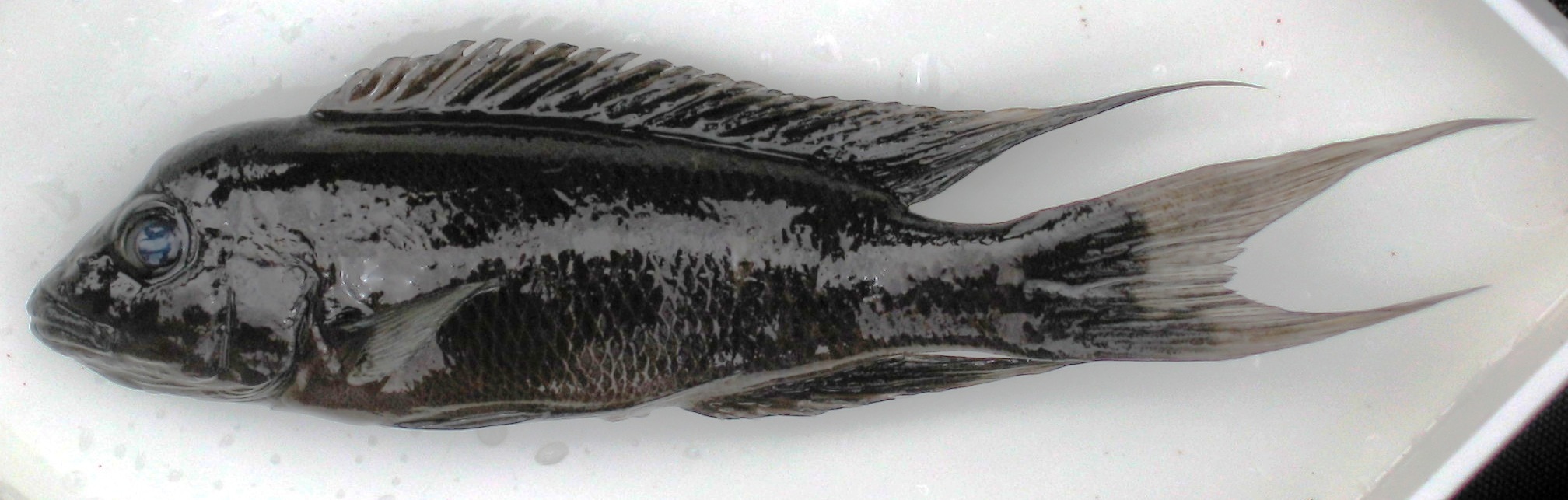
This is a streamlined, torpedo-bodied lamprologine that reaches about 6 in (15 cm) total length in the wild, with aquarium specimens occasionally pushing toward 7 in (18 cm). The most striking feature is its ontogenetic color change. Juveniles are beige to tan, set off by clean blue edging along the dorsal and caudal fins; as the fish matures it darkens dramatically, the adults turning matte black to a deep chocolate brown that can look almost uniform under tank lighting.
The caudal fin is forked, often described as crescent-shaped, and the body is noticeably more elongate than in look-alike congeners. Sexual dimorphism is weak: males may run slightly larger, and females are sometimes paler, but the difference is inconsistent and not a reliable way to sex the fish. In practice, keepers separate the sexes by behavior and venting rather than by color or finnage.
Range & habitat
Neolamprologus christyi is a Lake Tanganyika endemic with a restricted distribution along the southeastern shore. FishBase records it from Isanga, on the Zambian side, north to Kipili in Tanzania, and field observations place it at the southern Kipili islands and at sites such as Chiloelo Point near Kalepa. South of Mtosi it overlaps with the closely related N. modestus, a contact that has biological consequences (see below).
It is a shallow rocky-shore specialist, common where boulder fields meet open sand, and it rarely ranges below about 33 ft (10 m). Tanganyika's chemistry frames its tolerances: the lake runs hard and alkaline, and the conditions reported for this species span pH 7.0-8.5, a hardness of roughly 10-15 dH, and temperatures of 23-28 C (73-82 F). Because the site's focus is the water body itself, it is worth stressing that this is a fish of the lake's sunlit littoral interface, not its deep or pelagic zones.
Ecology & diet
By trade, N. christyi is a carnivore that forages over and between rocks at the sand margin. Gut-content analyses summarized in the literature and by hobby-grade biotope references point to a diet of invertebrates: crustaceans, small mollusks (snails), worms, and insect larvae. FishBase places its trophic level at about 3.3, consistent with a mid-level invertebrate predator rather than a piscivore or an algae grazer.
Its ecological role is that of a territorial benthic hunter occupying the rock-sand ecotone, a productive and heavily contested microhabitat in Tanganyika where dozens of lamprologines partition space and food. The species' strength and aggression are not incidental traits; in a habitat where a defensible crevice is a breeding asset, a powerful bite and a willingness to use it are how a fish holds ground.
Behavior & breeding
Like other lamprologines, N. christyi is a cave-spawning substrate brooder rather than a mouthbrooder. A pair excavates a cavity beside or beneath rocks and deposits a large clutch, reported at more than 250 eggs, though the number of fry that survive to free-swimming is usually under a hundred. Parental care is real and sustained: fry are most often tended by the female, which has led some observers to suspect a harem-like arrangement, while other field observations document both partners jointly defending the brood, pointing to facultative monogamy. The truth is probably that its mating system is flexible.
The most scientifically interesting note attached to this species comes from the lake itself. In the phylogenetic study of the Lamprologini by Sturmbauer and colleagues, a heterospecific breeding pair, N. christyi crossed with N. modestus, was photographed guarding fry near the Kalambo estuary in the southeast, exactly where the two species' ranges meet. Such natural hybridization between distinct lamprologines is a recurring theme in Tanganyika and a reminder that the boundaries in this species flock are young and sometimes porous.
In the aquarium
Among Tanganyikan keepers, N. christyi has a hard-earned reputation as one of the most aggressive African cichlids in the hobby, conspecifics and tankmates alike bearing the brunt. The signal is consistent across independent accounts: experienced keepers report pairs barely 4 in long clearing out tanks of much larger fish, and even sizeable setups in the 75-125 gallon range described as insufficient to keep the peace. Treat that as a baseline, not an exaggeration.
Practically, that means a spacious, hardscape-heavy tank. Biotope references suggest a minimum of about 300 liters (roughly 80 gallons) for a single formed pair, built around large rock structures that form caves over a fine sand bed; because each member of a pair may hold its own cave, square footage and line-of-sight breaks matter more than raw volume. Water should track the lake, hard and alkaline, around pH 7.5-8.5 and 23-27 C (73-81 F). Tankmates must be robust, fast Tanganyikans large enough not to read as prey, and breeding pairs of small shell-dwellers or brichardi-type colonies are a recipe for slaughter. This is not a beginner fish, and the most common mistake is underestimating it on the basis of its modest size.
Conservation
The IUCN Red List currently assesses Neolamprologus christyi as Least Concern, with the most recent assessment dated 28 February 2025. That is an upgrade in optimism from an older 2006 evaluation that listed the species as Vulnerable, and it reflects a relatively wide southeastern distribution and no evidence of a steep decline; collection for the aquarium trade is commercial but not at a scale flagged as a population-level threat. The honest summary is that the species itself is not presently in trouble.
The lake around it is another matter, and a shallow rocky-shore endemic is exposed to several of Tanganyika's pressures. Paleolimnological work by O'Reilly and colleagues (2003) found that climate warming has reduced the lake's mixing and primary productivity by roughly 20%, implying on the order of a 30% drop in fish yields; Cohen and colleagues (2016) estimate that warming has cost the lake something like 38% of its oxygenated benthic habitat since the early twentieth century, squeezing the very bottom-dwelling community this fish belongs to. Closer to shore, sedimentation and nutrient runoff from deforestation and development degrade the rocky littoral that N. christyi depends on (Cohen et al. 1993). The lake's headline fishery, the pelagic clupeids Stolothrissa and Limnothrissa together with the predatory Lates, feeds millions across four nations and is governed jointly through the Lake Tanganyika Authority. Those basin-scale stresses do not currently endanger this species, but they bear directly on its habitat guild, and a Least Concern listing should be read as a status that depends on the lake's littoral staying healthy.
Sources
- FishBase: Neolamprologus christyi (summary, ID 8655)
- Eschmeyer's Catalog of Fishes (California Academy of Sciences)
- FishBase point/occurrence data for Neolamprologus christyi
- GBIF: Neolamprologus christyi (Trewavas & Poll, 1952)
- tanganyika.si species account: Neolamprologus christyi
- Cichlid Room Companion: genus Neolamprologus
- Sturmbauer et al. (2010), Evolutionary history of the Lake Tanganyika cichlid tribe Lamprologini (Mol. Phylogenet. Evol.)
- Day et al. (2007), Phylogenetic relationships of the Lake Tanganyika cichlid tribe Lamprologini (PubMed abstract)
- African Diving Ltd blog: Neolamprologus christyi field localities (Chiloelo Point, Kipili islands)
- IUCN Red List: Neolamprologus christyi (Least Concern, 2025 assessment)
- O'Reilly et al. (2003), Climate change decreases aquatic ecosystem productivity of Lake Tanganyika (Nature; PubMed)
- Cohen et al. (2016), Climate warming reduces fish production and benthic habitat in Lake Tanganyika (PNAS)
- TRAFFIC / IUCN SSC: Climate change vulnerability and human use of wildlife in Africa's Albertine Rift (lists N. christyi)
- MonsterFishKeepers forum: keeper accounts of Neolamprologus christyi aggression and size — community/anecdotal
- Cichlid-Forum thread: keeping Neolamprologus christyi — community/anecdotal