Taxonomy & naming
George Albert Boulenger described this fish in 1898 as Lamprologus fasciatus, working from specimens J. E. S. Moore collected at Kinyamkolo, near the southern tip of Lake Tanganyika; the unique holotype sits in the Natural History Museum, London. The species epithet fasciatus means "banded," a nod to the dark vertical bars along its flanks.
Its genus has been a moving target. Maréchal and Poll (1991) and later Schelly, Stiassny and colleagues (2003) placed it in Neolamprologus, the name under which it still appears across much of the aquarium trade and in FishBase. Eschmeyer's Catalog of Fishes, however, now lists Altolamprologus fasciatus (Boulenger, 1898) as the valid combination, following Konings (2019), and the IUCN has adopted that placement as well, treating Neolamprologus fasciatus as a synonym. The disagreement is not mere bookkeeping: molecular work on the tribe Lamprologini has repeatedly recovered Lamprologus, Neolamprologus and several allied genera as para- or polyphyletic, so the boundaries between them are biologically fuzzy. Some authors have even floated a hybrid origin for this species, which would help explain why it resists clean assignment. We keep the long-familiar Neolamprologus fasciatus as the page title while flagging Altolamprologus fasciatus as the currently preferred name.
Appearance
This is a deep-bodied, strongly laterally compressed cichlid — built, like the rest of its group, to slip sideways into rock cracks. Set beside its better-known relatives Altolamprologus calvus and A. compressiceps, though, it reads as the slimmer, more pointed cousin: the snout is drawn out and the back lacks their pronounced hump, giving it a more elongate profile.
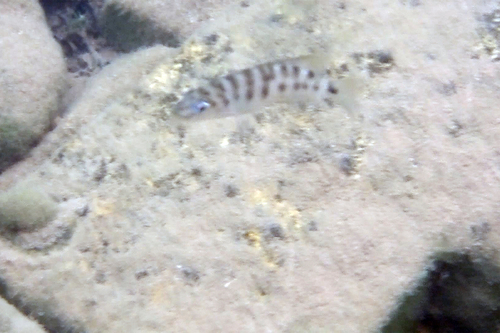
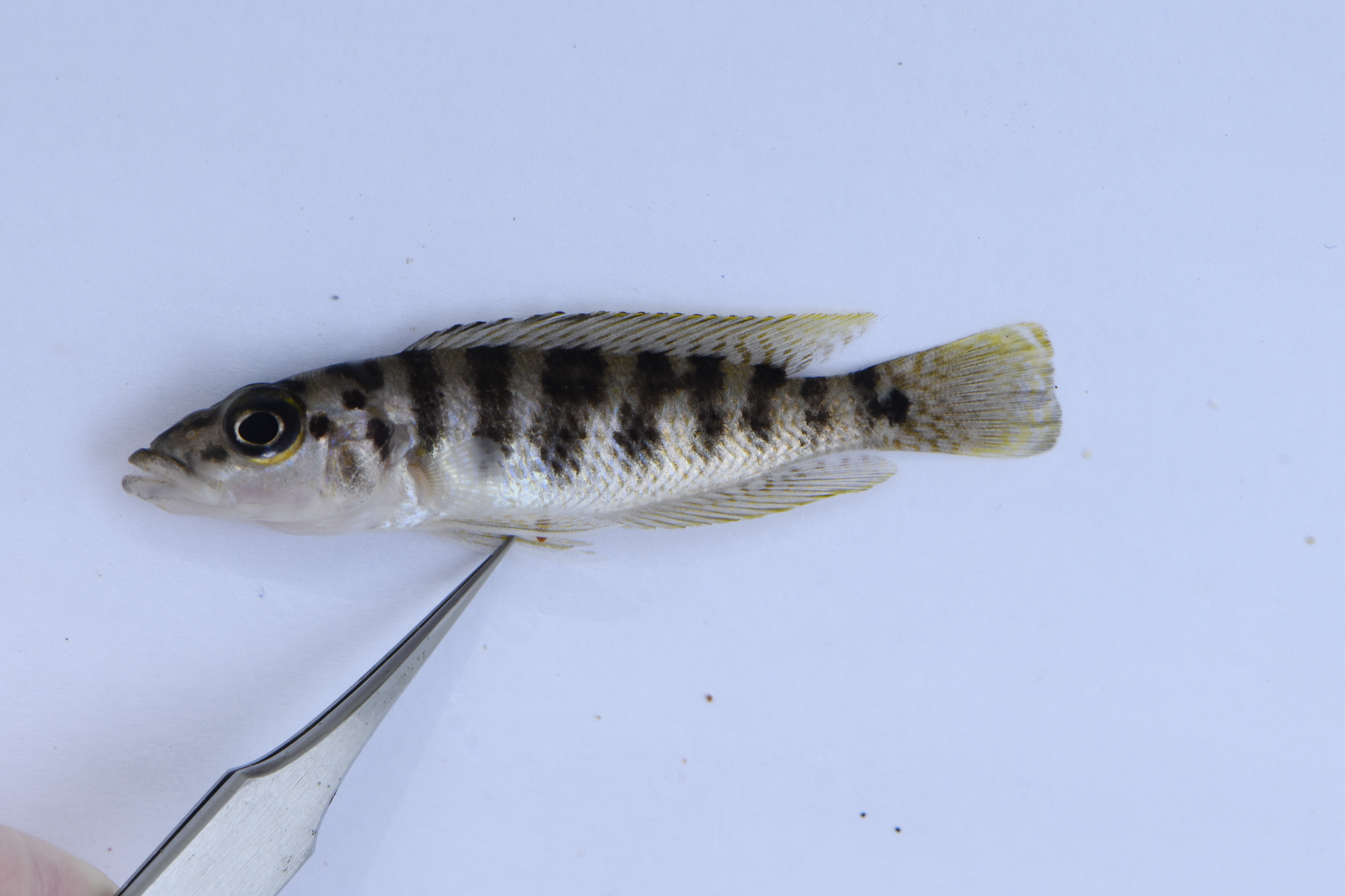
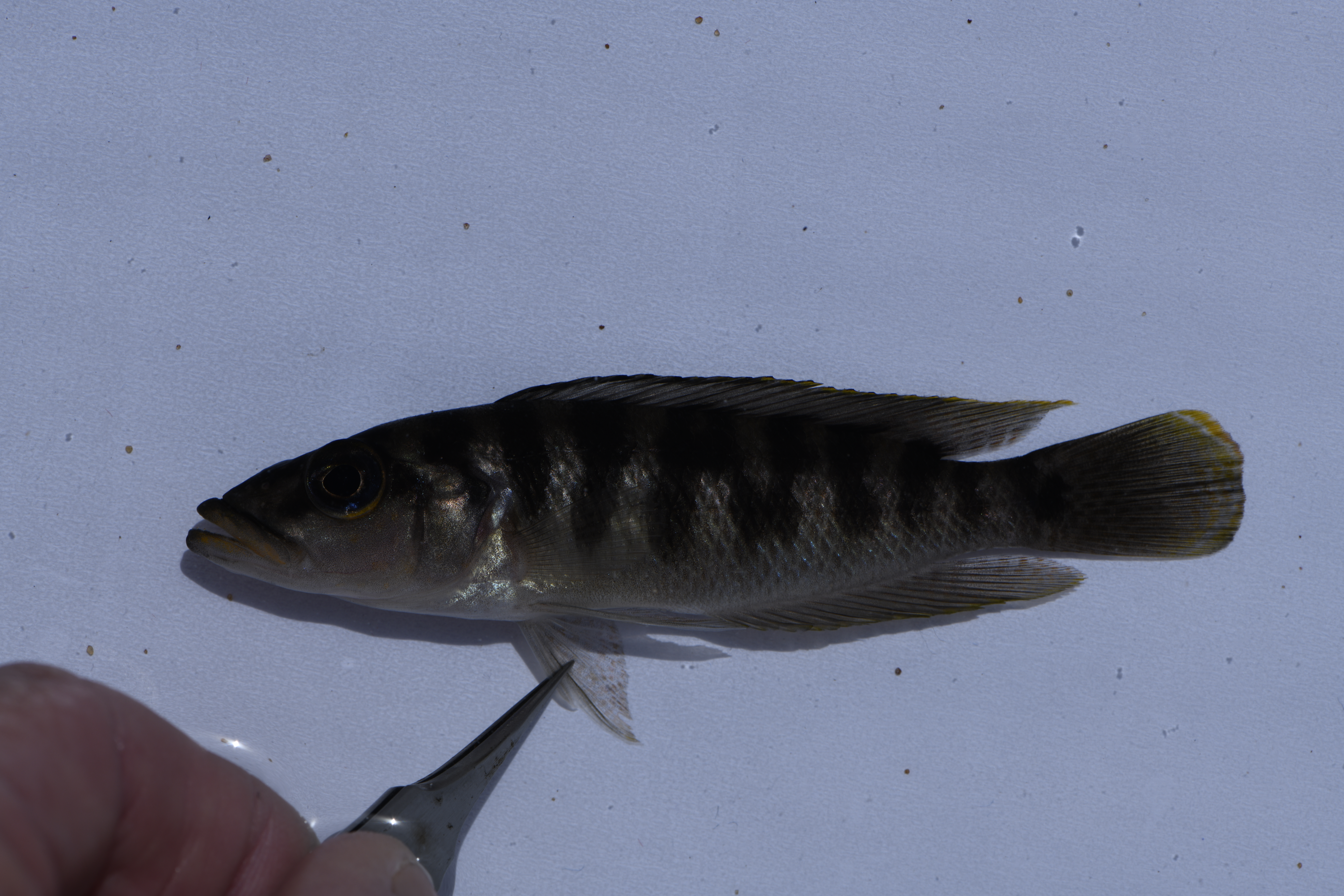
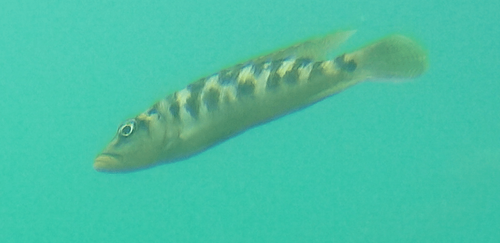
The ground color is a pale whitish to soft yellow, crossed by roughly nine darker vertical bars often overlaid with a faint blue iridescent sheen. The eyes are a striking bright blue, and small yellow flecks dot the gill covers, a touch more obvious in males. Dorsal and anal fins run far back and nearly meet the rounded tail. Sexual dimorphism is subtle in pattern but clear in size: males grow noticeably larger than females. Reported maximum length runs to about 6 in (15 cm) total length in FishBase and field guides, with some hobby sources citing up to 6.3 in (16 cm); females typically top out far smaller, around 3.5 in (9 cm). Lower figures occasionally quoted (around 3 in / 8 cm) most likely describe females or standard rather than total length.
Range & habitat
The species is endemic to Lake Tanganyika and effectively lake-wide, recorded along the Tanzanian, Zambian and Congolese shores, with the IUCN noting it is most common in the southern basin and distinctly rarer in the north — and apparently absent from the northeastern Burundi coast. No named geographic color variants are recognized despite that broad range, which is itself unusual for a Tanganyikan rock-dweller.
Its world is the rocky littoral and the transition zones where rock gives way to sand, mostly at modest depth — roughly 6.5–50 ft (2–15 m). It shares this habitat with A. calvus and A. compressiceps. FishBase characterizes it as benthopelagic and "not rock-bound," willing to move across very shallow open water rather than clinging to one reef. In-situ conditions are the hard, alkaline, thermally stable waters typical of the lake's surface layer: around 23–25 °C (73–77 °F), high pH and substantial mineral hardness.
Ecology & diet
Neolamprologus fasciatus is a carnivore and an ambush predator, sitting at a trophic level of roughly 3.8. Examined gut contents point to a diet heavy in shrimp and other crustaceans, but the fish is also a documented hunter of juvenile cichlids, using its compressed body to reach into crevices and its protrusible jaws to draw small prey out of cover.
Field observers note a behavioral twist that sets it apart from its relatives: where A. calvus and A. compressiceps tend to creep in close before striking, N. fasciatus has been described attacking from a greater distance — on the order of a meter — making it the more actively cruising hunter of the trio. In the wider community it functions as a small mid-level predator on the rocky shore, one of the many lamprologines that crop the lake's enormous output of cichlid fry and invertebrates.
Behavior & breeding
Outside of breeding, males are largely solitary, ranging over the rocks in search of prey. The mating system is best described as a loose harem: a male associates weakly with one or more females, and pair bonds are not strong. Spawning is substrate-based and exploits the size gap between the sexes. The female chooses a narrow cave, crevice, or empty snail shell whose entrance is too tight for the larger male to enter; she lays inside while he releases milt at the opening, and the current and her own movements carry it to the eggs.
The female then guards the clutch — on the order of 200 eggs — within the shelter, while the male patrols the surrounding area for a short period, often departing before the fry become free-swimming roughly ten days after spawning. This "female in the shell, male outside" strategy is a recurring theme among Tanganyika's lamprologines, and it is the same trick that makes the fish both fascinating and finicky to breed in captivity.
In the aquarium
This is a fish for a keeper who already understands Tanganyikans, not a starter cichlid — and certainly not a tankmate for anything small enough to be classed as food. Plan on an aquarium at least about 5 ft (150 cm) long, on the order of 50+ US gal (200 L) for a single male with one or more females; more fish or a mixed Tanganyikan community needs more room. Aquascape it with stacked rock that creates many tight caves and crevices over a fine sand floor, and for breeding offer either very narrow cave entrances or large empty snail shells that only the female can squeeze into.
Match the lake's chemistry: hard, alkaline water around pH 8.5–9.0 and roughly 75–79 °F (24–26 °C). Males are pugnacious toward rival males, so one male per setup is the usual rule, but the species is comparatively peaceful toward unrelated tankmates and turns territorial mainly when spawning. It readily takes quality prepared foods alongside frozen krill, mysis and similar meaty fare. Two honest caveats keepers repeat: don't house it with bite-sized fish, and don't expect easy breeding — getting the crevice geometry right, so the female is protected and the male is excluded, is the part people most often get wrong.
Conservation
The species is assessed by the IUCN as Least Concern, first in 2006 (as Altolamprologus fasciatus) and reaffirmed as Least Concern in the most recent update, on the strength of its wide, lake-spanning distribution and the absence of any major species-specific threat. It is collected for the ornamental trade and appears commercially in the hobby, but that pressure is modest and not flagged as a population-level risk; the one threat the assessment singles out is sedimentation of its rocky habitat from soil erosion. Its population trend is listed as unknown.
That "Least Concern" label, though, sits inside a lake under real strain. Lake Tanganyika is warming, and O'Reilly et al. (2003, Nature, doi:10.1038/nature01833) showed that stronger thermal stratification has reduced deep mixing and cut primary productivity by roughly 20%, with knock-on declines of around 30% in fish yields. Cohen et al. (2016, PNAS, doi:10.1073/pnas.1603237113) found that warming has shrunk the oxygenated benthic habitat available to lake animals by something like 38%. Shoreline development and erosion add sediment that smothers exactly the rocky, crevice-rich substrate this fish hunts and breeds in, and the great pelagic clupeid fishery (Stolothrissa and Limnothrissa, with their Lates predators) that feeds four nations underscores how much human demand the basin already carries. Governance is shared by Burundi, the Democratic Republic of the Congo, Tanzania and Zambia through the Lake Tanganyika Authority. None of this currently endangers N. fasciatus — a widespread, adaptable rock-dweller — but as a shallow littoral specialist it is squarely exposed to the sedimentation and warming reshaping its habitat, and "secure for now in a stressed lake" is the fair way to state its status.
Sources
- Eschmeyer's Catalog of Fishes — Lamprologus/Altolamprologus fasciatus (Boulenger 1898)
- FishBase — Neolamprologus fasciatus summary
- Cichlid Room Companion — Altolamprologus fasciatus species profile
- tanganyika.si — Neolamprologus (Altolamprologus) fasciatus, biotope and natural history
- AquaInfo — Altolamprologus fasciatus care profile
- Fishipedia — Altolamprologus (Neolamprologus) fasciatus
- IUCN Red List — Altolamprologus fasciatus (2006 assessment, e.T60593A12374040)
- Phylogenetic relationships of the Lake Tanganyika cichlid tribe Lamprologini (Mol. Phylogenet. Evol.)
- O'Reilly et al. 2003 — Climate change decreases aquatic ecosystem productivity of Lake Tanganyika (Nature)
- Lake Tanganyika: Status, challenges, and opportunities for research (J. Great Lakes Res.)
- Cichlid Room Companion — Altolamprologus fasciatus, predatory cichlid (public post)
- Quebec Cichlides — Altolamprologus calvus & compressiceps, telling them apart
- Cichlid-Forum — Altolamprologus with shell dwellers / tankmates (community thread) — community/anecdotal
- Fish Lore — shell dwellers and Altolamprologus tankmates (community thread) — community/anecdotal
- UKAPS — shell dwellers discussion (community thread) — community/anecdotal
- The Adaptive Radiation of Cichlid Fish in Lake Tanganyika (review, PMC)