

Taxonomy & naming
Neolamprologus furcifer was described by the prolific Belgian-British ichthyologist George Albert Boulenger in 1898, from specimens collected during J. E. S. Moore's expedition to Lake Tanganyika, with the type localities given as Kinyamkolo and Mbity Rocks at the lake's southern end. Boulenger placed it in Lamprologus; it was transferred to Neolamprologus in the modern revisions of the lamprologine cichlids (Maréchal & Poll 1991), and Eschmeyer's Catalog of Fishes lists it as valid as Neolamprologus furcifer (Boulenger 1898), with Lamprologus furcifer as the senior synonym.
The genus name blends Greek roots — neos (new) with the older lamprologus, itself from lampros (bright) and lagos (hare). The species epithet is the more telling one: furcifer is Latin for "fork-bearer," a reference to the deeply forked tail whose lobes draw out into long points in older fish. The genus is part of Tanganyika's large lamprologine flock — the substrate-spawning lineage that includes the shell-dwellers, Julidochromis, Telmatochromis and Altolamprologus — rather than the mouthbrooding radiations the lake is also famous for.
A long-standing puzzle was resolved in 2014, when Kullander, Norén and the Karlssons described a cryptic look-alike, Neolamprologus timidus, from the Tanzanian coast. Earlier reports of "two forms" of furcifer — one with two dark horizontal stripes, elongated fins and an orange iris, the other plainer with a yellow iris — turned out to conflate furcifer with this sympatric second species. The work usefully tightened the identity of true furcifer and is the reason older aquarium literature on the fish should be read with care.
Appearance
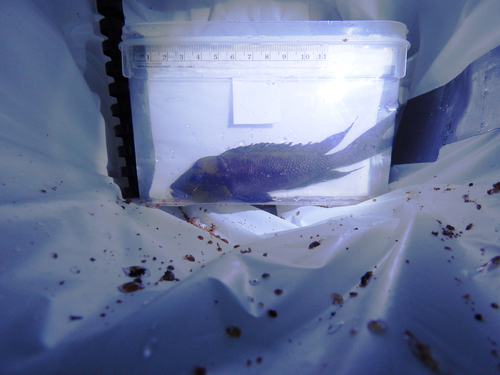
This is a moderately sized, elongate, laterally compressed cichlid reaching about 6 in (15 cm) in total length, with most adults closer to 5 in (13 cm). The body color is muted and variable — gray, beige, clay-brown, coppery or nearly dark purple depending on mood and locale — and up to six dark vertical bars can flicker into view across the flanks when the fish is excited or defending a site. Against that drab body the eye stands out: the iris ranges from pale blue to golden, set in a notably large eye.
The signature feature is the tail. The caudal fin is deeply forked and, especially in mature individuals, extends into two trailing filaments — the "fork" that named the species. The scales are small and numerous, extending onto the dorsal, anal and caudal fins. Sexual dimorphism is subtle: males grow somewhat larger and old males develop a modest nuchal hump on the forehead, but the sexes are otherwise hard to separate by eye, which complicates pairing fish in the aquarium. The large eye is widely read as an adaptation to the species' shaded, possibly crepuscular or nocturnal habits rather than a display trait.
Range & habitat
Neolamprologus furcifer is endemic to Lake Tanganyika and occurs essentially lake-wide, recorded along the rocky coasts of all four riparian nations — Burundi, the Democratic Republic of the Congo, Tanzania and Zambia. FishBase records it across the lake's latitudinal span (roughly 3°S–9°S), and aquarium collectors list dozens of named localities from Burundi in the north to the Zambian shore in the south.
It is a rock-dweller in the strict sense. The fish keeps to the rocky littoral, typically at depths of around 6–130 ft (2–40 m), and is tightly bound to the dark recesses between large boulders: crevices, caves, and the undersides of overhangs where light barely reaches. Vegetation is essentially absent from this biotope; the substrate is rock and sand. In-situ water is what the whole lake offers in its surface layers — warm and hard-alkaline, with FishBase citing roughly 73–77°F (23–25°C) for the species and field accounts noting habitat temperatures nearer 77–81°F (25–27°C). The defining trait of its niche is not depth or chemistry but architecture: furcifer needs three-dimensional rocky structure with shaded interior spaces, and it is rarely far from a crevice it can vanish into.
Ecology & diet
Furcifer is a benthic micro-predator, assigned a trophic level of about 3.4 in FishBase's diet-based estimate. It forages over and inside the rockwork for the small animals that live in the slits and holes of its habitat — aquatic insect larvae and small crustaceans foremost among them. A dietary study from Luhanga and Mbemba in the northwest of the lake (Yuma et al. 1998) found stomachs dominated by zoobenthos: aquatic insects, including mayfly (Ephemeroptera) nymphs and fish eggs, made up the larger share, with the endemic shrimp Limnocaridina latipes accounting for most of the rest.
The foraging style matches the prey. Furcifer works the vertical faces and undersides of rocks, frequently oriented belly-up beneath an overhang, using its large pectoral fins to hold station against the stone while it picks invertebrates from cracks. The big eye fits a fish that hunts in shade and perhaps at dusk and night. Within the rocky community it is a mid-level carnivore — predator of invertebrates and small eggs, and itself prey for the lake's larger piscivores, which is precisely the pressure that shapes its remarkable breeding behavior.
Behavior & breeding
Outside breeding, furcifer is solitary and shy, each fish holding a crevice-centered territory and bolting for cover when disturbed. It is a substrate spawner — specifically a cave-spawner — not a mouthbrooder. A female lays roughly 50 eggs on the ceiling of a rock cave at the heart of a territory; males are reported to be polygamous, attending several females' nests. The female alone tends the eggs and guards the fry, which remain in her territory for around nine weeks after hatching, an unusually long period of maternal care for a fish.
The most striking thing furcifer does, though, is camouflage its young as snails. Work by Satoh and colleagues in Lake Tanganyika showed that furcifer fry develop brown-and-white stripes that closely match Reymondia horei, the most abundant snail in the nest rocks, resembling the snails in size and shape as well as pattern — apparently the first documented case of a fish masquerading as a snail. Tellingly, where the snail is absent the fry don't develop the stripes. The mother actively maintains the illusion: she chases harmless algae-grazing fish away from the nest (which seems to keep the algae the snails feed on plentiful, drawing snails in) and physically carries non-striped snails out of the nest, leaving the convincing striped ones behind. When researchers removed the snails, mothers had to attack would-be predators about twice as often to compensate. A companion study found that brooding females ration their vigilance, prioritizing fast-darting carnivorous intruders over closer scale-eating fish — and pay for that focus, suffering more scale-eater bites while distracted. It is one of the more sophisticated parental-care systems known in fishes.
In the aquarium
Furcifer is a connoisseur's Tanganyikan, not a starter fish — it reaches the trade only occasionally and rewards keepers who can meet its needs rather than its looks. Give it the lake's water: hard and alkaline, broadly pH 8.0–9.0 and warm, around 77–81°F (25–27°C). The tank must be built around rock. A single fish or pair wants a long aquarium — practical keepers point to something on the order of a 4–5 ft, 100-gallon-plus footprint — aquascaped as a wall of stacked stone over sand, with deep caves and shaded overhangs that let the fish behave naturally and retreat when it wants to. Plants are unnecessary and beside the point.
The honest caution is aggression and pairing. Furcifer is strongly territorial, and the trouble starts with its own kind: conspecifics tolerate each other poorly in close quarters, and because the sexes look so alike, assembling a compatible pair is genuinely difficult — a recurring theme across the territorial Neolamprologus that hobbyists keep, where established pairs in particular become hard to house with anything. Tankmates should be chosen conservatively and only in a spacious, structure-rich tank; avoid other crevice-claiming rock-dwellers that will compete for the same real estate. Diet is straightforward by comparison — a varied carnivore menu of quality frozen and prepared foods, fed in small portions — but the fish's secretive, shade-loving nature means you'll often see less of it than you'd like. Treat it as an intermediate-to-advanced project where the payoff is behavior, not a community centerpiece.
Conservation
Neolamprologus furcifer is assessed by the IUCN Red List as Least Concern (assessment dated 19 February 2025), consistent with a lake-wide distribution and no evidence of major species-specific decline. It is not listed by CITES. Collection for the aquarium trade is light: the fish appears only sporadically in the hobby, and FishBase rates its overall fishing vulnerability as low. There is no indication that trade is a meaningful pressure on wild populations at present.
That species-level reassurance, however, sits inside a lake under real strain. Lake Tanganyika is warming, and the warming matters because it changes how the water mixes. O'Reilly et al. (2003, Nature, doi:10.1038/nature01833) found that rising temperatures have strengthened the lake's stratification and reduced the deep mixing that lifts nutrients to the sunlit surface, cutting primary productivity by roughly 20% — a decline that may translate into something like a 30% drop in potential fish yields. Cohen et al. (2016, PNAS, doi:10.1073/pnas.1603237113), reading a ~1,500-year sediment record, tied that warming to declines in fish and endemic molluscs and to a roughly 38% shrinkage of the oxygenated benthic habitat in their study areas — the very near-shore, structured zone where most of Tanganyika's endemics, furcifer among them, actually live. On top of that, sedimentation and nutrient runoff from deforested, developed catchments degrade the rocky littoral (Cohen et al. 1993), smothering the cracks and clean rock surfaces this species depends on, while a basin-wide pelagic fishery built on clupeids (Stolothrissa, Limnothrissa) and Lates feeds millions of people across four nations whose waters are coordinated through the Lake Tanganyika Authority. None of these pressures targets N. furcifer directly, but all of them bear on its guild: a shallow, rocky-shore, crevice-dwelling endemic is exposed precisely to the shoreline sedimentation and the squeezing of oxygenated near-shore habitat that the lake-level science describes. The accurate summary is the careful one — the species itself is currently Least Concern, but the rocky littoral it cannot live without is the part of Tanganyika most clearly under threat.
Sources
- Eschmeyer's Catalog of Fishes — Neolamprologus furcifer
- FishBase — Neolamprologus furcifer summary
- FishBase — Food and Feeding Habits, Neolamprologus furcifer (Yuma et al. 1998)
- IUCN Red List — Neolamprologus furcifer (Least Concern, 2025)
- Kullander, Norén, Karlsson & Karlsson (2014) — Description of Neolamprologus timidus, new species, and review of N. furcifer from Lake Tanganyika
- Satoh et al. (2017) — Parental females of a nest-brooding cichlid improve and benefit from the protective value of young masquerading as snails (Animal Behaviour)
- Satoh, Hotta & Kohda (2021) — Maternal care-providing cichlid Neolamprologus furcifer selectively focuses on high-threat carnivorous intruders (Frontiers in Ecology and Evolution)
- O'Reilly et al. (2003) — Climate change decreases aquatic ecosystem productivity of Lake Tanganyika (Nature)
- Cohen et al. (2016) — Climate warming reduces fish production and benthic habitat in Lake Tanganyika (PNAS)
- New Scientist — Fish lure snails to their nest to help camouflage their babies
- AquaInfo — Neolamprologus furcifer (John de Lange)
- Cichlid Room Companion — Neolamprologus genus overview
- Cichlid Fish Forum — Neolamprologus territoriality and pairing discussions — community/anecdotal
- Cichlid Fish Forum — Neolamprologus brichardi tank mates / aggression thread — community/anecdotal
- Aquarium Advice — Setting up a 100g Tanganyikan community (rockwork species stocking) — community/anecdotal
- MonsterFishKeepers — Experience with Neolamprologus (pairing-out from groups) — community/anecdotal