
Taxonomy & naming
Neolamprologus modestus was described by the Belgian-British ichthyologist George Albert Boulenger in 1898 as Lamprologus modestus, from specimens taken at Mbity Rocks and Kinyamkolo (now Mpulungu) at the southern tip of Lake Tanganyika, in present-day Zambia. It was later transferred to Neolamprologus, the large genus erected within the tribe Lamprologini that today holds the bulk of Tanganyika's substrate-spawning cichlids. The generic name stitches together Greek roots — neos (new), lampros (torch), and lagos (hare) — while the species epithet modestus simply means 'modest' or 'unassuming,' a fair description of a fish with little ornament.
The species sits at the center of two long-running identity puzzles. The first is its near-twin N. mondabu: the two are so alike in body shape, color, behavior, and habitat that they were historically confused, and they form a classic geographic species pair, with N. mondabu occupying most of the lake and N. modestus replacing it in the south. The most reliable separating character is the tail — N. modestus has a rounded caudal fin, whereas N. mondabu's is pointed to crescent-shaped; Poll (1978) also noted small spots on the caudal, anal, and dorsal fins of modestus that mondabu lacks. The second puzzle is N. petricola, which Ad Konings in his 2015 treatment regards as a synonym of N. modestus; other workers keep them apart on subtle differences in body depth and the male's forehead profile. Until the question is settled, treating them as distinct remains defensible. Boulenger's original Lamprologus modestus is the accepted synonym; the IUCN lists the local name 'Umundigwa.'
Appearance
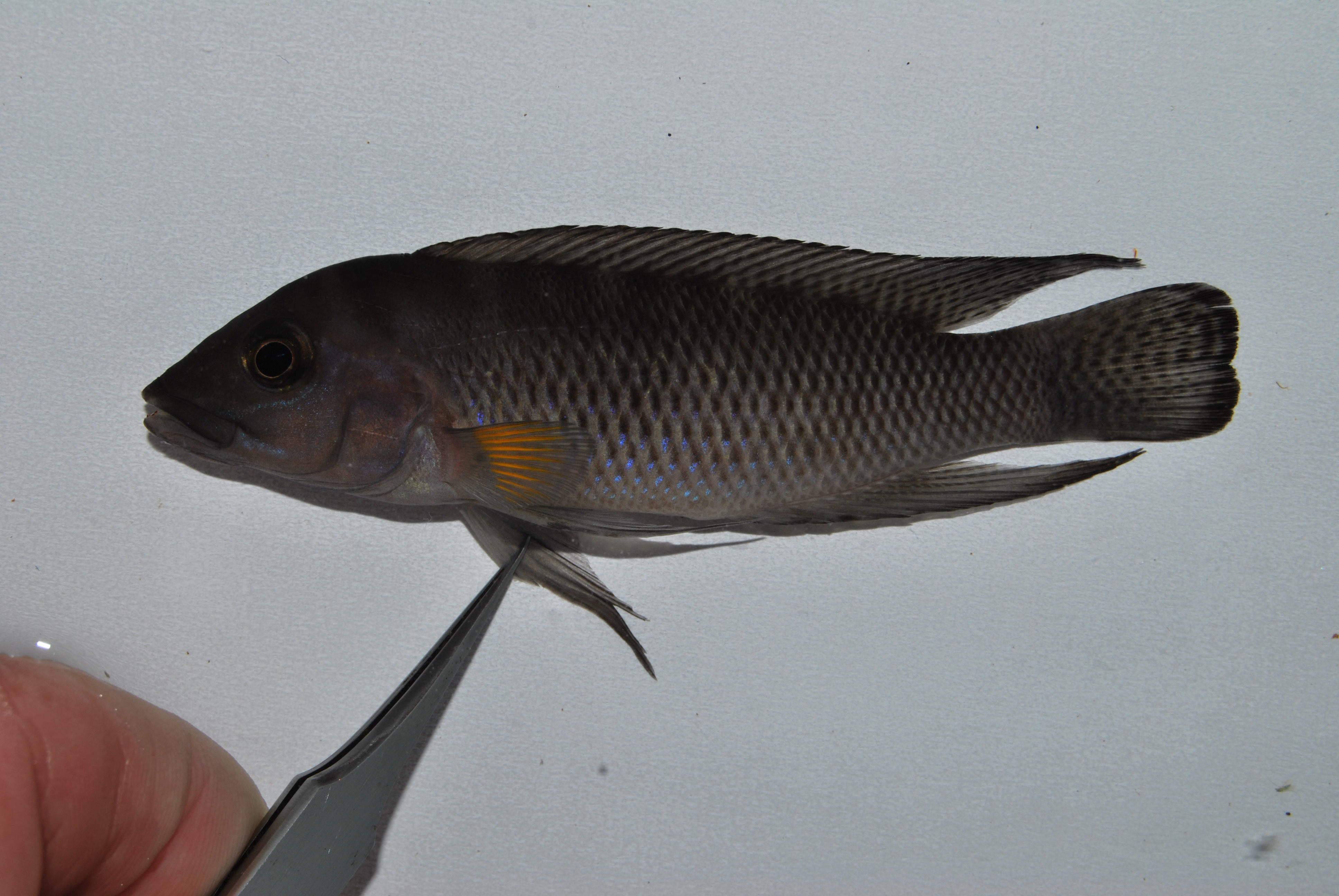
This is not a showy cichlid. N. modestus is a moderately deep-bodied lamprologine reaching about 4.7 inches (12 cm) total length, with females running smaller — FishBase gives roughly 4 inches (10 cm) for females against the 12-cm maximum. The base color is a plain cream-beige that, depending on mood and surroundings, can deepen to a muddy brown; fins are clear to faintly marked, with the small spotting on the unpaired fins that helps separate it from N. mondabu.
Sexual dimorphism is muted. Males and females share essentially the same coloration, and the practical tells are size and head shape: males grow larger and develop a more pronounced frontal hump (nuchal bump) with age, a feature that is more exaggerated in the closely allied N. petricola. The rounded caudal fin is the single most useful field character, distinguishing it at a glance from the pointed-tailed mondabu and from the more deeply forked, slender N. christyi with which it overlaps in parts of the south.
Range & habitat
Neolamprologus modestus is a Tanganyikan endemic confined to the southern basin of the lake, recorded from the Democratic Republic of the Congo, Zambia, and the southern Tanzanian shore. FishBase summarizes it bluntly as 'endemic to the south end of Lake Tanganyika'; the IUCN maps a widespread southern distribution spanning all three countries. Specialist field records place confirmed populations along the Zambian coast — for example between Cape Chipimbi and Nkamba Bay, and between Mbete Bay and Kilewani on the Tanzanian side — with populations along the Tanzanian coast near Kasanga sometimes flagged as N. cf. modestus pending resolution of the petricola/mondabu complex.
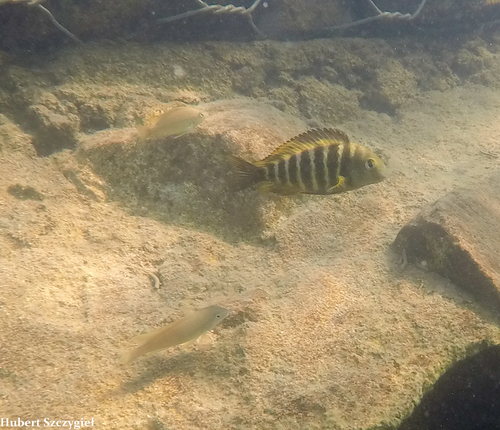
The fish is a creature of the rocky and intermediate littoral — the zone where boulders give way to sand. It is reported usually from about 6 to 12 m (20–40 ft), with the IUCN bracketing the species between roughly 5 and 40 m (16–130 ft). Importantly, it is not a strict rock-dweller: the conservation assessment describes it as seen over sand as well as on rocks, typically near the surface and close to shore. Like all Tanganyikan cichlids it lives in hard, alkaline water — the open lake runs warm and stable at roughly 73–77°F (23–25°C) near the surface, highly buffered, with a pH well above 8.
Ecology & diet
N. modestus is a benthopelagic carnivore that earns FishBase a calculated trophic level of about 3.5. What it actually eats is where the sources part ways, and the disagreement is worth stating plainly. The detailed literature summary (drawing on Konings) casts it as something of a snail specialist, feeding on the small gastropods that graze the rocky 'biocover' — Chytra kirki, Spekia zonata, Paramelania demoni, and Tanganyicia rufofilosa — and even raiding the eggs of the Tanganyika killifish, Lamprichthys tanganicanus. The IUCN assessment, by contrast, calls it 'not a specialised feeder,' describing a generalist that takes small snails and other invertebrates. The most coherent reading is a mollusc-leaning opportunist: invertebrates and snails form the core of the diet, with killifish eggs and other small prey taken when available.
Within the community it is one of the lake's most abundant and ubiquitous shoreline cichlids — common enough that the IUCN flags it as 'one of the most common and ubiquitous fish in the lake.' That abundance, combined with a generalist invertebrate diet, makes it an unremarkable but ecologically reliable member of the southern littoral fauna rather than a narrow specialist tied to a single resource.
Behavior & breeding
Socially, N. modestus is largely solitary in the sense that it does not form the cooperative, multi-generational colonies of the brichardi group — comparative behavioral work groups it with non-cooperative lamprologines such as N. tetracanthus and Telmatochromis temporalis — yet many individuals are commonly seen together over good habitat. It is a substrate spawner and a cave brooder. In the wild, observers (Konings) report males holding harems of two to five females, each female tending her own clutch in a rocky crevice or cave; in aquaria the species more often settles into pairs, with the male relatively tolerant of his mate.
Breeding is prolific and runs year-round, with clutches reported from roughly 200 to 500 eggs. Both parents care for the brood. Reports differ on exactly where spawning happens — most sources describe egg-laying inside caves and crevices, while one older summary notes the fish leaving the rocky biotope to spawn on sandy bottom; the cave-brooding account is the better-corroborated one. As with most lamprologines, the pair becomes pointedly territorial while guarding eggs and fry, even in a fish otherwise described as calmer than its relatives.
In the aquarium
N. modestus is an uncommon but rewarding aquarium fish — the IUCN notes it appears in the trade nationally and internationally, though it is 'not very common due to its size,' and tank-raised stock (often sold by collection locale, e.g. 'Kavala') does circulate. Honesty about temperament matters: hobbyist accounts and specialist sources agree it is moderately aggressive and strongly territorial, especially when breeding, even if it is widely judged calmer than the more slender N. christyi. Experienced keepers liken its disposition to the mid-sized Neolamprologus 'leleupi type' — assertive but not brutal — which means plenty of broken-up rockwork and caves so subordinate fish and females can hold their own space.
For a bonded pair, plan on a footprint around 50 gallons (about 200 L); larger, longer tanks are needed for a community or a harem. Aquascape with stacked rock forming caves and territories over a fine sand base, and replicate the lake's water — hard and alkaline, pH comfortably above 8, with temperatures in the low-to-mid 70s°F (around 23–25°C). Tankmates should be robust Tanganyikans that aren't easily bullied and aren't small enough to be eaten; mixing it with the visually similar mondabu/petricola/christyi cluster invites both hybridization risk and confusion. The most common keeper mistake is underestimating a 'plain' fish: it is not a beginner community species, and breeding pairs will hold and defend a territory in earnest.
Conservation
Neolamprologus modestus is assessed as Least Concern on the IUCN Red List (assessed 26 February 2025; Haambiya 2025), an assessment that explicitly rests on its wide southern distribution and the absence of known major widespread threats. Its population trend is listed as unknown, though the species is described as very common. The assessment does flag real, if localized, pressures: sedimentation from soil erosion and overexploitation by beach seining, and minor use as a local food fish alongside its presence in the ornamental trade. In short, the species itself is not in trouble — but the rocky, near-shore habitat it depends on is exactly the kind under strain across the lake.
That lake-level context is the part worth taking seriously. Lake Tanganyika is warming, and the warming has consequences: O'Reilly et al. (2003, Nature, DOI 10.1038/nature01833) linked rising temperatures and weaker vertical mixing to roughly a 20% decline in primary productivity, with knock-on losses in fish yields estimated near 30%. Cohen et al. (2016, PNAS, DOI 10.1073/pnas.1603237113) used sediment cores to show that warming has reduced oxygenated benthic habitat — on the order of 38% loss since the 1940s — and that declines in commercially important fishes and endemic molluscs track the warming rather than fishing pressure alone. Shoreline sedimentation from deforestation and erosion (documented by Cohen and colleagues since the early 1990s) degrades precisely the rocky littoral where N. modestus lives and where its snail prey graze the biocover. Layered on top is intense human use of the lake: the pelagic clupeid fishery (the sardines Stolothrissa tanganicae and Limnothrissa miodon) together with the predatory Lates feeds millions across four riparian nations — Burundi, the DRC, Tanzania, and Zambia — whose shared management runs through the Lake Tanganyika Authority. For a shallow, snail-eating shoreline endemic, the proximate risks are sedimentation and near-shore seining rather than the open-water fishery; the honest summary is that this is a secure, abundant fish living in a lake whose littoral is being slowly squeezed.
Sources
- Eschmeyer's Catalog of Fishes — Neolamprologus modestus (Boulenger, 1898)
- FishBase — Neolamprologus modestus (Boulenger, 1898)
- FishBase — Neolamprologus mondabu (range/species-pair note)
- GBIF — Neolamprologus modestus occurrence records
- Encyclopedia of Life — Neolamprologus modestus
- Planet Catfish Cat-eLog — Neolamprologus modestus (type locality, synonymy)
- IUCN Red List — Neolamprologus modestus (Haambiya 2025, Least Concern)
- tanganyika.si — Neolamprologus cf. modestus 'Singa Island' (distribution, diagnosis, care)
- tanganyika.si — Neolamprologus mondabu 'Mawimbi' (species-pair diagnosis, Poll 1978)
- tanganyika.si — Lake Tanganyika Habitats (rocky littoral community)
- Cichlid Room Companion — Neolamprologus genus overview
- Fishipedia — Neolamprologus modestus
- African Diving Ltd — Lamprologine geographic counterparts (petricola/modestus, tetracanthus/brevianalis)
- Cichlid-Forum — Neolamprologus modestus keeping thread (anecdotal) — community/anecdotal
- O'Reilly et al. 2003, Nature — Climate change decreases productivity of Lake Tanganyika
- Cohen et al. 2016, PNAS — Climate warming reduces fish production and benthic habitat in Lake Tanganyika
- Lake Tanganyika: Status, challenges, and opportunities for research (J. Great Lakes Research)