
Taxonomy & naming
The species was described by the prolific British-Belgian ichthyologist George Albert Boulenger in 1906 as Lamprologus mondabu, based on material that Dr. W. A. Cunnington collected at Kaboge during the third Tanganyika Expedition; the surviving syntypes (BMNH 1906.9.8.103-104) are held at the Natural History Museum in London. Maréchal and Poll moved it to the genus Neolamprologus in their 1991 CLOFFA treatment, and Eschmeyer's Catalog of Fishes lists Neolamprologus mondabu (Boulenger, 1906) as the valid name today. It sits in the tribe Lamprologini, the substrate-spawning radiation that dominates Tanganyika's rocky shores.
The genus name is a small piece of zoological whimsy, stitched from the Greek neos (new), lampros (torch), and lagos (hare) — "new Lamprologus." The species epithet mondabu derives from a local name rather than a Latin descriptor. The fish has no settled English common name; in the hobby it travels under the bare scientific binomial, often tagged with a collection locality such as 'Kigoma' or 'Cape Kabogo'. Its taxonomic history is entangled with N. modestus: the two were long treated as a single species, and only the consistent difference in tail shape (see Appearance) reliably separates them.
Appearance
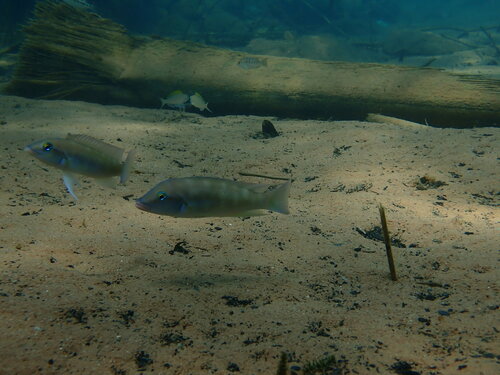
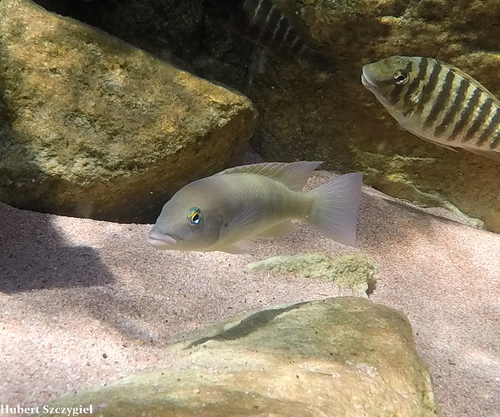
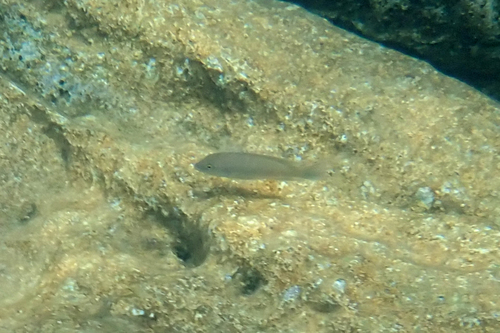
Neolamprologus mondabu is a modestly sized, fairly deep-bodied lamprologine in muted earth tones — tan to grey-brown, sometimes with a faint sheen and subtle vertical shading, with the unremarkable look common to many rock-dwelling Tanganyikans whose business is camouflage, not display. FishBase records a maximum of 10.7 cm (4.2 in) total length, drawing on Maréchal and Poll's CLOFFA figures, while the specialist literature collated by Ad Konings puts well-grown adults at up to about 12 cm (4.7 in); the modest discrepancy is the usual gap between museum measurements and the largest fish seen in the field. There is no strong sexual dimorphism in color or pattern — the most reliable difference is simply that males grow larger than females.
The feature that matters for identification is the tail. In N. mondabu the caudal fin is pointed and triangular, sometimes nearly straight-edged, but never rounded — the opposite of the rounded tail of the very similar N. modestus, which replaces it in the south. Poll also noted that the small spots scattered on the caudal, anal, and dorsal fins of N. modestus are absent in mondabu. It is further confused with N. christyi and the undescribed N. sp. 'eseki', but differs from those in having only a weakly developed, short-lobed tail rather than a pronounced crescent.
Range & habitat
This is a Lake Tanganyika endemic, found nowhere else on Earth. It is distributed throughout most of the lake — along the Democratic Republic of the Congo coast from Uvira southward, the Burundian shoreline in the north, and down the Tanzanian coast at least as far as Segunga — and reaches the Zambian shores, but it drops out in the extreme south, where the ecologically equivalent N. modestus takes over its niche. The IUCN and FishBase both frame the two species as geographic replacements occupying the same role at opposite ends of the lake.
It is a shallow-water fish. The IUCN assessment gives a depth range of just 0 to 15 m (0 to 49 ft), and it is typically seen near the surface and close to shore over both rock and sand, favoring rocky and intermediate (mixed rock-and-sand) biotopes. In situ, this is the warm, hard, alkaline water characteristic of Tanganyika's surface layer: FishBase cites a pH of roughly 7.4 to 8.4, general hardness of 7 to 30 dH, and temperatures of about 23 to 27 °C (73 to 81 °F). The habitat distinction within that shallow band — rock versus open sand — turns out to matter a great deal to how the fish breeds.
Ecology & diet
Neolamprologus mondabu is a benthic generalist carnivore rather than a trophic specialist. It feeds mainly on small invertebrates gleaned from the substrate, takes the occasional small snail, and — a detail repeated from FishBase through Konings and the IUCN — preys on the eggs of the Tanganyika killifish, Lamprichthys tanganicanus, an egg-scattering open-water fish whose spawn it raids opportunistically. FishBase places it at a trophic level of about 3.4, squarely in the mid-level predator band, and rates its fishing vulnerability as low.
Where many of Tanganyika's lamprologines have carved out narrow feeding specializations to coexist on a crowded reef, mondabu's breadth and abundance make it one of the lake's ecological workhorses: the IUCN describes it as "one of the most common and ubiquitous fish in the lake." Usually solitary, it nonetheless occurs at high local density, so that many individuals are often visible at once over a good stretch of shoreline — a dispersed population of small predators rather than a school.
Behavior & breeding
Like all lamprologines, N. mondabu is a substrate spawner, not a mouthbrooder, and it organizes itself into harems. Reviews of Tanganyikan reproductive behavior group it with relatives such as Lepidiolamprologus profundicola and Neolamprologus furcifer as a harem breeder in which a single male oversees the territories of several females — field studies report two to five females per male — with little or no direct paternal brood care; the female guards the eggs and fry. Reported clutches are large for the fish's size, roughly 200 to 500 eggs.
The most interesting wrinkle is timing. Takemon and Nakanishi's 1998 study in the northern lake found that mondabu concentrates its spawning around the first half of the lunar cycle — a lunar synchronization documented across several Lamprologini and noted as common in marine fishes but genuinely rare in freshwater ones. The same study revealed a substrate effect with real fitness consequences: larger females held territories on open sand and smaller ones on stony ground, and the sand-dwelling females released more offspring per month. The authors attributed this to more intense spawning and better brood protection in the open, where predators are easier to spot and repel than among the crevices of the rocks — which is why a nominally rock-associated fish leaves the rocks to breed. In keeping with its harem system, males are relatively tolerant of females, but both sexes defend the breeding territory vigorously while guarding eggs and fry.
In the aquarium
Neolamprologus mondabu is uncommon in the hobby — not because it is difficult, but because it is plain next to the lake's marquee species, and it is rarely imported or bred for sale. Keepers who do encounter it describe a fish that is more even-tempered than slender, hot-blooded congeners like N. christyi or the notoriously belligerent N. tretocephalus, yet still firmly territorial, especially when it has a clutch to defend.
The honest requirements track its biology. Plan on a tank of at least roughly 200 liters (about 55 US gallons) for a single pair, and more for any kind of community, with a footprint that provides both rockwork — stacked stone forming caves and sightline breaks — and an area of open fine sand, since this is a fish that wants both. Water should be hard and alkaline (pH comfortably above 7.5) and kept in the mid-70s to low-80s °F to mirror the lake's surface layer. The usual lamprologine caveat applies: a settled, spawning pair will treat the tank as theirs and can make life miserable for, or simply kill, smaller or less aggressive tankmates, so plan stocking around that rather than hoping a breeding pair will mellow. As with related Tanganyikans, the practical route to a pair is to grow out a small group of juveniles and let one form, rather than buying two adults and forcing an introduction.
Conservation
The IUCN Red List assessed Neolamprologus mondabu as Least Concern in its 2025 evaluation (Fermon, 2025; the species was also rated Least Concern in 2006). The justification is straightforward: a Tanganyika-wide distribution, abundance throughout most of the lake, and no known major widespread threats. The population trend is listed as unknown, and the assessors flag sedimentation and pollution from soil erosion and agricultural runoff as the threats most likely to bear on it. The fish is taken locally for food and enters the commercial aquarium trade nationally and internationally, but neither pressure is judged significant at the species level.
That reassuring status sits inside a lake under real strain, and honesty requires holding both facts at once. Lake Tanganyika is warming: O'Reilly and colleagues (2003, Nature) showed that rising temperatures have strengthened stratification and shoaled the mixing depth, cutting nutrient resupply to surface waters — they estimated primary productivity may have fallen by roughly 20%, implying about a 30% drop in fish yields. Cohen et al. (2016, PNAS) extended the paleoecological record and tied lake warming to declines in commercial fishes and endemic molluscs, alongside a substantial loss of oxygenated benthic habitat. Closer to mondabu's own world, decades of work beginning with Cohen's group in the 1990s have documented how deforestation of the catchment drives sediment into the lake, smothering the rocky littoral that shallow shore species depend on. As a near-surface inhabitant of rocky and intermediate shorelines, N. mondabu is more exposed to that nearshore sedimentation and shoreline development than to the warming-driven, deep-water and pelagic changes that most threaten the open-water fishery feeding the four lakeshore nations. The lake's wider stresses are managed, at least on paper, through the four-country Lake Tanganyika Authority. For now this is a common fish in a stressed lake — secure as a species, but a useful reminder that "Least Concern" describes the fish, not the water it lives in.
Sources
- Eschmeyer's Catalog of Fishes: Neolamprologus mondabu
- FishBase: Neolamprologus mondabu
- IUCN Red List: Neolamprologus mondabu (Fermon, 2025, e.T60606A47202820)
- Takemon & Nakanishi (1998), Reproductive success in female Neolamprologus mondabu: influence of substrate types, Environmental Biology of Fishes 52:261-269
- Sefc (2011), Mating and Parental Care in Lake Tanganyika's Cichlids, Int. J. Evol. Biol.
- O'Reilly et al. (2003), Climate change decreases aquatic ecosystem productivity of Lake Tanganyika, Nature (PDF)
- Cohen et al. (2016), Climate warming reduces fish production and benthic habitat in Lake Tanganyika, PNAS
- Lake Tanganyika: Status, challenges, and opportunities for research (J. Great Lakes Research review)
- tanganyika.si — Neolamprologus mondabu species & locality profile (after Konings 2015)
- Cichlid Room Companion — Neolamprologus mondabu profile (public page; curator P. Tawil)
- African Diving Ltd blog — lunar spawning among Tanganyikan lamprologines (cites Takemon & Nakanishi 1998)
- Cichlid-forum.com — Lake Tanganyika species discussion (keeping/aggression of Neolamprologus; community notes) — community/anecdotal
- Cichlid-forum.com — community thread referencing N. mondabu's scarcity in the hobby — community/anecdotal