Taxonomy & naming
Neolamprologus mustax was described by the Belgian ichthyologist Max Poll in 1978 as Lamprologus mustax, from a holotype — a male of about 74.8 mm standard length — collected at Cape Nundo on the southern Zambian shore of Lake Tanganyika. That original combination is its only synonym; the species was folded into the genus Neolamprologus when the sprawling lamprologine genus Lamprologus was split, and Eschmeyer's Catalog of Fishes and the IUCN both carry the authority as "(Poll, 1978)" with the parentheses marking the genus change.
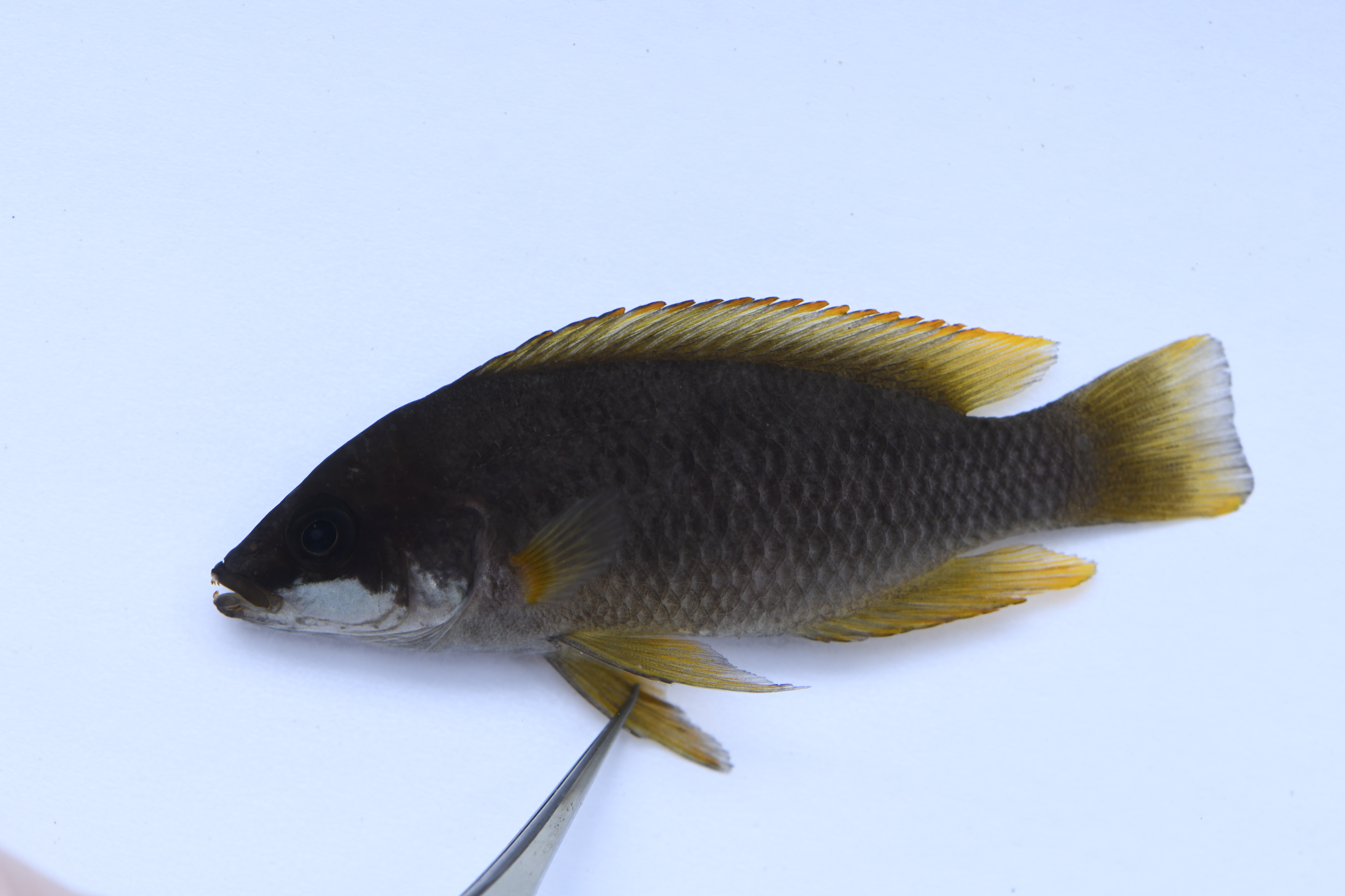
The specific epithet is the most charming part of the name. "Mustax" refers to a beard or moustache, a reference to the white pigment on the chin and lower head that, as the early hobbyist literature noted, shows up in all known populations — a rare case of a Tanganyikan cichlid name that actually tells you what to look for. The genus name Neolamprologus is a Greek compound (roughly "new" plus elements of the older Lamprologus).
Its placement in the lake's species flock is genuinely messy. N. mustax belongs to the tribe Lamprologini and sits close to the yellow N. leleupi and its relatives N. longior and N. cylindricus. Toward the northern edge of its range, populations grade into forms that specialists treat as intermediates between leleupi and mustax — the fish marketed by collectors as N. sp. "leleupi blue chin" and N. sp. "leleupi kapampa" — so the line between species here is more a smear than a border.
Appearance
This is a compact, elongate lamprologine reaching about 3.5 in (9 cm) total length in the wild; aquarium specimens occasionally push a little past that, to roughly 4 in (10 cm). The body is the streamlined, cigar-ish shape typical of cave-dwelling Neolamprologus, built for slipping into rock recesses rather than open-water cruising.
Coloration is variable across the range — beige, tan, yellowish, and darker brown forms all occur — but the diagnostic feature is consistent: a band of white or cream pigment across the chin and the underside of the head, the "beard" the species is named for. That pale chin is the cleanest way to separate it from the solidly yellow N. leleupi, whose coloration runs from bright yellow to deep brown without the characteristic light chin. Sexual dimorphism is modest: males grow noticeably larger than females, but the two sexes are otherwise hard to tell apart on color or pattern alone. Because the species overlaps and intergrades with the leleupi group, field identification often comes down to locality as much as to the fish in hand.
Range & habitat
Neolamprologus mustax is a Lake Tanganyika endemic with a notably southern distribution. It runs along nearly the entire Zambian shoreline — sources note a gap between Chituta Bay and the Kalambo River — and continues up the western, Congolese side into the southern Democratic Republic of the Congo as far north as Moliro. The IUCN frames it as widespread in the Zambian sector and reaching the southern extreme of the DRC, citing populations around Cape Chipimbi, Kombe, Kachese, Cape Nangu, and up to Moliro. Reports of mustax-like fish farther north, near Kiku, are now generally attributed to the intermediate leleupi-kapampa form rather than true mustax.
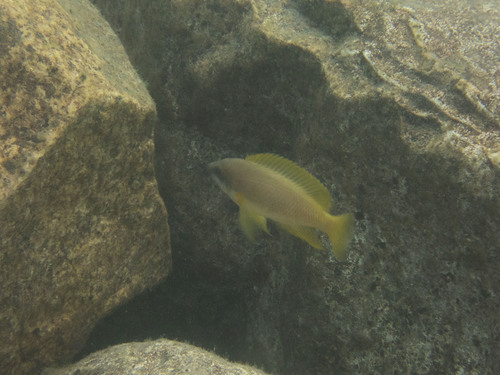
This is a rock specialist, and a comparatively deep one. It lives in rocky and rubble-strewn biotopes, typically below about 20 m (65 ft), tucked into the recesses and crevices of the substrate; the IUCN assessment gives a depth range of 0 to 130 ft (0–40 m). Like the rest of the lake's rocky-shore community, it sits in the warm, hard, alkaline water that defines Tanganyika — roughly 73–77°F (23–25°C) at the surface, with a high pH and considerable buffering. It does not stray onto open sand or into the pelagic zone; its whole life is bound to the structured rocky margin.
Ecology & diet
N. mustax makes its living as an invertebrate picker. In the wild it forages over the biocover — the "aufwuchs" film of algae, detritus, and small animals coating the rocks — and probes deep recesses in the substrate for prey, taking shrimps, other crustaceans, and assorted invertebrates. FishBase places it at a trophic level of about 3.5, consistent with a small carnivore that leans on invertebrates rather than a herbivore or a fish-eater; the IUCN describes it as omnivorous but invertebrate-driven. Feeding is usually a solitary affair rather than a shoaling scramble.
There is one nice ecological wrinkle that the field observations record: larger individuals — those over about 2 in (5 cm) — are often seen foraging inside the territories of the algae-farming cichlid Variabilichromis moorii, while smaller mustax are absent from those same patches, apparently excluded by the territory-holder, possibly on the basis of their coloration. It is a small reminder that on a Tanganyikan reef, who gets to eat where is governed as much by social tolerance as by what food is physically present.
Behavior & breeding
Socially, this is a territorial and combative little fish. Within its own species it is highly aggressive, and males are notably rough on females — a combination that shapes how it must be housed. At the same time it is a relatively poor defender against the lake's larger, pushier lamprologines, so in the wild it relies on the dense cover of the rocky habitat to hold its ground.
Breeding follows the classic lamprologine cave-spawner pattern rather than mouthbrooding. The female deposits a relatively small clutch — on the order of 20 to 50 eggs — on the underside of a rock or the ceiling of a cave, and then tends them closely until the fry are free-swimming. The male, by contrast, contributes little parental care after spawning and, in keepers' accounts, may scarcely return to the nest. FishBase summarizes the strategy simply: a substrate spawner that raises its young in seclusion, spawning in caves. By the standards of its relatives it is regarded as a more demanding fish to breed than the closely allied N. leleupi, N. longior, or N. cylindricus.
In the aquarium
N. mustax reaches the aquarium trade as a wild-collected or tank-raised Tanganyikan specialist rather than a mass-market fish, and it should be kept like one. The water needs to mirror the lake: hard, alkaline, and warm, in the high-70s°F (mid-20s°C), with the pristine, well-filtered conditions that rift-lake cichlids demand and frequent water changes to keep nitrogenous waste low.
The counterintuitive point experienced keepers make is about tank size. Despite a body length of only about 4 in (10 cm), this species wants a large footprint — commonly cited as around 300 liters (roughly 80 gallons) or more — precisely because its intraspecific aggression is so high and its defense against bigger neighbors so weak. The aquascape should be heavy on rock, arranged into a maze of caves and passages that break sightlines and give a harried female somewhere to retreat. Avoid housing it with aggressive lamprologines that will simply bully it off its territory. The common mistakes are predictable: too small a tank, too little rockwork, and pairing it with tankmates that overwhelm a fish which fights hard but cannot win against larger opponents. It is not a beginner's first Tanganyikan, and it is more challenging to spawn than the yellow leleupi it superficially resembles.
Conservation
On the IUCN Red List, Neolamprologus mustax is assessed as Least Concern (assessed February 2025, published 2025; it also carried Least Concern in 2006). The rationale is its endemism paired with a reasonably wide distribution across the Zambian sector and southern DRC and the absence of any known major, range-wide threat. The population trend is listed as unknown, and the assessors note it is probably naturally sparse rather than abundant. Trade pressure is real but limited: the fish enters the ornamental aquarium trade and is taken locally for food, with no large commercial or international fishery directed at it. So the honest headline is that the species itself is not currently in trouble.
That said, its home is under strain, and a rocky-shore invertebrate-picker is exposed to exactly the pressures Lake Tanganyika faces. The IUCN assessment itself flags sedimentation, overfishing, and other coastal human impacts that — following Plisnier et al. (2018, Journal of Great Lakes Research) — appear to have altered community structure and reduced biodiversity in sub-littoral zones near shore. Those local effects sit inside a larger, slower change: O'Reilly et al. (2003, Nature, DOI 10.1038/nature01833) tied decades of surface warming and weakened vertical mixing to roughly a 20% decline in primary productivity, with knock-on losses to fish yields, and Cohen et al. (2016, PNAS, DOI 10.1073/pnas.1603237113) used sediment records to show warming accompanying losses of commercially important fishes and a substantial reduction — on the order of a third — of oxygenated benthic habitat. Sedimentation from deforested catchments smothering the rocky littoral (documented since Cohen et al. 1993) bears most directly on a species like this, whose entire niche is the structured rock between roughly 20 and 130 ft (6–40 m). The lake also supports a pelagic clupeid (Stolothrissa and Limnothrissa) and Lates fishery feeding four nations, and is managed jointly through the Lake Tanganyika Authority. None of this places N. mustax on a threatened list today; it simply means that a fish judged secure on paper lives in a lake whose littoral is being quietly degraded, and that its long-term fortunes are tied to how that wider basin is governed.
Sources
- FishBase: Neolamprologus mustax (Poll, 1978)
- Eschmeyer's Catalog of Fishes — Neolamprologus mustax (species record)
- IUCN Red List: Neolamprologus mustax (Mabo, L. 2025, e.T60611A47203128)
- GBIF — Neolamprologus mustax occurrence records (via FishBase)
- Poll, M. (1978). Contribution à la connaissance du genre Lamprologus — original description of Lamprologus mustax (Persée)
- The taxonomic diversity of the cichlid fish fauna of ancient Lake Tanganyika (ResearchGate fulltext)
- tanganyika.si — Neolamprologus mustax 'Kombe' (biotope, distribution, breeding; Konings-based)
- tanganyika.si — Neolamprologus sp. 'leleupi blue chin' Lupota (intermediate forms)
- The Cichlids Yearbook Vol. 1 — etymology of 'mustax' / white chin coloration (SlideShare)
- Greater Chicago Cichlid Association — Neolamprologus leleupi (congener comparison)
- Cichlid Room Companion / cichlidae.com (public reference; Konings 1998 distribution note)
- Cichlid Forum — Managing aggression in a Tanganyikan community (keeper discussion) — community/anecdotal
- Aquarium Advice Forum — Lake Tanganyika setup (keeper discussion) — community/anecdotal
- Reddit r/Aquariums — Tanganyikan biotope tank and Neolamprologus compatibility — community/anecdotal
- Plisnier, P.-D. et al. (2018). Monitoring climate change and anthropogenic pressure at Lake Tanganyika. J. Great Lakes Research 44(6):1194–1208
- O'Reilly, C.M. et al. (2003). Climate change decreases aquatic ecosystem productivity of Lake Tanganyika. Nature (PubMed)
- Cohen, A.S. et al. (2016). Climate warming reduces fish production and benthic habitat in Lake Tanganyika. PNAS 113(34):9563–9568