Taxonomy & naming
The species was described in 1977 by the American ichthyologists Reeve M. Bailey and Donald J. Stewart, in a paper on additions to the cichlid fauna of Zambian Lake Tanganyika (Occasional Papers of the Museum of Zoology, University of Michigan, No. 679). They originally placed it in the genus Lamprologus as Lamprologus prochilus; the holotype was collected at Nyika Bay off the northern tip of Nkumbula Island, about 2 km (1.2 mi) north of Mpulungu, in less than 5 m (16 ft) of water.
It was later transferred to Neolamprologus, the large lamprologine genus that holds most of Tanganyika's rock-dwelling "lamp" cichlids, and that placement is accepted by Eschmeyer's Catalog of Fishes and FishBase. The genus name combines Greek roots (neos, "new," with the older Lamprologus); the specific epithet prochilus refers to its prominent, projecting lips — an apt description for a fish defined by its jaws. Within the genus, the Cichlid Room Companion places it in the buescheri species group, alongside other deep, cave-oriented lamprologines. There is no widely used English common name; in the hobby it travels simply as N. prochilus, sometimes tagged with a collection locality such as Kasanga or Kambwimba.
Appearance
N. prochilus is a comparatively large, elongate lamprologine with a somewhat laterally compressed, flattened body, a triangular head, a notably large eye, and a rounded caudal fin. Ground color is muted — pale yellow shading to a pinkish or mauve cast — and the three faint longitudinal stripes typical of the genus are usually only weakly visible. Juveniles show vertical barring, a pattern that can persist faintly in some adult females.
The defining trait is the mouth. The jaws are very large and strongly protrusible, with the lower jaw bearing projecting mandibular processes, so the fish can shoot its mouth forward to engulf prey. Enlarged sensory pores are visible on the top of the head — part of an expanded lateral-line canal system that helps it detect invertebrates in near-darkness. This big-jawed, cave-hunting body plan looks a great deal like that of Altolamprologus compressiceps, a case of convergent evolution rather than close kinship; unlike Altolamprologus, however, prochilus lacks thickened, armored scales, which leaves it more prone to injury and skin problems.
Reports of size vary with how 'maximum' is measured. FishBase lists a maximum of about 6.7 in (17 cm) total length, and aquarium sources note it as the largest species in the genus. Field-derived figures compiled by tanganyika.si put typical adults around 6 in (15 cm) with large males occasionally exceeding 7 in (18 cm), and females markedly smaller at roughly 3.5 in (9 cm). Apart from that size difference, the sexes are not strongly dimorphic.
Range & habitat
This is a Tanganyikan endemic with a narrow distribution: it is known only from the southern end of the lake, essentially the Zambian sector around Mpulungu, with the type locality at Nkumbula Island. FishBase and the IUCN both treat it as endemic to the south end; some hobby and trade sources additionally report it from the nearby Tanzanian coast near Kasanga and from the northwestern (Congolese) shore, and locality names like Kambwimba and Kasanga circulate among aquarists. Treat those wider claims as less certain than the well-documented Zambian core.
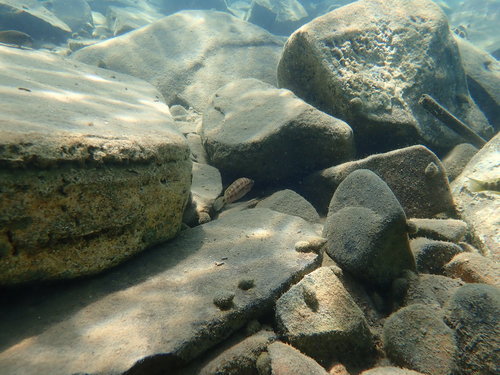
It is a fish of the deep rocky littoral. Depth estimates differ between sources — FishBase gives a range of roughly 16–131 ft (5–40 m), the IUCN assessment a band of about 33–197 ft (10–60 m), and field observers report it most often around 100 ft (30 m). What the accounts agree on is the microhabitat: N. prochilus lives among rubble-strewn rock and stays inside dark caves and crevices, rarely venturing into the open. The cichlid authority Ad Konings has noted observing it in the lake only once, a measure of how reclusive and locally uncommon it is. Like all Tanganyikan cichlids it lives in hard, alkaline water — the lake runs roughly pH 8.6–9.0 with high carbonate hardness and surface temperatures around 75–82 °F (24–28 °C).
Ecology & diet
N. prochilus is a carnivore and an ambush suction-feeder built for the cave environment. It preys mainly on small crustaceans and other invertebrates sheltering within the dark recesses of the rocky biotope, and is reported to take small fishes as well. The mechanics fit the morphology: the highly protrusible jaws generate suction to pull hidden prey from cracks, while the enlarged cephalic sensory pores help it locate that prey in very low light. FishBase places it at a trophic level near 3.7, consistent with a small predatory cichlid rather than a top piscivore.
Ecologically it is one of the less abundant residents of the deep rocky slope. Its low population density, secretive habits, and dependence on a specific structural niche — caves within rubble at moderate depth — mean it occupies a relatively specialized corner of Tanganyika's famously crowded rock-cichlid community rather than competing in the open over algae-covered boulders the way many surface-zone lamprologines and tropheines do.
Behavior & breeding
Socially, N. prochilus is largely solitary and territorial outside of breeding, defending a cave or crevice and showing intolerance toward conspecifics and similar fishes that intrude. It is a substrate (cave) spawner with biparental care — a pair-bonding strategy in which both male and female guard the brood, in contrast to the maternal mouthbrooding seen in many other Tanganyikan cichlid lineages.
The fish is not very prolific. The IUCN assessment, drawing on Konings, gives a clutch size of around 50 eggs deposited inside a cave, with both parents defending the eggs vigorously. Aquarium observation aligns with this: early spawns from a young pair may produce only a handful of eggs (reports of about five), rising toward roughly 50 as the pair matures, with a pair often shepherding on the order of 20 fry. The fry are secretive, tending to stay partly hidden near the rockwork, and juveniles carry the vertical barring noted above. This combination of small broods and a cryptic lifestyle helps explain why the species is uncommon in the lake and only intermittently available to hobbyists.
In the aquarium
N. prochilus is an uncommon, specialist's fish rather than a beginner cichlid, and it is rare in the trade. Most stock is wild-collected or maintained by experienced Tanganyika keepers. Give it a tank built around its biology: a long aquarium of at least roughly 65–80 gallons (250–300 L) for a pair, a sand base, and abundant rockwork stacked into many caves, passages, and deep crevices, with relatively subdued lighting to mimic its shaded habitat. Maintain hard, alkaline water (high pH and carbonate hardness) at about 75–82 °F (24–28 °C), with the strong filtration and stable chemistry all Tanganyikans need.
Temperament is the thing keepers most often misjudge. For its size it can be the most aggressive fish in a tank, and a settled pair will defend its breeding cave fiercely — yet it is physically a weak fighter. Because it lacks the armored scales of look-alike Altolamprologus and has large but fragile jaws, it is easily wounded and prone to skin problems if housed with bruisers. The practical rule is to pair it with calmer Tanganyikan cichlids that are too large to be eaten but not aggressive enough to injure it, and to avoid genuine bullies. It generally ignores peaceful, non-territorial tankmates that keep out of its cave. It can be reluctant to accept dry foods, so a varied meaty diet is wise. To avoid hybridization, do not keep it alongside congeners.
Conservation
The IUCN Red List assesses Neolamprologus prochilus as Least Concern, most recently reassessed on 28 February 2025 (Fermon 2025; the previous assessment, also Least Concern, dates to 2006). The justification is that the species is endemic to Lake Tanganyika but reasonably widespread within the Zambian sector with no known major widespread threats, though it is noted as not very abundant and its population trend is unknown. It carries no CITES listing. It is taken locally for food on a small scale and appears in the national and international aquarium trade, but neither is currently considered a significant pressure. The threats the assessors do flag are local and habitat-specific: sedimentation, and rapid habitat modification around developing shoreline settlements such as Mpulungu and Mbite Island — exactly the inshore rocky zones this cave-dweller depends on.
That species-level reassurance sits inside a lake under real strain. Lake Tanganyika has warmed over the past century, and stronger thermal stratification has slowed the vertical mixing that lifts nutrients into the sunlit surface waters; O'Reilly and colleagues (2003, Nature) linked this to a substantial decline in primary productivity, with downstream consequences for fish yields. Cohen and colleagues (2016, PNAS) used sediment-core records to show that warming has coincided with declining fish abundance and an estimated loss of roughly 38% of the oxygenated benthic habitat available to bottom-living animals. Layered on top are basin-scale sedimentation and nutrient loading from deforestation and shoreline development (Cohen et al. 1993), which smother the rocky littoral, and the heavy pelagic fishery for clupeids (Stolothrissa and Limnothrissa) and their Lates predators that feeds the four nations — Zambia, Tanzania, the Democratic Republic of the Congo, and Burundi — sharing the lake under the coordination of the Lake Tanganyika Authority. For N. prochilus the most direct of these is the inshore one: as a shallow-to-moderate-depth rocky-cave specialist with low natural abundance and small broods, it is especially exposed to sedimentation and shoreline development that degrade and silt up its cave habitat, even though the species itself remains, for now, Least Concern.
Sources
- Eschmeyer's Catalog of Fishes — Neolamprologus prochilus (Bailey & Stewart 1977)
- FishBase — Neolamprologus prochilus summary
- GBIF — Neolamprologus prochilus
- Bailey & Stewart 1977, Cichlid fishes from Lake Tanganyika: additions to the Zambian fauna including two new species (orig. description, via CRC reference)
- Cichlid Room Companion — Neolamprologus prochilus species profile (public page)
- tanganyika.si — Neolamprologus prochilus (Konings-derived field & biotope notes)
- Fishipedia — Neolamprologus prochilus fish sheet
- iNaturalist — Neolamprologus prochilus taxon page
- Cichlid Room Companion — public Facebook species note on N. prochilus (keeping/breeding, anecdotal) — community/anecdotal
- African Cichlid Association group — N. prochilus noted as largest Neolamprologus, 17 cm/7 in (public post, anecdotal) — community/anecdotal
- IUCN Red List — Neolamprologus prochilus (Fermon 2025, Least Concern)
- O'Reilly et al. 2003, Climate change decreases aquatic ecosystem productivity of Lake Tanganyika (Nature)
- Cohen et al. 2016, Climate warming reduces fish production and benthic habitat in Lake Tanganyika (PNAS)
- Lake Tanganyika: Status, challenges, and opportunities for research (basin review, ScienceDirect)