
Taxonomy & naming
The species was described by the Belgian ichthyologist Max Poll in 1949 as Lamprologus savoryi, from material collected at Kigoma on the eastern shore of Lake Tanganyika; the holotype (MRAC 114261) is held at the Royal Museum for Central Africa in Tervuren, with paratypes split between Tervuren, the Belgian royal natural-history institute, and the Natural History Museum in London. The name is now valid as Neolamprologus savoryi (Poll, 1949), the transfer to Neolamprologus following Maréchal and Poll's 1991 treatment in the Check-list of the Freshwater Fishes of Africa and upheld by later authors including Schelly et al. (2003) and Konings (2015, 2019). The genus name strings together Greek roots — neos (new), lampros (bright or torch) and lagos (hare) — while the species epithet honors Bryan Wyman Savory (1904-1988), the British District Commissioner of Kigoma in the old Tanganyika Territory.
In the hobby it is one of the "princess" cichlids, the informal name for the Neolamprologus brichardi group, and is usually sold simply as Neolamprologus savoryi with a collection-locality tag ("Magara," "Mahale," "Mlowa Point" and so on). It is generally regarded as the most ancestral form of the group and lends its name to a recognized savoryi complex within it. A distinctive population sometimes circulated as N. sp. "Savoryi Fulwe," said to have a more elongate body and to lack the juvenile barring, has been noted by aquarists but is not a formally described species — a reminder that the boundaries inside this fast-radiating flock are still being worked out.
Appearance
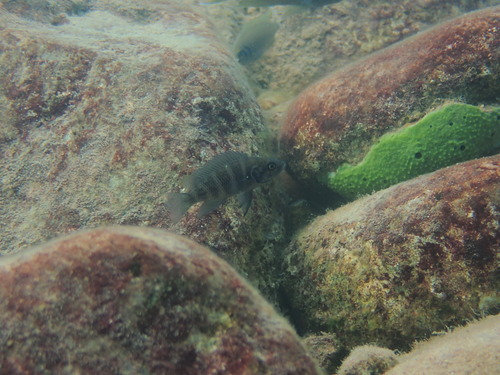
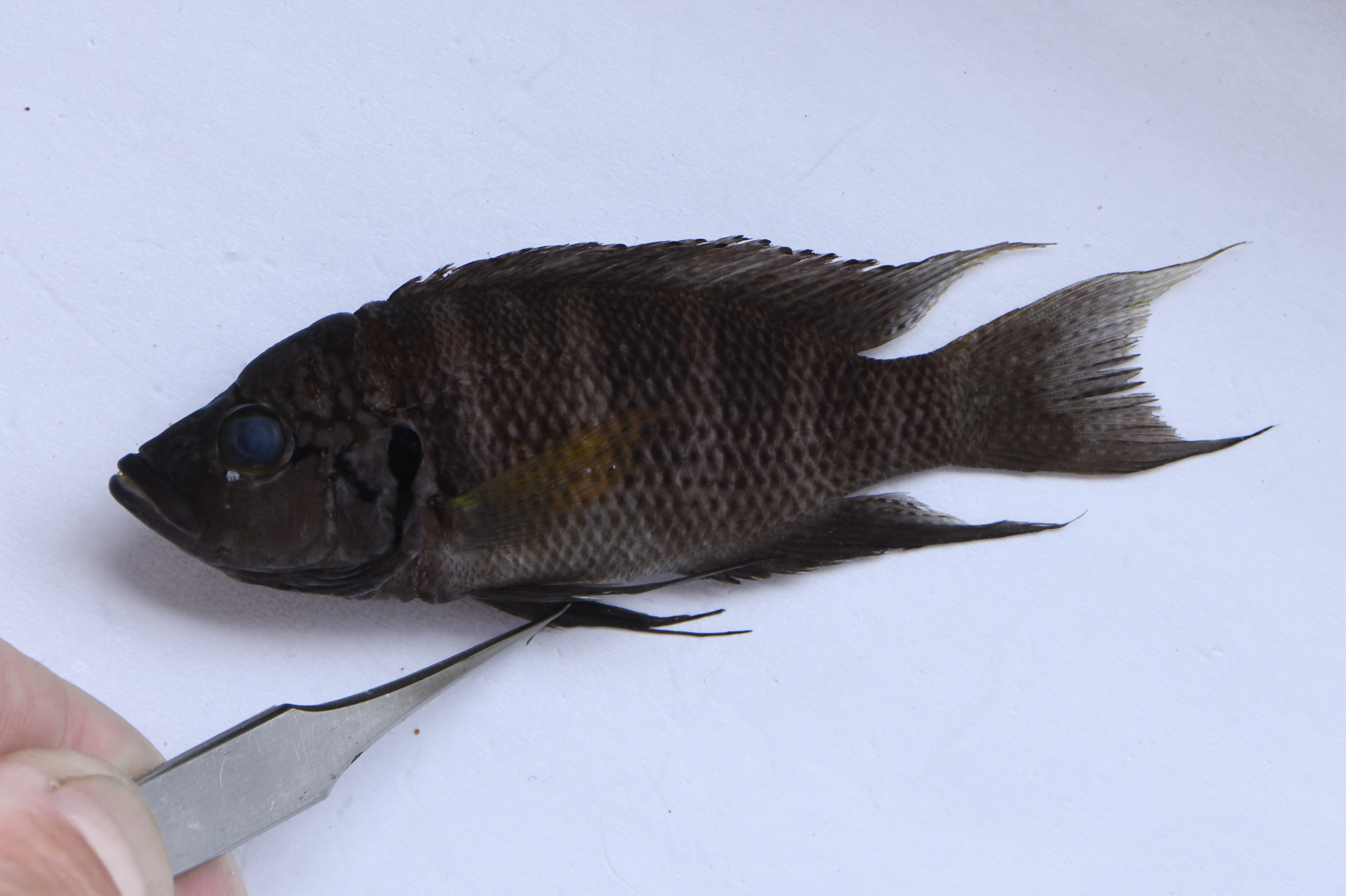
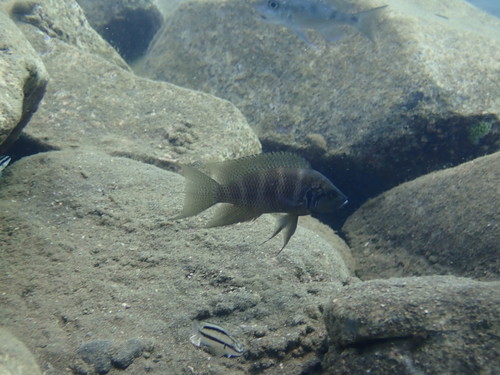
Savoryi is a compact, fairly stocky princess cichlid rather than a long-finned showpiece. Its ground color is a muted brown to grey-bronze, darker than most of its relatives, broken by a scatter of pale spots and faint markings on the head and gill cover and by light edging on the fins; the overall effect is more cryptic than gaudy, which suits a fish that spends its life in dim, deeper rockwork. Juveniles wear a set of distinct vertical bars that fade as they mature, a useful field mark and a trait shared with several close relatives.
Reports of size are consistent and small. FishBase gives a maximum of about 3 in (8 cm) total length; the specialist site tanganyika.si puts wild adults near 2.8 in (7 cm) and tank-raised fish slightly larger at 3.1-3.5 in (8-9 cm). The sexes look much alike in color and finnage, and the reliable difference is size: males are the larger sex, with females often noticeably smaller, around 2.4 in (6 cm). That male-larger pattern is the opposite of the better-known sex-reversed julies and matters for how the fish organizes its social groups.
Range & habitat
Neolamprologus savoryi is endemic to Lake Tanganyika and occurs nowhere else. Unlike many of the lake's rock cichlids, which fragment into isolated populations on separate reefs, savoryi is genuinely lake-wide: the IUCN assessment records it from all four riparian countries — Burundi, the Democratic Republic of the Congo, Tanzania and Zambia — and field observers describe it in nearly every rocky area around the lake. It is a rock-dweller, tied to boulders, rubble and crevices, but it is also noted to occur over deep sandy bottoms where scattered rocks are present nearby, which helps explain how broadly it is distributed.
Depth figures vary with the source, and the disagreement is worth stating plainly. FishBase lists a usual range of about 20-39 ft (6-12 m); the IUCN assessment gives 13-66 ft (4-20 m); and tanganyika.si reports 33-131 ft (10-40 m), deeper than the 16-82 ft (5-25 m) band typical of other princess cichlids. The consensus is that savoryi tends to live deeper and in dimmer, more sediment-rich rock than its kin, which fits its darker, more camouflaged coloration. Measured water over its habitat is hard and alkaline, with FishBase citing pH 7.3-8.5 and warm tropical temperatures of roughly 73-79 F (23-26 C) — the stable, mineral-rich chemistry characteristic of this ancient rift lake.
Ecology & diet
Savoryi is a micropredator of the rocky littoral. FishBase summarizes its diet as small invertebrates and places it at a high trophic level of about 4.2, and the IUCN assessment likewise records it as feeding on invertebrates; hobby field notes specify insect larvae and small crustaceans such as copepods. It is often described as the most omnivorous of the princess cichlids, taking small amounts of plant-derived material alongside its animal prey, but the weight of the evidence is that this is a hunter of tiny invertebrates rather than an algae grazer. The fish keeps low and close to cover: both adults and fry stay among the rocky rubble and are rarely seen out in the open, a habit that has earned it a reputation as one of the more secretive princess species.
Within the crowded community of Tanganyikan rock cichlids, savoryi is one of many small benthic specialists carving up the available food and shelter. Its own social groups defend a patch of reef against both rival conspecifics and a range of cichlid and non-cichlid predators that probe the rocks for eggs and young — a constant pressure that, as the behavioral work below suggests, is part of why the species lives in defended groups at all.
Behavior & breeding
This is where savoryi is most interesting, and where the field literature corrects a long-standing hobby simplification. It is a cave-spawning, biparental substrate breeder, not a mouthbrooder, and it is not prolific — spawns are small, typically fewer than a dozen fry, deposited in deep, dark recesses in the rock. Aquarists have long kept it as a "loosely bonded pair," with male and female each holding a crevice and the male visiting only to spawn, and that does describe how it often behaves in a tank.
In the lake, though, the picture is richer. In the most detailed study of the species, Heg, Bachar and Taborsky (2005, Ethology 111:1017-1043) found savoryi to be a cooperative breeder living in permanent groups: a single large breeding male, one to four breeding females, and anywhere from three to 33 subordinate helpers, with groups averaging around 14 fish. Larger males held more females and larger male helpers; when several females shared a group, each tended to carve out her own sub-territory with its own attendant helpers. All group members joined in defending and maintaining the territory and showed submissive behavior toward larger individuals. A later experimental study of staged territorial intrusions (Reddon and colleagues, with Balshine) found dominant males and females both highly aggressive toward predators and toward same-sex rivals, while subordinates contributed little defense and appeared to shelter under the protection of the larger group members. The lake's princess cichlids — savoryi among them, alongside the celebrated N. pulcher and N. brichardi — are in fact among the very few fishes anywhere known to breed cooperatively, with non-breeding helpers that "pay to stay" by guarding and rearing young that are usually not their own. The honest summary is that the aquarium pair is a stripped-down version of a naturally group-living, helper-assisted social system.
In the aquarium
Savoryi is a manageable Tanganyikan that earns a reputation as relatively peaceful for a Neolamprologus, though "peaceful" here means tolerant of unrelated tankmates, not of its own kind on a breeding territory. The right setup is the standard rock-cichlid one: hard, alkaline water in the high-7s to mid-8s pH, stable temperatures in the mid-70s F (around 24-26 C), fine sand, and plenty of rockwork stacked to form caves and crevices, with subdued lighting that suits a fish from deeper, dimmer habitat. Hobby guidance suggests a pair or a male with two females can be housed in a tank of roughly 25 gallons (about 100 L), but the more rewarding — and more natural — approach is to keep a small group in a larger, rock-filled tank and let its social structure express itself, much as keepers do with N. brichardi colonies. In a spacious community Tanganyika aquarium it defends only a modest territory and mixes well with open-water fish such as Cyprichromis that use a different part of the tank.
Two realistic expectations help. First, this is not a fish that floods a tank with fry; spawns are small and secretive, often noticed only when a few juveniles appear among the rocks, so patience is the rule. Second, like other princess cichlids it can become belligerent toward conspecifics in confined quarters once a group forms and starts breeding, so cramped tanks invite trouble. Its drabber coloring means it will never be a retailer's headline fish, but for a keeper interested in behavior rather than flash, a settled group of savoryi delivers one of the more engaging social displays among the smaller Tanganyikans.
Conservation
On the IUCN Red List, Neolamprologus savoryi is assessed as Least Concern (assessment by Haambiya, published 2025, reaffirming the same status it has held since 2006). The justification is straightforward: it is an endemic with a genuinely lake-wide distribution and no known major widespread threat. Its population trend is recorded as unknown for want of monitoring. The species-specific pressures the assessment does flag are modest — sedimentation and pollution from agricultural and forestry runoff that can degrade its rocky habitat, plus a small impact from harvest, since it is taken only lightly (as occasional bycatch eaten locally and as a collected aquarium fish rather than a targeted food species). None of its sites lie within a protected area, and the assessors note that better research and population monitoring would be valuable.
That reassuring status sits inside a lake under real strain, and accuracy means holding both facts at once. Lake Tanganyika has warmed over the past century, and O'Reilly et al. (2003, Nature, DOI 10.1038/nature01833) linked that warming to stronger stratification, weaker vertical mixing and an estimated ~20% decline in primary productivity, with knock-on losses on the order of roughly 30% in fish yields. Cohen et al. (2016, PNAS, DOI 10.1073/pnas.1603237113) used sediment cores to document an associated loss of oxygenated benthic habitat — about 38% — alongside declines in commercially important fishes and endemic molluscs. Shoreline deforestation and agriculture drive sedimentation that smothers the nearshore rocky littoral (Cohen et al. 1993), and the great pelagic clupeid (Stolothrissa, Limnothrissa) and Lates fishery that feeds four nations is managed jointly through the Lake Tanganyika Authority. For savoryi the relevant exposure is its habitat rather than the open-water fishery: as a rock-associated fish of the sediment-rich, deeper littoral, it is squarely in the path of the sedimentation and nutrient loading that degrade rocky reefs, even though it sits below the worst of the deep-water deoxygenation that threatens offshore communities. The careful statement is the right one — the species itself is currently secure, but the lake it depends on is not, and keeping its rocky shores clean is what keeps it that way.
Sources
- Eschmeyer's Catalog of Fishes — Neolamprologus savoryi (Poll, 1949)
- FishBase — Neolamprologus savoryi (Poll, 1949)
- GBIF — Neolamprologus savoryi
- IUCN Red List — Neolamprologus savoryi (Haambiya 2025, e.T60605A47202743)
- Heg, Bachar & Taborsky (2005) — Cooperative Breeding and Group Structure in the Lake Tanganyika Cichlid Neolamprologus savoryi (Ethology 111:1017-1043)
- Reddon et al. — Sex and social status affect territorial defence in a cooperatively breeding cichlid fish, Neolamprologus savoryi (ResearchGate)
- O'Reilly et al. (2003) — Climate change decreases aquatic ecosystem productivity of Lake Tanganyika (Nature)
- Cohen et al. (2016) — Climate warming reduces fish production and benthic habitat in Lake Tanganyika (PNAS)
- Phiri et al. (2023) — Lake Tanganyika: status, challenges, and opportunities for research (J. Great Lakes Research)
- Cichlid Room Companion — Neolamprologus savoryi (J. M. Artigas Azas; public abstract)
- tanganyika.si — Neolamprologus savoryi (biotope, size, diet, breeding profile)
- The Cichlid Stage — Neolamprologus savoryi and alloparental care
- American Fisheries Society — Lake Tanganyika: home of the only cooperatively breeding fishes in the world
- African Diving Ltd — Neolamprologus savoryi field notes (princess prototype, deep recess spawning) — community/anecdotal
- Cichlid Fish Forum — Julidochromis questions thread (keeper photo & sexing of Neolamprologus savoryi) — community/anecdotal