Taxonomy & naming
The species was described by George Albert Boulenger in 1899 as Lamprologus tetracanthus, from a single specimen (the holotype, MRAC 244) collected at Albertville — the colonial name for the town now called Kalemie, on the Congolese shore of Lake Tanganyika. It was later moved into the genus Neolamprologus, and it carries a special status there: it is the type species of Neolamprologus, the species that anchors the genus name. The genus is usually parsed from Greek roots as neos ("new") plus the older name Lamprologus, itself built on lampros, "bright" or "torch." The species epithet tetracanthus means "four-spined," and it is unusually literal — most lamprologine cichlids carry five or six anal-fin spines, while this fish has only four. That four-spine count, which also gives it the English name "fourspine cichlid," is a genuine diagnostic character rather than a marketing flourish.
Its limits are not fully settled. Eschmeyer's Catalog of Fishes treats Lamprologus marginatus (Boulenger, 1914) and the more recently named Neolamprologus brevianalis as junior synonyms of N. tetracanthus, folding several geographically distinct, similar-looking forms into one species. Other workers — including some collectors and the operation African Diving — argue that brevianalis, marginatus and tetracanthus are better kept as separate species, citing colour differences such as a red dorsal margin in tetracanthus versus yellow lips in brevianalis, with their distributional boundaries still poorly mapped. We follow the taxonomic authority and treat them as one variable species, while flagging that the trade and some field guides split them; a fish sold as 'tetracanthus' from one locality can look noticeably different from another.
Appearance
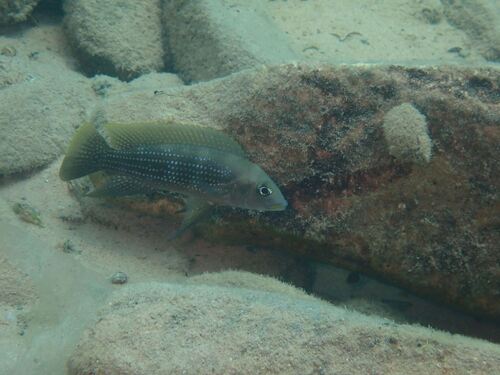
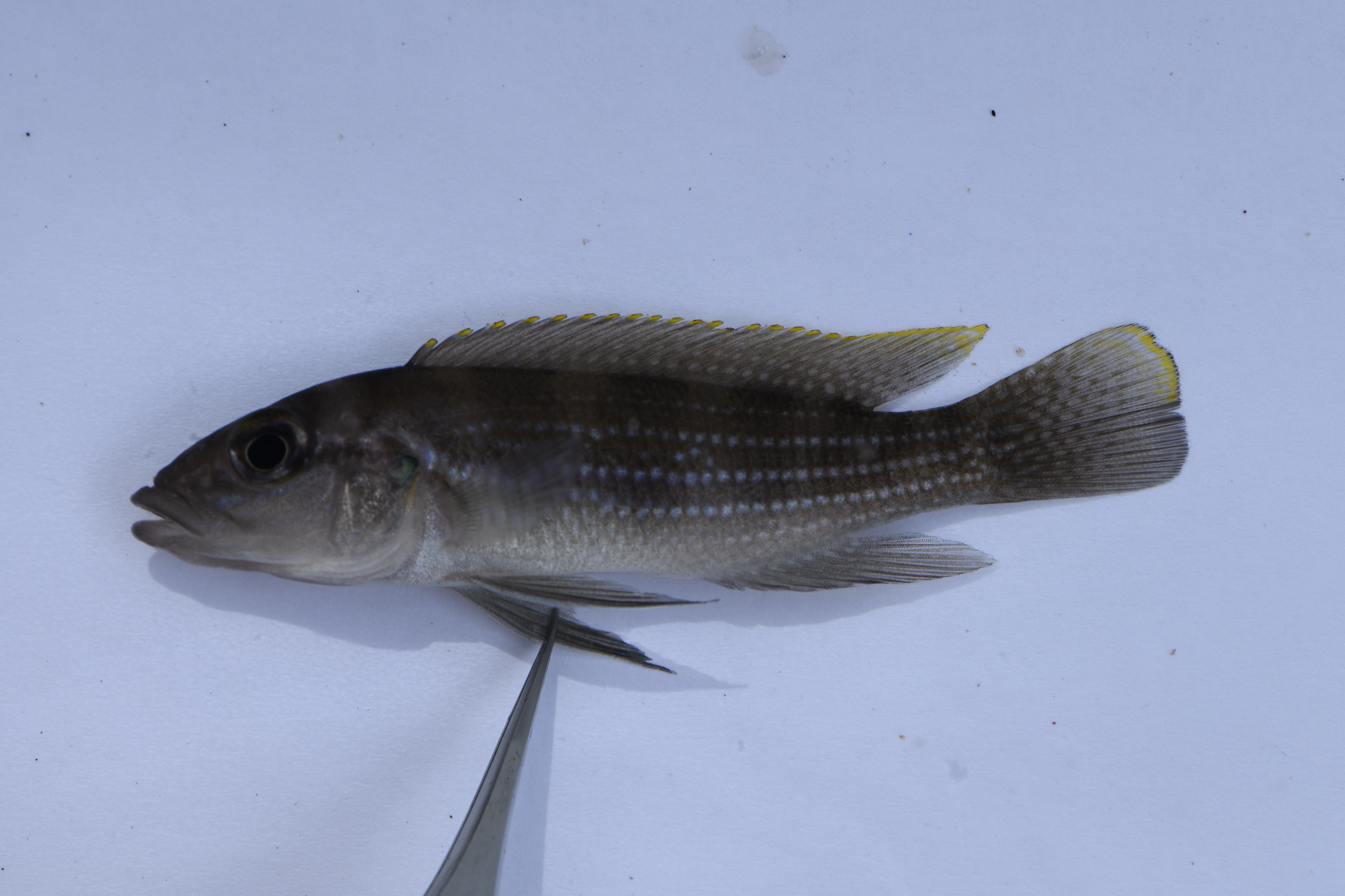
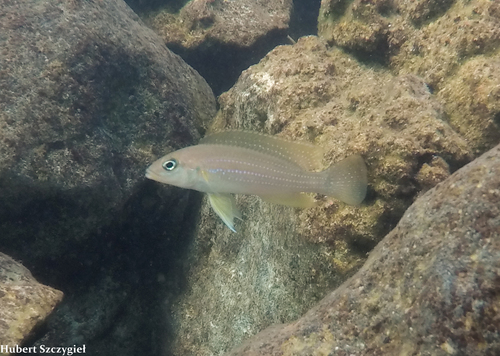
This is a slender, elongate cichlid with the lean profile of a sit-and-wait predator rather than the deep, disc shape of a rock-grazer. The ground colour is a brownish to greenish yellow, over which run neat longitudinal rows of small, glittering white-to-silver dots that carry onto the unpaired fins — the feature behind the trade name "pearl-lined cichlid." The dorsal, anal and tail fins are rounded and edged in a pale yellow-white, often with a black submargin and, particularly in northern populations, a reddish dorsal edge. A spawning or stressed fish can darken dramatically, the body going so dark that the pearl rows nearly vanish.
Size reports vary in a way that mostly tracks geography. FishBase gives a maximum of about 8 in (20 cm) total length, while field observers put wild males at roughly 7–8 in (18–20 cm) and note aquarium fish reaching about 10 in (25 cm); within the genus it is exceeded in length only by Neolamprologus cunningtoni. Populations are not uniform: Zambian fish are reported as notably smaller, around 5.5 in (14 cm), with the largest specimens coming from the Kipili Archipelago in Tanzania. Females run roughly 20% smaller than males, but otherwise the sexes look much alike, which makes this a notoriously hard fish to sex by eye — keepers who have bred it routinely admit they were never certain which fish was the male even after a successful spawn.
Range & habitat
Neolamprologus tetracanthus is a lacustrine endemic — found only in Lake Tanganyika — but within the lake it is one of the more widely distributed lamprologines, recorded along much of the shoreline rather than confined to a single stretch of coast. FishBase places it between about 3°S and 9°S, spanning the lake's length.
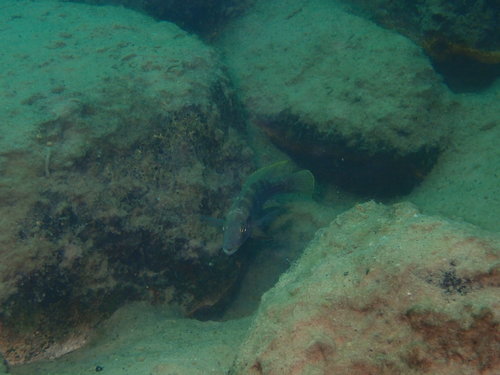
It is a fish of the intermediate zone, the transitional ground where rock gives way to open sand or mud, and it leans toward the sandy side of that boundary. FishBase reports it as a sand-dweller most often found at depths of about 6–12 m (20–40 ft), with a measured preference for hard, alkaline water: a pH of roughly 7.5–8.0, a carbonate hardness around 12–15 dH, and temperatures near 23–25 °C (73–77 °F). Field accounts extend its range both shallower and considerably deeper, from less than 10 m down to around 60 m (about 200 ft) over sandy or muddy bottoms. That is the lake's characteristic medium — ancient, stable, mineral-rich, hard and alkaline — and an aquarist's first job is to reproduce it rather than the soft water many other cichlids want.
Ecology & diet
This is a carnivore, and a fairly high-order one: FishBase assigns it a trophic level around 3.8, near the top of the cichlid range. In the lake it feeds on molluscs, insect larvae and small fishes, hunting over open sand where it can spot prey moving on the bottom. Its most distinctive feeding trick concerns snails. Unlike the heavy-jawed mollusc-crushers of the lake, N. tetracanthus does not pulverize shells; instead it takes the snail and effectively sucks the soft body out of the shell, a suction-feeding method that lets a slender-jawed fish exploit prey that would otherwise need a crusher's dentition. Crustaceans round out the invertebrate side of the diet.
Within the nearshore community it sits as a mid-sized predator on the sand flats and intermediate zone, taking small fish and the bottom invertebrates that shelter there. Its snail-eating habit is the part keepers notice first — more than one Tanganyikan hobbyist has remarked, half in relief, that a tetracanthus will keep a tank's nuisance-snail population in check.
Behavior & breeding
In the wild, N. tetracanthus is a substrate spawner with a flexible social system. Where predators are abundant it tends to form pairs, with both parents sharing defence; under lower predation it more often lives in harems, a single male holding a territory that overlaps those of several females. Both sexes maintain and defend space. Spawning happens within the female's territory: she excavates a nest in the sand beneath a rock or in a cave, and lays a relatively large, often fairly open clutch — field accounts put it on the order of 100–200 eggs, sometimes deposited where they are partly visible from outside, unlike the hidden clutches of the small shell-dwellers. Once the fry are free-swimming, brood care is usually carried out by the female alone, though the male joins in where predation pressure is high.
Aquarium breeding confirms the lake picture and adds the part keepers dread: the aggression. A bonded pair can be intensely territorial, and brood defence turns them on essentially everything else in the tank. Keepers who have spawned them describe how difficult sexing is, how the pair will guard a cloud of a couple hundred fry, and how a breeding pair in a 7-foot tank can annex six feet of it and drive every other fish into the rocks. Reports of clutch size and ferocity vary — the same fish gets described as "the devil of the fish world" by one keeper and merely "mildly aggressive" by another — which probably reflects real differences between individuals and between a settled single fish and a spawning pair. The fry themselves are reported as fast-growing and easy to raise, taking newly hatched brine shrimp and then grazing readily on algae and prepared foods.
In the aquarium
This is a striking fish and a genuinely difficult community resident, and honest care advice leads with the second point. Water is the easy part: hard, alkaline conditions with a pH held above about 7.5, temperatures in the low-to-mid 70s °F (about 23–25 °C), and the clean, well-filtered, stable parameters any Tanganyikan expects. A sand bottom is appropriate to a fish that hunts and digs over open substrate. Because it excavates, rockwork should be set on the tank bottom before the sand goes in, so the fish cannot undermine an unstable pile.
Space and temperament are where people get it wrong. This is a large, predatory lamprologine: anything under roughly 4 in (10 cm) is a potential meal, which rules out the small shell-dwellers and slim Tanganyikan minnows it is sometimes shelved beside. Experienced keepers consistently recommend a long tank — field-guide advice of at least 500 L and a footprint around 2 m (about 6–7 ft) for any community attempt is well matched to forum experience, where a single specimen can be worked into a big mixed Tanganyikan or even Central American tank, but a pair tends to take over. The realistic options are a species tank for a pair or a one-male-several-female group, or a single individual kept as a centrepiece among other large, robust cichlids in a tank big enough to dilute its aggression. Tankmates that work tend to be other tough Tanganyikans of similar size — large Lepidiolamprologus, the bigger Neolamprologus, robust Cyprichromis up in the water column — while slow-growing Altolamprologus and small calvus/compressiceps will simply be outpaced or bullied. The single most common mistake is buying it for its looks and treating it like the peaceable shell-dwellers it superficially recalls; it is neither small nor peaceful, and a proven pair is a commitment of tank space, not a casual addition.
Conservation
On its own account, Neolamprologus tetracanthus is not currently a species of concern. The IUCN Red List assessed it as Least Concern in its most recent evaluation, published in 2025 (date assessed 24 February 2025), reflecting a wide distribution around the lake and no evidence of a species-specific decline. It is collected for the aquarium trade and turns up in artisanal catches, but neither the trade nor local fishing is flagged as a threat to the species as a whole, and its broad range across all four riparian nations buffers it against the localized risks that menace narrowly endemic, single-reef cichlids. The honest headline is that this is a secure species — but one living in a lake under real and growing strain.
Those basin-level pressures are well documented. Long-term limnological work (O'Reilly et al., 2003, Nature) showed that a warming surface layer has increased the stability of the water column and, with weakening winds, reduced the deep mixing that lifts nutrients into the sunlit zone; sediment-core evidence implied roughly a 20% decline in primary productivity over the twentieth century and, by extension, on the order of a 30% drop in potential fish yields. Paleoecological work since (Cohen et al., 2016, PNAS) tied that warming to measured declines in commercial fishes and endemic molluscs and estimated that reduced mixing had shrunk the oxygenated benthic habitat in their study areas by about 38%. On top of climate, catchment deforestation and farming wash eroded sediment into the nearshore, degrading the rocky and intermediate littoral (Cohen et al., 1993), while the pelagic fishery of clupeid sardines (Stolothrissa and Limnothrissa) and the predator Lates that feeds the four bordering nations remains under pressure — challenges that the four-country Lake Tanganyika Authority exists to coordinate against.
For a fish like N. tetracanthus, the relevant threads are sedimentation and the health of the benthos. As a sand- and intermediate-zone predator, it lives squarely in the depth band where shoreline development and eroded sediment settle out and smother the bottom, and its reliance on molluscs ties its food supply to the same endemic snail populations the warming-and-mollusc studies flag as vulnerable. None of this has so far moved its Red List status, and it should not be overstated: the species itself remains Least Concern. But its dependence on a healthy sandy littoral and a productive benthic food web gives it a real stake in the lake's wider condition, and that condition is, slowly, deteriorating.
Sources
- Eschmeyer's Catalog of Fishes — Lamprologus tetracanthus (Boulenger, 1899), valid as Neolamprologus tetracanthus
- Eschmeyer's Catalog of Fishes — Lamprologus marginatus (Boulenger, 1914), synonym of N. tetracanthus
- FishBase — Neolamprologus tetracanthus (Boulenger, 1899), Fourspine cichlid
- IUCN Red List — Neolamprologus tetracanthus (Least Concern, assessed 24 February 2025)
- tanganyika.si — Neolamprologus tetracanthus (locality variants, habitat, breeding, diagnostic notes)
- Klinesteker, C. — Fourspine Cichlid, Neolamprologus tetracanthus (Grand Valley Aquarium Club / SWAM keeping & breeding account)
- O'Reilly et al. (2003), Nature — Climate change decreases aquatic ecosystem productivity of Lake Tanganyika
- Cohen et al. (2016), PNAS — Climate warming reduces fish production and benthic habitat in Lake Tanganyika
- Phiri et al. (2023), J. Great Lakes Research — Lake Tanganyika: Status, challenges, and opportunities for research collaborations
- Sturmbauer, Salzburger, Duftner, Schelly & Koblmüller (2010), Mol. Phylogenet. Evol. 57:266–284 — Evolutionary history of the Lake Tanganyika cichlid tribe Lamprologini
- MonsterFishKeepers — 'Neolamprologus tetracanthus tank mates?' (keeper experience, anecdotal) — community/anecdotal
- Cichlid-Forum — 'Neolamprologus Tetracanthus' temperament & breeding thread (keeper experience, anecdotal) — community/anecdotal
- ACE Forums (Australia) — 'Anyone keeping Neolamprologus Tetracanthus?' (keeper experience, anecdotal) — community/anecdotal
- Fishi-Pedia — Neolamprologus tetracanthus (Fourspine cichlid) species sheet
- GBIF — Neolamprologus tetracanthus (Boulenger, 1899) occurrence records