
Taxonomy & naming
The species was described by the Belgian ichthyologist Max Poll in 1949 as Lamprologus toae, from material collected at Kavala Island in Braconé Bay on the Congolese (then Belgian Congo) shore of Lake Tanganyika; the holotype sits in the Royal Museum for Central Africa at Tervuren. It was moved into the genus Neolamprologus in the 1991 CLOFFA check-list of African freshwater fishes by Maréchal and Poll, and Eschmeyer's Catalog of Fishes lists Neolamprologus toae (Poll 1949) as the current valid combination.
Neolamprologus belongs to the tribe Lamprologini, the large radiation of substrate-spawning cichlids that dominates Tanganyika's rocky and intermediate habitats. The genus as currently defined is widely acknowledged to be a taxonomic grab-bag — not a tidy natural group — and several species, toae among them, have at times been shuffled between Lamprologus and Neolamprologus or flagged for eventual revision. The species name honors the Toa (Toua) River area near the type locality. There is no established English common name; in the hobby it usually travels under the bare scientific binomial, occasionally with a collection-locality tag attached.
Appearance
Neolamprologus toae is a modestly sized, fairly elongate lamprologine. FishBase, the Catalog of Fishes reference base and aggregators such as the Encyclopedia of Life all give a maximum of about 12 cm (4.7 in) total length, though aquarium and field reports of typical adults tend to run shorter, often in the 8–10 cm (3–4 in) range — the 12 cm figure is best read as an upper bound rather than an everyday size.
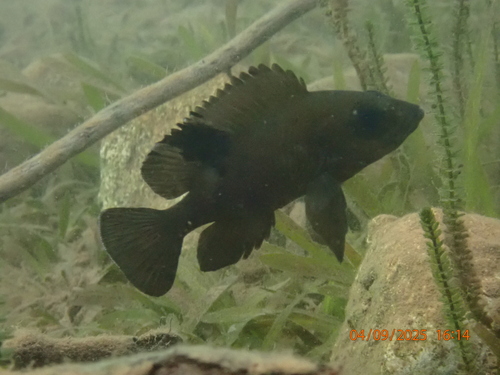
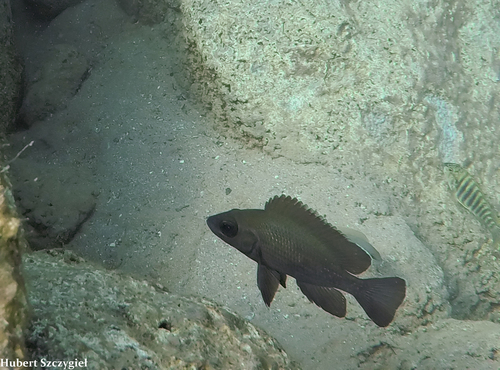
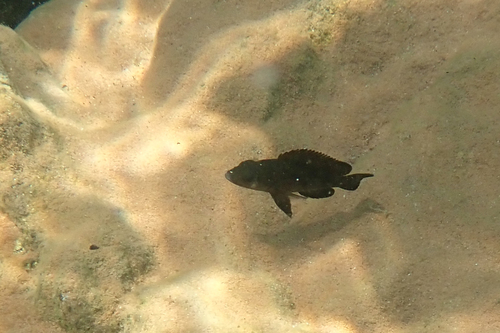
The ground color is a subdued grey-brown, the body finely flecked so that it reads as faintly spangled rather than boldly marked — a cryptic livery that suits a fish living against sand-dusted rock. The IUCN assessment notes a striking regional twist: an entirely black variant occurs in the northern Tanzanian part of the lake, a reminder that Tanganyikan cichlids frequently differ in color from one stretch of shoreline to the next. Sexual dimorphism is slight; males average marginally larger, but the two sexes are not reliably told apart on color alone, which is one reason the species is harder to pair up than the lake's more dimorphic cichlids.
Range & habitat
The species is endemic to Lake Tanganyika — found in that single rift lake and nowhere else on Earth — which makes it, like most of the lake's fauna, a lacustrine endemic with a global range no larger than one body of water. Its distribution is weighted toward the northern and central parts of the lake. The 2025 IUCN assessment reports it from Burundi (south to around Rumonge) and down the Congolese coast to about Kasanga, and notes that it does not occur in the far south in Zambia.
Neolamprologus toae is a creature of the intermediate, or transition, habitat: the cluttered interface where a sandy or muddy bottom meets scattered stones and rock piles, producing caves and crevices for shelter against open feeding ground. FishBase records a depth band of roughly 1 to 40 m, and the IUCN describes it as a rock-dweller near the shore. Biotope surveys bear this out — at lightly disturbed sites such as Cape Banza on the Ubwari Peninsula it has been logged as a regular but minor component of the rocky community, on the order of a few percent of the fish present. Like the rest of the lake's cichlids it lives in hard, alkaline, mineral-rich water: Tanganyika typically runs a pH in the mid-8s to low-9s, high carbonate hardness, and surface temperatures in the mid-20s Celsius.
Ecology & diet
Within its community Neolamprologus toae is a benthic micro-carnivore. FishBase summarizes its feeding as taking insect larvae at night, and the IUCN assessment broadens this to insect larvae and crustaceans; basin-wide trophic compilations likewise place it among the lamprologines that work the substrate for small invertebrates rather than grazing algae or hunting other fish. FishBase's modeled trophic level of about 3.8 is consistent with a diet built on invertebrate prey.
The nocturnal angle is the genuinely interesting part. Many of Tanganyika's intermediate-zone lamprologines forage by day; a fish that does much of its feeding after dark is exploiting a different slice of the same habitat, picking over crevices and sediment for larvae and small crustaceans when diurnal competitors have settled. In a lake famous for fine-grained dietary partitioning — algae scrapers, scale eaters, sponge pickers, sand sifters — toae's role is a quieter one, but it is a real specialization in time as much as in food type.
Behavior & breeding
Like the great majority of lamprologines, Neolamprologus toae is a substrate spawner rather than a mouthbrooder: it lays its eggs on a hidden surface — typically inside a cave or rock crevice — and the parents guard the clutch and the resulting fry on site. This is the opposite strategy to the lake's many mouthbrooding cichlids, and it ties the fish tightly to structured habitat that offers defensible nooks. The IUCN assessment cites a comparatively generous clutch for a cave spawner, in the range of 150 to 250 eggs.
Behaviorally it is territorial and not especially sociable with its own kind. Reports consistent with close relatives describe a fish best kept as a single pair, defending a patch around its chosen cave; this is one of those cases where the lake's intermediate-zone lamprologines reward a keeper who gives a bonded pair enough room and clear sightline boundaries. Because the sexes are so similar in appearance, would-be breeders often have to grow out a small group and let a pair form rather than buying a sexed pair off the shelf.
In the aquarium
This is not a beginner's Tanganyikan, and not because it is delicate — it is simply uncommon, slow to sex, and territorial enough to need a thought-out tank. It belongs in a hard-water, high-pH setup that mirrors the lake: pH comfortably above 8, substantial carbonate hardness, stable temperatures in the mid-70s Fahrenheit (low-to-mid 20s Celsius), and immaculate water. The aquascape should echo the intermediate zone it comes from — an open sand floor broken by piled rock that yields caves and defensible lines of sight — rather than a bare or purely rocky tank.
Give it footprint over height: a pair wants its own territory, and tankmates should be other robust Tanganyikans housed with enough space that disputes stay ritual rather than lethal. Keepers chasing a spawn typically grow out a half-dozen juveniles to let a pair sort itself out, since you cannot reliably buy a true pair on looks. The honest caveat is availability: although the species is listed as commercially farmed and present in the aquarium trade, it shows up only sporadically and rarely in volume, so much of the lived-experience literature is thin and should be read as anecdotal until corroborated. Treat the detailed care folklore that circulates for its showier cousins as a starting point, not gospel, for this fish.
Conservation
Neolamprologus toae was assessed for the IUCN Red List as Least Concern in 2025 (assessment e.T60600A47202431, D. Mushagalusa), an upgrade in confidence over earlier listings but still resting on a thin evidence base: the population trend is recorded as unknown, and the assessors note the species is "not very abundant." The Least Concern call rests on its lake-wide, if patchy, northern distribution rather than on any sign that its numbers are secure. The assessment is candid that sedimentation, water pollution, habitat disruption and overfishing all bear on the species, and warns that the loss of its specialized intermediate-zone habitats, combined with intensive seine, gillnet and line fishing, could push it toward a worse status. It is collected for the trade and is reportedly farmed commercially, but there is no evidence that targeted collection threatens wild stocks.
That species-level reassurance has to be set against a lake under real strain. Lake Tanganyika has warmed measurably over the past century, and stronger thermal stratification has slowed the vertical mixing that brings nutrients to the surface: O'Reilly and colleagues (Nature, 2003; DOI 10.1038/nature01833) linked this warming to roughly a 20% drop in primary productivity, with knock-on losses to fish yields. Cohen and colleagues (PNAS, 2016; DOI 10.1073/pnas.1603237113) found that warming has reduced the lake's oxygenated, habitable benthic zone, with sediment-core evidence that fish populations began declining before industrial-scale fishing intensified. Closer to toae's own neighborhood, shoreline deforestation and erosion are pushing sediment onto the rocky and intermediate littoral that this fish depends on (Cohen and colleagues, 1993), smothering the crevices it shelters and feeds in. The lake is shared by Burundi, the Democratic Republic of the Congo, Tanzania and Zambia and managed jointly through the Lake Tanganyika Authority, but its great clupeid-and-Lates pelagic fishery and its inshore communities alike are squeezed by warming and overfishing. So the honest framing is this: Neolamprologus toae is currently Least Concern, yet it is a shallow, habitat-tied endemic in a lake whose littoral is being degraded by sedimentation and whose productivity is slipping — exactly the kind of species whose status could change faster than a 2025 label suggests.
Sources
- Eschmeyer's Catalog of Fishes — Lamprologus toae (Poll 1949), valid as Neolamprologus toae
- FishBase — Neolamprologus toae (Poll, 1949) summary
- GBIF — Neolamprologus toae (Poll, 1949)
- Encyclopedia of Life — Neolamprologus toae
- IUCN Red List — Neolamprologus toae (Mushagalusa 2025, e.T60600A47202431, Least Concern)
- O'Reilly et al. 2003, Nature — Climate change decreases aquatic ecosystem productivity of Lake Tanganyika
- Cohen et al. 2016, PNAS — Climate warming reduces fish production and benthic habitat in Lake Tanganyika
- Alin, Cohen et al. 1999, Conservation Biology — Effects of landscape disturbance on animal communities in Lake Tanganyika (sedimentation)
- Sturmbauer & Meyer 1994, Mol. Biol. Evol. — Mitochondrial phylogeny of the Lamprologini, the major substrate-spawning lineage of Tanganyika
- Day et al. 2007, Mol. Phylogenet. Evol. — sand-dwelling lineage of Lake Tanganyika cichlids (places N. toae)
- tanganyika.si — Habitats of Lake Tanganyika (N. toae listed in the transition/intermediate zone)
- tanganyika.si — Neolamprologus genus index
- Biotope Aquarium Project — Shallow intermediate habitat, Cape Banza, DRC (N. toae 2–5% of community; reviewed by Ad Konings) — community/anecdotal
- Biotope-aquarium.info — Intermediate Rocky Habitat, Lake Tanganyika, Zambia (community context) — community/anecdotal
- Cichlid Room Companion — Neolamprologus genus profile
- Cichlid Fish Forum (cichlid-forum.com) — community keeping experience for Tanganyikan Neolamprologus — community/anecdotal