
Taxonomy & naming
George Albert Boulenger described this fish in 1899 as Lamprologus tretocephalus, working from material collected at Albertville (modern Kalemie) on the Congolese shore of Lake Tanganyika; the unique holotype (MRAC 231) still resides in the Royal Museum for Central Africa in Tervuren. It was later transferred to the genus Neolamprologus, and Eschmeyer's Catalog of Fishes lists Neolamprologus tretocephalus (Boulenger, 1899) as the valid combination, with Lamprologus tretocephalus as the original basionym.
The species epithet is the more interesting half of the name. "Tretocephalus" joins the Greek tretos, meaning perforated or pierced, to kephale, head — a reference to the conspicuous sensory pores of the head and lateral-line system. The genus name Neolamprologus is itself a compound of Greek roots (neos, new; lampros, torch; lagos, hare). In the hobby the fish is universally the "five-bar" or "five-barred" cichlid. It belongs to the tribe Lamprologini, the substrate-spawning radiation that dominates Tanganyika's rocky and shell habitats and includes everything from thumbnail shell-dwellers to meter-defending bruisers like this one.
Appearance
This is a deep-bodied, robust cichlid that reaches about 15 cm (5.9 in) total length; wild fish typically top out near 14 cm (5.5 in), with aquarium specimens occasionally a touch larger. Males grow noticeably bigger and heavier-headed than females, but the two sexes are otherwise hard to tell apart — there is no dramatic difference in fin shape or color, which makes pairing this species a patient exercise.
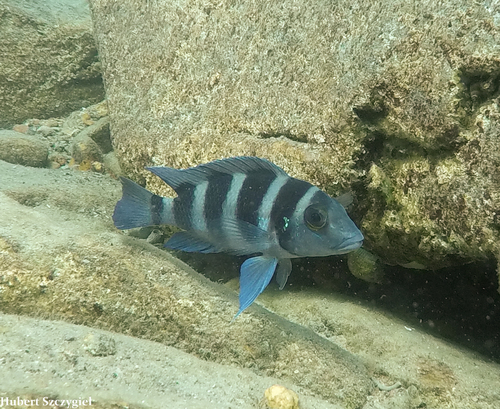
The pattern is the whole point. Five black vertical bars cross a body that ranges from chalky bluish-grey to near-white, the bars broad over the back and tapering toward the belly, with neon and violet-blue edging picked out along the unpaired fins. The look has earned the fish frequent comparisons to a small Cyphotilapia frontosa. Color is mood-dependent: the bars can wash out to a uniform grey, a frightened fish may instead flip to a longitudinal stripe, and a parent guarding fry shows its sharpest contrast across the upper body. The one identification trap is the closely related Neolamprologus sexfasciatus, which overlaps it on parts of both shorelines; the rule is simple arithmetic — tretocephalus carries five bars, sexfasciatus six.
Range & habitat
Neolamprologus tretocephalus is endemic to Lake Tanganyika and, unusually for a Tanganyikan cichlid, occupies only the northern half of the lake. On the western (Congolese) shore it ranges north of the Livua River, and on the eastern (Tanzanian) shore north of Cape Mpimbwe; it reaches into Burundian and Congolese waters at the head of the lake but is absent from the far north above Nyanza-Lac and, at the southern end, does not appear in Zambia. Its range partly overlaps that of N. sexfasciatus, the two meeting along defined stretches of each coast.
It is a fish of the shallow rocky and intermediate zones — the transition where tumbled rock gives way to sand and pebble. Records place it between roughly 1 and 10 m (3–33 ft), with an average depth near 5 m (16 ft), squarely in the sunlit, well-oxygenated littoral. The water it lives in is hard and alkaline, warm and stable: FishBase gives a pH of about 7.6–8.0, moderate hardness, and a temperature band of 24–26°C (75–79°F), the year-round signature of Tanganyika's surface waters.
Ecology & diet
Despite its bar-and-cave appearance, the five-bar is less a cave ambusher than a substrate forager. It works the sandy patches between small rocks and pebbles, taking the invertebrates that live in and on the sand — insect larvae and crustaceans make up the bulk of the diet. What sets it apart is a taste for snails: studies of its gut and dentition show strong, molarized teeth on the lower pharyngeal bone, the crushing mill of a durophagous (hard-shelled-prey-eating) cichlid, and gastropods account for on the order of a tenth of what it eats in the wild. FishBase places it at a trophic level of about 3.4, the mid-carnivore range.
In the community of the rocky littoral it is a generalist benthic predator rather than a specialist of a single food, which is part of why it is widely distributed where suitable habitat exists. That same flexibility, paired with a willingness to defend a sizable patch of bottom, lets it claim and hold feeding territory against fish that outweigh it.
Behavior & breeding
Five-bars are monogamous substrate spawners with intense biparental care. A pair selects and excavates a cavity beneath a rock and the female deposits her eggs out of sight on the cave ceiling or wall — clutches are large, commonly around 200–300 eggs, slightly fewer than its six-barred cousin produces. Once the fry are free-swimming the division of labor is clear: the female stays tight over the brood while the male patrols and enforces the territory's outer boundary. Parental care is unusually prolonged for a lamprologine, lasting roughly four months, after which the juveniles — by then around 3 cm — are driven off.
This is where the species earns its reputation. Toward its own kind it is severely aggressive; a bonded, spawning pair will expand and defend a very large territory and become nearly impossible to house with anything else in a modest tank. During aggressive displays it flares its gill covers wide to bulk up its head, a posture reminiscent of the advanced N. pulcher group, even though its open, cave-spawning breeding style aligns it more with large lamprologines such as N. tetracanthus. Outside of breeding the hostility eases considerably, and a lone juvenile can be comparatively easygoing — a fact that fools many a buyer.
In the aquarium
The five-bar is a striking, durable, long-lived Tanganyikan that is also a genuine handful, and the gap between those two facts is where keepers get into trouble. Juveniles are sold looking like manageable dwarfs; experienced hobbyists on cichlid-forum.com and MonsterFishKeepers consistently warn that they grow into fish that can intimidate or kill tankmates and that a settled, spawning pair is the most aggressive phase of all — multiple keepers report needing a tank of about 6 ft (around 180 cm) before a pair can be housed with other robust species at all. The recurring community advice is blunt: keep a single specimen, or commit to a species tank for a pair, and don't try to keep two adults that aren't a bonded couple.
Provide a sandy bottom with generous rockwork for cover and an open swimming lane; a pair needs at least roughly 250 L (about 65 US gal), and more is better. Water should be hard and alkaline — pH around 7.8–8.5, moderate to high hardness, temperature 24–26°C (75–79°F) — and kept clean, as the species is sensitive to deteriorating quality. It is an unfussy eater that takes quality pellets and frozen foods readily; the natural snail diet can be honored with the occasional snail but is not a strict requirement. Suitable tankmates, where space allows, are other large, area-partitioning Tanganyikans that occupy different parts of the tank; small, mild rock-dwellers and look-alike lamprologines are poor choices. The species is bred commercially, so tank-raised stock is generally available — a better starting point than wild imports for most aquarists.
Conservation
The IUCN Red List assesses Neolamprologus tretocephalus as Least Concern (assessor Yves Fermon, assessed 28 February 2025, version 2025-2), reaffirming an earlier 2006 Least Concern listing. The reasoning is straightforward: the fish is endemic to Lake Tanganyika but widely distributed across the northern basin, with no major lake-wide threats identified, though the assessment notes it is "not abundant" and that its population trend is unknown. The single threat flagged for the species itself is sedimentation — soil erosion washing into its shallow rocky habitat — affecting it in certain areas rather than throughout its range. Collection for the aquarium trade is real but largely defused by commercial captive breeding, so wild populations carry little harvest pressure.
That clean bill of health sits inside a lake under measurable strain, and the distinction matters. Lake Tanganyika is warming: O'Reilly et al. (2003, Nature, doi:10.1038/nature01833) linked rising temperatures to stronger stratification, shallower mixing, and an estimated ~20% decline in primary productivity, with knock-on losses in fish yield. Cohen et al. (2016, PNAS, doi:10.1073/pnas.1603237113) used sediment-core records to show that warming has tracked with declines in commercially important fishes and a substantial loss — on the order of 38% — of oxygenated benthic habitat as the oxygen-poor deep water shoals upward. The pelagic clupeid fishery (Stolothrissa and Limnothrissa, with the predatory Lates) feeds millions across the four riparian nations and is managed jointly through the Lake Tanganyika Authority, but the basin also faces shoreline development, deforestation, and the nutrient and sediment loading that follow.
For a fish like the five-bar, the relevant pressure is local rather than the deep-water productivity story: as a shallow rocky-shore species it lives precisely where sedimentation from catchment erosion smothers the rock-and-sand interface it forages over, and where shoreline disturbance is most direct. So the honest summary is the one the data support — the species itself is not currently threatened, but its habitat guild is exposed to the same creeping degradation tightening across Tanganyika's littoral, which is why ongoing monitoring of its populations is explicitly recommended.
Sources
- Eschmeyer's Catalog of Fishes: Neolamprologus tretocephalus
- FishBase: Neolamprologus tretocephalus (Boulenger, 1899)
- GBIF: Neolamprologus tretocephalus
- Encyclopedia of Life: Neolamprologus tretocephalus
- IUCN Red List: Neolamprologus tretocephalus (Fermon 2025, e.T60587A47201611)
- O'Reilly et al. 2003, Climate change decreases aquatic ecosystem productivity of Lake Tanganyika (Nature; PubMed)
- Cohen et al. 2016, Climate warming reduces fish production and benthic habitat in Lake Tanganyika (PNAS)
- Lake Tanganyika: Status, challenges, and opportunities for research (J. Great Lakes Research)
- tanganyika.si — Neolamprologus tretocephalus species profile (habitat, distribution, breeding)
- Fishipedia — Neolamprologus tretocephalus
- Aqua-Fish.net — Five-bar cichlid (Neolamprologus tretocephalus) care
- Pet Village — Keeping and Breeding the Five-Bar Cichlid
- Cichlid-Forum.com — 'Anyone keep Neolamprologus tretocephalus?' (community thread) — community/anecdotal
- MonsterFishKeepers — Neolamprologus tretocephalus, Five-Bar Cichlid (community thread) — community/anecdotal
- ACE Forums (Australia) — Neolamprologus tretocephalus help (community thread) — community/anecdotal
- Reddit r/Cichlid — 'Just a picture of the 5 bar' (community thread) — community/anecdotal