Taxonomy & naming
Neolamprologus walteri was formally described in 2007 by Piet Verburg and Roger Bills, in a Zootaxa paper that simultaneously named it and its close neighbour N. chitamwebwai from Lake Tanganyika. The valid name — Neolamprologus walteri Verburg & Bills, 2007 — is recognized by Eschmeyer's Catalog of Fishes, FishBase, and the IUCN. The holotype, a 48.4 mm male, was collected at Tembo Rock on the Bangwe peninsula, about 5 km south of the Tanzanian town of Kigoma. Occasionally the fish is still credited to other authors in older hobby write-ups, but the 2007 description is the authoritative one.
The species epithet honours Horst Walter Dieckhoff, a German aquarist who recognized the fish as an undescribed form and, with Ad Konings' 1988 book, established the trade name "walteri" long before the science caught up. The genus name Neolamprologus is a compound of Greek roots (loosely "new bright Lamprologus"), and the fish sits in the tribe Lamprologini, the vast flock of substrate-spawning cichlids that dominates Tanganyika's rocky and shelly habitats. Within that flock, N. walteri belongs to the N. savoryi complex — the "Princess" or "falcicula" group — and is closely allied to N. falcicula and N. chitamwebwai. The three are hard to tell apart, and Ad Konings has argued that walteri and chitamwebwai may simply be habitat variants of N. falcicula; Verburg and Bills, however, separated them on consistent differences in body proportions, fin markings, scale counts, and ecology, and most authorities now treat walteri as a distinct species.
Appearance
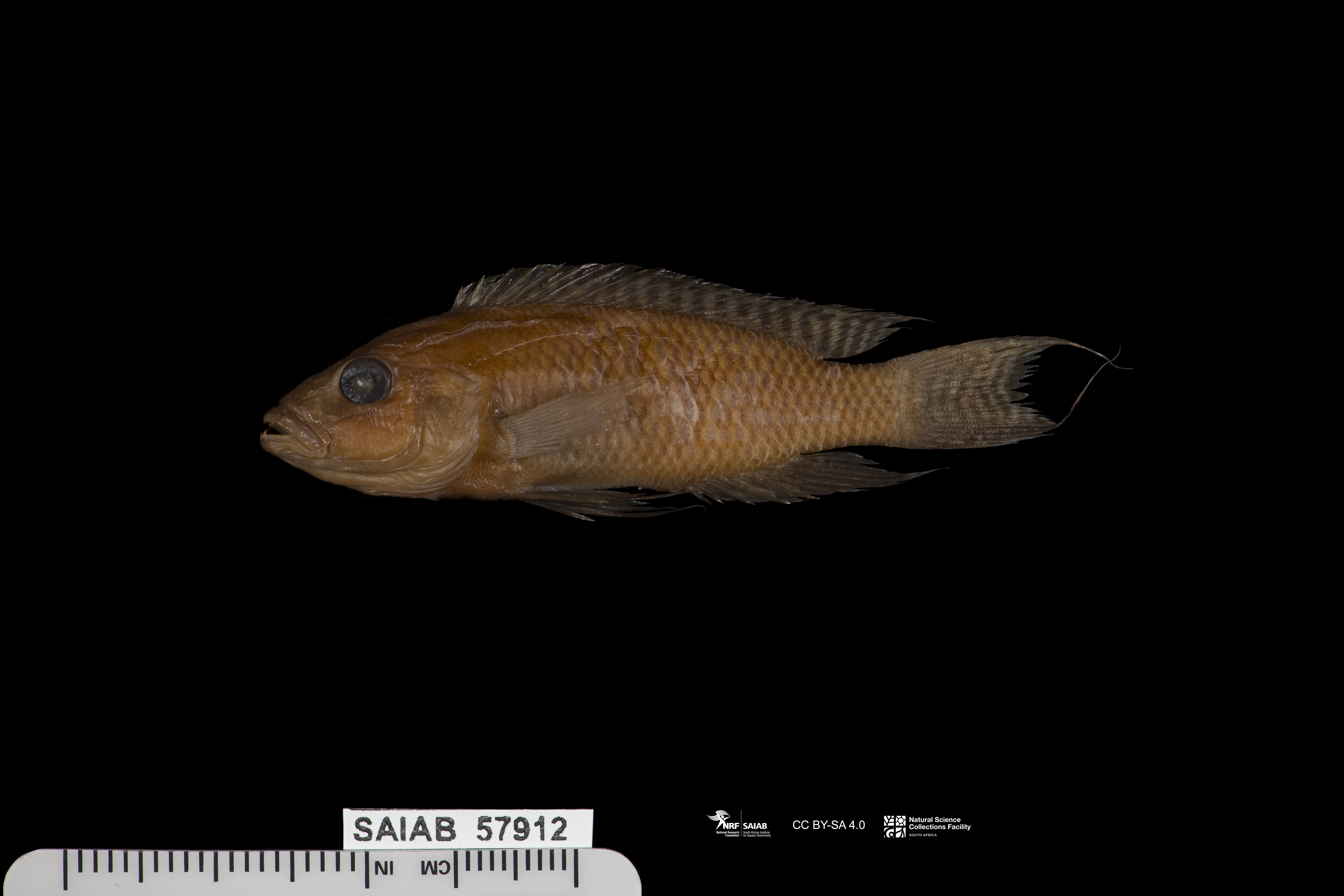
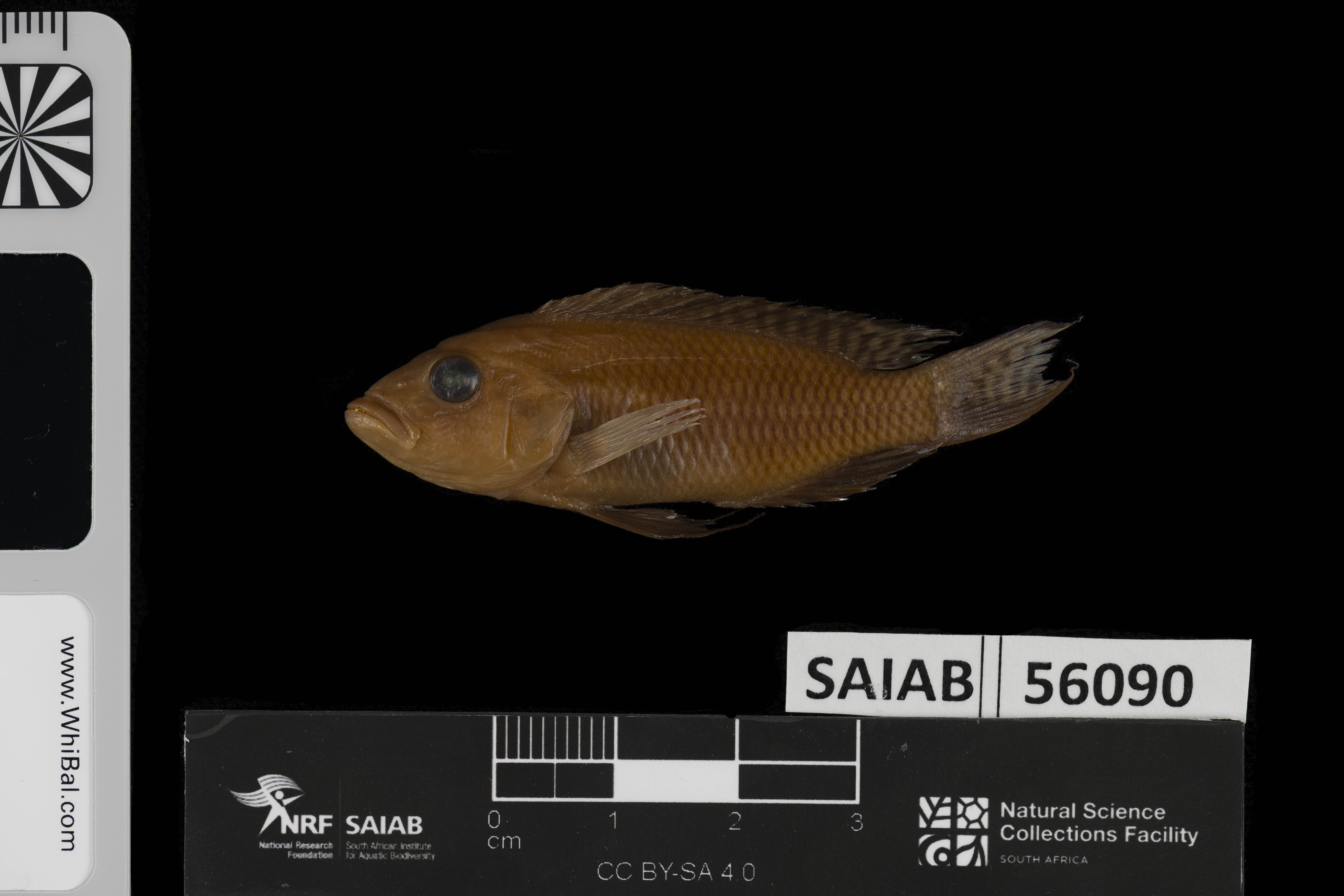
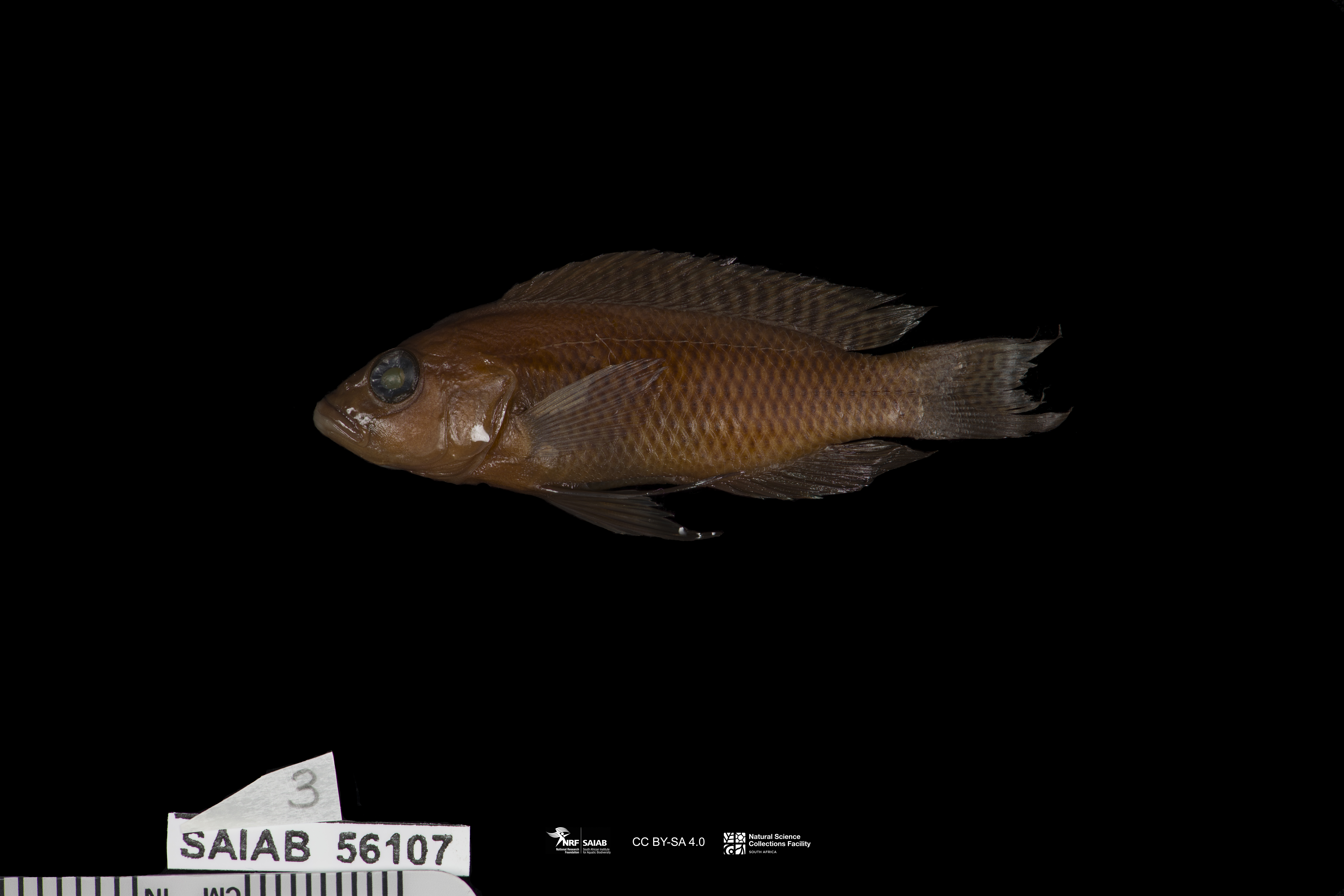
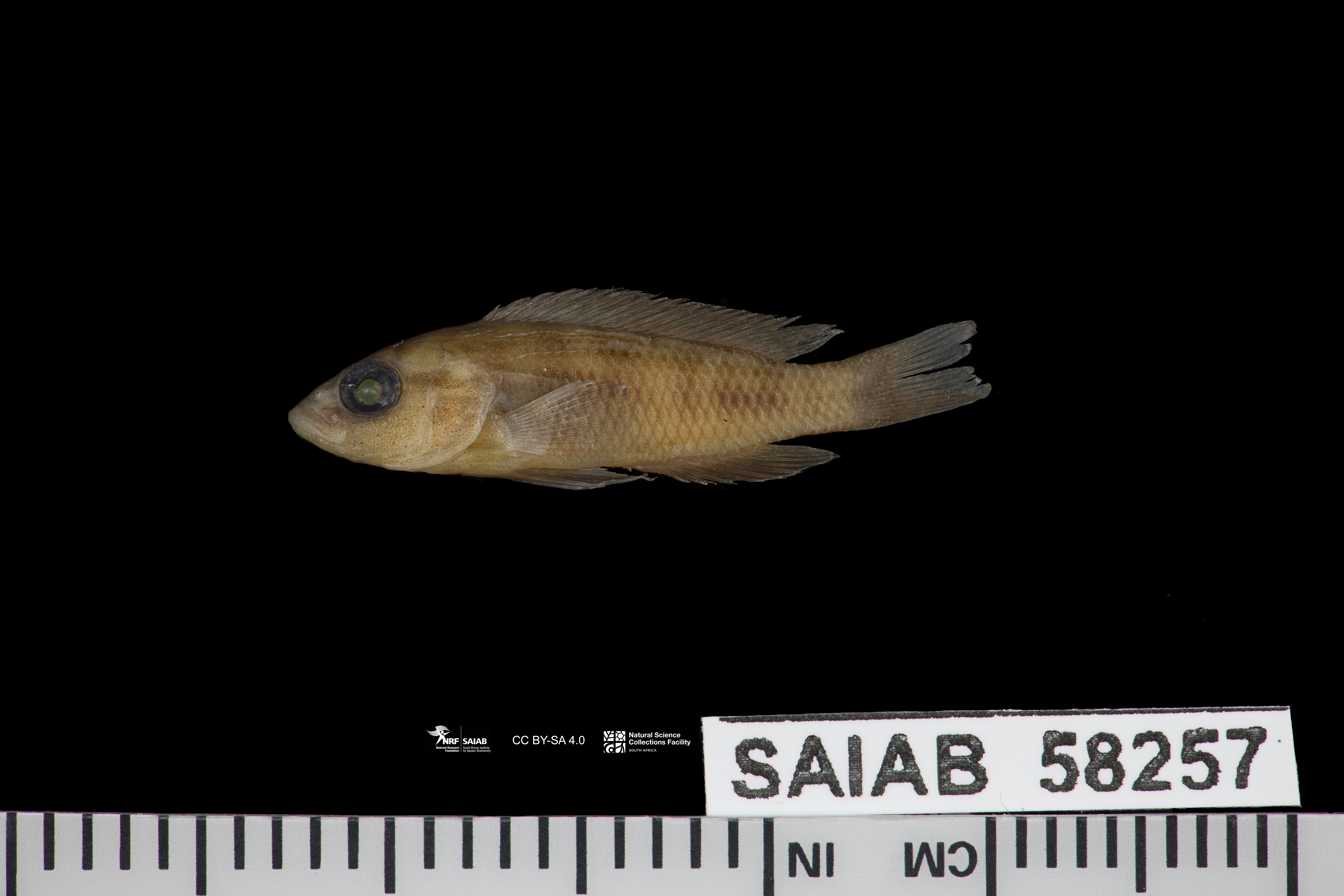
This is a small cichlid. The type series tops out at 5.7 cm (2.2 in) standard length — males to about 56.7 mm, females to 49.6 mm — with no real size difference between the sexes; hobby sources that quote an adult size near 9 cm (3.5 in) are measuring total length more loosely, and the fish you actually see is compact, deep-bodied, and short. The overall colour is dark, ranging from grey to nearly black, with the trailing edges of the scales darker than their centres, which gives the flanks a fine checkered look. Larger fish tend to lighten somewhat.
The distinguishing marks are on the head and the unpaired fins. A blue eye and a blue stripe beneath it lend a flash of colour to an otherwise sombre fish, and the dorsal and caudal fins carry conspicuous black-and-white banding along their margins plus vertical bands across the membrane — these fin patterns are a key field character separating walteri from the plainer-finned N. falcicula. There are no markings on the gill cover and, unlike the closely related N. savoryi, no dark bars on the body (though stressed individuals can briefly show them). Juveniles look quite different: drab grey-brown with bluish dorsal and anal fins and faint vertical bars on the body, a combination that distinguishes young walteri from the bright yellow-orange juveniles of N. falcicula. Separating it from N. chitamwebwai comes down to subtleties — walteri is the deeper, shorter-bodied of the two, with more pronounced fin markings — and to which habitat the fish is sitting in.
Range & habitat
Neolamprologus walteri is a lacustrine endemic, found nowhere on Earth but Lake Tanganyika, and within the lake it is confined to a narrow stretch of the northeastern shore. Its core range runs from near the Burundi–Tanzania border in the north to Cape Kabogo in the south — roughly 140 km of coast — with additional records around Kigoma and as far south as Halembe. It is absent from the southern, Zambian end of the lake. Around Kigoma it is, by Verburg and Bills' account, by far the most common fish in the littoral.
It is highly stenotopic — fussily tied to one habitat type. That habitat is the sheltered rocky littoral: gentle slopes of small stones and rubble, the rubble often cemented together by calcite and dusted with stromatolite (cyanobacterial) crusts, with fine sediment filling the gaps between stones. The fish is strongly associated with accumulations of the freshwater bivalve Pleiodon spekii, whose 10–15 cm shells cement into beds riddled with small cavities that the cichlids use for shelter and breeding. Depth records span 2 to 30 m, but the species is most common and most abundant between about 7 and 15 m. This habitat preference is what segregates it from its look-alikes: N. chitamwebwai occupies the more exposed sites with large boulders and steep slopes, so although the two can live within a few metres of each other, their ranges essentially never overlap — substrate, not geography, draws the line. Like all of Tanganyika's rock-dwellers, walteri lives in hard, alkaline, well-oxygenated water.
Ecology & diet
Neolamprologus walteri is a mid-level omnivore — FishBase places it at a trophic level of about 3.4 — that feeds in two distinct modes. It either forages directly on the bottom, taking bites from the substrate surface and ingesting sediment (which is then egested through the gills and mouth), or it lifts off and hovers 10 to 50 cm above the rock, picking plankton out of the water column. There is a neat ontogenetic split in how individuals make their living: juveniles stay within about 5 cm of the substrate, while larger, older fish drift higher off the bottom and become more dependent on a planktonic diet.
In its dense colonies the species shares space with other Lamprologini, and the way it partitions that space is striking. Where it co-occurs with the fairy cichlid N. brichardi — a much more mobile, higher-fecundity relative — the two stratify the water column: walteri holds the lower layer, hugging the bottom at an average 20–30 cm, while N. brichardi forages in roughly equal numbers immediately above it, around 60 cm up. Walteri also lives alongside N. savoryi, another low-fecundity rock-dweller. As a small, abundant, sediment-and-plankton feeder packed at high density across hundreds of square metres of shoreline, it is a workhorse of the rocky littoral food web rather than a specialist or a top predator.
Behavior & breeding
The defining trait of N. walteri is its extreme philopatry — its refusal to leave home. Individuals are strongly bound to a small patch of rock and are rarely seen to travel more than two metres; across some 60 observation dives, the describers recorded a fish moving farther than that only once. An individual's home range is just 20–200 cm across, larger fish holding larger patches. The fish excavate sediment from beside and between the rocks, opening up crevices that serve as daytime refuges from predators and nighttime shelters, and these crevices are shared communally by several fish.
Breeding follows the lamprologine substrate-spawner pattern. Rather than pairing off across open territory, walteri forms congregations of small, contiguous territories — each about a square metre or less and held by a group that typically includes two or more adults plus several subadults and juveniles. Eggs are deposited hidden inside the excavated crevices (they were never directly observed in the wild) and guarded there. Reproductive output is low — usually only on the order of 10–20 fry per spawning, far fewer than the colonial, fast-breeding N. brichardi alongside it — and the tiny young stay glued to the substrate, vanishing into cover at the first sign of disturbance. The adults are wary by day but turn aggressive when guarding eggs and fry: other fish of similar size are driven out of the territory. Hobbyists keeping walteri and its near-twin falcicula echo this from the tank, describing them as among the more belligerent small Tanganyikans once a pair has formed — one keeper reported a young walteri/falcicula pair killing an adult yellow lab within hours.
In the aquarium
Neolamprologus walteri is a connoisseur's Tanganyikan rather than a mainstream stocklist fish — it shows up in the trade intermittently and is easy to confuse with falcicula and chitamwebwai, so locality information is worth chasing down. It is small, which tempts people to underestimate it, but it is a colony fish that wants a footprint of rock more than a tall tank. A pair or a male with two females can be kept in something around 150 L (about 40 US gallons); a small group does better with more floor space. The setup that suits it is the one it evolved in: a sandy base with rock piled into a maze of crevices, passages, and small caves, in hard, alkaline, well-oxygenated water in roughly the high-7s to high-8s pH that the open lake provides.
The honest caution is temperament. Day to day these are unobtrusive, bottom-hugging fish, but a spawning group becomes pugnacious and will harass tankmates near its patch — the very aggression keepers warn about in this "Princess" cluster. They are best kept as a colony in a species tank or with robust, non-rock-competing Tanganyikans rather than in a peaceful community. A second common mistake is mixing them with their close relatives: walteri, falcicula, chitamwebwai, and brichardi are similar enough to hybridize and to fight over the same niche, so they should not be combined. Get the rockwork, the water hardness, and the social setup right, and walteri rewards you with exactly the dense, busy colony behaviour it shows on the reef — which is the whole point of keeping it.
Conservation
The IUCN Red List assesses Neolamprologus walteri as Least Concern, in an assessment dated 11 March 2025. The reasoning is straightforward: the species is endemic to Lake Tanganyika but common and locally very abundant along its stretch of the eastern coast — colonies can cover hundreds of square metres at densities of 20–30 fish per square metre — and no major, widespread threat to it has been identified. (Older hobby references that list the species as "not evaluated" predate this 2025 assessment.) The assessment does flag local, species-specific pressures: increased siltation and turbidity could harm it locally; untreated wastewater and nutrient-driven eutrophication have been reported around Kigoma, the centre of its range; and the fish is taken both for local consumption and for the ornamental trade, where targeted collection in its limited range could meaningfully reduce populations. Its population trend is currently unknown, and none of its range is confirmed to fall within a protected area.
Those local pressures sit inside a lake under broad strain, and the connection matters for a shallow, rock-bound homebody like walteri. The clearest shoreline threat is sedimentation: deforestation and farming in the catchment send eroded soil into the nearshore, and long-term work on the lake has linked these sediment plumes to reduced species richness in exactly the rocky littoral communities walteri depends on — fine silt smothers the stromatolite-crusted rubble and clogs the shell beds and crevices it shelters and breeds in. Layered on top is climate warming: O'Reilly and colleagues (2003, Nature) found that a warming surface has stabilized the water column and weakened the wind-driven mixing that lifts deep nutrients into the sunlit zone, inferring roughly a 20% drop in primary productivity and on the order of a 30% decline in fish yields over the twentieth century, while Cohen and colleagues (2016, PNAS) tied continued warming to a roughly 38% loss of the lake's oxygenated benthic habitat. These basin-scale forces fall hardest on the pelagic clupeid-and-Lates fishery that feeds the four nations bordering the lake — Burundi, Tanzania, the Democratic Republic of the Congo, and Zambia — whose shared waters depend on coordinated management through the Lake Tanganyika Authority. The honest summary is that N. walteri itself is presently secure, but it is a narrow-range littoral specialist whose habitat is being degraded by the same shoreline sedimentation and basin warming that strain the lake as a whole.
Sources
- Eschmeyer's Catalog of Fishes — Neolamprologus walteri (Verburg & Bills, 2007)
- FishBase — Neolamprologus walteri (Verburg & Bills, 2007)
- GBIF — Neolamprologus walteri (Plazi taxonomic treatment of the original description)
- GBIF Backbone — Neolamprologus walteri Verburg & Bills, 2007
- Verburg, P. & Bills, R. (2007) — Two new cichlid species Neolamprologus (Teleostei: Cichlidae) from Lake Tanganyika, East Africa. Zootaxa 1612:25–44
- Cichlid Room Companion — Neolamprologus walteri (public profile: taxonomy, original description, Konings' note on the falcicula group)
- tanganyika.si — Neolamprologus walteri (type locality, rocky biotope, diet, breeding, comparison with chitamwebwai and falcicula)
- IUCN Red List — Neolamprologus walteri (Least Concern, assessed 11 March 2025; Mabo 2025)
- Alin et al. (1999) — Effects of Landscape Disturbance on Animal Communities in Lake Tanganyika (sedimentation and rocky-littoral species richness), Conservation Biology
- O'Reilly et al. (2003) — Climate change decreases aquatic ecosystem productivity of Lake Tanganyika, Nature 424:766–768
- Cohen et al. (2016) — Climate warming reduces fish production and benthic habitat in Lake Tanganyika, PNAS 113:9563–9568
- Cichlid-Forum — "neolamprologus walteri question" (community: walteri/falcicula aggression, single-species colony advice) — community/anecdotal
- Reddit r/Cichlid — Setting up a Neolamprologus brichardi tank (community: hard alkaline water parameters, pH ~8.5, for Princess-group lamprologines) — community/anecdotal
- MonsterFishKeepers — Experience with Neolamprologus (community: substrate-spawning lamprologine aggression intensifies once paired) — community/anecdotal