Taxonomy & naming
The species was described in 1962 by the Belgian ichthyologist Max Poll and his collaborator Hubert Matthes, from specimens collected at Kalungwe on Lake Tanganyika. They originally placed it in a genus of their own making, Ophthalmochromis, as Ophthalmochromis nasutus; the holotype is held at the Royal Museum for Central Africa in Tervuren. Eschmeyer's Catalog of Fishes now lists the valid combination as Ophthalmotilapia nasuta (Poll & Matthes, 1962), following later workers including Maréchal & Poll (1991) and Konings, who folded Ophthalmochromis into Ophthalmotilapia.
The genus name joins the Greek ophthalmos, "eye," with tilapia, the long-standing name for African cichlids; the epithet nasuta means "large-nosed," a nod to the blunt, fleshy snout that distinguishes adults of this species. It belongs to the tribe Ectodini, the lake's flock of sand- and open-water specialists, and within that tribe to the small group of long-finned cichlids hobbyists call featherfins, alongside Cyathopharynx, Cunningtonia, Aulonocranus and the rest of the genus Ophthalmotilapia (O. ventralis, O. boops and O. heterodonta). Like most Tanganyikan cichlids it occurs as a patchwork of geographically distinct, differently coloured populations, traded under place names such as Kipili, Chimba, Isinga and Mukosa.
Appearance
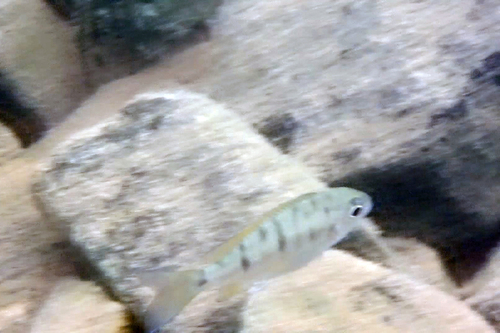
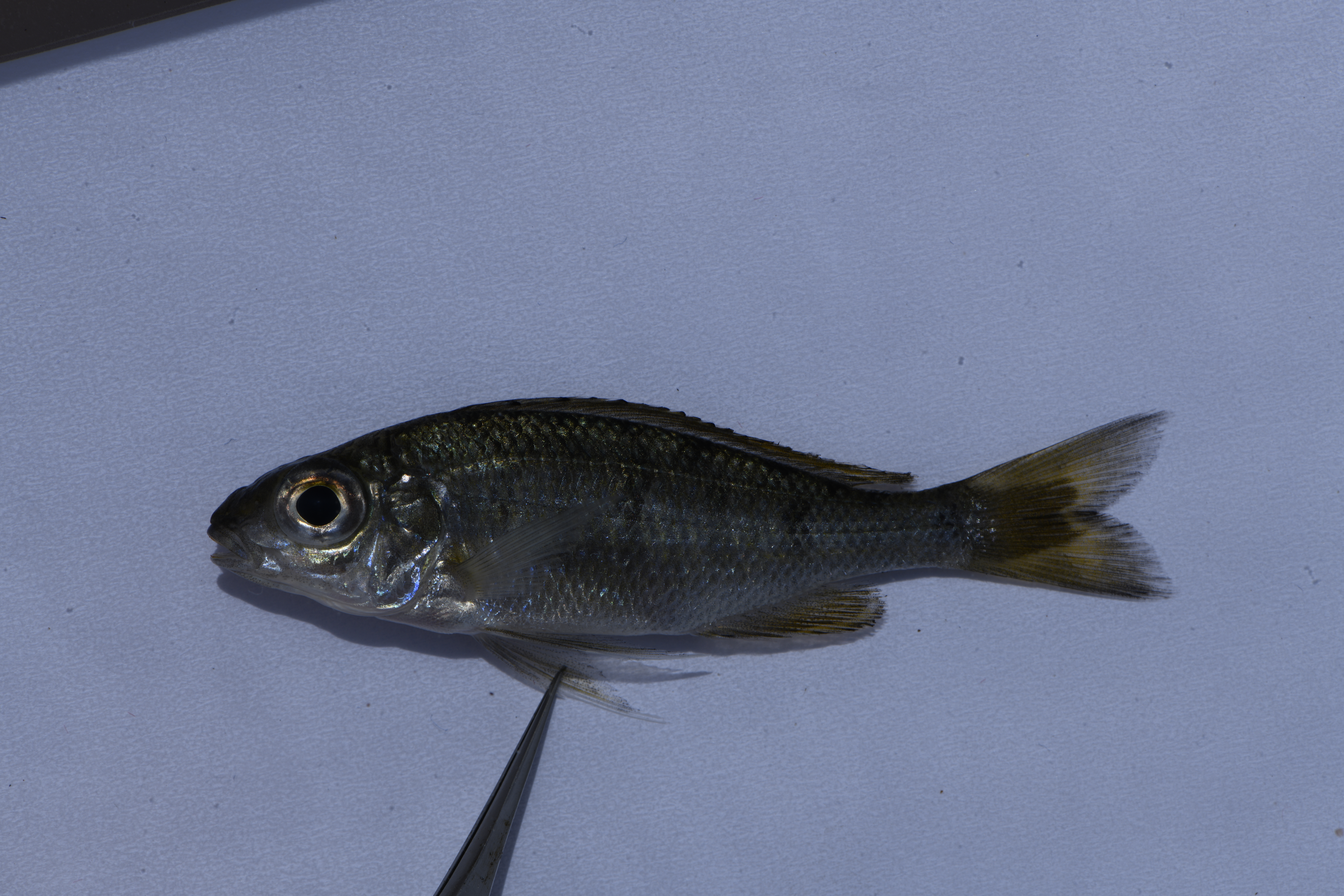
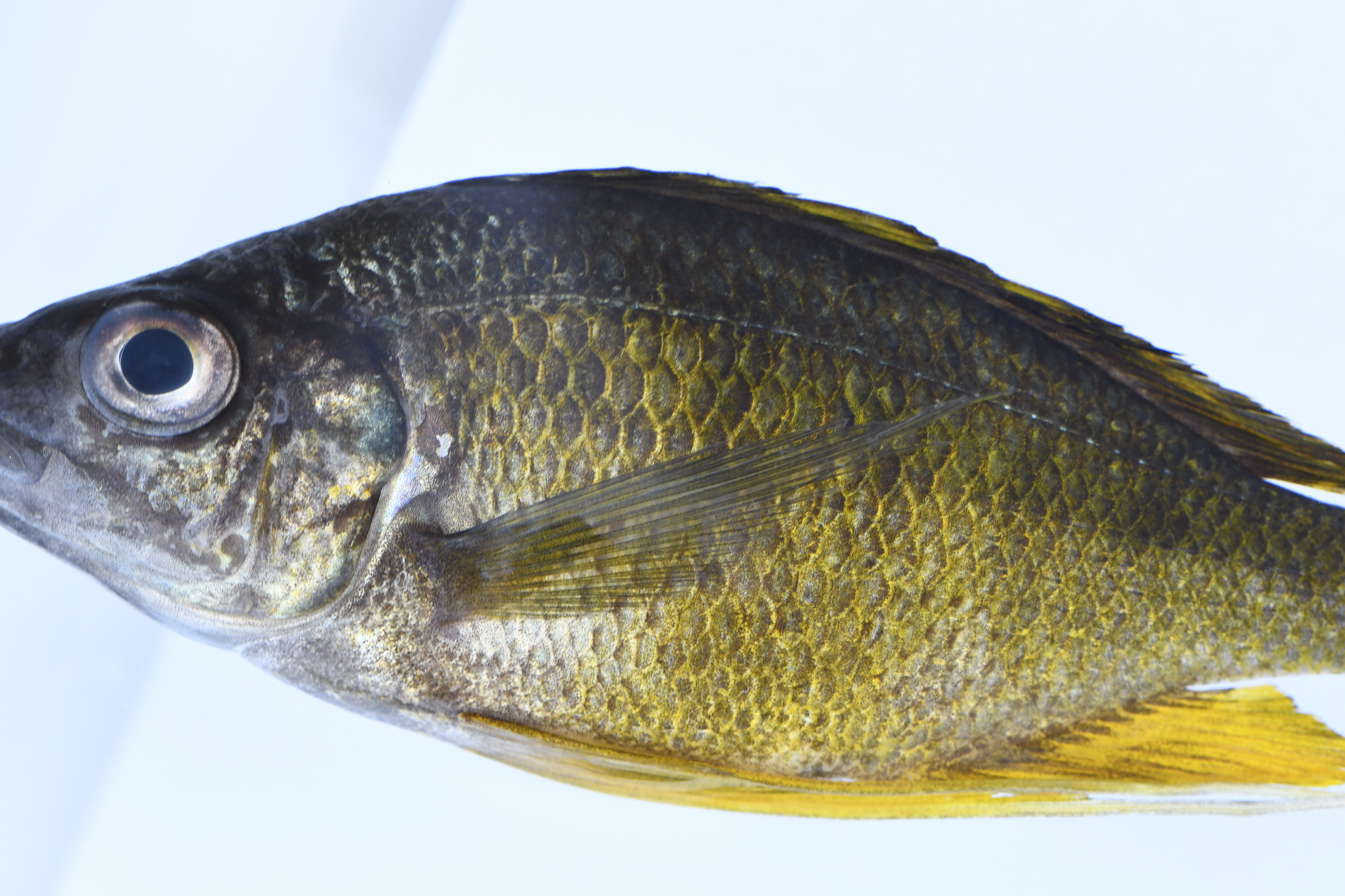
This is an elongate, laterally compressed cichlid with the high-set, slightly upturned mouth of a midwater feeder. Males reach about 7.9 in (20 cm) total length; females are smaller, commonly cited around 6 in (16 cm), and far more plainly dressed. Dominant males of most populations are some version of yellow — from a soft moss-and-gold in the Isinga form to the vivid lemon of the Kipili and Chimba fish — usually with darker flanks or spotting and a metallic sheen across the head, while females and subordinate males are a muted silver-grey.
The genus's signature feature is the pair of greatly elongated pelvic fins, which in courting males trail well past the tail and end in swollen, pigmented pads. These tips act as visual "egg-dummies," the equivalent of the anal-fin egg-spots that many other African cichlids use — a point worth stressing, because Ophthalmotilapia conspicuously lacks true anal egg-spots and has shifted that signalling job to the pelvic-fin lures instead. Males also carry a longer dorsal fin and the pronounced nasal swelling that gives the species its name. Because several Ophthalmotilapia overlap in range and a few yellow variants exist in otherwise blue species, colour alone is an unreliable guide to identity; snout shape and fin structure are surer marks.
Range & habitat
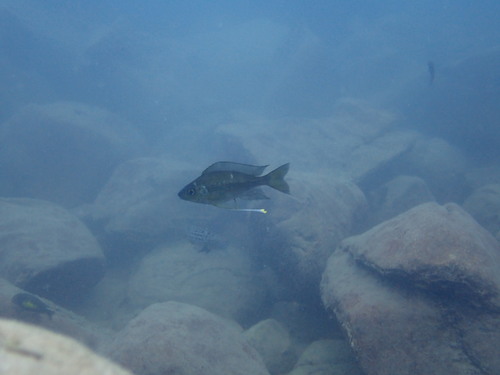
Ophthalmotilapia nasuta is endemic to Lake Tanganyika and ranges essentially lake-wide, recorded from all four riparian nations — Burundi, the Democratic Republic of the Congo, Tanzania and Zambia. It is a fish of the upper, well-lit zone over and just off rocky and intermediate shorelines. The IUCN places it between roughly 3 and 33 ft (1–10 m), and Ad Konings describes it hovering in the water column one to two metres above rocky slopes; FishBase similarly puts it at 2–10 m, "well off the slope." Hobby accounts add a sex difference, with female shoals tending to hold over the 10–33 ft (3–10 m) band while territorial males drop somewhat deeper to build their nests.
The in-situ water is that of Tanganyika generally: hard, strongly alkaline (pH around 8–9), mineral-rich and thermally stable, with surface temperatures near 75–79°F (24–26°C). The species sits at the meeting point of two biotopes — it shelters and spawns near the rock but feeds out over open water and sand — which is one reason it crosses paths, and occasionally hybridises, with its congeners where their ranges overlap.
Ecology & diet
Functionally, O. nasuta is a planktivore. FishBase assigns it a low trophic level of about 2.1, reflecting a diet dominated by the microscopic plankton it picks from the water drifting past, supplemented by small invertebrates and insect larvae sifted from the substrate. The upturned mouth and slender body suit a fish that feeds suspended in midwater rather than rasping algae from rock like a Tropheus or digging through sand like some of its Ectodine relatives.
That trophic position makes it part of the lake's enormous plankton-grazing guild — the band of small fishes that convert Tanganyika's drifting production into food for larger predators. Although it carries the omnivore label, its gut is built like a herbivore's, long and thin, a detail experienced keepers flag because it dictates how the fish should be fed in captivity. In the lake, its role is unremarkable individually but collectively significant: abundant, mid-water, and a link between the plankton and the lake's many piscivores.
Behavior & breeding
Breeding is where this fish earns its reputation. Ophthalmotilapia nasuta is a maternal mouthbrooder and a lek breeder: males gather on communal arenas where each builds and defends a nest, and females visit to spawn with one or more of them before carrying the eggs off alone. On the lek, a male excavates a shallow sand crater — keepers report diameters from about 12 in to as much as 24 in (30–60 cm) — with neighbouring nests spaced a couple of metres apart and dozens of males sometimes clustered together, mirroring the sand-cichlid leks seen elsewhere in the lake.
Courtship turns on the pelvic-fin lures. A displaying male flashes the egg-shaped tips at a gravid female; as she snaps at these dummies, believing them to be eggs she has just laid, she takes in the male's milt and fertilisation occurs inside or near her mouth. Females brood the comparatively large eggs and early larvae for several weeks, then release well-developed fry near the surface close to shore. Studies of the closely related O. ventralis show these leks are not tidy: subordinate "floater" or sneaker males attempt to parasitise spawnings, and females routinely visit several males, so a single brood can have mixed paternity. Outside of spawning the fish are loosely gregarious, and although males are territorial on the lek, O. nasuta is the gentler member of its genus — keepers consistently rate it smaller and less combative than O. ventralis or O. boops, with same-tank males that posture and chase but rarely injure one another.
In the aquarium
This is a rewarding but demanding Tanganyikan, better suited to an experienced rift-lake keeper than a beginner. The recurring theme from people who keep them well is space: Ophthalmotilapia want to own most of the open substrate, so they need to be the dominant fish in a long tank — a footprint of at least 5–6 ft (150–180 cm), holding several hundred litres, is the realistic minimum for a colony. Stock them as a group with multiple females and at least two or three males so that lek competition and male attention are spread out; a lone male in too small a tank will harass the females relentlessly, a failure pattern keepers describe again and again.
Water must mimic the lake — hard, alkaline (pH 8 and up, with many keepers running considerably higher), low in nitrate, and 75–79°F (24–26°C). Despite being nominal omnivores, their long herbivore-style gut means they should be fed a vegetable-based diet with plankton, brine shrimp and similar small foods, and kept off rich, high-protein fare that leads to digestive trouble. Good open-water and sand-sharing tankmates include Cyprichromis and the gentler, gregarious sand-dwellers such as Enantiopus and certain Xenotilapia; rock-bound, substrate-hungry fishes like Julidochromis and the more aggressive Xenotilapia tend to compete for the same floor space and are best avoided. Handle them gently — like their relatives they are prone to eye damage when netted roughly — and given room, clean hard water and the right diet, they are otherwise robust and will spawn freely.
Conservation
Ophthalmotilapia nasuta was assessed as Least Concern on the IUCN Red List in 2025 (assessor Y. Fermon), reaffirming its 2006 LC status. The reasoning is straightforward: it is a common fish distributed right around Lake Tanganyika with no major species-specific threat, though the population trend is listed as unknown and some of the rarer colour morphs are uncommon in the wild. The species is harvested for the ornamental trade rather than as food, and because the most intensely yellow populations command the highest prices, particular local forms can face concentrated collection pressure even while the species overall is secure. The IUCN also flags incidental bycatch from illegal, non-selective gear — beach seines and monofilament nets, especially toward the northern end of the range — and sedimentation as plausible pressures.
Those threats only make sense against the backdrop of the lake itself, which is under real strain. Long-term work by O'Reilly and colleagues (Nature, 2003) found that a warming climate has strengthened the lake's stratification and reduced the deep mixing that fertilises its surface waters, cutting primary productivity by an estimated fifth and, by their reckoning, lowering fish yields by something like thirty percent. Cohen and colleagues (PNAS, 2016) later estimated that warming has shrunk the oxygenated benthic habitat at the bottom of the lake by roughly 38 percent. Closer to shore, deforestation-driven erosion and sedimentation are degrading the rocky and intermediate habitats this very species depends on (a pressure documented since Cohen and colleagues' work in 1993). Meanwhile the pelagic clupeid sardine and Lates fishery that feeds millions across the four basin nations remains heavily exploited, and management is coordinated internationally through the Lake Tanganyika Authority — which has trialled a seasonal fishing ban that, sustained, would give littoral spawners like O. nasuta breathing room. For a shallow, rock-and-sand species, the honest summary is this: the fish itself is not threatened today, but it lives in a lake whose shoreline habitats and productivity are slowly being eroded by warming and sediment, and its long-term fate is tied to how those basin-wide pressures are managed.
Sources
- Eschmeyer's Catalog of Fishes — species record for Ophthalmochromis/Ophthalmotilapia nasuta
- FishBase — Ophthalmotilapia nasuta summary
- GBIF — Ophthalmotilapia nasuta (Poll & Matthes, 1962)
- Cichlid Room Companion — Ophthalmotilapia nasuta species profile (T. Andersen / J. M. Artigas Azas)
- Poll, M. & Matthes, H. (1962). Trois poissons remarquables du lac Tanganika. Annales du Musée royal de l'Afrique Centrale (orig. description)
- Reproductive parasitism in the lekking mouthbrooding cichlid Ophthalmotilapia ventralis (ResearchGate)
- ForAquarist — Ophthalmotilapia nasuta: Breeding and Rearing (M. Veselý)
- Cichlid Forum — 'Featherfin questions' thread (Lake Tanganyika species) — community/anecdotal
- Cichlid Forum — 'Idealistic community tank to replicate a mood from the lake' (Kipili Gold nasuta) — community/anecdotal
- Aquadiction — Ophthalmotilapia ventralis featherfin profile (genus reference)
- IUCN Red List — Ophthalmotilapia nasuta (Fermon 2025; LC, e.T60619A47203668)
- O'Reilly, C. M. et al. (2003). Climate change decreases aquatic ecosystem productivity of Lake Tanganyika, Nature 424:766–768
- Cohen, A. S. et al. (2016). Climate warming reduces fish production and benthic habitat in Lake Tanganyika, PNAS
- Lake Tanganyika: Status, challenges, and opportunities for research (J. Great Lakes Research, 2023) — basin warming, mixing and sedimentation review
- tanganyika.si — Ophthalmotilapia boops/ventralis biotope notes (rocky-slope habitat, sympatry)