Taxonomy & naming
George Albert Boulenger described this fish in 1898 as Paratilapia ventralis, working from specimens collected at Kinyamkolo at the south end of Lake Tanganyika; the type series sits in the Natural History Museum in London. It was later moved into the genus Ophthalmotilapia, and Eschmeyer's Catalog of Fishes lists it as valid as Ophthalmotilapia ventralis (Boulenger, 1898), following the treatments of Maréchal & Poll (1991) and Konings (2015, 2019).
The genus name blends the Greek ophthalmos, "eye," with tilapia, itself derived from a southern African (Bechuana) word for fish — a nod to the eye-like spots that decorate members of the group. O. ventralis belongs to the Ectodini, the tribe of sand- and intermediate-zone Tanganyikan cichlids that includes the sandsifting Xenotilapia and the featherfins Cyathopharynx and Cunningtonia. In the hobby it travels under "featherfin," "ventralis," and the older trade name "blue goldtip," usually tagged with a collection locality (Kambwimba, Chituta, Mpimbwe, Kasakalawe and so on) that signals which colour form a fish belongs to.
Appearance
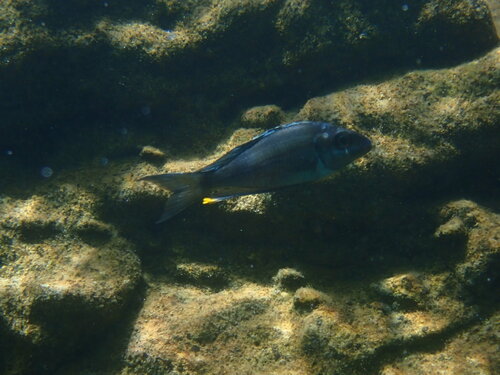
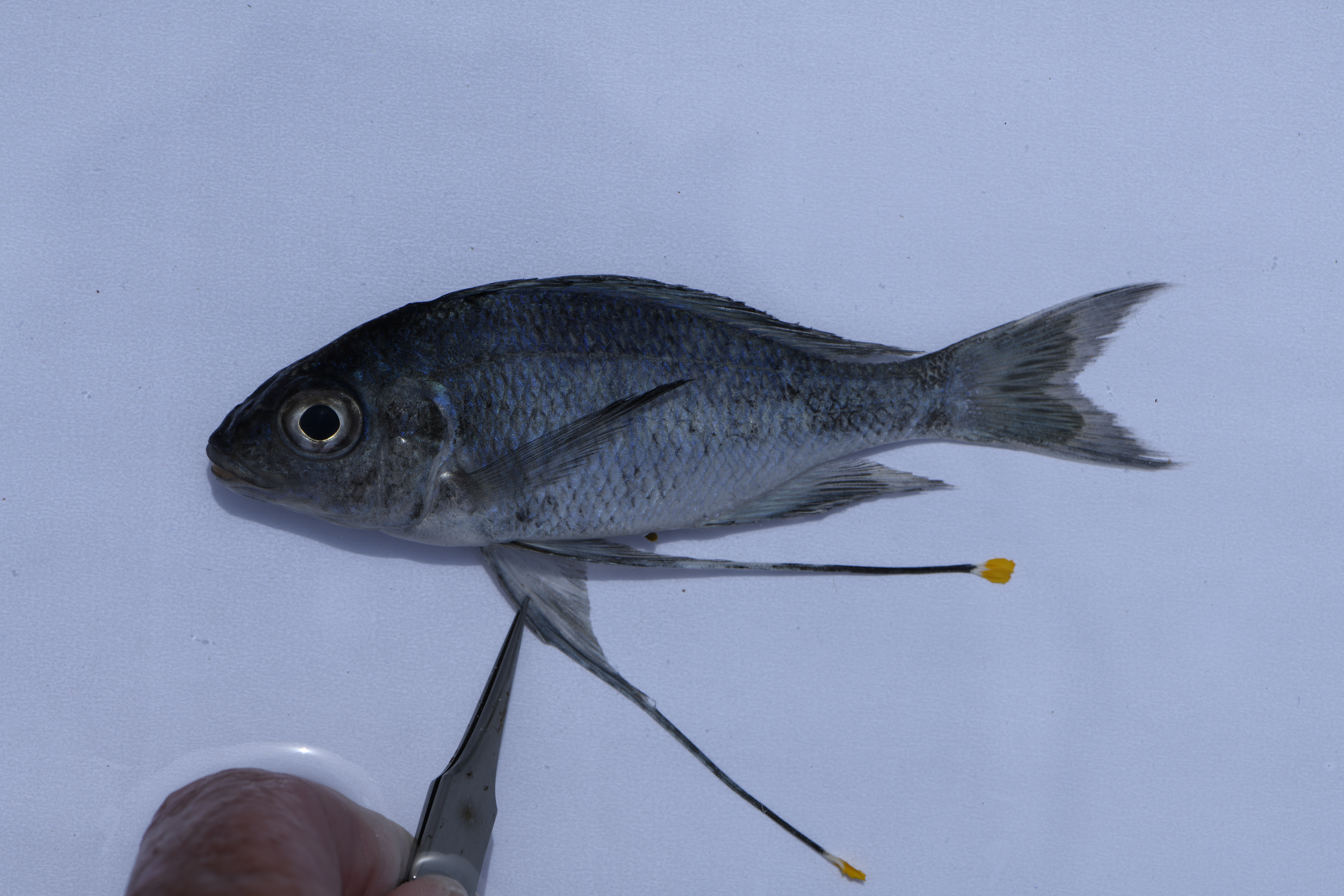
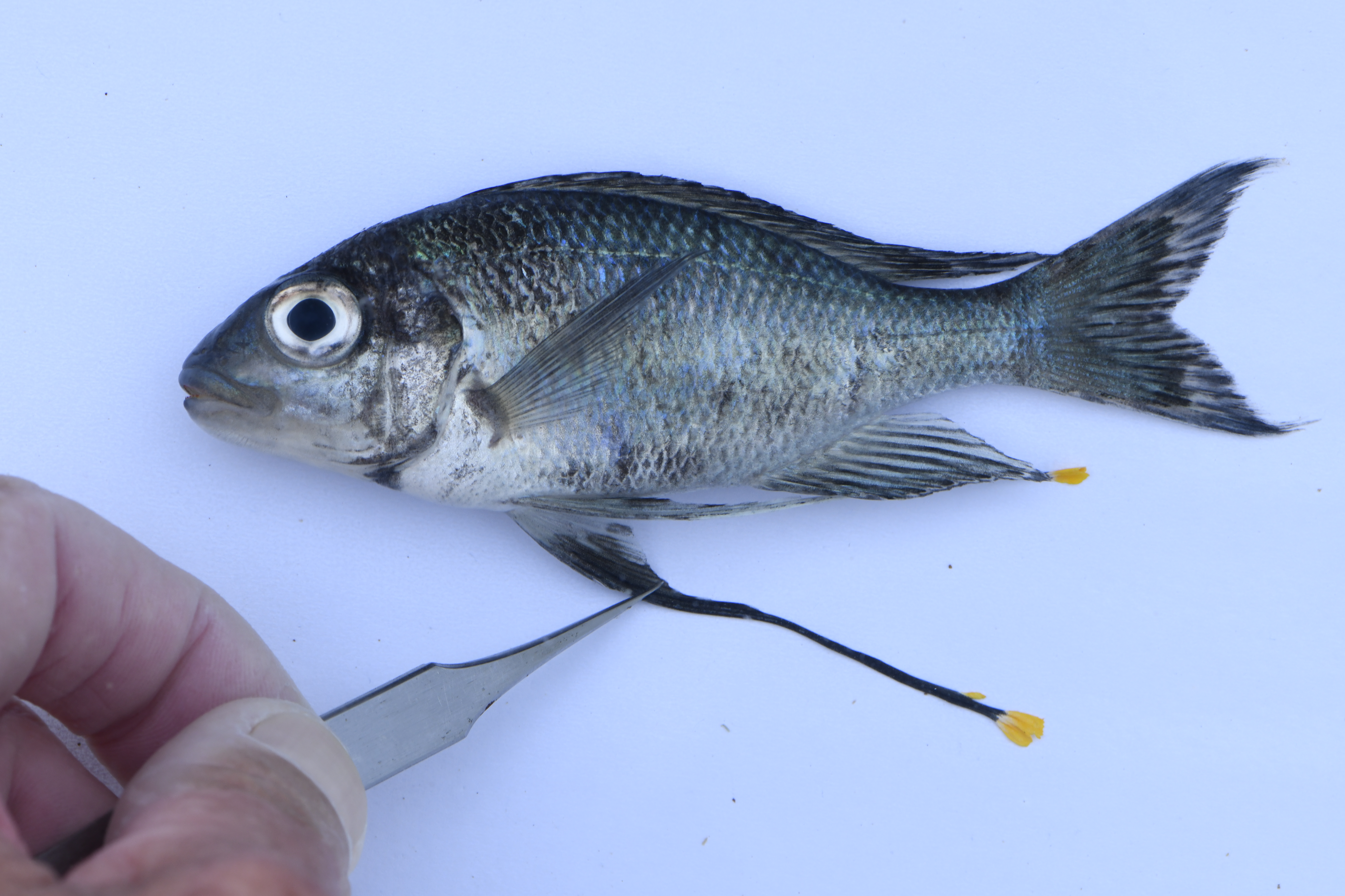
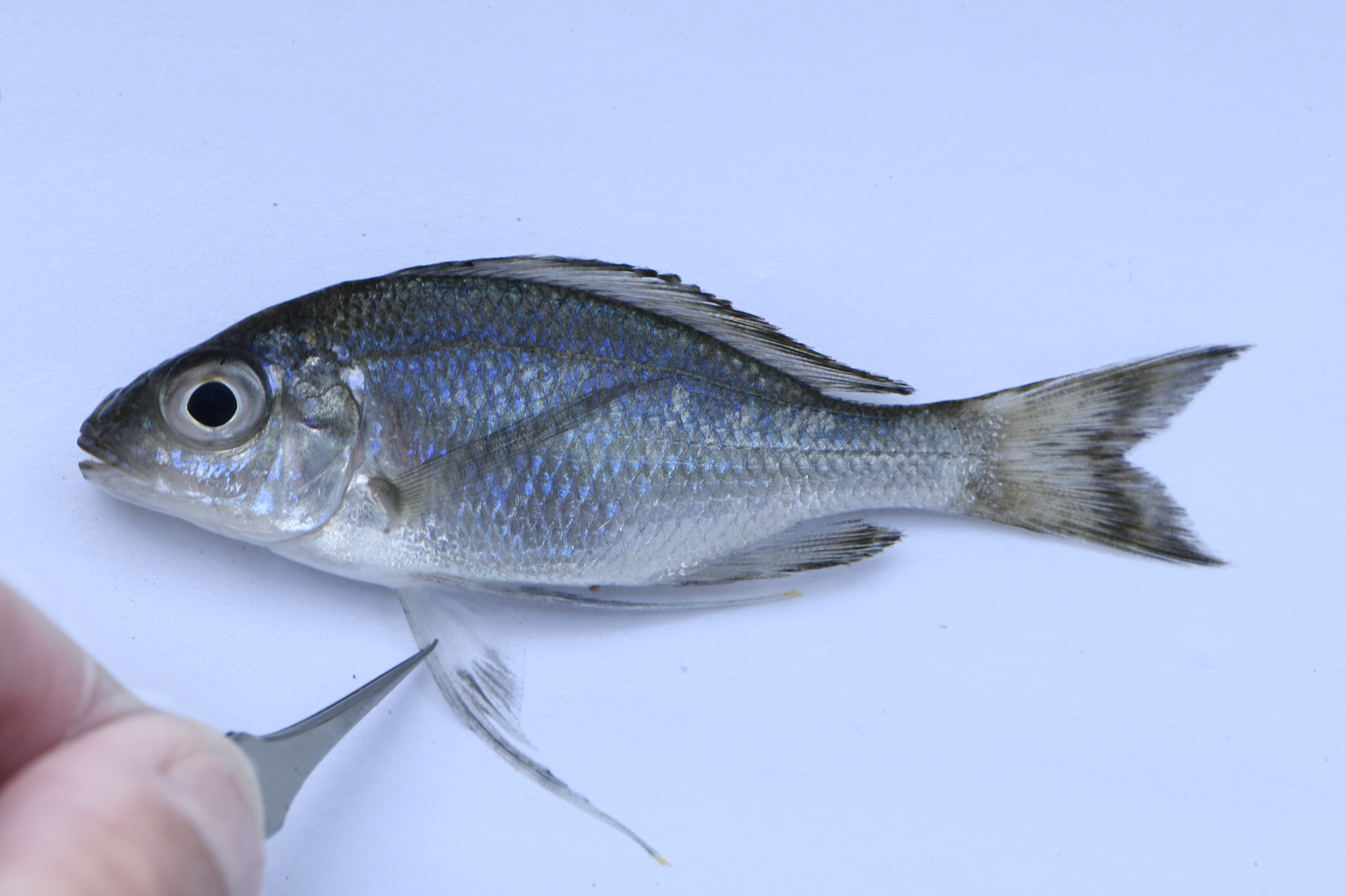
This is a moderately large, laterally compressed cichlid. FishBase gives a maximum of about 6 in (15 cm) total length for males; females run smaller, commonly cited around 4.5–5 in (11–12 cm). The defining feature is the pelvic (ventral) fins: in mature males they extend far past the body in long, trailing filaments tipped with a swollen, vividly coloured pad. That pad is the fish's "egg-dummy," and its colour — often yellow, orange, or white — is the trait the fins advertise.
Sexual dimorphism is pronounced. A displaying male can switch on an electric, metallic blue across the body so suddenly and so intensely that keepers describe it as the fish swimming into a beam of sunlight; the head, depending on the morph, may carry contrasting orange-brown, gold, or violet tones. Females and non-displaying males are far plainer, a soft greenish-silver with a faint metallic sheen. Crucially, males only acquire full colour as they approach adult size, at roughly eight to nine months, which is why juveniles in a dealer's tank look so unremarkable. The species fragments into a long list of regional colour forms — well over twenty are recognized in the trade — and these are genetically distinct enough that mixing them risks hybridization.
Range & habitat
O. ventralis is endemic to Lake Tanganyika, the deep Rift Valley lake shared by Tanzania, the Democratic Republic of the Congo, Zambia and Burundi. Sources disagree on the exact spread: FishBase localizes it to the south end of the lake, while the 2025 IUCN assessment, drawing on Konings, describes a near lake-wide distribution that thins out only in the far north and reaches further north on the eastern shore than the western. The truth is probably that the southern and central coasts hold the bulk of its range, with the species essentially absent from the northernmost basin.
Depth reports also vary, and the difference matters. The IUCN assessment treats it as a shallow rocky-littoral fish that is "not thought to go below 5 m," living over rock and at the interface where rock meets sand; FishBase records a 2–10 m band and notes individuals "well off the slope," and some hobby profiles stretch the figure to 20 m. Taken together, this is best read as a fish of the upper rocky and intermediate zone — clear, hard, alkaline water with measured pH around 7.5–9 and temperatures of roughly 73–79 °F (23–26 °C). Males establish their courtship arenas on the sandy patches between and below the rocks.
Ecology & diet
Accounts of what O. ventralis actually eats pull in two directions, and the honest answer is "both." The IUCN assessment calls it a herbivore that thrives mainly on algae growing on rocks, and FishBase's modelled trophic level of about 2.2 sits firmly at the plant-grazing end of the scale. Yet FishBase's own biology note has it feeding on "microorganisms drifting by in plankton clouds," and field and hobby observers describe a mixed menu of zooplankton, tiny invertebrates, and the biofilm and diatom film coating the rocks.
The two pictures are reconcilable: like many Ectodini, this is a fine-particle feeder that combs aufwuchs — the carpet of algae, diatoms and micro-invertebrates on hard surfaces — while also picking suspended plankton from the water column above its territory. Its low trophic level and fine gill rakers fit a grazer-cum-micropredator rather than a piscivore, and its modest size makes it prey for the larger predatory cichlids and Lates of the same shoreline rather than a threat to them.
Behavior & breeding
The breeding system is the reason this fish fascinates biologists. O. ventralis is a maternal mouthbrooder with a lek-like mating structure: males clear and defend a small sandy court, building a low crater or bower roughly a foot across, and then display from it to passing females while neighbouring males do the same nearby. Sexual selection here is intense and has been studied directly — female choice favours males that hold larger, well-shaped sand structures, and assessment appears to be thought to involve females sampling and comparing courts, though bower function in this group is debated before committing.
Spawning itself showcases the egg-dummy trick. The female lays a few eggs at a time and immediately takes them into her mouth; she is then drawn to the bright pads on the tips of the male's trailing pelvic fins, which mimic her own eggs. As she snaps at these false eggs, the male releases sperm, and fertilization happens inside her mouth. (This pelvic-fin placement is itself notable — the better-known egg-spots of Malawi haplochromines sit on the anal fin.) Clutches are small, generally well under twenty eggs and seldom more than about sixteen, and the female alone broods the developing young — measured at lengths up to nearly 0.8 in (2 cm) — before releasing free-swimming fry near the surface close to shore. Males provide no parental care; their entire investment is the court and the display.
In the aquarium
Featherfins are rewarding but not a beginner's fish, and the hobbyist consensus is consistent on why. They want length: a tank of at least 5–6 ft (a 4-footer is the bare floor and tends to suppress both colour and breeding) gives males room to space their courts and lets a harem function. The standard stocking is one male with several females, or a couple of dominant males plus a larger group of females in a big tank — experienced keepers report that in a typical aquarium only one male fully colours up at a time, with a "showdown" deciding the matter. Multiple males can be peaceful when crowded yet turn into "aggressive nutters" toward each other, and sometimes toward females, when given more space, so the social outcome is genuinely tank-dependent.
Water quality is the other recurring theme. This is a sensitive species that responds visibly to clean, stable, hard alkaline water and frequent modest changes; stress from poor conditions or pushy tankmates shows up first as a male losing colour and refusing to feed. They are not aggressive toward unrelated species and mix well with shell-dwellers, sandsifters such as Xenotilapia, and Cyprichromis. A few practical truths keepers learn the hard way: the fish ship poorly and are expensive, juveniles are drab so they will never be an impulse-buy shop fish, and the many locality morphs hybridize freely — keep one form per tank if the fry are to mean anything. A diet built on spirulina-based prepared foods with cyclops, daphnia, and brine shrimp suits their grazing-plus-plankton biology; heavy protein is best avoided.
Conservation
The IUCN Red List assessed O. ventralis as Least Concern in March 2025 (assessor L. Mabo), reaffirming a status it has held since 2006. The reasoning is that the species is widespread and locally very common along the south and central coasts, with no evidence of an overall decline. That said, the assessment is candid about species-specific pressures: collection for the aquarium trade may be driving localized declines of the most desired colour morphs, sedimentation and shoreline settlement are degrading critical habitat, and the fish can turn up as bycatch in illegal non-selective gear — a particular concern around Kantalamba. Encouragingly, some communities have responded; at Utinta, village authorities have imposed a fee on fish collection specifically to protect the local form.
The wider story is the lake's. Lake Tanganyika is warming, and reduced mixing of its water column has cut primary productivity — O'Reilly et al. (2003, Nature, doi:10.1038/nature01833) estimated roughly a 20% decline in productivity with fish yields falling on the order of 30%. Cohen et al. (2016, PNAS, doi:10.1073/pnas.1603237113) documented an associated loss of roughly 38% of the lake's oxygenated benthic habitat as the oxygenated layer shrinks, and decades of catchment deforestation have pushed sediment onto the nearshore rocks (Cohen et al. 1993). Because O. ventralis is a shallow rocky-shore grazer, sedimentation is the basin trend that bears most directly on it — silt smothers the algal and diatom film it feeds on and fragments the rocky patches its breeding arenas depend on. The same shoreline supports the pelagic clupeid (Stolothrissa and Limnothrissa) and Lates fishery that feeds four nations, and governance is now coordinated across Tanzania, the DRC, Zambia and Burundi through the Lake Tanganyika Authority, which has trialled a May–August fishing ban that would give this species a reproductive window. The accurate summary is the unglamorous one: the fish itself is not currently threatened, but it lives in a lake that is under real and growing strain.
Sources
- Eschmeyer's Catalog of Fishes: Ophthalmotilapia ventralis (Boulenger 1898)
- FishBase: Ophthalmotilapia ventralis summary
- FishBase Field Guide: Ophthalmotilapia ventralis
- iNaturalist taxon: Ophthalmotilapia ventralis (Featherfin)
- IUCN Red List: Ophthalmotilapia ventralis (e.T60621A47203790, 2025)
- O'Reilly et al. 2003, Climate change decreases aquatic ecosystem productivity of Lake Tanganyika (Nature)
- Cohen et al. 2016, Climate warming reduces fish production and benthic habitat in Lake Tanganyika (PNAS)
- Bower-building behaviour is associated with increased sperm production in Ophthalmotilapia ventralis (J. Evol. Biol.)
- Indirect vs. direct mate choice in a bower-building cichlid — Hemitilapia oxyrhynchus, Lake Malawi, cited as a genus comparison (PubMed 18547351)
- Variation in sperm motility and seminal protein expression under sexual selection in O. ventralis (ResearchGate)
- Salzburger et al. 2007, Adaptive sequence evolution in a colour gene involved in the formation of cichlid egg-dummies (BMC Biology)
- Amcoff et al. 2013, Evolution of egg dummies in Tanganyikan cichlid fishes (PDF)
- Cichlid Room Companion: Ophthalmotilapia ventralis (Anikstein, 2003)
- Aquadiction: Ventralis Featherfin Cichlid profile & care guide
- Maidenhead Aquatics (Fishkeeper.co.uk): Ventralis Featherfin Cichlid
- Fishipedia: Ophthalmotilapia ventralis
- Cichlid-Forum: Ophthalmotilapia ventralis, size of group? — community/anecdotal
- Cichlid-Forum: Ophthalmotilapia ventralis Chituta breeding — community/anecdotal
- Cichlid-Forum: My Ophthalmotilapia ventralis Mpimbwe breed — community/anecdotal