
Taxonomy & naming
Oreochromis korogwe was described by Rosemary Lowe (later Lowe-McConnell) in 1955, in her revision of new Tilapia from Lake Jipe and the Pangani River of East Africa (Bulletin of the British Museum (Natural History), Zoology 2(12): 347-368). The type material came not from a wild river reach but from government experimental aquaculture ponds at Korogwe, a town on the Pangani in northeastern Tanzania - hence the name. It now sits in the genus Oreochromis, the maternal-mouthbrooding tilapiines, within the cichlid subfamily Pseudocrenilabrinae.
The nomenclature here repays a careful eye. In the same 1955 paper Lowe named four Pangani-system species - O. korogwe, O. jipe, O. girigan, and O. pangani. Eschmeyer's Catalog of Fishes and subsequent workers (Seegers et al. 2003; Seegers 2008) treat the last three of those as a single species, O. jipe, so the name "Oreochromis pangani" you sometimes see is a synonym of O. jipe, not of korogwe. Oreochromis korogwe itself remains valid (Catalog of Fishes; FishBase; GBIF). A short note on the Lake Malawi attribution that brought you here: korogwe is a coastal/riverine East African tilapia, and the basin-wide tilapia survey of Shechonge et al. (2019) recorded zero korogwe from Lake Malawi. Treat any "Lake Malawi" tag on this species as spurious - most likely a backbone-taxonomy or occurrence-database mismatch - rather than evidence the fish lives there.
Appearance
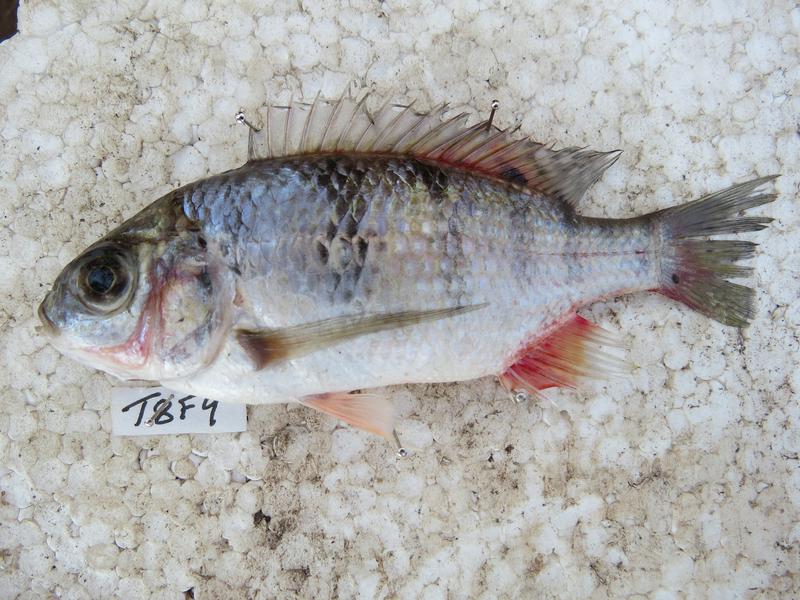
This is a small tilapia. FishBase gives a maximum of 16.1 cm (6.3 in) standard length after Trewavas & Teugels (1991); an older figure of 18 cm SL is considered unconfirmed, and the largest reliable total length is about 20.8 cm (8.2 in). By the standards of the food-fish tilapias - some of which top 40-50 cm - korogwe is decidedly compact, with a short, deep, laterally compressed body. Fin counts run to roughly 16-18 dorsal spines and 9-11 soft rays, with the unusual feature that about half of all individuals carry four anal spines rather than the usual three.
Color is strongly sex- and mood-dependent, which is typical of the genus. Females, immature males, and juveniles are a silvery grey on the flank with a pale belly and a distinctive melanin pattern - seven to nine broken vertical bars that read as a spotted or checkered look down the back. Breeding males transform: they darken overall, develop a series of white spots or pale bars along the flanks, blacken on the throat and chest, and flush red along the margins of the dorsal and caudal fins with a reddish tinge to the pectorals. Researchers have noted that males from the southern (Lindi-area) populations tend toward a bluish sheen with less contrast than northern Pangani fish. That checkered female pattern, together with the pale flank bars of ripe males, is in fact what let ichthyologists re-identify southern lake populations that had earlier been misfiled under other species.
Range & habitat
The native range is the lower Pangani River and the neighbouring Zigi River in northeastern Tanzania, possibly extending into the Kenyan headwaters of the Pangani system; the IUCN treats it as essentially endemic to the Zigi and Pangani drainages. Beyond that core, it has been introduced to the Mlingano Dam south of the Pangani near Tanga, and very likely to other coastal-zone reservoirs. A more recent and genuinely surprising discovery is a cluster of disjunct populations far to the south, in three small lakes near Lindi - Rutamba, Nambawala, and Mitupa - reported by Shechonge et al. (2019); a population earlier collected at Lake Rutamba in 1982 had been mis-assigned to another species entirely, and only fresh material revealed it as korogwe. Records from the crater lake Lake Chala have been claimed but could not be confirmed in that same survey.
In habitat terms this is a fish of warm lowland rivers, floodplain pools, and shallow coastal lakes rather than a deep, clear-water rift lake. FishBase classes it as a benthopelagic, tropical species tolerant of fresh and brackish water - a useful trait in coastal drainages where salinity fluctuates. It is precisely this riverine, floodplain ecology that marks it as foreign to the Lake Malawi fauna: nothing about korogwe's biology fits the rocky reefs, sand flats, or open pelagic zones that structure the Malawi cichlid radiation.
Ecology & diet
Lowe's original account described korogwe as feeding on insects and algae, and FishBase places it at a trophic level of about 3.2 - the omnivorous mid-water position typical of smaller Oreochromis, which graze algae and detritus but also take aquatic invertebrates. Like other tilapiines it is a generalist grazer-omnivore rather than a trophic specialist, and that flexibility is part of why the genus colonizes disturbed and man-made waters so readily.
In its native rivers korogwe is only a minor component of artisanal fisheries; it is too small to be a primary target where larger tilapias are available. FishBase rates its fishing vulnerability as low and its resilience as high, with a population doubling time under fifteen months. Ecologically the more interesting story is competitive: in the southern lakes it now shares water with the much larger, aggressive Nile tilapia (O. niloticus), which elsewhere dominates native tilapias for food and shelter. Korogwe's small body and fast turnover make it the kind of species you would expect to be squeezed out - yet, as the conservation section notes, the field data tell a more nuanced tale.
Behavior & breeding
Oreochromis korogwe is a maternal mouthbrooder, the reproductive mode that defines the genus: after spawning, the female takes the fertilized eggs into her mouth and broods them there through hatching and the early free-swimming stage, releasing the fry to forage and gathering them back at the first sign of danger. This is an energetically costly strategy that trades large clutches for high per-offspring survival, and it lets tilapias breed successfully in shallow, variable, predator-rich floodplain waters.
Direct behavioral observations of korogwe in the wild are thin - it has never been a focus of detailed breeding study the way the commercial tilapias have - but the broad pattern can be read with confidence from its anatomy and from the genus. The pronounced male nuptial coloration (darkened body, white flank bars, red-edged fins) and the enlarged jaws reported in breeding males both point to males establishing and defending spawning territories, displaying to and courting females, much as other Oreochromis males do over scrapes or pits in soft substrate. Beyond that, the honest answer is that the fine details of its territoriality, spawning-site choice, and brood size in nature remain largely undocumented.
In the aquarium
There is essentially no aquarium literature on this species, and that absence is itself the honest takeaway: Oreochromis korogwe is not in the ornamental trade. It does not appear in cichlid-forum or hobbyist breeding logs, it is not a CARES-program fish, and you will not find a care sheet built on real keeping experience - the search results that pair its name with "African cichlid" tanks are generic threads that never actually concern this fish. Anyone seeking a Malawi cichlid for a rift-lake aquarium should look elsewhere entirely; korogwe is a coastal Tanzanian riverine tilapia with no place in a mbuna or Aulonocara setup.
If it were kept - in a research or conservation context rather than a living-room display - the requirements would follow general small-Oreochromis practice rather than rift-lake protocols: a long tank with open sand, warm water (roughly mid-70s to low-80s Fahrenheit, about 24-28 C), and tolerance of hard, somewhat alkaline and even slightly brackish conditions given its coastal range. Expect tilapia behavior: substrate digging, male territoriality intensifying at breeding, and prolific mouthbrooding once a pair settles. We are describing genus-level expectations here, not verified husbandry for korogwe specifically, and we flag it as such rather than dress folklore up as fact.
Conservation
The IUCN Red List assesses Oreochromis korogwe as Least Concern (assessed 31 January 2006, Hanssens; the assessment carries a "needs updating" annotation). The reasoning was simple: it is reasonably widespread through the Pangani and Zigi basins and had no documented major threat. There is no targeted ornamental or food-fishery pressure on the species; it is only a minor catch. But "Least Concern" should be read against two real and growing concerns. First, the species' genetic integrity: there is documented hybridization with native O. jipe in northern Tanzania and with the non-native Nile tilapia (O. niloticus) in the south, and the spread of stocked Nile tilapia across East African waters has repeatedly eroded the distinctness of native tilapias through competition and introgression. Second, the southern Lindi-area populations (Rutamba, Nambawala, Mitupa) are small, isolated, and evolutionarily distinct - exactly the kind of narrow-range lineage that a single invasion or habitat change can imperil. A bright spot: in Lake Rutamba, korogwe appears to persist alongside invasive Nile tilapia partly because it grows faster than the larger invader, with hybrids growing at korogwe-like rates (Champneys et al.), suggesting relative fitness, not just niche overlap, governs the outcome.
Because korogwe is not a Lake Malawi species, the Malawi basin's pressures do not bear on it directly - but the framing is worth stating plainly for readers who arrived expecting a Malawi fish. The Lake Malawi/Niassa/Nyasa basin review of Chavula et al. (2023, Journal of Great Lakes Research 49(6):102241) catalogues over-fishing and the collapse of the chambo (Oreochromis) fishery, heavy sediment and nutrient loading off deforested catchments, roughly +0.7 C of shallow-water warming that strengthens stratification and suppresses productivity, and the looming risk of invasive species. Two of those threads - the fragility of native Oreochromis stocks under fishing and stocking pressure, and the destabilizing role of introduced tilapia - are exactly the forces shaping korogwe's future in its own coastal Tanzanian waters, even though the lake itself lies in a different basin and a different cichlid world.
Sources
- Eschmeyer's Catalog of Fishes - Oreochromis korogwe / Tilapia pangani (Lowe 1955)
- FishBase - Oreochromis korogwe (Korogwe tilapia) summary
- FishBase - Oreochromis korogwe field-guide diagnosis
- GBIF - Oreochromis korogwe (Lowe, 1955)
- IUCN Red List - Oreochromis korogwe (Least Concern, 2006)
- Shechonge et al. 2019, Widespread colonisation of Tanzanian catchments by introduced Oreochromis tilapia fishes (Hydrobiologia)
- Champneys et al., Rapid growth of a locally-endemic tilapia may enable persistence with an invasive congener (Aquatic Invasions)
- Limited hybridization between introduced and Critically Endangered Oreochromis in Tanzania (PMC)
- Ancient and Recent Hybridization in the Oreochromis Cichlid Fishes (Molecular Biology and Evolution)
- Newly discovered tilapia cichlid fish biodiversity threatened by hybridization with non-native species (ResearchGate)
- Genner et al., A Guide to the Tilapia Fishes of Tanzania (2018)
- Chavula et al. 2023, Lake Malawi/Niassa/Nyasa basin: Status, challenges, and research needs (J. Great Lakes Research 49(6):102241)
- Lake Malawi/Niassa/Nyasa basin review (ADS abstract, DOI 10.1016/j.jglr.2023.102241)
- World Register of Marine Species - Oreochromis korogwe
- iNaturalist - Korogwe Tilapia (Oreochromis korogwe)