

Taxonomy & naming
Oreochromis mortimeri was described by the British ichthyologist Ethelwynn Trewavas in 1966, originally as Tilapia mortimeri, from a series of specimens collected at Chiwanda in the Luangwa Valley of Zambia (holotype BMNH 1932.12.16.878). Trewavas's own 1983 monograph on the tilapiine genera Sarotherodon, Oreochromis and Danakilia moved it into Oreochromis — the genus of maternal mouthbrooders — where Eschmeyer's Catalog of Fishes and FishBase both retain it today. The species honours M. A. E. Mortimer, a research and administrative officer in Zambia's Department of Game and Fisheries who carried out a great deal of productive fish-culture work between 1951 and 1965.
The genus name blends Latin aurum (gold) with Greek chromis, a perch-like fish. In English it is the Kariba tilapia or Kariba bream; Afrikaans speakers call it Kariba-kurper, and Zambian fishers sometimes the "mozzie." One point worth stating plainly: this is a Zambezi-system fish, and any listing that places it in Lake Malawi is in error. It belongs to the southern-African Oreochromis radiation alongside O. mossambicus, O. andersonii and O. macrochir, not to Malawi's haplochromine cichlid flock.
Appearance
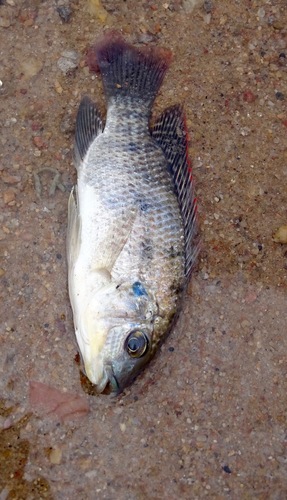
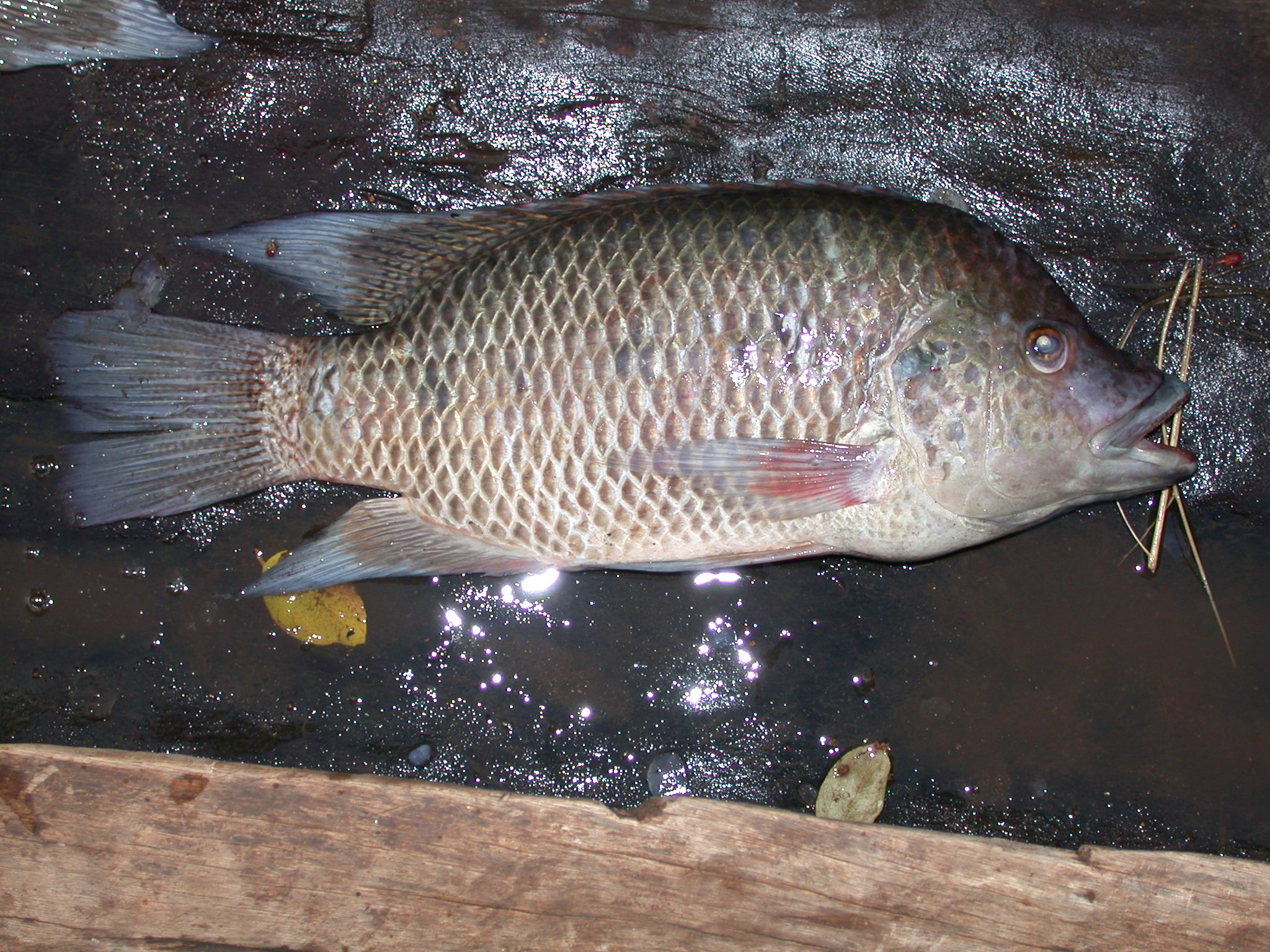
The Kariba tilapia is a deep-bodied, laterally compressed cichlid built on the familiar tilapiine plan, reaching about 48 cm (19 in) total length and a published maximum weight near 4.1 kg (9 lb), though most fish taken in the fishery were considerably smaller. The dorsal fin carries 16-17 spines and 10-13 soft rays; there are 2-3 rows of scales on the cheek. In life the body is a greenish- to blue-grey, each scale bearing a darker central spot. Females and immature males often show one to three dark blotches along the midline — markings that can deepen or appear only as the fish dies.
The fish is easiest to confuse with its relative O. mossambicus, and juveniles of the two are essentially indistinguishable. Useful separators in adults include a relatively shorter caudal peduncle and, in breeding males, the colour and fin pattern: a male in nuptial dress turns iridescent blue-green to bronze with bright spots on the dorsal and caudal fins. The red edge on the dorsal fin is less pronounced than in O. mossambicus, and the red band at the rear of the tail is narrow rather than broad. As in many Oreochromis, the jaws of mature males become greatly enlarged.
Range & habitat
Oreochromis mortimeri is the only fish endemic to the middle Zambezi, occupying the river and its tributaries from the Cahora Bassa Gorge upstream to the Victoria Falls, including the Luangwa and Hunyani (Manyame) rivers and, above all, Lake Kariba — the vast reservoir impounded behind the Kariba Dam in 1958-1963. Its natural range spans Zimbabwe, Zambia and Mozambique. It has been introduced beyond this in a few places, including the Lufira system of the upper Congo basin in the Democratic Republic of the Congo.
This is a benthopelagic, schooling, mainly diurnal fish of warm, quiet waters — river backwaters, floodplain pools and the inshore margins and shallow bays of Lake Kariba, where it breeds in water only a few metres deep. It is notably salt-tolerant for a freshwater cichlid. Kariba itself is a strongly seasonal, stratifying lake: a thermocline forms around September-October at roughly 15-20 m (50-65 ft) and deepens toward an annual turnover, so the species' shallow-water life history is tied to the lake's seasonal rhythm of mixing, water level and flooding.
Ecology & diet
The Kariba tilapia is a low-trophic-level grazer and detritivore — FishBase places it around trophic level 2.2. Its diet is dominated by filamentous algae and diatoms scraped from surfaces, supplemented by higher plant material, detritus, and a modest animal fraction: dipteran (midge) larvae, cladocerans and copepods, aquatic and terrestrial insects, shrimps, worms and the occasional mollusc. That broad, plant-and-detritus-based diet is typical of Oreochromis and made the fish an efficient converter of primary production into harvestable flesh — the basis of its former commercial importance.
In a young Lake Kariba it flourished, dominating the inshore community and contributing on the order of half the commercial catch by weight in the lake's productive early decades. That ecological success, unfortunately, became the source of its vulnerability: a generalist herbivore-detritivore of warm shallows occupies almost exactly the niche that the introduced Nile tilapia exploits even more aggressively.
Behavior & breeding
Like all Oreochromis, O. mortimeri is a maternal mouthbrooder, and it breeds for much of the year — practically all year round in suitable conditions, with several spawnings per season. Breeding is a lek-style affair: males gather in arenas in shallow water down to about 4 m (13 ft), each excavating a saucer-shaped nest depression with a raised mound at its centre. Males court passing females with displays; after spawning and fertilisation over the nest, the female takes the eggs into her mouth and moves off.
Mouthbrooding females shoal together and do not feed while carrying. Eggs hatch after roughly ten days but the young stay in the mouth for several days more; once their yolk reserves are used up the fry make brief feeding sorties, darting back into the mother's mouth at any threat. After about another ten days the female releases them — around 1 cm long — into warm, shallow marginal nursery areas, where they feed independently in small shoals, and she returns to the arena to spawn again. Recorded fecundity is modest for a tilapia; one Zambian study found O. mortimeri females carrying far fewer oocytes (about 1,000) than co-occurring T. rendalli or even the invasive O. niloticus, a reproductive disadvantage that likely compounds its decline.
In the aquarium
This is not an aquarium fish in any practical sense, and the honest advice is to look elsewhere. O. mortimeri is a food and sport species, not an ornamental one: it is reared experimentally in aquaculture and prized as a gamefish and bream on the table, but it has essentially no presence in the cichlid hobby. There is no body of hobbyist keeping experience for it the way there is for Malawi mbuna or the smaller Tanganyikans — the cichlid-forum and Reddit discussions that touch "tilapia" almost always concern food-fish Oreochromis or unrelated aggressive species kept as oddballs, not this Zambezi endemic.
If you generalise from the genus, the realities are predictable. At nearly half a metre, a single adult needs a very large tank or pond, not a community aquarium; like other large Oreochromis it is a digging, plant-uprooting, water-fouling fish that becomes territorial and aggressive when breeding. The far more important point is conservation, not husbandry: a Critically Endangered endemic is exactly the kind of fish that should be conserved in managed, pure-stock refuges — the measure the IUCN assessors called for — rather than circulated as a curiosity.
Conservation
Oreochromis mortimeri is assessed by the IUCN as Critically Endangered (criterion A2ae), in the assessment by Marshall and Tweddle published in 2007, with a decreasing population trend; the listing is flagged as needing updating. The justification is stark: an estimated decline of at least 80% over ten years, with no known refuges, as the introduced Nile tilapia (O. niloticus) displaces and hybridizes the species throughout its range. The Kariba tilapia has disappeared completely from parts of Lake Kariba, is declining in the Zambezi below the dam, and faces the same fate in Lake Cahora Bassa now that Nile tilapia have reached it. Catch records tell the same story: inshore gillnet catch-per-unit-effort in Kariba fell from roughly 18 kg per 100 m of net in the late 1970s to about 5 kg by the mid-1980s, and the species' share of the commercial catch slid from around half to under a fifth. Some ichthyologists fear it may now be functionally extinct in the wild, though that has not been confirmed; comparative studies show the alien grows faster and is far more fecund, a competitive edge that explains the rout. Filling Kariba also shrank the shallow breeding and nursery habitat the species depends on, an early stress that left it poorly placed to resist the invader.
The pressure that has all but erased the Kariba tilapia is precisely the threat now hanging over the rift lakes this site centres on. Lake Malawi — where O. mortimeri does not occur, contrary to some database entries — is itself under severe and compounding strain. The basin review by Chavula and colleagues (2023, Journal of Great Lakes Research 49(6):102241) documents heavy over-fishing and the collapse of the endemic chambo (Oreochromis karongae and relatives, also Critically Endangered), sediment and nutrient loading off deforested catchments, roughly 0.7 °C of shallow-water warming that strengthens stratification and cuts the productivity feeding the fishery, and a rising invasive-species risk. That last threat is the direct parallel: Nile tilapia have reportedly been introduced to Lake Malawi, where they could hybridize with the native chambo just as they erased O. mortimeri in the Zambezi. The Kariba tilapia is therefore best read as a finished experiment in what unmanaged Nile-tilapia introduction does to a warm-water endemic — a warning the lakes still holding their endemic cichlids cannot afford to ignore.
Sources
- Eschmeyer's Catalog of Fishes — Oreochromis mortimeri (species record)
- FishBase — Oreochromis mortimeri (Kariba tilapia) summary
- FishBase — Oreochromis mortimeri country/occurrence (Lake Cahora Bassa)
- IUCN Red List — Oreochromis mortimeri (Marshall & Tweddle 2007, CR)
- Chavula et al. 2023 — Lake Malawi/Niassa/Nyasa basin: status, challenges and research needs, J. Great Lakes Research 49(6):102241
- Nyirenda, M. S. — Abundance, growth and reproductive biology of Oreochromis niloticus compared with tilapiines indigenous to the middle Zambezi (MSc thesis, Univ. of Zambia)
- Broad niche overlap between invasive Nile tilapia and indigenous Oreochromis spp. (Entropy 17(7):4959)
- Growth rates of alien O. niloticus and indigenous O. mortimeri in Lake Kariba, Zimbabwe (ResearchGate)
- The inshore fish community of Lake Kariba half a century after its creation (ResearchGate)
- U.S. Fish & Wildlife Service — Ecological Risk Screening Summary: Kariba Tilapia (Oreochromis mortimeri)
- Yale Environment 360 — How aquaculture is threatening the native fish species of Africa
- FAO — Recent developments in the fisheries of Lake Kariba (Zambia/Zimbabwe)
- Lake Kariba Inshore Fishery Management Plan 2023-2032 (Zimbabwe Parks)
- WorldFish — Observations on gillnet catches of Kariba tilapia in the Bumi Basin, Lake Kariba
- Global Biotic Interactions — Oreochromis mortimeri (Kariba tilapia) interactions
- Cichlid Fish Forum — community discussions on keeping tilapia (anecdotal) — community/anecdotal
- r/Cichlid — 'Does anyone here own tilapia?' (anecdotal community signal) — community/anecdotal