Taxonomy & naming
Linnaeus described this fish in 1758 as Perca nilotica, the type material taken from the Nile near Cairo — the "niloticus" simply means "of the Nile." It spent much of the twentieth century under the name Tilapia nilotica before Trewavas's landmark 1983 revision of the tilapiine cichlids moved the maternal mouthbrooders into the genus Oreochromis, where it has stayed; the Catalog of Fishes lists it as valid as Oreochromis niloticus (Linnaeus, 1758). The genus name blends the Latin for mountain or, by another reading, gold (aurum) with the Greek chromis, an old word for a perch-like fish.
Nile tilapia sits in the cichlid subfamily Pseudocrenilabrinae, the African cichlid radiation. It is a wide-ranging, geographically variable species: several regional forms were once treated as subspecies (niloticus, baringoensis, cancellatus, eduardianus, filoa, sugutae, tana, vulcani), reflecting populations scattered across the Nile, the East African rift lakes, and the West African river basins. In Tanganyika it is the riverine and shallow-margin tilapia, taxonomically and ecologically distinct from the lake's own endemic, Oreochromis tanganicae.
Appearance
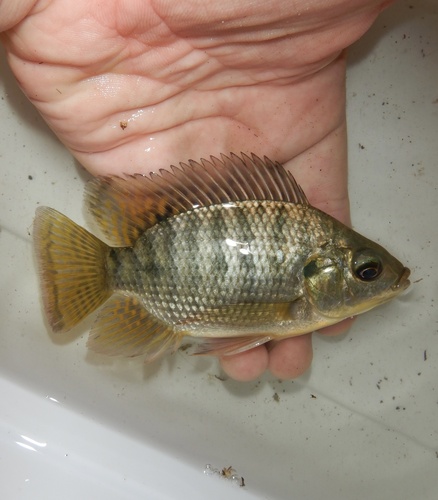
This is a big, robust cichlid. FishBase records a maximum of about 24 in (60 cm) standard length and a published weight near 9.5 lb (4.3 kg), with a maximum reported age of nine years, though most fish — wild or farmed — are taken well below that ceiling. The body is deep (depth roughly 36–50% of standard length) and laterally compressed, carried on a comparatively small head, with a long dorsal fin of 15–18 spines and 11–13 soft rays.
The single most reliable field mark is the tail: O. niloticus shows regular vertical bars running through the full depth of the caudal fin at every life stage — wide and arched in juveniles, finer in adults. That feature separates it from look-alike congeners whose caudal markings are faint or absent. Coloration is otherwise modest by cichlid standards. Breeding males turn bluish-pink and may develop a dark throat, belly, and pelvic and anal fins; females and non-breeding fish are brownish above and silvery-white below, typically crossed by about ten thin vertical bars. Unlike the males of some related tilapias, a mature male's jaws are not greatly enlarged, and the breeding genital papilla is not tasselled — details useful to ichthyologists sorting one Oreochromis from another.
Range & habitat
Nile tilapia is native across northern, western and eastern Africa: the Nile basin from Lakes Albert and Edward down to the delta, the Ethiopian rift lakes and the Awash, the endorheic lakes Turkana and Baringo, Lake Kivu, and — relevant here — Lake Tanganyika, including the Rusizi inflow and the Lower Malagarasi system (Trewavas 1983; IUCN 2023). In West Africa it is native to the Senegal, Gambia, Volta, Niger, Benue and Chad basins. This natural range is the crucial caveat to its global reputation: across most of the planet O. niloticus is an introduced aquaculture fish, but in the Tanganyika basin it belongs.
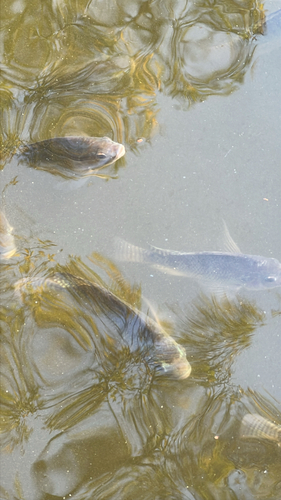
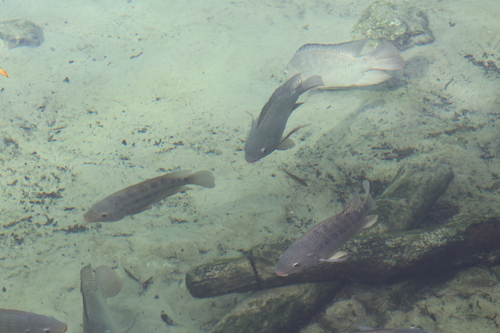
Within the lake it is a creature of the margins, not the deep clear-water reefs that define Tanganyika's famous cichlid flock. FishBase gives a depth range of 0–20 m, and the species favours the well-vegetated littoral, river mouths and swampy inflows — the soft, productive, often turbid water that the rift-lake rock specialists avoid. It tolerates a broad temperature window (a natural range of roughly 13.5–33 °C) and even brackish water, though not full salinity. That habitat guild matters: a vegetated shallow-margin generalist is exposed to a very different set of pressures than a deep pelagic or a rocky-shore endemic.
Ecology & diet
Nile tilapia feeds low on the food web. It is mainly diurnal and almost entirely herbivorous, taking phytoplankton and benthic algae as the bulk of its diet, supplemented by aufwuchs (the film of algae and micro-organisms on submerged surfaces) and detritus; where phytoplankton is abundant it dominates the gut contents. FishBase places the species at a trophic level near 2.0 — about as close to primary producer as a fish gets. Juveniles are more omnivorous than adults, taking copepods and insect larvae before settling into the adult plant-and-detritus diet.
That low, flexible trophic position is exactly why the fish thrives in disturbed, nutrient-rich, and artificial waters worldwide, and why it grows fast on cheap inputs in ponds. In a productive lake margin it functions as an efficient grazer converting algae and detritus into fish biomass — ecologically useful, and commercially valuable, which is also what makes its global spread so hard to contain.
Behavior & breeding
Reproduction is the classic Oreochromis pattern: a maternal mouthbrooder with a lek-like mating system. Males excavate simple pits or nests in firm sand in shallow water, generally between about 2 and 6.5 ft (0.6–2.0 m) deep, and defend them. Schools of ripe females gather above the territories, and a female descends to spawn, laying eggs in batches that the male fertilizes before she takes them into her mouth and departs. A single male typically fertilizes the eggs of more than one female over a courtship that can run for hours.
The female alone broods. She carries up to roughly 200 eggs in her buccal cavity, where they hatch in about a week and the fry remain until the yolk sac is absorbed. Spawning needs water above about 20 °C and can recur on a roughly monthly cycle through a warm season, and fish may mature in as little as three to six months at small size. This combination — early maturity, repeated brooding, parental mouth-protection of the young, and broad environmental tolerance — is the reproductive engine behind the species' success as both a farmed fish and an invader.
In the aquarium
Be honest about what this fish is: a food and pond species, not a display cichlid. It is hardy, undemanding on water chemistry (it does well anywhere from roughly pH 6 to 9 and across a wide temperature band), and a fast, heavy grower that quickly outgrows ordinary aquaria. A fish heading toward 20-plus inches needs the footprint of a stock tank or a heated pond, not a 55-gallon display; keepers who report success with adult tilapia almost invariably keep them in large vats, ponds, or 200-plus-gallon systems, a point echoed repeatedly in hobbyist forums. Smaller setups end in stunting, fouled water from the fish's heavy grazing-and-defecating habit, or both.
Aggression is real but more bulldozer than scalpel: a breeding male digs, rearranges décor, and bullies by sheer size rather than the intricate territorial warfare of rift-lake rock dwellers. Tankmates need to be similarly large and robust. The deeper caution is legal and ecological, not behavioral — O. niloticus is a notorious invasive and a prolific hybridizer with other Oreochromis, so further stocking has been banned in several countries (South Africa, Malawi and Zambia among them). Never release it, and check local regulations before acquiring it; in many jurisdictions it is restricted or prohibited precisely because it keeps so easily and escapes so well.
Conservation
On its own account, Nile tilapia is in no trouble: the IUCN Red List assesses it as Least Concern (assessed 2020, amended version published 2023), a widespread, abundant species with no major range-wide threats, though the assessors note it can decline locally under intense fishing and flag hybridization and overfishing as the main regional concerns in eastern Africa. There is no collection pressure on it as an ornamental; the pressure runs the other way, as a farmed fish that spreads.
That reversal is the heart of the Tanganyika story. O. niloticus is native to the lake's inflows and shallow margins, but farmed strains raised in the basin have escaped into the lake, and recent genetic work in the far south (Bbole et al. 2023) could not determine whether the Nile tilapia now turning up in catches there is indigenous or descended from aquaculture escapees of 15–20 years ago. That same study found no hybridization yet between O. niloticus and the lake's endemic Oreochromis tanganicae — but it warns that the genetic purity of the endemic is exactly what is at risk, given how readily Nile tilapia hybridizes elsewhere.
This fish should be placed against Tanganyika's wider strain rather than blamed for it. The lake is warming and stratifying more strongly: O'Reilly et al. (2003) inferred a roughly 20% decline in primary productivity from sediment isotope records, implying on the order of a 30% drop in fish yields, and Cohen et al. (2016) estimated a loss of about 38% of the oxygenated benthic habitat as deep water deoxygenates. Sedimentation from shoreline deforestation is degrading the rocky littoral (Cohen et al. 1993), and the pelagic clupeid fishery — the Stolothrissa and Limnothrissa "sardines" and their Lates predators — feeds millions across four nations (DR Congo, Tanzania, Burundi, Zambia) under the shared governance of the Lake Tanganyika Authority. A shallow-margin generalist like O. niloticus is buffered against the deep-water oxygen squeeze that threatens benthic specialists, and as a tolerant grazer it may even benefit from disturbed, nutrient-loaded shorelines. The honest summary: the species is secure, the lake is not, and here the Nile tilapia is best read less as a victim of Tanganyika's pressures than as one more agent of change along its margins.
Sources
- Eschmeyer's Catalog of Fishes: Oreochromis niloticus (species record)
- FishBase: Oreochromis niloticus (Nile tilapia) summary
- FishBase: Oreochromis tanganicae (Tanganyika tilapia) summary
- IUCN Red List: Oreochromis niloticus (Diallo et al. 2023, amended 2020 assessment, Least Concern)
- Trewavas, E. (1983) Tilapiine Fishes of the Genera Sarotherodon, Oreochromis and Danakilia (via FishBase reference)
- Bbole et al. (2023) Escapes from aquaculture facilities; conservation concerns for Oreochromis tanganicae, an endemic of Lake Tanganyika, Egyptian Journal of Aquatic Research
- Shechonge et al. (2019) Widespread colonisation of Tanzanian catchments by introduced Oreochromis tilapia
- O'Reilly et al. (2003) Climate change decreases aquatic ecosystem productivity of Lake Tanganyika, Nature
- Cohen et al. (2016) Climate warming reduces fish production and benthic habitat in Lake Tanganyika, PNAS
- Lake Tanganyika: Status, challenges, and opportunities for research (J. Great Lakes Research, 2023)
- Africa Museum: Sardines of Lake Tanganyika Prove One And Indivisible (clupeid fishery, four-nation management)
- FAO: Proposal for implementation of the Lake Tanganyika Framework Fisheries Management Plan
- Dominance of introduced Nile tilapia in Lake Victoria (AquaDocs fisheries record)
- Effect of environmental factors on growth performance of Nile tilapia (PMC, optimum temperature)
- USGS NAS: Nile Tilapia (Oreochromis niloticus) species profile (invasive status)
- Cichlid Fish Forum: tank size and dimensions for large aggressive cichlids — community/anecdotal
- Reddit r/Cichlid: keeper accounts of tilapia size and housing — community/anecdotal
- MonsterFishKeepers: keeping Nile tilapia in large tanks/ponds with other cichlids — community/anecdotal