Taxonomy & naming
George Albert Boulenger described Oreochromis shiranus in 1897, from specimens collected in the Upper Shiré River by Dr. Percy Rendall and sent to the British Museum (the paper appeared in the Proceedings of the Zoological Society of London for 1896, which is why some sources date the name 1896). The species epithet simply ties the fish to the Shiré, Lake Malawi's outflow river. Eschmeyer's Catalog of Fishes lists it as valid, in family Cichlidae, subfamily Pseudocrenilabrinae, with five syntypes still held at the BMNH.
Like the other Malawi tilapias, it began life under the catch-all genus Tilapia and was moved into Oreochromis — the maternal mouthbrooding tilapias — through Trewavas's foundational 1983 revision of the tilapiine genera. Two subspecies are recognized: the nominate O. shiranus shiranus of Lake Malawi, Lake Malombe and the Shiré down to Kapachira Falls, and O. shiranus chilwae (Trewavas, 1966) of Lakes Chilwa and Chiuta and their feeder streams. The two are told apart largely by fin colour — yellow-orange fin margins in the Malawi form, deep red in the Chilwa form. The chilwae subspecies sits at headwaters of the Rovuma drainage, and its relationship to Oreochromis placidus ruvumae has been flagged as needing a modern genetic look. In Malawi the fish is lumped into the broad vernacular "chambo," though strictly that name belongs to the endemic O. karongae group; "Shire tilapia" is the standard English name.
Appearance
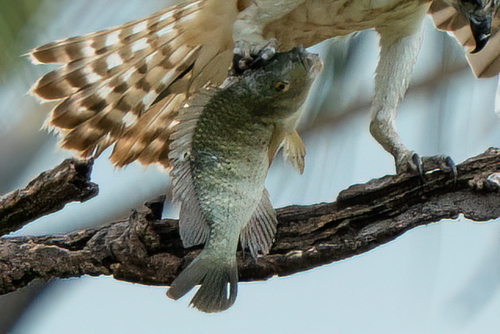
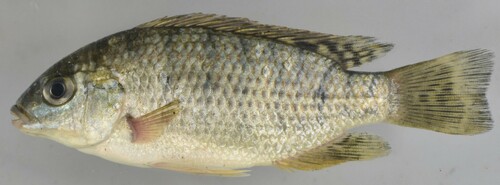
This is a big, deep-bodied tilapia. FishBase gives a maximum of about 39 cm (15 in) standard length; the IUCN assessment notes males reaching roughly 37 cm (15 in) total length, so a foot-plus fish is realistic in the wild. The fin counts run 15-18 dorsal spines and 10-13 soft rays, with the telling feature being the anal fin: normally four spines, occasionally three or five. Almost every other cichlid in Lake Malawi has three anal spines, so a fourth is a near-unique field mark for an Oreochromis in this lake.
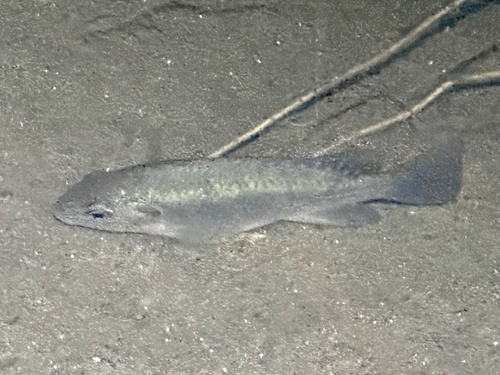
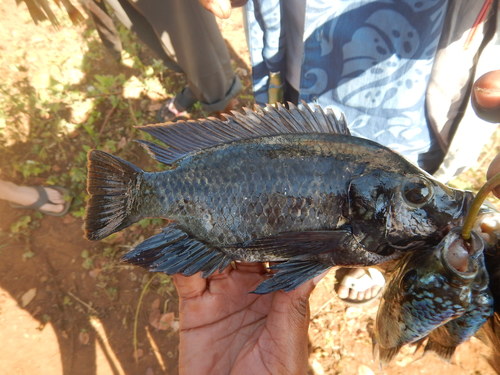
Colour depends on sex, maturity and population. Females and juveniles from the Lake Malawi catchment are a dark olive above, fading to yellow-gold below; fish from Lakes Chilwa and Chiuta and the Rovuma run more silvery. Unusually for the genus, the horizontal stripes are often more obvious than the vertical bars. Breeding males transform: they grow notably large jaws and a concave (dished) head profile and turn near-black, with red margins on the dorsal and caudal fins. Underwater or in a tank, those males show scattered white spots across the upper flanks — but the spots vanish fast under stress, so a netted fish looks a flat, uniform black. One more separator from look-alike males in the lake: O. shiranus lacks the genital tassel some other Oreochromis develop.
Range & habitat
The nominate subspecies ranges through the whole Lake Malawi drainage — the lake itself, Lake Malombe, and the Upper and Middle Shiré River — plus tributary streams in Malawi, Mozambique and Tanzania. It turns up around the Maleri Islands, Thumbi West and Chizumulu Island, but it is fundamentally a shoreline animal: the IUCN account stresses it has never been recorded far from shore. Stray individuals occasionally wash down the Middle Shiré rapids and are found as far as Chikwawa in the Lower Shiré, but they arrive battered and in poor condition. The chilwae subspecies holds the endorheic Lakes Chilwa and Chiuta, where it is one of the few fish that tolerates those waters' high turbidity and seasonal salinity.
Within its range, O. shiranus is a fish of very shallow, densely vegetated water and lagoons rather than the open lake or the rocky reefs the mbuna own. FishBase classes it as benthopelagic and brackish-tolerant, with a recorded temperature window of 23-42 °C (73-108 °F) — an enormous span that speaks to its life in shallow, sun-warmed margins and isolated pools. That shallow-vegetated guild matters for everything downstream: feeding, breeding and the specific pressures the fish faces.
Ecology & diet
Oreochromis shiranus is a microphage — a small-particle grazer. In the wild it feeds on detritus, phytoplankton and benthic algae, and FishBase places it at a trophic level of about 2.0, essentially a primary consumer. That fits the broader pattern of the genus, whose members rasp and filter phytoplankton, periphyton and detritus rather than hunting prey. The shallow, vegetated lagoons it favours are exactly the productive, algae-rich margins that such a feeding style exploits.
Ecologically it is a grower and a converter of plant and microbial production into fish flesh — which is precisely why it became an aquaculture staple. FishBase notes that males in particular grow fast, and the species is rated as having medium resilience and only low-to-moderate fishing vulnerability, both consistent with a productive, quick-maturing fish near the base of the food web. In the lake community it shares the shallow herbivore-detritivore niche with relatives like the chambo (O. karongae complex) and the substrate-spawning Coptodon rendalli, which is part of why all of them get bundled under one market name.
Behavior & breeding
O. shiranus is a maternal mouthbrooder, the reproductive mode that defines Oreochromis. Sexually active males excavate basin- or crater-shaped nests in shallow, secluded water — FishBase records nest depths from about 0.15 to 1.5 m (6 in to 5 ft), dug in sand overlaid with mud near rooted vegetation. After spawning over the nest, the female takes the fertilized eggs into her mouth and broods them there; she continues to shelter the fry in her mouth until they reach roughly 10 mm, releasing and re-collecting them as they begin to forage.
Breeding is seasonal in the wild. Work summarized from Lake Malawi describes a clear hot-season breeding window, roughly September through April. The crater-digging, the dramatic black-and-red nuptial males with their enlarged jaws, and the brooding females are the visible signatures of the system. Because the species spawns readily and the sexes are reasonably easy to tell apart in breeding condition, it has been a workhorse in Malawian aquaculture research — including studies comparing spawning rates of wild versus selectively bred strains and efforts to skew progeny toward faster-growing males.
In the aquarium
Be honest about what this fish is: a food and aquaculture tilapia, not an ornamental cichlid. It is not collected for the aquarium trade, and you will rarely see it offered outside Africa or specialist circles. When it does appear, the keeping reality follows from its biology. This is a fish that can top a foot in length, so the floor is a large tank — a six-foot footprint is the right order of magnitude for adults, the same advice serious keepers give for any big Malawi haplochromine or tilapia. Water should be hard and alkaline in the Rift-lake style, warm, and very well filtered; the species' wild tolerance to a 23-42 °C range and to brackish, turbid water makes it forgiving of conditions, not delicate.
The honest caveats are about behaviour and scale, not fragility. Like most large tilapias it is a vigorous digger — keepers consistently report that Oreochromis will rework the substrate and uproot rooted plants, so a planted aquascape is a losing battle. Breeding males are territorial and will dig and defend craters, so crowding and tankmate choice matter; pair it only with robustly sized Rift-lake cichlids that can hold their own. And mind the identity: "chambo"-type tilapias are routinely mislabeled in the hobby, so confirm you actually have O. shiranus (those four anal spines, the lack of a genital tassel) rather than a congener before making breeding plans.
Conservation
On its own account, Oreochromis shiranus is in reasonable shape. The IUCN Red List assessed it as Least Concern (assessment dated 23 May 2018, by Konings, Phiri and Kanyerere; errata published 2019). Both subspecies are described as common and wide-ranging — an estimated extent of occurrence around 30,000 km2 — and the Chilwa form's tolerance of degraded, turbid, saline water gives it real resilience. It is a heavily used food and aquaculture fish but is not taken by the ornamental trade, so collection pressure of the kind that threatens narrow-range reef endemics simply does not apply here. The assessment does flag specific risks tied to this fish's shallow, vegetated guild: heavy local fishing (especially in the Shiré River and swampy lake margins), clearance of aquatic vegetation during fishing that erodes its breeding habitat, and sedimentation that can suppress the shallow-water algae it grazes. Its presence inside Lake Malawi and Liwonde National Parks offers some protection.
That species-level calm sits inside a strained lake, and the distinction is worth stating plainly. The basin review by Chavula and colleagues (Journal of Great Lakes Research, 2023; DOI 10.1016/j.jglr.2023.102241) documents a lake under multiple pressures: over-fishing that has driven a steep decline in the commercially prized chambo (the O. karongae group, three of whose members are now assessed as Critically Endangered), sediment and nutrient loading washing off deforested catchments, an estimated warming of roughly 0.7 °C in shallow waters that strengthens stratification and trims primary productivity, and the looming risk of invasive species. Two of those bear directly on O. shiranus. As a shallow-margin, algae-grazing breeder, it is squarely exposed to the catchment sedimentation and shoreline disturbance that degrade its inshore habitat — the very mechanism the Red List names. And the invasion risk is concrete: the spread of Nile tilapia (Oreochromis niloticus) into the Malawi catchment raises the prospect of competition and hybridization with the native Oreochromis, O. shiranus among the species at risk of genetic swamping. So the accurate framing is not alarm but vigilance: the Shire tilapia is currently Least Concern, but it lives in a lake whose food web and water quality are visibly under pressure, and its fate is tied to how those basin-scale problems are managed.
Sources
- Oreochromis shiranus — Eschmeyer's Catalog of Fishes (CAS)
- Oreochromis shiranus, Shire tilapia — FishBase
- Oreochromis shiranus Boulenger, 1897 — GBIF
- Oreochromis shiranus — IUCN Red List (Konings, Phiri & Kanyerere 2018, errata 2019)
- Lake Malawi/Niassa/Nyasa basin: Status, challenges, and research needs — Chavula et al. 2023, J. Great Lakes Research
- Nile Tilapia, Oreochromis niloticus: a threat to native fishes of Lake Malawi (Stauffer et al.)
- Nile tilapia invades the Lake Malawi catchment — ResearchGate
- Comparison of spawning rate between wild and improved strain of Oreochromis shiranus (Boulenger, 1897)
- Ngwira — breeding biology of Oreochromis shiranus (GRÓ Centre report)
- Production of predominantly male tilapia progeny using O. karongae and O. shiranus — Data in Brief
- Oreochromis — overview (genus feeding ecology), ScienceDirect Topics
- Oreochromis shiranus — Cichlid Room Companion (public profile)
- Red List Assessment of Lake Malawi Finds Fish Species Threatened (chambo decline)
- More fish in Lake Malawi at risk of extinction — WWF
- Tilapia in Malawian aquaculture (T. rendalli, O. shiranus, O. karongae) — AgEcon Search
- Cichlid Forum — Oreochromis shiranus discussion (sexing / keeping, community) — community/anecdotal
- Perth Cichlid Society — Malawi tilapia popularity and tank notes (community) — community/anecdotal
- FishLore Cichlid Forum — digging behaviour, plant uprooting, filtration (community) — community/anecdotal