Taxonomy & naming
Albert Günther described this fish in 1894 as Chromis tanganicae, from material collected on Lake Tanganyika by E. Coode-Hore; the syntypes still sit in London's Natural History Museum (NHMUK 1889.1.30.7-9). It was later folded into the tilapiine reshuffle that Ethelwynn Trewavas formalized in her 1983 monograph on Sarotherodon, Oreochromis and Danakilia, which placed it in Oreochromis — the maternal-mouthbrooding tilapias. The genus name blends Greek roots for "mountain" (oreos) and chromis, an old name for a perch-like fish; the species epithet simply marks the lake it came from.
It belongs to the family Cichlidae, subfamily Pseudocrenilabrinae, and the tribe Oreochromini — a lineage of riverine and lacustrine tilapias rather than a product of Tanganyika's famous endemic species flock. Together with the Nile tilapia (O. niloticus), it is one of only two oreochromine cichlids in the lake. Phylogenetic work treats both as relatively recent colonists that arrived after Tanganyika's spectacular cichlid radiation was already mature, so they sit somewhat apart from the lamprologines, tropheines and other deep-endemic groups the lake is celebrated for. Vernacular names include "ngege," "likoke" and "ingege" in Swahili and Kirundi-speaking communities around the lake; in English it is the Tanganyika or Tanganyikan tilapia.
Appearance
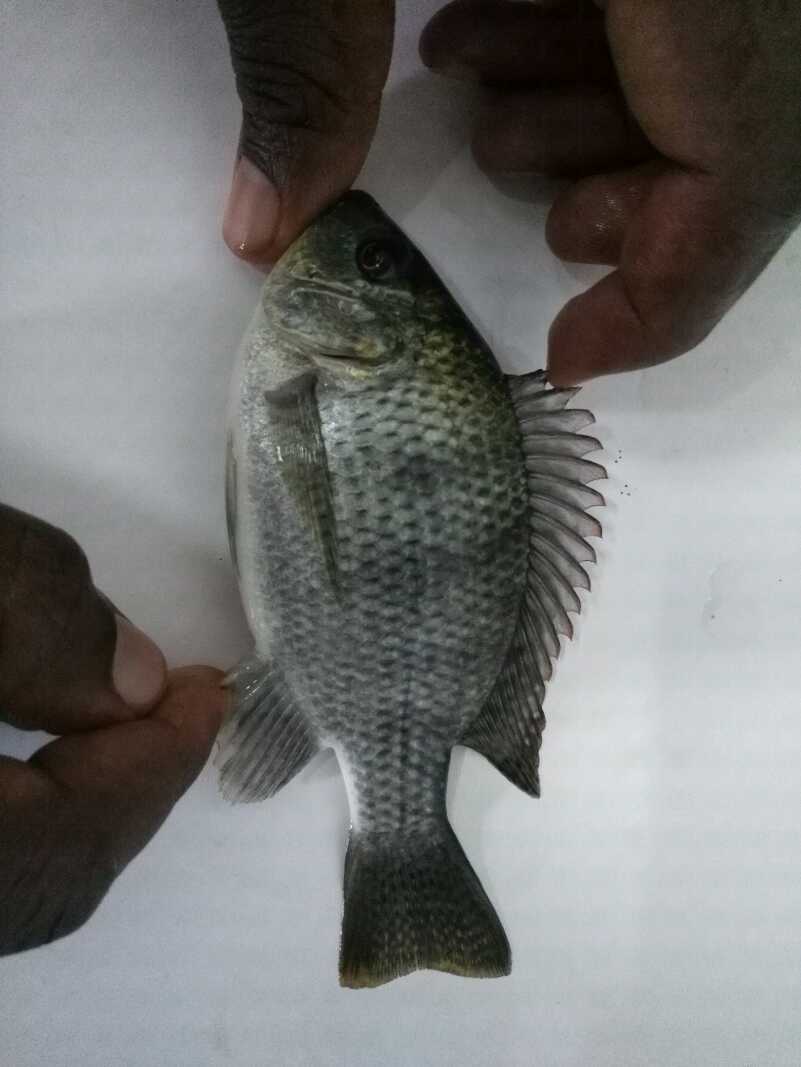
This is a big, deep-bodied tilapia. FishBase gives a maximum of about 16.5 inches (42 cm) total length, while older accounts from introduced Burundi populations report fish near 18 inches (45 cm) and around 5.5 pounds (2.5 kg); a Cichlid Room Companion forum keeper likewise cited lake fish of "18 inches or better." Meristics are typical tilapiine: 15–17 dorsal spines, 11–15 dorsal soft rays, three anal spines, and 30–31 vertebrae, with a deep preorbital bone (24–29% of head length) and very small but overlapping scales on the chest and belly.
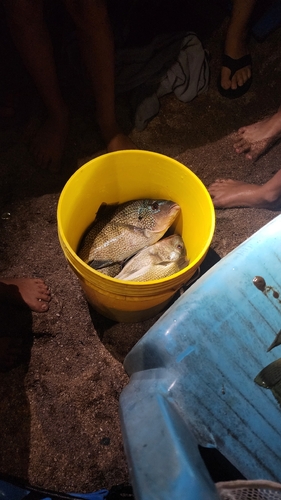
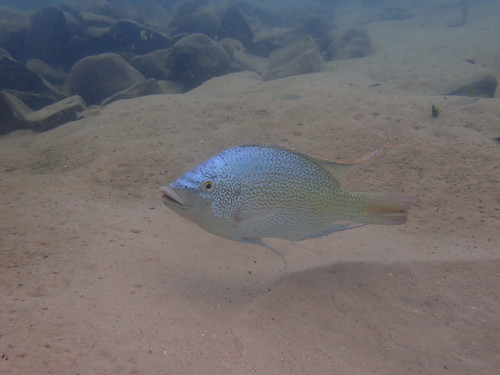
Color is strongly tied to social rank. A dominant, territorial male is the standout — covered in complex, bright pale-blue markings across the head, flanks and unpaired fins, over a ground color that ranges from grey through yellow to vivid red, with a grey-white lower head, a frequently red-backed tail and a broad red margin on the dorsal fin. Females and non-territorial males are a far plainer silvery color flecked with pearly spots, sometimes showing faint vertical or horizontal barring. Males grow larger and develop longer dorsal and anal fins with maturity. The combination of size, deep body and wide tooth bands separates it from the introduced Nile tilapia, with which it shares the lake.
Range & habitat
Oreochromis tanganicae is endemic to Lake Tanganyika, the long rift lake shared by Burundi, the Democratic Republic of the Congo, Tanzania and Zambia. Within the lake it is a coastal, littoral fish, concentrated over sandy and muddy shallows and around the deltas and lower reaches of major affluent rivers such as the Rusizi in the north and the Malagarasi to the east. It enters brackish, sediment-laden river mouths but is not normally found far upstream — this is a lake fish that uses river mouths, not a river fish.
Its preferred ground is telling. The swampy, soft-bottomed, river-influenced shores it favors are atypical for Tanganyika, whose shorelines are otherwise dominated by endemic rock- and sand-dwelling cichlids; these marginal habitats are part of why the tilapia coexists with, rather than competes head-on against, the lake's specialist flock. Recorded in-situ temperatures sit around 75–79 °F (24–26 °C), consistent with the warm, stable surface layer of this tropical lake. Despite the presence of the often-invasive Nile tilapia, O. tanganicae remains the dominant tilapiine across its native range.
Ecology & diet
Trophically, this is a low-level grazer rather than a predator — FishBase assigns it a trophic level of about 2.0. It has been observed browsing the surface film of sheltered waters, and stomach analyses summarized by Trewavas found large quantities of the diatoms Pinnularia and Navicula alongside ingested sand grains, the classic signature of a fish scraping benthic and epiphytic algae (aufwuchs) and filtering phytoplankton. Hobby and field accounts describe it feeding in shoals, sometimes large foraging schools, working the algal-rich shallows.
Ecologically it functions as one of the lake's larger herbivore-detritivores, converting primary production — diatoms, algae, phytoplankton and associated organic matter — into a substantial body of fish flesh. That role, combined with fast growth and large adult size, is exactly what makes it a desirable target: it sits low on the food web yet grows big, an efficient protein producer. Its parasite fauna has been catalogued too, including monogenean flukes (Cichlidogyrus, Gyrodactylus) and an acanthocephalan, the kind of host-specific community that often accompanies a long-resident lake fish.
Behavior & breeding
Oreochromis tanganicae is a maternal mouthbrooder, following the reproductive playbook of its larger congeners such as the Mozambique and Nile tilapias. Males establish and defend territories in shallow water over sheltered sandy or muddy bottoms, where they excavate simple pits in the substrate as spawning sites. After spawning, the female takes the fertilized eggs into her mouth; the male plays no further part in brood care. The female incubates the clutch and continues to shelter the free-swimming fry in her mouth for several weeks, a strong-mothering strategy that trades high fecundity for high offspring survival.
Breeding appears tied to the warm shallows: brooding females of roughly 9–10 inches (23–25 cm) have turned up in catches off sandy beaches, pointing to inshore spawning grounds. Outside of breeding the fish is gregarious and shoaling rather than strongly aggressive, though males are territorial and a tank rarely holds more than one mature male peaceably. As of the published hobby literature, the species was not known to have been spawned in aquaria — most accounts of its reproduction are inferred from wild observation and from the well-documented behavior of related Oreochromis.
In the aquarium
This is a fish for the specialist with space, not a community-tank candidate. Seriously Fish suggests an aquarium on the order of 80 x 24 x 24 inches (about 210 x 60 x 60 cm), roughly 200 US gallons (760 litres), for an adult — and that is a floor, not a target. A sandy substrate suits it; live plants are pointless because they will be grazed and uprooted, and because the fish is a heavy, messy feeder, oversized mechanical and biological filtration is essential. It is undemanding on water chemistry within a hard, alkaline Rift-lake range: roughly pH 7.5–9.0, moderate to high hardness, and 75–82 °F (24–28 °C).
Diet is the easy part — it is unfussy and will take most prepared foods, and benefits from vegetable matter to match its grazing nature. Temperament is the catch: it is not especially aggressive toward tankmates too large to be swallowed, but males are territorial and the practical, honest advice is to keep one male, optionally with several females, and to choose only robust, similarly sized companions if any. The species is seldom seen in the hobby and only occasionally exported; a dominant male in full color is a genuinely striking display animal, but realistic expectations about adult size, mess and tank footprint should come first.
Conservation
The IUCN Red List rates Oreochromis tanganicae as Least Concern, most recently reassessed on 2 March 2025 (the prior assessment dates to 2010). It is widespread within the lake, abundant in inshore markets — among the most common nearshore species sold at the northern end of Tanganyika — and is a mainstay of local subsistence fisheries, providing protein to some of the poorest littoral households. It is also being promoted as an aquaculture species. The species-specific worry is not extinction but genetic integrity: farmed Nile tilapia (O. niloticus) escaping from aquaculture facilities raises the risk of hybridization, and a 2023 genetic study by Bbole and colleagues, while finding no hybridization yet between native O. tanganicae and the Nile tilapia in southern Tanganyika, explicitly called for measures to protect the native species' genetic purity.
That relatively secure status sits inside a lake under real strain — and as a shallow, river-mouth grazer, this tilapia is exposed to the inshore pressures most directly. Sedimentation and nutrient loading from deforested catchments degrade the soft-bottomed littoral and delta habitats it depends on, and basin reviews flag pollution, habitat loss and overfishing as escalating stressors (Phiri et al. 2023). Layered over that is climate: O'Reilly et al. (2003) showed that surface warming and reduced vertical mixing have cut the lake's primary productivity by roughly 20%, with knock-on declines in fish yields, and Cohen et al. (2016) found that warming has shrunk oxygenated benthic habitat by about 38% in studied areas alongside falling commercial fish and mollusc abundance. Tanganyika's headline fishery is the open-water one — clupeid "dagaa"/"ndagala" sardines (Stolothrissa and Limnothrissa) and the predatory Lates, together yielding on the order of 165,000–200,000 tonnes a year and feeding millions across four nations — but the same warming-and-sediment forces that threaten that pelagic system also bear on inshore species like O. tanganicae. Management is meant to be coordinated through the four-country Lake Tanganyika Authority, established in 2003. The honest summary: the Tanganyika tilapia itself is not currently threatened, but its lake is, and the littoral habitats it occupies are squarely in the path of those pressures.
Sources
- FishBase — Oreochromis tanganicae (Tanganyika tilapia)
- Eschmeyer's Catalog of Fishes (California Academy of Sciences)
- GBIF — Oreochromis tanganicae (Günther, 1894)
- IUCN Red List — Oreochromis tanganicae (Least Concern)
- USFWS Ecological Risk Screening Summary — Oreochromis tanganicae
- Bbole et al. (2023), Conservation concerns for Oreochromis tanganicae, Egyptian Journal of Aquatic Research
- The adaptive radiation of cichlid fish in Lake Tanganyika (review, PMC)
- Seriously Fish — Oreochromis tanganicae (Tanganyikan Tilapia)
- Cichlid Room Companion — Oreochromis tanganicae (public post)
- O'Reilly et al. (2003), Climate change decreases productivity of Lake Tanganyika, Nature (DOI 10.1038/nature01833)
- Cohen et al. (2016), Climate warming reduces fish production and benthic habitat in Lake Tanganyika, PNAS (DOI 10.1073/pnas.1603237113)
- Phiri et al. (2023), Lake Tanganyika: status, challenges, and opportunities, Journal of Great Lakes Research
- African Great Lakes Inform (ACARE) — Lake Tanganyika fisheries profile
- The Nature Conservancy — Restoring balance to Lake Tanganyika / Lake Tanganyika Authority
- African Cichlid Breeders — Oreochromis varieties discussion (community) — community/anecdotal