Taxonomy & naming
The fish was described in 1964 by the Belgian ichthyologist Dirk Thys van den Audenaerde, originally as a subspecies of the Nile tilapia, Tilapia nilotica upembae, from Nyonga in the Upemba region of what was then the Belgian Congo (the holotype is held at the Royal Museum for Central Africa in Tervuren). Ethelwynn Trewavas's 1983 revision of the tilapiine cichlids moved it into the genus Oreochromis, the maternal mouthbrooding tilapias, and Eschmeyer's Catalog of Fishes now lists it as a valid species, Oreochromis upembae (Thys van den Audenaerde, 1964). The genus name blends Latin aurum, gold, with Greek chromis, a perch-like fish; the species epithet simply marks its type locality in the Upemba wetlands.
It sits in the small clade of "tasselled" tilapias that Trewavas placed in the subgenus Nyasalapia, defined by a fleshy genital tassel in breeding males. Its taxonomy is genuinely unsettled at the eastern edge of its range. Trewavas described a Tanganyika-basin form as Oreochromis malagarasi in 1983; the IUCN and GBIF currently fold that name into O. upembae, listing O. upembae ssp. malagarasi as an infraspecific taxon, whereas more recent regional work — the tilapia guide of Genner, Turner and Ngatunga (2018) and the Malagarazi checklist of Bigirimana and colleagues (2024) — treats O. malagarasi as a distinct, valid species of the Lake Tanganyika drainage. Anyone tracing this fish should expect to meet it under several names: Tilapia upembae, Sarotherodon upembae, and the Malagarasi tilapia among them.
Appearance
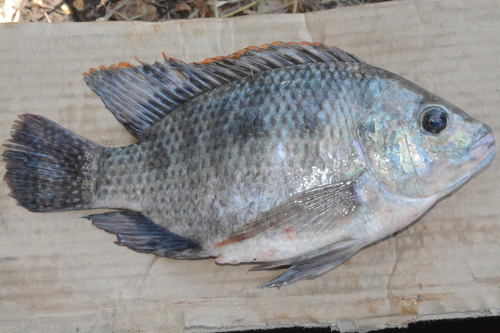
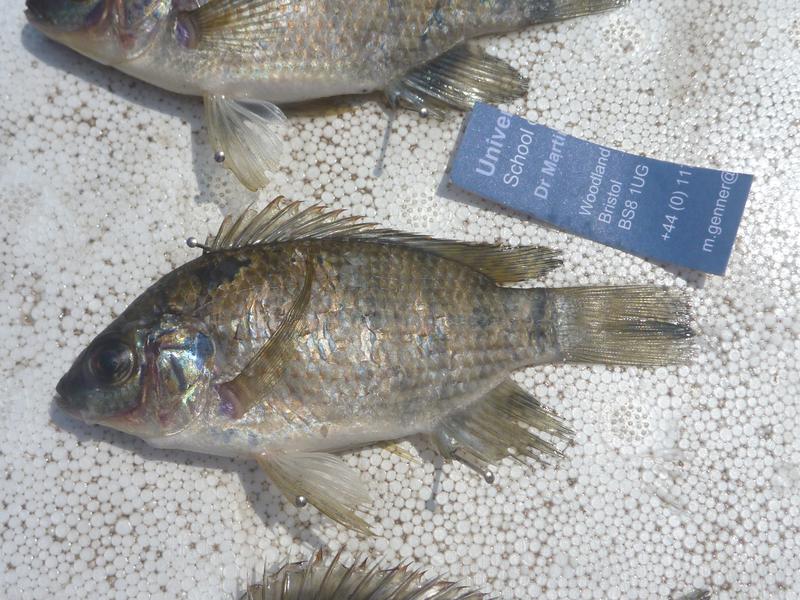
Oreochromis upembae is a short-headed, deep-bodied tilapia that reaches about 8 in (21 cm) standard length; the closely allied Malagarazi form runs a little larger, to roughly 11 in (27 cm) total length. The dorsal fin carries 14–16 spines and 11–13 soft rays, the anal fin three spines, and the lateral-line scale series 28–31 — characters that, taken together, separate it from look-alike congeners. Bicuspid outer teeth wear to single points with age.
The most reliable field marks are the two to four large, vaguely outlined dark blotches along the midline from gill cover to tail base, plus a spot on top of the caudal peduncle, all of which persist into adulthood rather than fading as in some relatives. The tail is densely scaled almost to its edge and crossed by narrow dark vertical stripes or rows of spots — a pattern recalling a slightly less orderly version of the Nile tilapia's. Breeding males are the showpiece: the dorsal and caudal fins flush orange to red along their margins, and the genital papilla extends into the pale, tasselled projection that gives this group its name. That tassel is not mere decoration; comparative work on the subgenus links it to sexual selection and the mechanics of sperm transfer at spawning.
Range & habitat
This is fundamentally a fish of the upper Congo, not of the rift lakes. Its core range is the Lualaba River and the Upemba lakes and Kamalondo Depression of southeastern Democratic Republic of the Congo, downstream along the upper and middle Congo to Yangambi and Isangi. FishBase describes it as benthopelagic and tropical, and the IUCN's habitat coding spans permanent and seasonal rivers, freshwater lakes and marshes — a generalist of slow, warm, lowland water rather than a rocky-shore specialist.
Its connection to Lake Tanganyika is genuine but marginal and taxonomically tangled. The IUCN assessment records it from the Malagarazi basin and from Burundi's affluents of Lake Tanganyika, and the Catalog of Fishes adds the Malagarazi River basin to its distribution. Field surveys in Burundi (Bigirimana et al. 2024) collected it from rivers such as the Rumpungwe in the upper Malagarazi, water that ultimately drains to Tanganyika. Whether the lake-margin population is true O. upembae or the separate O. malagarasi remains the open question above. Either way, this is not a deep-water Tanganyikan cichlid of the open lake; it is a river-and-swamp tilapia that touches the lake's western and eastern fringes through inflowing systems.
Ecology & diet
Like other Oreochromis, O. upembae feeds low on the food web — FishBase places it at a trophic level of about 2.5, the realm of detritus-and-microalgae grazers rather than predators. Observations on its close Tanganyika-basin counterpart describe it working the soft, flocculent bottom deposits, a slurry of finely divided plant matter, protozoa, bacteria, algae and detritus, with young fish opportunistically scavenging fish offal near canoe landings. That bottom-feeding habit fits a sandy, depositional habitat better than a scoured rocky one.
Ecologically the species matters most as biomass. In the Upemba National Park, an annotated ichthyofaunal checklist (Katemo Manda et al. 2023) names O. upembae as the single most important species in local fisheries — a large, abundant grazer converting wetland productivity into protein for people. With a high resilience score (population doubling time under fifteen months) and low fishing vulnerability in FishBase's models, it is the kind of robust, fast-turnover tilapia that can sustain steady artisanal pressure where habitat stays intact.
Behavior & breeding
Oreochromis upembae is a maternal mouthbrooder: the female takes the fertilized eggs and developing fry into her mouth and shelters them there. Trewavas recorded females brooding in the lee of sandbanks in the Congo at Yangambi, which points to calm, sandy margins as the preferred nursery. As in the broader genus, spawning almost certainly follows the tilapia template — a male clears or scrapes a shallow nest or pit in soft substrate, courts passing females, and fertilizes the eggs the female then gathers to brood.
The tasselled genital papilla of breeding males is the distinctive twist. In this group the male's tassel and the female's egg-collecting behaviour are tied together in the spawning sequence, and the trait is read as a product of sexual selection rather than a simple plumbing detail. Beyond that, hard behavioural data specific to O. upembae are thin: its territoriality, the size of breeding aggregations and seasonal triggers have not been documented in the detail lavished on the Great Lakes' haplochromine flocks. What can be said with confidence is that it is a substrate-nesting, mouthbrooding tilapia of soft-bottomed water — not a specialized rock-dweller.
In the aquarium
Oreochromis upembae is essentially never kept as an ornamental fish, and that absence is itself the honest answer. There is no established hobby trade, no care sheet, and no body of keeper reports for this species specifically — the aquarium and forum chatter around "tilapia" overwhelmingly concerns farmed Nile and Mozambique tilapia, not this upper-Congo endemic. Anyone who did keep it should plan as they would for any robust, foot-long Oreochromis: a large tank or pond measured in hundreds of litres, sand substrate, hard alkaline tropical water in the rough range its relatives tolerate, and the expectation of a strong digger that will rework the bottom and uproot plants.
The realistic framing is that this is a food and conservation fish, not a display animal. The genus is notorious for aggression and for hybridizing freely — a serious concern given the live taxonomic question between O. upembae and O. malagarasi, where careless mixing could muddy already-blurred lines. If the goal is the fish's distinctive midline blotches and a breeding male's tasselled, red-edged finnage, those are sights for a field researcher or a dedicated aquaculture setting far more than for a community tank.
Conservation
The IUCN Red List assesses Oreochromis upembae as Least Concern (assessed 2009, published 2010), with an unknown population trend and no known major threats, and flags the assessment as needing updating. The rationale is its wide distribution across the Congo and the protection that part of its range enjoys inside Upemba National Park. There is no targeted ornamental collection to worry about; the pressure on it is the ordinary pressure of an artisanal food fishery, which it appears to withstand given its high reproductive resilience. For the core Congo populations, in short, the honest verdict is that the species itself looks secure even though the data are dated and thin.
The more interesting conservation story is at the species' Lake Tanganyika edge, where it must be read against the basin's wider strain. Tanganyika holds a famously endemic cichlid fauna — on the order of 250 endemic cichlids — and is under documented stress: O'Reilly et al. (2003, Nature, doi:10.1038/nature01833) tied decades of warming and weakened mixing to roughly a 20% drop in primary productivity and lower fish yields, and Cohen et al. (2016, PNAS, doi:10.1073/pnas.1603237113) inferred a loss of nearly 38% of the lake's oxygenated benthic habitat as the warming surface caps deep-water renewal. Layered on that are shoreline sedimentation that smothers littoral habitat, the great clupeid-and-Lates pelagic fishery feeding four countries, and the four-nation governance challenge coordinated through the Lake Tanganyika Authority. O. upembae is not a deep or pelagic Tanganyikan fish, so the productivity and deep-oxygen story bears on it only indirectly; as a river-and-swamp tilapia of the Malagarazi and Burundian inflows, its real exposure is to sedimentation, wetland conversion and degradation of those feeder catchments. The cleanest summary is the careful one: the species is rated Least Concern and its Congo strongholds look stable, but its lakeside foothold sits within a basin under real and well-documented pressure, and its very identity there — O. upembae or the separate O. malagarasi — still needs resolving before its Tanganyika-edge status can be judged with confidence.
Sources
- Eschmeyer's Catalog of Fishes — Oreochromis upembae (species record)
- FishBase — Oreochromis upembae summary
- FishBase — Oreochromis malagarasi (Malagarasi tilapia) summary
- GBIF — Oreochromis upembae (Thys van den Audenaerde, 1964)
- IUCN Red List — Oreochromis upembae (Moelants 2010, Least Concern)
- Bigirimana et al. 2024 — An Updated Checklist of the Fishes from the Upper Malagarazi (Lake Tanganyika Basin) in Burundi (Diversity 16(7):417)
- Katemo Manda et al. 2023 — The Upemba National Park (Upper Congo Basin, DR Congo): An Updated Checklist (Diversity 15(9):966)
- Lake Tanganyika: Status, challenges, and opportunities for research (J. Great Lakes Research, 2023)
- O'Reilly et al. 2003 — Climate change decreases aquatic ecosystem productivity of Lake Tanganyika (Nature, doi:10.1038/nature01833)
- Cohen et al. 2016 — Climate warming reduces fish production and benthic habitat in Lake Tanganyika (PNAS, doi:10.1073/pnas.1603237113)
- Sexually selected genital adornment and sperm packaging in tasselled Oreochromis (JSTOR)
- Freshwater Ecoregions of the World — Lake Tanganyika (endemism overview)
- AquaticRepublic — Oreochromis upembae distribution record (Upper Congo, Lualaba)
- Reddit r/Cichlid — keeper discussion of tilapia temperament and tank needs — community/anecdotal
- AquariaCentral forum — tankmates for a tilapia cichlid (community thread) — community/anecdotal