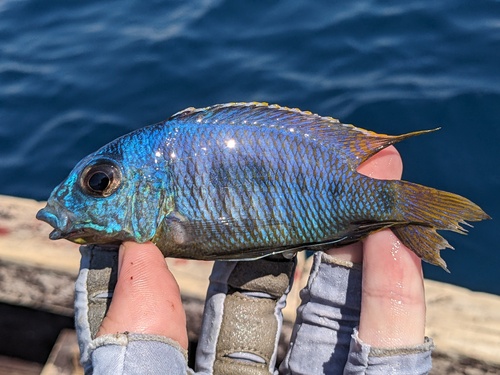


Taxonomy & naming
The species was described by the British ichthyologist Ethelwynn Trewavas in 1935 as Haplochromis heterodon, from material collected at Deep Bay and Monkey Bay in Lake Malawi. As the lake's enormous haplochromine flock was carved into finer genera over the following decades, the fish passed through Cyrtocara heterodon before settling into Otopharynx, the genus erected for a cluster of Malawi haps with a distinctive pharyngeal-jaw articulation. Catalog of Fishes and FishBase both carry the valid name as Otopharynx heterodon (Trewavas, 1935), with Haplochromis heterodon and Cyrtocara heterodon as senior-combination synonyms.
The names themselves are descriptive once unpacked. Otopharynx couples the Greek for "ear" with "pharynx," a reference to the prootic bone — a skull element near the balance organ — taking part in how the upper throat-jaw is hinged in the genus. The epithet heterodon, "different tooth," flags the variability of the outer jaw teeth, which can be bicuspid, tricuspid, or simply pointed in larger fish. In the hobby it is the "royal blue hap," and in the ornamental trade it has moved under labels such as "Haplochromis Royal Blue" and "Big Spot Tanzania." One caveat worth stating plainly: the IUCN assessment notes the species "may be a complex of species" in need of revision, so some populations sold under this name may not all prove to be one biological species.
Appearance
This is a moderately deep-bodied hap with a long dorsal fin that runs back nearly to the tail, large pectorals, and pointed pelvic fins. The sexes diverge sharply. Dominant males turn metallic, royal blue, often crossed by darker vertical bars and washed with yellow over the chest and belly, with a dark stripe through the eye; females and juveniles stay a cryptic, sandy silver marked by a row of three black blotches along the flank — the "big spot" of the trade name.
Reported sizes vary, and it is worth being honest about the spread rather than picking one number. FishBase lists a maximum of 12.8 cm (5.0 in) total length, drawn from the CLOFFA checklist and reflecting wild-caught fish. Hobby and field sources push higher: aquarium specimens are commonly cited at up to about 15 cm (6 in), and one Lake Malawi field reference gives males to roughly 17 cm (6.7 in) with females smaller, near 14 cm (5.5 in). The practical takeaway is a fish that finishes somewhere around 5–6 in (13–15 cm) for most keepers, with males the larger and far more colorful sex.
Range & habitat
Otopharynx heterodon is endemic to Lake Malawi (also called Niassa and Nyasa), the long rift-valley lake shared by Malawi, Mozambique, and Tanzania, and it is distributed essentially lake-wide rather than confined to a single shore. Documented localities span the lake from north to south — Chilumba, Nkhata Bay, Likoma Island, and Monkey Bay among them — and the IUCN gives an estimated extent of occurrence near 29,600 km² with a much smaller occupied area of roughly 1,220 km², the difference reflecting how patchily suitable the bottom is.
The fish favors the intermediate zone, the transitional band where rocky shoreline gives way to open sand, and it is also found over the sediment-rich substrates of deeper water. That habitat choice is tied directly to how it feeds: it is drawn to loose, stirred-up sediment. In situ the water is hard and alkaline — the conditions any Malawi cichlid demands — with FishBase citing a pH range of about 7.4–8.4, general hardness of roughly 7–30 dH, and temperatures around 23–27°C (73–81°F). Because it lives along the rock–sand interface and into deeper sediment rather than on shallow reef faces, it is a habitat generalist by Malawi standards, which partly explains its broad range.
Ecology & diet
Otopharynx heterodon is best described as an opportunistic benthic feeder. Rather than rasping algae from rock like the mbuna or hunting open water like the zooplanktivorous utaka to which several of its relatives belong, it works the bottom, taking edible material — small invertebrates, organic particles, and detritus — from sediment drifting in the water column or churned up off the substrate. Field observers note it is actively attracted to stirred-up sediment, the kind raised by larger fish foraging or by water movement, which makes it something of a camp-follower at the sediment–water boundary.
That puts it at a middle trophic position; FishBase estimates a trophic level near 3.4, consistent with a generalized invertebrate-and-detritus diet rather than strict herbivory or piscivory. In community terms it is one of many sand- and intermediate-zone haps that partition the lake's vast soft-bottom habitat among themselves, each tuned to a slightly different particle size, depth, or feeding tactic — the kind of fine niche-splitting that underlies Malawi's extraordinary cichlid diversity.
Behavior & breeding
Like the great majority of Lake Malawi haplochromines, O. heterodon is a maternal mouthbrooder, and its breeding follows the familiar lek-style script. A ripe female is courted by a colored-up male who quivers, flares his fins, and leads her over a chosen patch of sand; she lays a small clutch and immediately takes the eggs back into her mouth, where the male fertilizes them as the pair circle. Clutch sizes reported by aquarists run modest, on the order of 20 to 60 eggs, and the female broods them for roughly three weeks — about 21 days — before releasing free-swimming fry, often sheltering among rocks until the young are ready.
What sets this species apart from many of its tank-busting relatives is temperament. The IUCN and field accounts agree that males are only rarely territorial, defending space mainly when actively spawning, and one population is noted to spawn on sand between rocks without building the elaborate bowers some related forms construct. The result is an unusually mild-mannered hap — a trait keepers consistently report — though, as with all mouthbrooders, holding females need refuge from harassment to carry a brood to term.
In the aquarium
The royal blue hap has cycled in and out of fashion in the Malawi hobby for years, often paired with the similarly understated O. lithobates, and it is genuinely one of the easier-tempered haps to live with. The honest guidance is to lean into that mildness rather than fight it. Keep it as a harem — one male to several females — in a long tank; sources converge on a minimum footprint around 130–150 cm (roughly 50–60 in, or a standard 75–125 gallon four-to-six-foot tank), with more length always better for spreading out the male's attention.
A sand bottom is not optional cosmetics; it lets the fish do what it does in the wild, sifting and foraging, and males color up best when relaxed over open sand with rockwork to break sightlines. Water should be hard and alkaline in the usual Malawi range. The real pitfall is tankmate choice: this is a peaceful fish that does poorly with boisterous or aggressive company, and pairing it with rowdy mbuna or hyper-dominant haps will leave it stressed, washed-out, and outcompeted at feeding. Calm Aulonocara (peacocks) and other gentle sand-dwelling haps make far better neighbors. It eats readily — quality pellet or flake rounded out with frozen brine shrimp, mysis, and similar — and is not fussy, which only adds to its reputation as a forgiving, if unflashy-until-settled, community Malawian.
Conservation
Otopharynx heterodon is assessed by the IUCN as Least Concern (assessed 20 June 2018 by Konings & Kazembe; errata 2019), on the straightforward grounds that it is endemic to Lake Malawi but widespread and lake-wide, with no known major threats acting across its range. The population trend is listed as unknown. There is some species-specific collection pressure — it is regularly taken for the ornamental-fish trade at Chizumulu Island and occasionally at Lupingu in Tanzania — but at present that harvest is small-scale and not considered a threat to the species overall, and the fish occurs within Lake Malawi National Park, which affords part of its range formal protection.
That reassuring species-level verdict sits inside a lake under real and growing strain, and the two should be held together rather than confused. The basin review by Chavula and colleagues (2023, Journal of Great Lakes Research 49(6):102241) documents severe pressures across the Lake Malawi/Niassa/Nyasa system: heavy fishing and the long decline of the chambo (Oreochromis) fishery, rising sediment and nutrient loading washing off deforested catchments, climate warming that intensifies the lake's stratification and can suppress the nutrient mixing that drives productivity, and the risk posed by invasive species. For a sediment-zone feeder like O. heterodon, the most relevant of these is the sediment and nutrient loading that reshapes the very soft-bottom habitat it depends on — the right caution is that a fish secure today can still be eroded by basin-scale change, even while its Red List status remains Least Concern.
Sources
- Otopharynx heterodon (Royal blue hap) — FishBase species summary
- Otopharynx heterodon — FishBase territory/distribution list
- Haplochromis heterodon Trewavas, 1935 — FishBase synonym detail
- Catalog of Fishes (Eschmeyer/CAS) — Otopharynx heterodon species record
- Otopharynx heterodon (Trewavas, 1935) — CLOFFA / Africa Museum type record
- Otopharynx heterodon — IUCN Red List assessment (Least Concern, 2018; errata 2019)
- Chavula et al. 2023, Lake Malawi/Niassa/Nyasa basin: Status, challenges, and research needs (J. Great Lakes Res. 49(6):102241)
- Otopharynx heterodon 'Hai Reef' — malawi.si (Konings field data & photos)
- Otopharynx heterodon — AquaInfo species profile
- Otopharynx heterodon — Cichlid Room Companion species profile
- Lake Malawi Cichlids in Their Natural Habitat (Konings) — utaka/feeding context
- Taxonomic investigation of zooplanktivorous Lake Malawi cichlids (PMC)
- Otopharynx heterodon from Lake Malawi — Cichlid-Forum (community profile, photo by Ad Konings) — community/anecdotal
- Royal Blue Hap / Otopharynx lithobates Tanzania (intermediate-zone Otopharynx context) — Practical Fishkeeping
- Otopharynx heterodon — GBIF species occurrence page
- Eschmeyer's Catalog of Fishes — reference summary (ECoF, 2024)