Taxonomy & naming
George Albert Boulenger described Perissodus microlepis in 1898 from a specimen collected at Mbity Rocks on Lake Tanganyika; the unique holotype is held in London (BMNH 1898.9.9.61), and Eschmeyer's Catalog of Fishes still lists the name as valid in its original combination. The genus name is a compact piece of zoological shorthand — from the Greek perissos, 'uneven' or 'odd,' and odous, 'tooth' — pointing to the irregular, almost comb-like teeth that set the scale-eaters apart. The species epithet microlepis simply means 'small-scaled.' Two later names, Perissodus burgeoni David 1936 and P. gracilis Myers 1936, are treated as synonyms.
The fish sits in the cichlid subfamily Pseudocrenilabrinae and, with its close relatives, in the tribe Perissodini — Lake Tanganyika's dedicated scale-eating lineage. Roughly six endemic Perissodini species share the lake, each working the scale-eating trade a little differently by depth and prey, and P. microlepis is the best studied of them by a wide margin. To hobbyists it usually travels under no common name more specific than 'scale-eater' or 'Tanganyika scale-eating cichlid,' which is fair enough: the diet is the whole identity of the animal.
Appearance
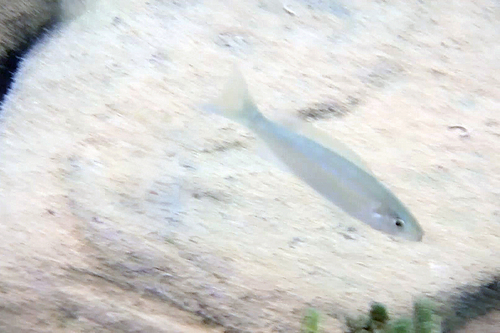
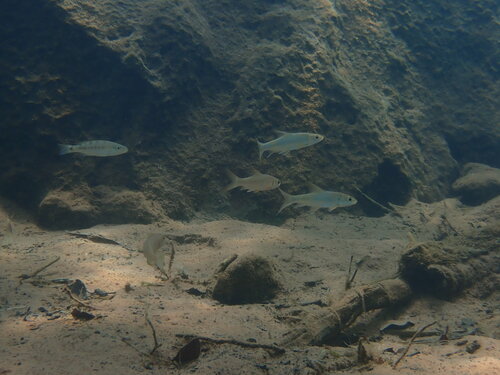
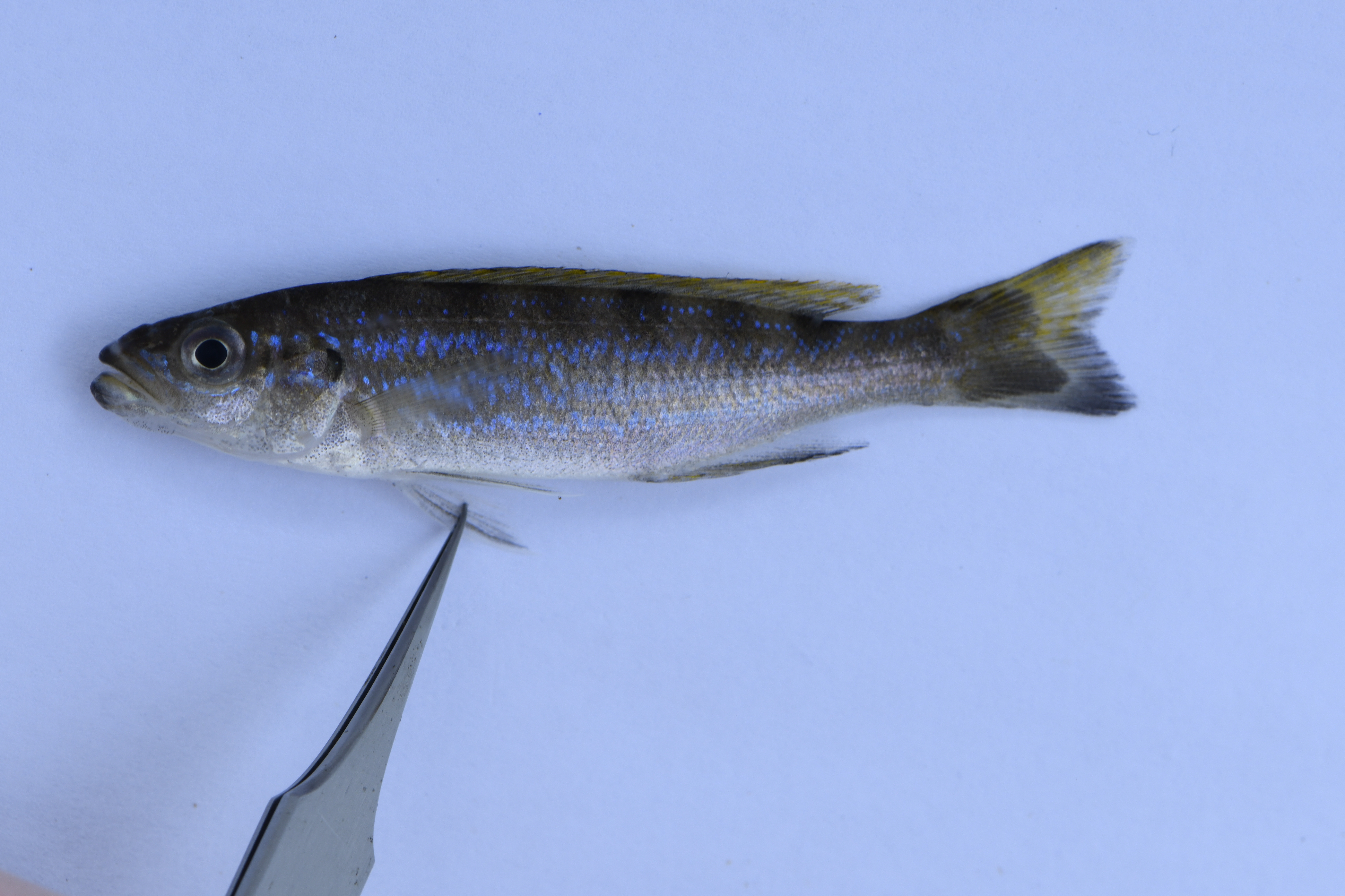
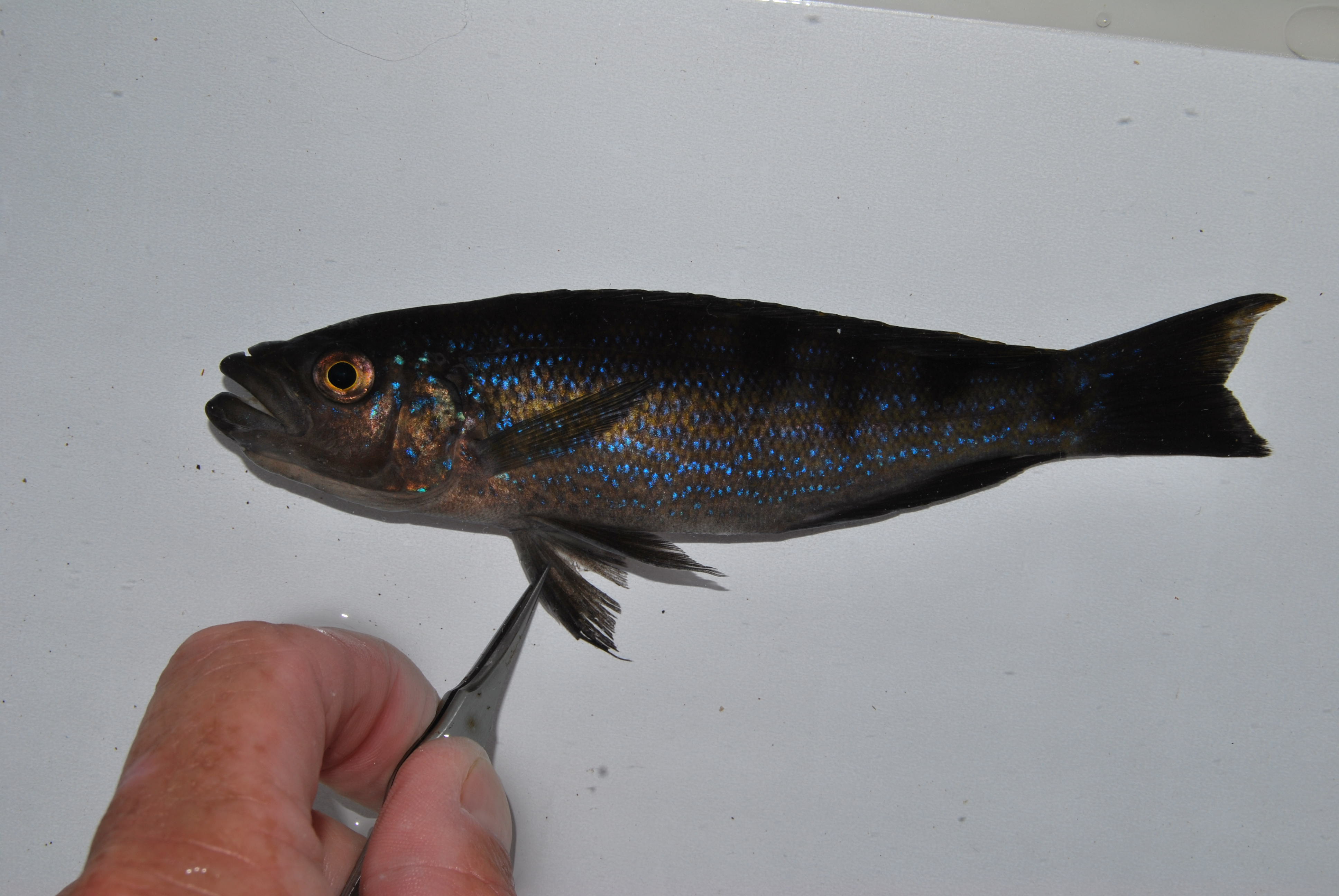
This is a modest, silvery, laterally compressed cichlid — FishBase gives a maximum of about 4.3 inches (11 cm) total length, and most aquarium and field individuals are smaller, so despite its fearsome reputation it is not a large fish. The body is deep and slab-sided with a slightly upturned face, and the coloration is unshowy by Tanganyikan standards: a pale to grayish ground, often with faint vertical barring and a darker wash along the back, that helps it slip in among other cichlids unnoticed. That plainness is the point. A scale-eater that hopes to approach a feeding Tropheus from behind does better looking like background than like a threat, and some observers have read its pattern as a loose visual cheat that lets it mingle with potential prey.
The feature that makes this fish famous is not its color but the set of its head. The mouth and the skull behind it are twisted slightly to one side, so that an individual's jaws gape preferentially either to the left or to the right. The asymmetry is subtle to the eye — you are not looking at a cartoonishly bent face — but it is real and measurable, and it lines up with which side of a prey fish the individual attacks. How discrete that left/right difference actually is turns out to be one of the genuinely unsettled questions about the species, and we return to it below. Sexual dimorphism is slight; sexes are difficult to tell apart on external appearance alone, and pairs are usually sorted out by behavior rather than by markings.
Range & habitat
Perissodus microlepis is endemic to Lake Tanganyika and occurs lake-wide, recorded from all four riparian countries — Burundi, the Democratic Republic of the Congo, Tanzania, and Zambia. It is a demersal fish of the inshore zone: the IUCN account describes it as found in all habitat types but especially common over shallow rocky shores, and the older collecting literature placed it and its relative P. straeleni mainly in rocky regions shallower than about 230 feet (70 m). That tie to the rocky littoral is not incidental — it is where the deep-bodied algae-grazing cichlids it likes to rob are densest.
The water it lives in is the hard, alkaline, strikingly stable environment characteristic of Tanganyika: high pH, well-buffered, and warm, with FishBase giving a temperature range of roughly 75–82°F (24–28°C) for the species. Because P. microlepis is a parasite-by-proxy on the rocky-shore community rather than a specialist of one reef, it ranges across the whole lake wherever suitable prey aggregate, which is part of why the IUCN regards its distribution as continuous rather than fragmented.
Ecology & diet
Scale-eating — lepidophagy — is a rare feeding mode, and Perissodus microlepis is its textbook practitioner. Adults subsist largely on the scales of other living fish, which they wrench off with a battery of fine, loosely set teeth; the early aquarium observations of Marlier and Leleup in the 1950s found captives that would take nothing else on offer, refusing worms, fish powder, and prepared foods in favor of scales from live fish. The usual victims are deep-bodied cichlids of similar or larger size that feed head-down on the algal film — Tropheus, Petrochromis, and Pseudosimochromis are named repeatedly — caught off guard while preoccupied with grazing. The attack itself is a fast lunge from behind and to the side, and a successful strike rasps loose a mouthful of scales that the predator swallows whole. FishBase places the species at a trophic level around 4.2, which is high, but the ecology is better thought of as parasitic than predatory: the prey is wounded, not killed, and lives to be bitten again.
The diet is not fixed across the life cycle. Studies of gut contents (Nshombo and others) and the field observations summarized by Konings agree that juveniles begin as ordinary plankton-feeders, like most young cichlids, and only 'scale up' to lepidophagy once they reach roughly 1.5–2 inches (4–5 cm). Even as adults, scale-eaters take some zooplankton and invertebrates alongside scales, so the specialization is strong but not absolute. Within the lake the species is one node in a small guild of co-occurring scale-eaters that partition the resource — a striking example of how Tanganyika's cichlid radiation has filled even the strangest ecological niches several times over.
Behavior & breeding
The hunting behavior is where this fish became scientifically famous. In a 1993 Science paper, Michio Hori reported that P. microlepis comes in two forms — one with the mouth twisted left, one twisted right — and that the two consistently attack opposite flanks of their prey: right-mouthed fish strip scales from the prey's left side, left-mouthed fish from the right. By his account the trait was inherited as a simple Mendelian character (with right dominant), the two forms sat near a 50:50 ratio, and their relative frequencies oscillated over a cycle of about two and a half years. Hori's explanation was negative frequency-dependent selection: when one form becomes common, prey learn to guard that flank, so the rarer form enjoys better hunting and is favored — the same logic that makes left-handed fencers disproportionately successful. A difficult 2018 enclosure experiment in the lake, stocking prey with all-left, all-right, or mixed scale-eaters, found that mixed groups fed best, supporting the frequency-dependence idea directly.
That clean story has been productively muddied. Beginning with Van Dooren and colleagues (2010) and Kusche and colleagues (2012), several groups found that mouth asymmetry in P. microlepis follows a continuous, single-peaked distribution centered near symmetry, rather than two cleanly separated morphs — a pattern Palmer and others describe as antisymmetry, with the strength of the twist developing partly through use rather than being fixed by a single gene at birth. Whether laterality drives behavior or behavior shapes the morphology, and whether mating is assortative, disassortative, or random with respect to mouth side, remain contested. The honest summary is that the frequency-dependence result has held up well, while the original 'two discrete morphs from one gene' framing has not — and the fish is now studied as a model for how behavior, development, and genetics jointly produce a lopsided body.
Breeding is no less unusual. P. microlepis is a biparental mouthbrooder that forms pair bonds. The eggs — more than 200 in a typical spawn — are laid and fertilized on the substrate before the female takes them into her mouth; they hatch in about two days, and roughly a week later she releases the fry. Care does not end there. The male defends the territory and, once the young reach about 6 mm (around day ten or eleven post-spawning), takes over collecting and sheltering them when threatened. Field studies by Yanagisawa and by Ochi and Yanagisawa documented a further twist: parents will 'farm out' some of their young, transferring offspring to the broods of other pairs, a predominantly male tactic, and genetic work has since confirmed that wild broods routinely contain unrelated alloparental young.
In the aquarium
Perissodus microlepis turns up in the hobby only occasionally, and it is a specialist's fish rather than a community animal. The obvious worry — that it will shred its tankmates' scales — is real but manageable, and experienced keepers report a consistent pattern: a scale-eater raised alongside a fixed set of tankmates from a young age tends to leave them alone, while a newcomer added to an established tank is recognized and attacked. The practical advice that recurs on the Cichlid Room Companion and similar forums is therefore to buy young fish and settle the whole community together, so that 'tankmates for life' is literally true. Keepers also note that captive individuals can be weaned onto prepared foods more easily than the all-scales reputation suggests, though a scale or protein-rich substitute keeps them in good condition.
Beyond that, the requirements are standard hard-water Tanganyikan fare: alkaline, well-buffered water, stable warmth in the mid- to high-70s°F (around 24–26°C), strong filtration, rockwork for cover, and the clean conditions these lake fish expect. Because it is a pair-bonding biparental mouthbrooder, it can in principle be bred in captivity, and the brood care is fascinating to watch — but documented aquarium spawnings are scarce, and pairing can be the bottleneck. Treat the lurid 'eats other fish alive' billing as a description of wild ecology, not a warning that it will devastate a tank; the bigger honest caveat is simply that this is an uncommon, behaviorally demanding cichlid better suited to a dedicated Tanganyikan keeper than to a first community tank.
Conservation
At the species level, Perissodus microlepis is not currently at risk. The IUCN Red List assessed it as Least Concern in March 2025 (Sibomana 2025, reviewed by the Tanganyika specialist Ad Konings), repeating its 2006 listing; the rationale is that it is widely distributed lake-wide with no known major threats, though the population trend is recorded as unknown and the assessors note it is 'very common' in its habitat but never truly abundant. There is no targeted fishery or collection pressure on the scale-eater specifically. So the species itself sits in a comfortable place — the caveats lie one level up, in the state of the lake it cannot leave.
Lake Tanganyika is under broad, well-documented strain. O'Reilly and colleagues (2003, Nature) showed that twentieth-century warming has strengthened the lake's stratification and weakened the wind-driven mixing that lifts deep nutrients to the surface, cutting primary productivity and, by their estimate, implying a substantial decline in fish yields. Cohen and colleagues (2016, PNAS) extended the case with paleoecological records, linking sustained warming to falling fish abundance and a roughly 38% contraction of oxygenated bottom habitat in their study areas. Layered on top are sedimentation and nutrient loading from deforested catchments, and the heavy commercial fishery for the pelagic clupeids (Stolothrissa, Limnothrissa) and the Lates predators that depend on them — all of it managed, imperfectly, across four nations through the Lake Tanganyika Authority.
For P. microlepis, the lake-level pressures bear on it indirectly but unavoidably, because it is an obligate parasite of the inshore rocky-shore cichlid community. Its prey base — the Tropheus and Petrochromis and their kin that graze the algal film on littoral rocks — is exactly the assemblage most exposed to sedimentation, which smothers the rock substrate and the algal turf those grazers need, and to shoreline development. A scale-eater is only ever as secure as the community it robs: thin out the rocky-shore grazers, or degrade the reefs that hold them, and the niche this fish occupies narrows with them. None of this makes Perissodus microlepis threatened today, and the assessment is right to call it Least Concern — but its fortunes are tied to a lake whose trajectory, on warming, productivity, and shoreline integrity, is pointing the wrong way.
Sources
- Eschmeyer's Catalog of Fishes — Perissodus microlepis (species record, Boulenger 1898; holotype, synonymy)
- FishBase — Perissodus microlepis (size, ecology, trophic level, distribution, etymology)
- GBIF — Perissodus microlepis Boulenger, 1898 (taxonomy & occurrences)
- Hori, M. (1993), 'Frequency-Dependent Natural Selection in the Handedness of Scale-Eating Cichlid Fish', Science 260:216-219
- Hori (1993) abstract & metadata — PubMed
- Van Dooren, van Goor & van Putten (2010), 'Handedness and asymmetry in scale-eating cichlids: antisymmetries of different strength', Evolution 64:2159-2165
- Raffini, Fruciano et al. — 'Towards understanding the genetic basis of mouth asymmetry in the scale-eating cichlid Perissodus microlepis' (continuous unimodal distribution; antisymmetry debate)
- Lee, Kusche, Meyer et al. (2015), 'Genetic and environmental effects on the morphological asymmetry in the scale-eating cichlid fish, Perissodus microlepis', Ecology & Evolution 5:4277-4286
- Ochi, H. & Yanagisawa, Y. (2005) — Parental care and brood farming-out in Perissodus microlepis, Environmental Biology of Fishes
- McKinnon, J. (2023), 'Lessons From Lake Tanganyika's Scale Eating Fish', MIT Press Reader (Hori, Liem & Stewart, and the 2018 enclosure experiment, in plain language)
- O'Reilly, Alin, Plisnier, Cohen & McKee (2003), 'Climate change decreases aquatic ecosystem productivity of Lake Tanganyika', Nature 424:766-768
- Cohen, A.S. et al. (2016), 'Climate warming reduces fish production and benthic habitat in Lake Tanganyika', PNAS 113(34):9563-9568
- IUCN Red List — Perissodus microlepis (Sibomana 2025, Least Concern; ecology & breeding notes)
- Cichlid Room Companion 'Ask Pam' — Perissodus microlepis (keeping/aggression: biparental mouthbrooder, attacks newly added fish) — community/anecdotal
- The Cichlid Stage — 'The scale eating cichlid' (hobbyist overview & links)