Taxonomy & naming
Petrochromis ephippium was named by Pierre Brichard in 1989, originally as a subspecies — Petrochromis trewavasae ephippium — in his Book of Cichlids and All the Other Fishes of Lake Tanganyika. Brichard separated it from the nominate P. trewavasae on three points: a less elongated, less filamentous caudal fin, a brown-to-yellow-orange body rather than the dark brown of true trewavasae, and a wider distribution. The Latin ephippium means "saddle," describing the pale rectangular blotch that can sit under the dorsal fin.
Its rank has see-sawed. Eschmeyer's Catalog of Fishes treated ephippium as a junior synonym of P. trewavasae (a position FishBase still echoes in its taxonomic remarks). A subsequent morphological and molecular revision of the genus by Mattsson (2018), however, re-validated it as a distinct species, designating a neotype (NRM 59565) and diagnosing it from trewavasae by an emarginate (shallowly notched) rather than lunate caudal fin, 12–14 gill rakers on the lower limb of the first arch, and 34–36 lateral-line scales. That same study showed the aquarium-trade "P. sp. Moshi" is genetically identical to ephippium — the two share mitochondrial sequences and are one species. The IUCN's 2025 assessment follows the revalidated treatment, listing Petrochromis ephippium as a full species with Brichard, 1989 as authority.
The genus Petrochromis (Boulenger, 1898) — "rock" + chromis — is a tight flock of specialized algae-scrapers endemic to Tanganyika, defined by dental pads packed with many slender tricuspid teeth. P. ephippium sits in the trewavasae complex alongside several look-alikes, which is exactly why its identity has been so slippery.
Appearance
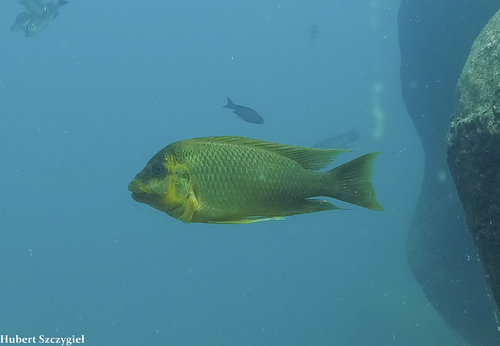
This is a compact, deep-bodied Petrochromis with a broad snout, thick lips, and a large, slightly superior mouth — the toolkit of a rock-grazer. Maximum size is commonly cited at about 7 in (18 cm) total length, with dominant males reported a touch larger, toward 8 in (20 cm). Body color runs brown to yellow-orange, and many fish show the diagnostic saddle: a pale, roughly rectangular patch under the dorsal fin that gives the species its name. The caudal fin is emarginate — shallowly concave — rather than drawn out into the long filaments of P. trewavasae.
Sexual dimorphism is modest and mostly about size and behavior: dominant males grow largest and color up, while the difference between a sub-dominant male and a female can be hard to read at a glance. Inside the mouth, the dental pads carry dense rows of fine tricuspid teeth with slender shafts — not for biting but for combing. The most reliable way to separate ephippium from its congeners is the combination of fin shape, gill-raker count, and scale counts rather than color alone, since brown-to-orange Petrochromis from neighboring rocky stretches can look maddeningly similar in a dealer's tank.
Range & habitat
Petrochromis ephippium is a Lake Tanganyika endemic with a near lake-wide distribution, recorded along the Democratic Republic of Congo, Tanzanian, and Zambian shores. There are two notable gaps: it has not been found in Burundi waters at the lake's northern tip, and it is absent along a stretch from Kapampa (DRC) south to Cape Kachese (Zambia), where the very similar P. trewavasae takes its place — a neat example of how closely related rock-cichlids partition the shoreline.
The fish belongs to the shallow, precipitous rocky habitat: zones where boulders are piled on one another into a maze of caves and crevices, typically only a few meters down — collection notes put it around 5 m (roughly 16 ft). This is the sunlit-to-bright transition where sunlight still drives a thick algal turf on the rock. Tanganyika's water sets the envelope for the species: hard, alkaline, and warm, with pH around 8.6–9.0 and surface temperatures generally in the mid-70s to upper-70s °F (about 24–28 °C). It is a lacustrine, demersal fish tied to hard substrate — you won't find it over open sand or in the pelagic zone.
Ecology & diet
P. ephippium is a herbivorous grazer, and its biology is built almost entirely around "aufwuchs" — the felt of unicellular diatoms, filamentous algae, and associated micro-invertebrates that coats sunlit rock. Rather than biting off whole strands, Petrochromis press their tricuspid combs against the stone and rake, harvesting the loosely attached diatoms and softer growth while leaving tougher filaments behind. FishBase places the species at a trophic level of about 2.0 — essentially a primary consumer — and lake studies of the genus (Yamaoka's classic work on feeding behavior and dental morphology) frame these fish as some of the most finely tuned algae-scrapers in the cichlid radiation.
In the wild that grazing happens across a defended patch of rock. Males hold feeding territories and work them steadily through the day, which makes the species an active participant in the constant turnover of the rocky littoral's algal carpet. The flip side of a low-protein, high-fiber natural diet matters in captivity: a gut adapted to grazing fibrous algae does poorly on rich, meaty foods, a point the hobby returns to again and again.
Behavior & breeding
Like the rest of its genus, P. ephippium is a maternal mouthbrooder. After courtship and spawning, the female takes the eggs into her mouth and broods the developing young there, releasing free-swimming fry once they are well along — there is no paired substrate-guarding here. Dominant males are polygamous, spawning with multiple females over a season.
The defining trait is temperament. Males are strongly territorial and will defend a feeding and spawning spot vigorously; the IUCN assessment itself notes them as "strongly territorial" and known to defend their feeding spots. Hobby and specialist accounts are blunter still: Petrochromis are among the more aggressive Tanganyikan cichlids, fast-swimming and relentless, and confrontations between dominant males can turn into damaging fights. In the lake, space and the three-dimensional cover of piled rock diffuse that aggression; in a glass box it concentrates it, which is the single fact that drives almost every captive-care decision below.
In the aquarium
This is not a beginner fish, and it is not a fish for a standard tank. Experienced Tanganyika keepers converge on long footprints — a 6-foot tank is the practical floor and 8 feet is better — stocked with a sizable group so that aggression is spread across many targets rather than focused on one or two. Keepers on the large-cichlid forums routinely run groups of a dozen-plus adults in 180-gallon-class tanks, and they stress two things over and over: a 6×2-foot (or wider) footprint, and serious filtration with large, frequent water changes, because these constant grazers eat heavily and produce a heavy bioload. Single males kept with too few tankmates tend to bully, and conspecific males generally cannot be housed together in modest tanks.
Water should mirror the lake: hard, alkaline (pH roughly 8.2–9.0), and warm (around 77–79 °F / 25–26 °C). Decor is a rockscape over sand; the species is rough on plants and will not suit a planted tank. The diet point is the one keepers get wrong most: as a dedicated algae-grazer, P. ephippium needs a high-fiber, vegetable- and spirulina-based diet, and rich, protein-heavy pellets are widely blamed in the African-cichlid community for digestive trouble and "bloat." (The mechanism is debated — some experienced keepers argue diet quality and husbandry matter more than protein percentage alone — but the practical advice is consistent: feed green, feed in moderation, keep the water pristine.) Wild-type ephippium is uncommon in the trade and usually moves under the name "Petrochromis sp. Moshi" or "Moshi Yellow," so confirm what you're actually buying.
Conservation
The IUCN Red List assessed Petrochromis ephippium as Least Concern in 2025 (assessor L. Mabo). The reasoning is straightforward: it is endemic to Lake Tanganyika but has a near lake-wide distribution, is described as the most common species in its genus, and faces no identified major, widespread threat. The assessment does flag localized pressures — sedimentation from deforestation and agricultural expansion along the shoreline, plus subsistence fishing and some collection for the ornamental trade — but rates these as affecting only part of the range. So the honest headline is that this particular fish is, for now, secure.
That security sits inside a lake under real strain, and as a shallow rocky-shore grazer P. ephippium is exposed to exactly the pressures that bite hardest in the littoral. Sedimentation is the direct one: silt washing off cleared hillsides smothers the rock and the algal turf the species grazes, degrading the habitat it cannot leave (the deterioration of Tanganyika's rocky shorelines has been documented since Cohen and colleagues' 1990s work). The basin-wide signal is climate-driven. O'Reilly et al. (2003, Nature, doi:10.1038/nature01833) showed that warming has strengthened stratification and weakened the mixing that fertilizes the lake, cutting primary productivity by an estimated ~20% and implying roughly a 30% drop in potential fish yields; Cohen et al. (2016, PNAS, doi:10.1073/pnas.1603237113) found warming has already reduced the oxygenated benthic habitat available to the lake's animals by something like a third. Those changes are felt most directly by the pelagic clupeid (Stolothrissa/Limnothrissa) and Lates fishery that feeds four nations, but they reshape the whole system a rock-grazer lives in. Governance is shared across Burundi, the DRC, Tanzania, and Zambia through the Lake Tanganyika Authority. The bottom line for ephippium: a Least-Concern endemic whose own population looks stable, in a water body whose long-term trajectory — warmer, more stratified, more sediment-laden — is the thing worth watching.
Sources
- FishBase — Petrochromis ephippium summary
- Eschmeyer's Catalog of Fishes (Cal. Academy of Sciences)
- GBIF — Petrochromis ephippium
- IUCN Red List — Petrochromis ephippium (Mabo 2025, LC)
- Mattsson, C. (2018) — A morphological and molecular analysis of the species diversity of the cichlid genus Petrochromis from Lake Tanganyika (bioRxiv 280263)
- Yamaoka — Feeding behaviour and dental morphology of algae-scraping cichlids in Lake Tanganyika (African Study Monographs)
- Yamaoka — Interspecific relationships of aufwuchs-eating fishes in Lake Tanganyika
- O'Reilly et al. 2003 — Climate change decreases productivity of Lake Tanganyika (Nature)
- Cohen et al. 2016 — Climate warming reduces fish production and benthic habitat in Lake Tanganyika (PNAS)
- Cichlid Room Companion — Petrochromis ephippium profile (public page)
- Fishipedia — Petrochromis ephippium
- PlanetCatfish Cat-eLog — Petrochromis ephippium
- Tanganyika.si — Petrochromis ephippium distribution map
- MonsterFishKeepers — Petrochromis tank size recommendations (forum) — community/anecdotal
- Cichlid-Forum — Keeping Petrochromis and Tropheus together (forum) — community/anecdotal
- Cichlid-Forum — Flakes vs. pellets and bloat prevention (forum) — community/anecdotal
- MonsterFishKeepers — Bloat: causes, cures and myths (forum) — community/anecdotal