

Taxonomy & naming
Petrochromis famula was described by the Belgian ichthyologist Hubert Matthes and the British cichlid authority Ethelwynn Trewavas in 1960, from a series of about 37 specimens collected at scattered sites that span almost the whole of Lake Tanganyika, from Luhanga in the northwest to Kasanga in the southeast. Eschmeyer's Catalog of Fishes, FishBase and the IUCN all carry the authority as Matthes & Trewavas, 1960; a 1962 date sometimes seen in the hobby traces to Blanc's later type catalogue rather than the original description, so 1960 is the correct year to cite.
The genus name pairs the Latin petra, "stone," with the Greek chromis, an old word for a perch-like fish — a fitting label for a lineage glued to rocky shores. P. famula sits in the tribe Tropheini, the group of Tanganyikan algae-eaters that also contains Tropheus and Simochromis. In their 1960 revision Matthes and Trewavas separated famula from its relatives mainly on its slightly isognathous jaws (upper and lower jaws of nearly equal length) and the absence of prominent cheek scales. Petrochromis is a notoriously difficult genus taxonomically: a morphological and molecular review by Mattsson and colleagues underscores how much overlapping variation runs through it, and many wild populations circulate in the trade under collection-locality tags (for example "Kambwimba") rather than tidy specific names.
Appearance
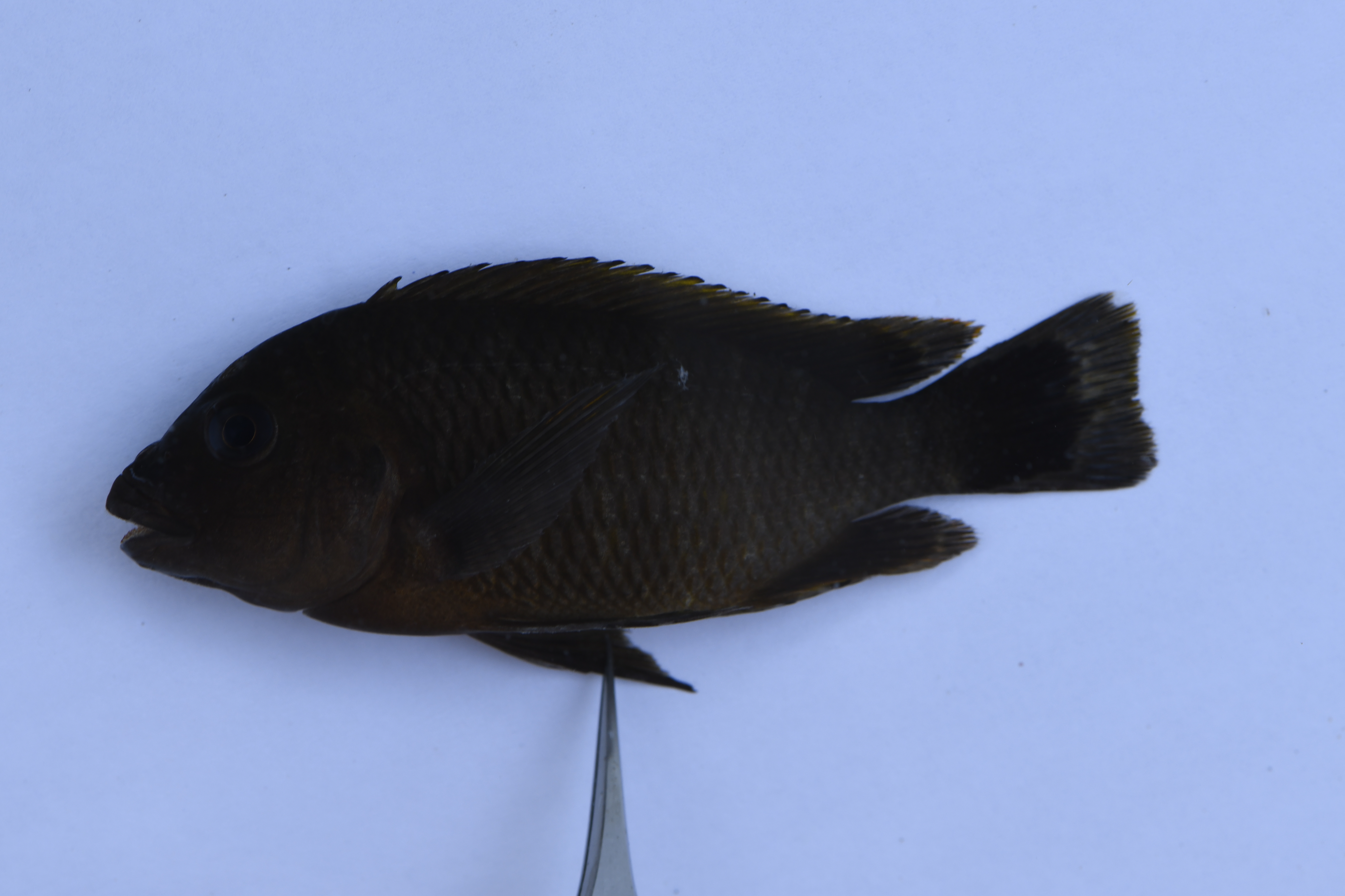
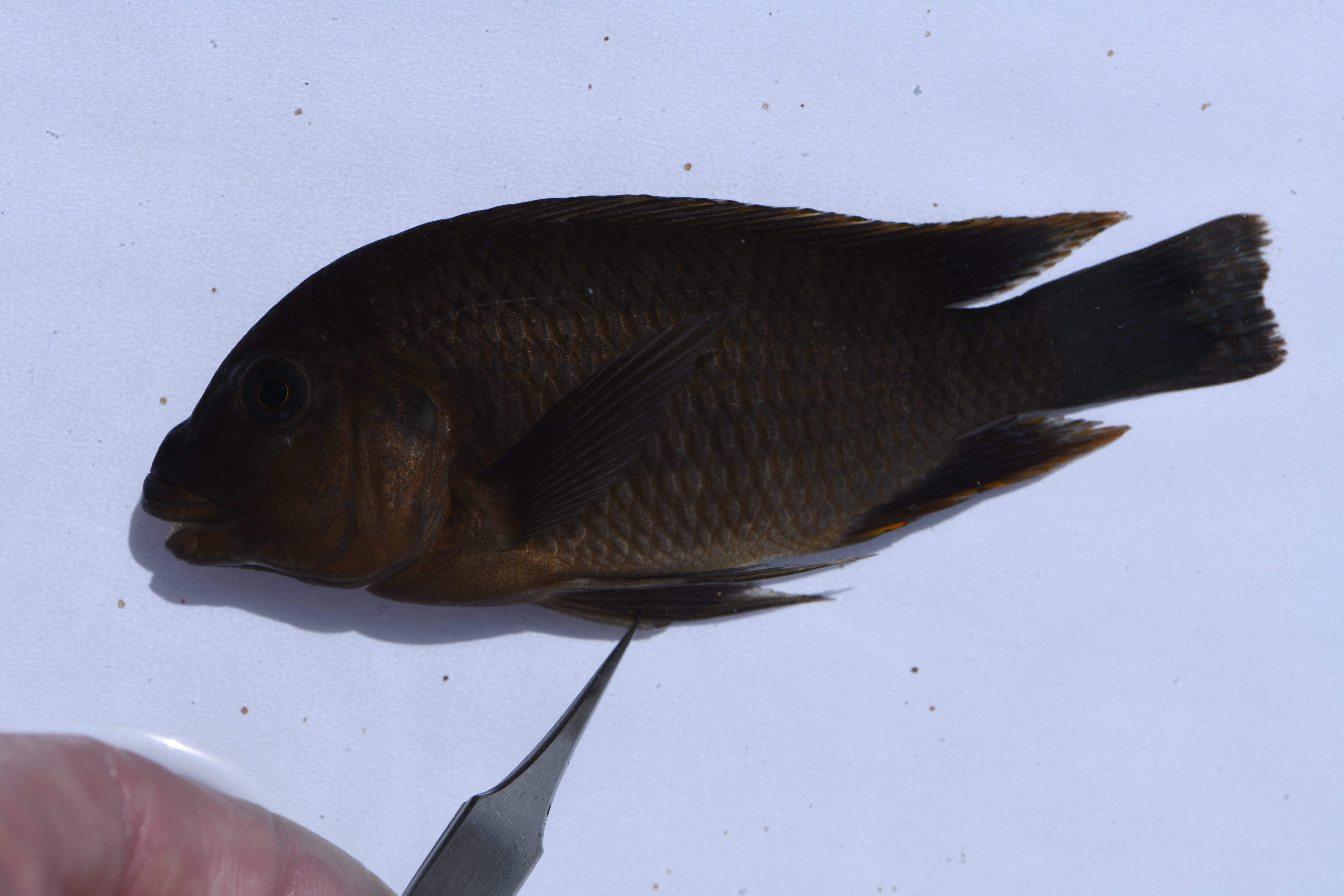
This is a moderately sized, deep-bodied cichlid. FishBase lists a maximum of 15.1 cm (about 6 in) total length, and field accounts put males at roughly 15 cm with females typically around 20 percent smaller; aquarium fish sometimes run a little larger than wild ones. The body is the robust, blunt-headed Petrochromis shape, built around the heavy jaw musculature the genus needs for scraping.
Colour is variable and population-dependent, generally a dark olive-to-brown base over which males show stronger contrast and more iridescence than females. As with most of the genus, the diagnostic feature is the mouth rather than the colour: thick, fleshy lips and broad, mobile pads of slender teeth tipped with three small cusps, arranged into a comb that the fish presses flat against rock. Sexing is done on soft signals — mature males are more colourful and develop more pointed dorsal, anal and pelvic fins, and males carry egg-spots on the anal fin used during spawning. Because famula overlaps in size and shape with other shallow-water Petrochromis, reliable identification in a tank usually leans on the known collection locality as much as on the fish itself.
Range & habitat
P. famula is endemic to Lake Tanganyika, the ancient rift lake shared by Burundi, the Democratic Republic of the Congo, Tanzania and Zambia. Sources differ slightly on how widely it ranges: FishBase characterises it as endemic to the north end of the lake, but the original type series, the Catalog of Fishes, the IUCN assessment and the genus revision all describe a lake-wide distribution along rocky shores, with considerable geographic variation between populations. The lake-wide reading rests on the stronger authorities, so it is the better one to trust, with the caveat that local abundance is patchy.
It is a shallow-water rock dweller. Field observations place it mainly in the upper few metres of the rocky littoral, with the highest concentrations around 2–3 m (7–10 ft) and individuals thinning out by roughly 5–6 m (16–20 ft). The biotope is exactly what the genus name promises: boulders and rubble carrying a turf of algae. In-situ chemistry is the hard, alkaline water typical of Tanganyika — broadly pH 7.5–9 and warm, around 23–27 °C (73–81 °F). Tying the fish to the water body, famula is a creature of the sunlit rocky shore rather than the open lake, which shapes both its diet and the threats it faces.
Ecology & diet
P. famula is a specialist herbivore — a "grazer" in the functional vocabulary of Tanganyikan algae-eaters, with a trophic level estimated at around 2.0, about as low as a fish gets. It works the epilithic biocover, the thin living film coating the rocks, and its tooth design tells the story: multiple rows of similar slender teeth with fork-like tricuspid tips, set on long stems hinged at the base so the comb can flex against an uneven surface. Studies of these communities show that grazers like Petrochromis selectively ingest unicellular algae, especially diatoms (bacillariophytes), winnowing them from the surface film rather than tearing off the tough filamentous strands that browsers such as Tropheus crop.
That distinction matters because Tanganyika's rocky shore is a textbook case of resource partitioning, where a dozen or more aufwuchs-eating cichlids share the same boulders by feeding in subtly different ways and at different depths. Within the genus, famula counts among the rocky-shore grazers that, as Konings notes, comb diatoms and algae from stone. It frequently shares ground with larger congeners such as P. polyodon and P. ephippium; being smaller, it tends to hold feeding territories in narrow crevices and caves the bigger fish cannot enter, while non-territorial individuals gather in loose groups that can slip into areas the giants are guarding.
Behavior & breeding
Socially, famula is territorial and pugnacious, though by the standards of a genus famous for bad tempers it is on the milder end. Aggression is aimed mainly at its own kind — males and females alike — while other species are tolerated rather better, with males defending their patch but not policing the whole tank. A useful natural-history detail is that it is not a fin-nipper, which separates its style of aggression from that of some neighbours.
Breeding follows the classic Tanganyikan mouthbrooding script. P. famula is a maternal mouthbrooder: a male holds a territory and lures a ripe female into a cave or shaded crevice, where she lays a few eggs at a time and immediately takes them into her mouth. She then nuzzles the egg-spots on the male's anal fin and inhales the milt he releases, so fertilisation happens inside her mouth. Clutches are modest — on the order of 15 eggs in the wild and often around 30 in aquaria, with reports up to about 60 — and the female broods them for roughly 30 days before releasing comparatively large, well-developed fry. Unusually for a mouthbrooder, a brooding female may continue to take in small food particles during incubation rather than fasting the entire time. The male plays no part once spawning is over.
In the aquarium
P. famula is an advanced keeper's fish that turns up in the hobby only occasionally, and the honest framing is: long tank, big group, heavy filtration, and patience. Because it is one of the smaller, slightly calmer Petrochromis, experienced keepers and field guides suggest it can be housed in roughly 400–500 L (about 100–130 US gal), but the practical bar is footprint over volume — a 6-foot (180 cm) tank is a sensible floor, and larger Petrochromis projects routinely use 6- to 8-foot tanks. Aquascape it with separated rock piles to break sightlines and create defensible crevices, an open sand floor, and oversized biological filtration with large, frequent water changes, because these fish eat constantly and produce a lot of waste. Keep hard, alkaline water in the high-pH, warm range the lake provides.
The single most important care point is diet: this is a low-protein, high-fibre grazer, and rich or meaty foods invite the bloat that plagues Tanganyikan herbivores. A spirulina- or vegetable-based staple, fed little and often, suits its digestion. On compatibility, the consistent message from keepers is to dilute aggression by stocking a decent group rather than a single pair, and to choose robust, similarly greedy tankmates — other Petrochromis or Tropheus — over delicate fish. Real-world reports bear this out: hobbyists have raised young famula alongside larger wild Tropheus successfully, with the bigger fish keeping intra-Petrochromis squabbles in check, and note that the genus stays out of trouble with peers as long as it cannot dominate. The flip side, well documented across the genus, is that mixing Petrochromis with Tropheus often suppresses Tropheus breeding once the Petros claim the best sites. Avoid pairing it with small, peaceful Tanganyikans such as shell-dwelling Neolamprologus or Julidochromis.
Conservation
The IUCN Red List assessed Petrochromis famula as Least Concern in its 2025 update (assessor L. Mabo, reviewed by cichlid specialist Ad Konings), unchanged from its 2006 listing. The reasoning is straightforward: it is a widespread, lake-wide species with no known major threat, even though its population trend has never actually been quantified. The assessment does flag two real pressures specific to this fish — small-scale subsistence fishing (it is caught for local consumption) and siltation from soil erosion — and notes light collection for the ornamental trade. So at the species level the verdict is genuinely reassuring; the honest statement is that famula itself is not in trouble, while the lake around it is under measurable strain.
That strain is well documented at the basin scale. O'Reilly and colleagues showed in 2003 that climate warming has reduced mixing and primary productivity in Lake Tanganyika, with estimates of roughly a 20 percent drop in productivity and correspondingly lower fish yields. Cohen and colleagues (2016) used sediment records to link the lake's warming to declines in commercially important fishes and a loss of oxygenated bottom habitat — on the order of a 38 percent reduction in the oxygenated benthic zone over recent decades. Layered on top are sedimentation from shoreline deforestation, which smothers the rocky algal film, and the heavy pelagic fishery for clupeids and Lates that feeds four nations. As a shallow rocky-shore grazer, famula's exposure runs mainly through that sediment pathway: its food is the algae on clean, sunlit rock, and turbid, silt-buried boulders are degraded feeding habitat. Governance of these shared waters falls to the four-country Lake Tanganyika Authority. The reasonable read is the one the Red List implies — a common fish today, but one whose well-being is tied to the long-term health of a warming, increasingly silt-stressed lake.
Sources
- Eschmeyer's Catalog of Fishes — Petrochromis famula (species record)
- FishBase — Petrochromis famula summary
- IUCN Red List — Petrochromis famula (e.T60656A47206438, assessed 2025)
- Seriously Fish — Petrochromis famula profile
- tanganyika.si — Petrochromis famula 'Kambwimba' (habitat, behaviour, breeding; photos by Ad Konings)
- Mattsson et al. — A morphological and molecular analysis of the species diversity of the genus Petrochromis from Lake Tanganyika
- Yamaoka — feeding behaviour and dental morphology of algae-scraping cichlids (Petrochromis), Lake Tanganyika
- Tada et al. — Diet disparity among sympatric herbivorous cichlids in the same ecomorphs in Lake Tanganyika (BMC Biology)
- Interspecific relationships of aufwuchs-eating fishes in Lake Tanganyika (resource partitioning)
- O'Reilly et al. 2003 — Climate change decreases aquatic ecosystem productivity of Lake Tanganyika (PubMed)
- Cohen et al. 2016 — Climate warming reduces fish production and benthic habitat in Lake Tanganyika (PNAS)
- Lake Tanganyika: Status, challenges, and opportunities for research (J. Great Lakes Research)
- FishBase — Tanganyika species ecology list (trophic level, endemism context)
- Cichlid-forum.com — Keeping Petrochromis and Tropheus in the same tank (community thread; F1 P. famula report) — community/anecdotal
- MonsterFishKeepers.com — Petrochromis tank size recommendations (community thread) — community/anecdotal
- Fishipedia — Petrochromis famula fish sheet
- Cichlid Room Companion — Petrochromis genus (catalog/groupings)