
Taxonomy & naming
George Albert Boulenger described Petrochromis fasciolatus in 1914 from specimens taken at Kapampa and Kilewa (Kileba) Bay on the Congolese shore of Lake Tanganyika, and the name remains valid today (Eschmeyer's Catalog of Fishes). The genus name joins Latin petra, "stone," with Greek chromis, an old name for a perch-like fish — a nod to the rocky habitat the whole genus exploits — while the species epithet fasciolatus means "finely banded," describing the row of narrow vertical bars on its flanks. Boulenger's own Petrochromis fasciatus, named the same year, is now treated as a synonym.
The fish sits within the Tropheini, the tribe of specialized rock-grazing mouthbrooders that includes Tropheus and Simochromis. One taxonomic wrinkle is worth flagging: hobby references and some catalogs cross-list this species under Interochromis, a genus erected for the related Interochromis loocki, and the two names are sometimes used interchangeably in the trade. For the purposes of identity the authority is clear — Catalog of Fishes and FishBase retain it as Petrochromis fasciolatus — but a keeper who encounters the Interochromis label is looking at the same lineage of fish, not a different one.
Appearance
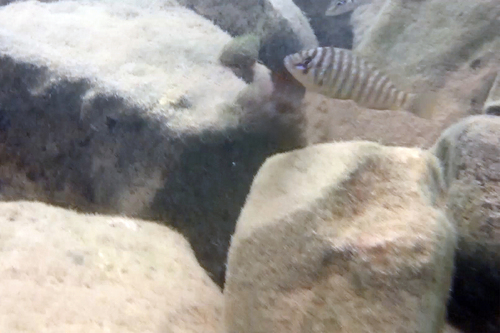
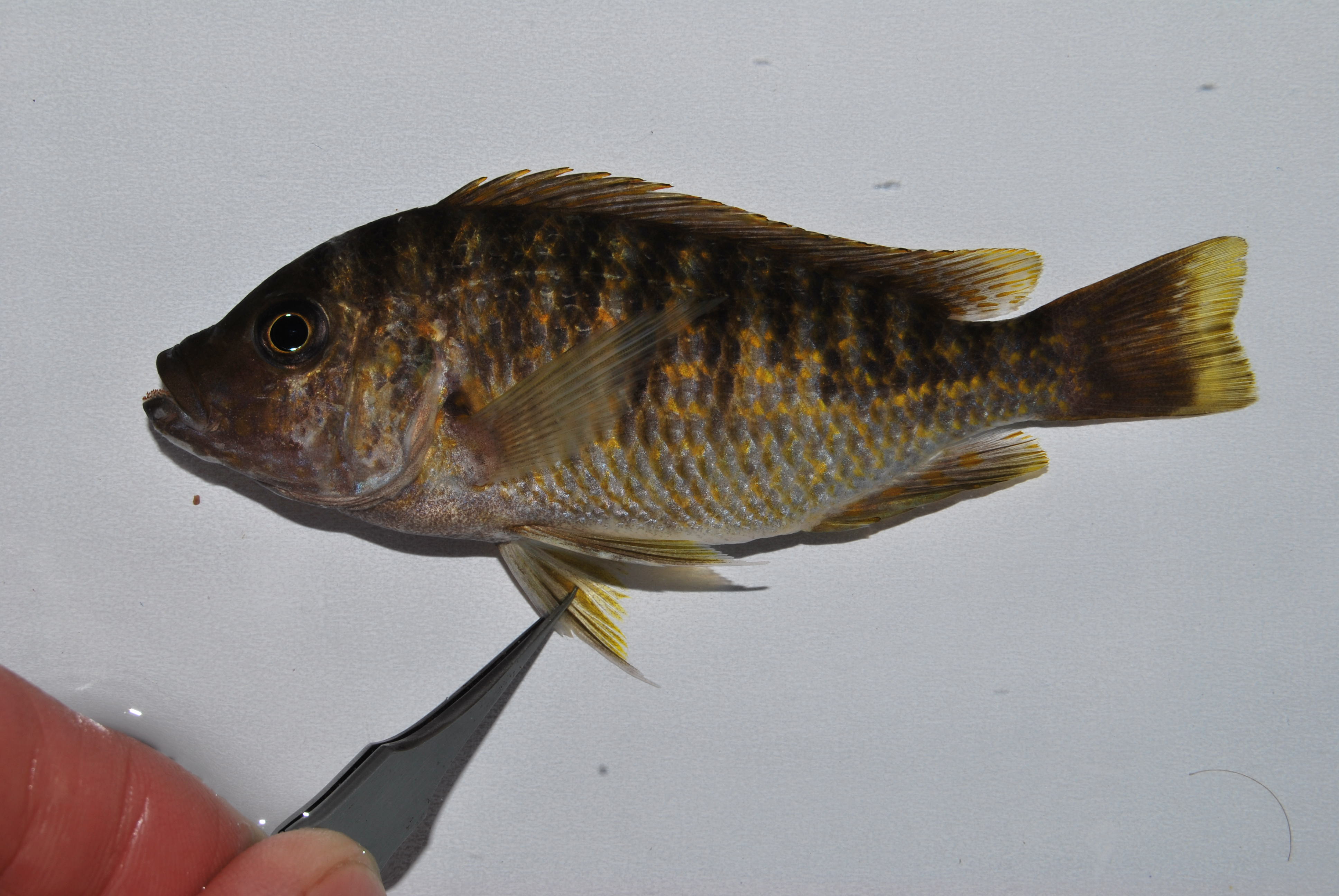
This is one of the smaller members of an otherwise bulky genus. Males reach roughly 6 in (15 cm) total length, with females staying about 20 percent shorter; aquarium fish sometimes run a little larger than wild ones. The body carries more than ten thin, dark vertical bars over a ground color that shifts by population — cream-white through yellowish to grey — and two bands typically cross the head.
The most reliable field mark is the mouth. Where most Petrochromis carry terminal or slightly down-turned lips suited to scraping flat rock, P. fasciolatus has a protruding lower jaw that tilts the mouth slightly upward. Sexual dimorphism is muted: both sexes share the basic pattern, but territorial males intensify in color and their bars blur, and in certain geographic forms males flash distinctive trim. The best known of these is the "Red Eye" form from around Ikola in central Tanzania, in which males show a bright orange-red stripe above the eye; other populations add orange or blue to the dorsal fin. These are regarded as geographic variants rather than separate species.
Range & habitat
Petrochromis fasciolatus is endemic to Lake Tanganyika and occurs lake-wide, with confirmed presence along all four national shorelines — Burundi, the Democratic Republic of the Congo, Tanzania and Zambia (IUCN). Rather than the clean rock walls favored by the lake's specialist grazers, it concentrates in the "intermediate" habitat: the transition zone where scattered rocks meet sand, and where the algal film on the stone is dusted with sediment and detritus.
Most foraging happens in fairly shallow water, generally down to about 23 ft (7 m), while territorial males drop to spawn in the deeper, rockier pockets of that same zone at roughly 26–49 ft (8–15 m). In-situ conditions are the hard, alkaline water typical of the lake — FishBase gives a pH band of about 7.4–8.4 and temperatures of 73–81°F (23–27°C). Being tied to the shallow rocky-sandy margin rather than open water or deep reef shapes both how the fish feeds and how it is exposed to shoreline pressures.
Ecology & diet
P. fasciolatus is a herbivorous grazer that combs the aufwuchs — the carpet of algae, diatoms and microbes coating submerged rock — using fleshy lips set with rows of fine, tricuspid teeth. It is a generalist by the standards of its genus: it carries far fewer combing teeth than the specialist Petrochromis and compensates by snapping at the film faster and more often. Stomach-content and DNA work by Hata and colleagues (2014) found its intake dominated by cyanobacteria, at least 75 percent, with diatoms making up around 20 percent; FishBase places it at a low trophic level near 2.0. Because it works the sediment-dusted rock of intermediate zones, it ingests a good deal of sand along with the algae, and tends to feed off vertical rock faces where less grit accumulates. Its gut is long — on the order of ten times body length — the classic plumbing of a fish that has to ferment hard-to-digest plant matter.
The ecologically striking part is how it gets to the food. Kohda and Takemon's 1996 field study on a Tanganyikan rocky shore showed that solitary fish or small groups were almost always driven off the best algal mats, which lay inside the feeding territories of more aggressive grazers — over 80 percent of foraging happened inside the territories of Variabilichromis (Neolamprologus) moorii, where algal density was more than ten times that elsewhere. Only large schools of 40 to 250 fish could swamp a territory owner's defenses, and the bigger the school, the longer each fish got to feed. It is, in effect, a fish that solves a competitive problem with sheer numbers.
Behavior & breeding
Unlike many of its rock-grazing neighbors, P. fasciolatus does not generally hold a permanent feeding territory; its day-to-day life is the roving, opportunistic schooling described above. Territoriality switches on for breeding. Like all Tropheini it is a maternal mouthbrooder: a male establishes a temporary spawning site in the deeper rocky portion of the intermediate zone, courts a female in, and spawning follows. The female takes her eggs into her mouth, fertilization occurs there as she mouths the male's anal-fin egg-spots, and she then withdraws from his territory to brood alone.
Reported clutches are small — field observations give roughly 20 to 40 eggs (Kuwamura 1986), with aquarium spawns often around 30. The female broods for about three weeks before releasing free-swimming fry by day and recalling them to the safety of her mouth at night; the young may shelter there until they outgrow it, up to about two months after spawning. Notably, females are reported to keep feeding while brooding, which is not universal among mouthbrooders.
In the aquarium
This is a Tanganyikan for experienced keepers, not a starter fish, and the difficulty is split between diet and temperament. On diet: it is a committed herbivore with a long, specialized gut, and it should be fed a vegetable-based ration — spirulina flake or pellet — and kept off meaty foods, which are widely blamed for the bloat that kills rift-lake grazers. It also eats a lot and produces a lot of waste, so strong filtration and disciplined water changes matter.
On temperament: even though it is one of the smaller Petrochromis, intraspecific aggression is real. A common keeper recommendation is a tank of at least 130 gallons (around 500 L), aquascaped with separated rock piles to break sight lines and open sand between them, and a group large enough to spread the bullying around. Tankmate experience is mixed and worth taking as anecdote rather than rule. On cichlid forums, several keepers report housing P. fasciolatus successfully alongside Tropheus for long stretches precisely because the two stay a similar size, with the main casualty being reduced Tropheus breeding as the petros claim the prime spawning sites; others find the pairing works only with luck and the right Tropheus variant. The recurring, corroborated lesson is that feeding is the flashpoint — matching pellet size and feeding often enough to keep a fast, hungry grazer satisfied does as much for peace as the rockwork does.
Conservation
The IUCN Red List assessed Petrochromis fasciolatus as Least Concern in February 2025, reaffirming its 2006 status, on the grounds that it is widespread and common throughout Lake Tanganyika with no known major threats. The assessment does name two real but localized pressures on the species: small-scale subsistence fishing, and siltation from soil erosion smothering the shallow rocky habitat it depends on. Collection for the aquarium trade is described as irregular rather than intensive, so trade is not flagged as a driver of decline.
That species-level calm sits inside a lake under genuine strain, and because this fish lives in the shallow rocky-sandy margin it is exposed to exactly the pressures degrading that margin. Lake Tanganyika is warming, and the warming matters: O'Reilly et al. (2003, Nature) linked rising temperatures and reduced vertical mixing to roughly a 20 percent fall in primary productivity, with knock-on declines in fish yield. Cohen et al. (2016, PNAS) used sediment cores to show that warming since the 19th century has been accompanied by losses of commercially important fish and the shrinking of oxygenated bottom habitat — on the order of a 38 percent reduction in the lake's habitable benthic zone. Shoreline deforestation and the resulting sedimentation (Cohen et al. 1993) bury the rocky littoral and the algal aufwuchs that fish like P. fasciolatus graze, the same siltation the IUCN flags for this species. Meanwhile the lake's huge pelagic clupeid-and-Lates fishery feeds millions across four countries and is managed jointly through the Lake Tanganyika Authority. The honest summary: P. fasciolatus itself is not currently threatened, but it is a shallow-littoral algae grazer in a lake whose littoral and productivity are both being eroded, and its fortunes are tied to whether those basin-scale pressures are checked.
Sources
- Eschmeyer's Catalog of Fishes — Petrochromis fasciolatus (Boulenger 1914)
- FishBase — Petrochromis fasciolatus summary
- IUCN Red List — Petrochromis fasciolatus (Mabo 2025, e.T60654A47206288)
- Kohda & Takemon (1996), Group foraging by the herbivorous cichlid Petrochromis fasciolatus in Lake Tanganyika, Ichthyological Research 43:55–63
- Hata et al. (2014), Diet disparity among sympatric herbivorous cichlids in Lake Tanganyika, BMC Biology 12:90
- Hata et al. (2015), Depth segregation and diet disparity in sympatric herbivorous cichlids in Lake Tanganyika
- O'Reilly et al. (2003), Climate change decreases aquatic ecosystem productivity of Lake Tanganyika, Nature 424:766–768
- Cohen et al. (2016), Climate warming reduces fish production and benthic habitat in Lake Tanganyika, PNAS 113:9563–9568
- tanganyika.si — Petrochromis fasciolatus species page (Ad Konings photos)
- AquaInfo — Petrochromis fasciolatus profile
- Fishipedia — Petrochromis fasciolatus
- Cichlid Room Companion — cichlid species catalog
- Cichlid-Forum — Keeping Petrochromis and Tropheus in the same tank — community/anecdotal
- Australian Cichlid Enthusiasts Forums — Petrochromis (fasciolatus breeding discussion) — community/anecdotal
- Cichlid-Forum — Mixing juvenile Petrochromis species in one tank — community/anecdotal
- UKNow — Lake Tanganyika Fisheries Declining from Global Warming (Cohen et al. summary)