
Taxonomy & naming
Petrochromis macrognathus was described by the Japanese ichthyologist Kosaku Yamaoka in 1983, in a revision of the genus Petrochromis published in the Japanese Journal of Ichthyology (30:129–141). His description was based on six specimens collected at Luhanga, on the northwestern (Congolese) shore of Lake Tanganyika, which remains the type locality. The genus name combines the Latin petra ("stone") with the Greek chromis, a generic term for a perch-like fish — fitting for a lineage glued to rocky substrate. The species epithet, from the Greek makros ("large") and gnathos ("jaw"), points to its diagnostic feature: a markedly projecting upper jaw.
The genus sits in the tribe Tropheini, the rock-dwelling algae specialists of Tanganyika that include the better-known Tropheus. Petrochromis itself has expanded considerably since Yamaoka's revision; later workers (notably Karlsson & Karlsson) added several species, and a morphological and molecular analysis of the genus places P. macrognathus in a clade alongside P. calliris and the deeper-living P. heffalumpus, with which it shares fin-ray counts and a subtruncate caudal fin. In the hobby it moves under a string of collection-locality names — 'Kitumba', 'Sibwesa', 'Katumbi Point', 'Sumbu' — and a superficially similar undescribed form sold as Petrochromis sp. 'kasumbe rainbow' is sometimes confused with it.
Appearance
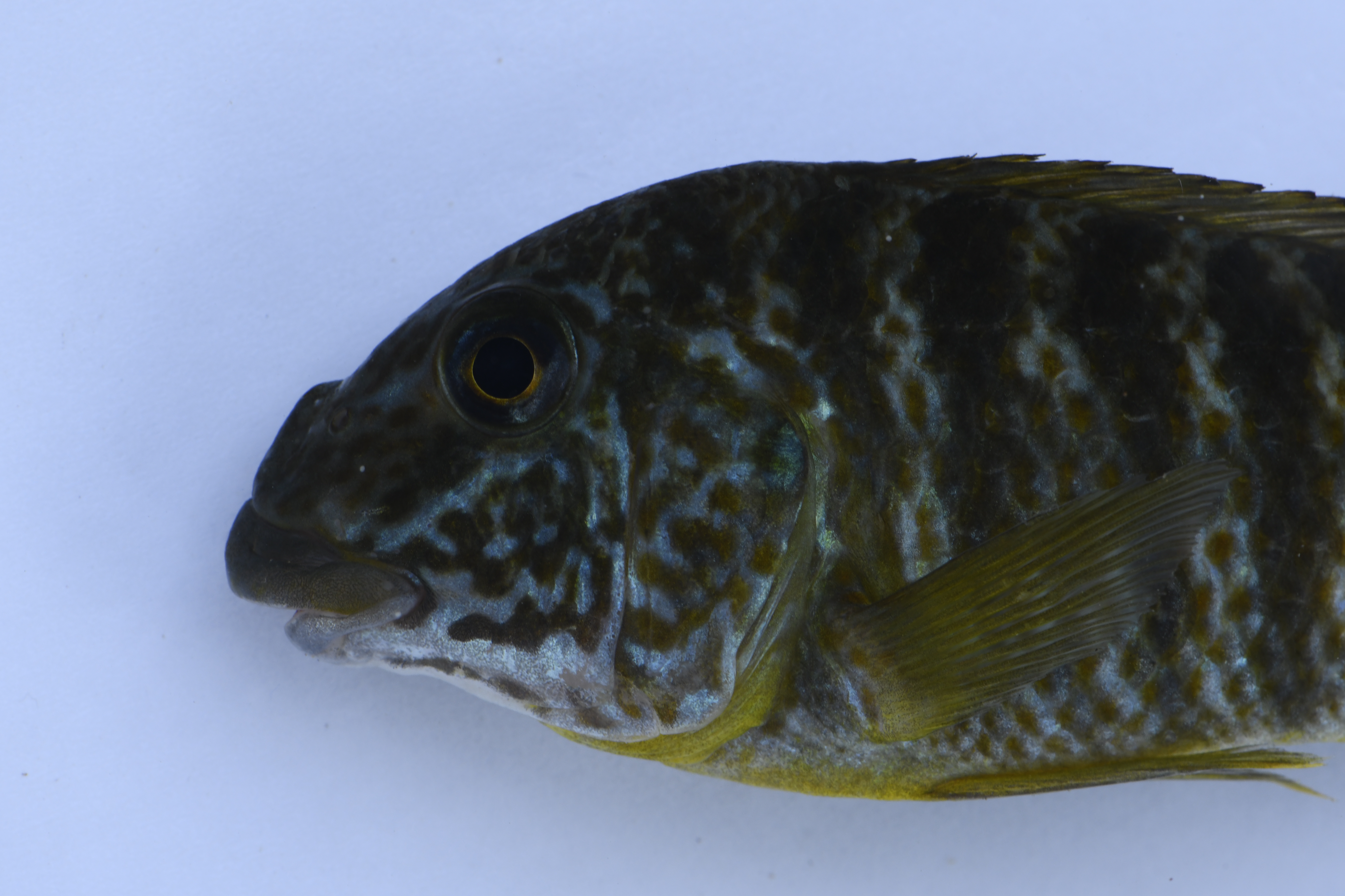
This is a robust, deep-bodied cichlid. FishBase lists a maximum of about 6.8 in (17.2 cm) standard length, while field-based specialist sources put adults nearer 8 in (20 cm) total length, noting they may grow larger still in aquaria — the figures are consistent once you account for the difference between standard and total length. Coloration is variable and geographically patterned, generally running through olive, brown and grey ground tones overlaid with darker markings, with brighter, more saturated forms among the southern populations that drive the ornamental trade.
The feature that separates P. macrognathus from every other Petrochromis is its mouth. The upper jaw projects strongly and the premaxillary ascending process is pronounced, producing the most strongly downturned mouth in the genus; even when closed, a conspicuous gap remains between the jaws and the chin region is distinctly concave. Small scales encroach onto the bases of the dorsal and anal fins. As in related tropheines, males carry true egg-spot ocelli on the anal fin — a breeding cue absent in Tropheus — which is one of the more reliable ways to sex mature fish, alongside the larger size and bolder territorial behavior of dominant males.
Range & habitat
Petrochromis macrognathus is a Lake Tanganyika endemic — it occurs nowhere else on Earth. Its distribution is nearly lake-wide but conspicuously patchy: FishBase notes it is absent north of Cape Kabogo, and specialist field records add that it has not been found along the Burundi shore, nor in Tanzania between Ikola and Taala Point, reappearing north of Ikola and south of Taala Point near Wampembe. This kind of mosaic, gap-riddled range is typical of Tanganyika's rock-restricted cichlids, whose populations are fragmented wherever stretches of sand or river mouth interrupt the rocky coast.
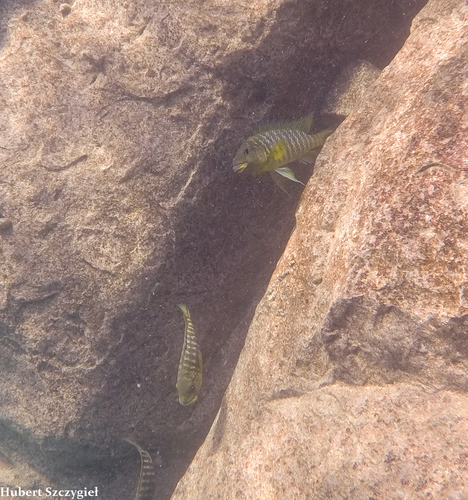
Its habitat is narrow and demanding: shallow, sediment-free rocky shores densely coated with algae, typically in the upper 0–3 m (0–10 ft) of the water column and often right in the surge zone where waves break against the boulders. It is described as a cryptic species, keeping close to and between the rocks, with territorial males retreating into large caves when threatened. Tanganyika is famously hard and alkaline — pH commonly around 8.6–9.0, high in carbonates and conductivity, with stable warm surface temperatures generally in the mid-20s °C (mid-70s to low-80s °F) — and P. macrognathus is adapted to exactly that turbulent, oxygen-rich, brightly lit margin of the lake.
Ecology & diet
P. macrognathus is an aufwuchs grazer — it makes its living scraping the thin biofilm of algae, diatoms and associated microfauna that coats sunlit rock. Yamaoka's field and dental studies of Tanganyika's algae-scraping cichlids place Petrochromis among the "grazers," which press the mouth flat against the rock and run through several rapid open-and-close cycles to comb material off the surface, as opposed to the "browsers" (like Tropheus) that nip and tear at filamentous algae. The grazers carry rows of loosely set, tricuspid teeth on broad dental pads and have long, convoluted intestines suited to processing large volumes of low-protein plant matter — FishBase places the species at a trophic level of about 2.0, near the herbivore floor.
Its feeding is built around the surge. FishBase records that it scrapes loose algae from the vertical faces of boulders in turbulent water, and because it must work between waves, its feeding stroke is fast; Yamaoka's measurements found that adult P. macrognathus completes grazing with among the fewest successive bites of any Petrochromis, taking large amounts of algal cover in each pass. The strongly downturned mouth lets it graze at a low angle to the substrate — functionally similar to scraping genera such as Tropheus — which also keeps its eyes oriented to watch for danger from above. It shares the shallow rocky zone with congeners such as P. calliris and competes with them for the same algal turf, a textbook case of the fine resource partitioning that lets so many cichlid species coexist on Tanganyika's reefs.
Behavior & breeding
By disposition P. macrognathus is shy of people and intensely territorial toward its own kind. Males hold and defend feeding territories on the rock and bolt into caves when alarmed; it is usually seen alone, though two or more individuals may share a stretch of reef. Like the rest of the genus, it is a maternal mouthbrooder. The male courts a female over his territory, where the anal-fin ocelli play their role in spawning; the clutch is modest, typically around 15 eggs or more, and after spawning the female leaves the male's territory to brood the eggs and larvae in her mouth until the fry are free-swimming. There is no biparental care.
The flip side of all that specialization is temperament. Specialist Tanganyika references rate P. macrognathus as one of the most aggressive cichlids in the entire lake — extremely hostile toward conspecifics and capable of killing other tropheines or vertically barred haplochromines kept with it. In the wild that aggression is diffused across open shoreline; the trouble starts when it is confined.
In the aquarium
This is emphatically not a beginner's fish, and not a community fish in any ordinary sense. The combination of large adult size, ferocious intraspecific aggression and a high-volume herbivorous appetite makes it demanding even for experienced Tanganyika keepers. Specialist sources recommend a minimum of roughly 800 L (about 210 US gal) for a group, with smaller numbers possible but not ideal in 500 L (about 130 gal); the practical takeaway is a long footprint, lots of rockwork forming caves and broken sightlines, and a sandy base. Match the lake: hard, alkaline water around pH 7.8–9.0, temperatures of roughly 23–28 °C (73–82 °F), strong current, high oxygenation, powerful filtration and disciplined water changes to keep nitrate low.
Diet is where keepers most often go wrong. As a dedicated algae grazer with a long gut, P. macrognathus needs a vegetable-based diet — spirulina-rich flakes or pellets — and only sparing amounts of protein; too much rich food invites the bloat that plagues Tanganyikan herbivores. Experienced keepers also note a feeding-management trap: these big grazers need feeding often and are food-aggressive, and in mixed setups with Tropheus the smaller fish can either be bullied off the food or overfed into bloat, with pellet size becoming a real headache. Petrochromis tend to claim top rank and the best breeding sites, suppressing tankmates' spawning. The honest advice is a species or carefully chosen tropheine setup, heavily stocked to spread aggression, in a tank most hobbyists would consider oversized.
Conservation
The IUCN Red List assessed Petrochromis macrognathus as Least Concern in 2025 (Mabo 2025; assessment e.T60655A47206364), with the population trend listed as unknown. It is not evaluated by CITES, and although it is collected for the ornamental trade — wild fish move under various locality names — there is no evidence that aquarium collection threatens the species at the lake-wide scale; FishBase rates its fishing vulnerability as low and its resilience as high. So the species itself is, for now, in reasonable shape.
The lake it depends on is not. Lake Tanganyika is under measurable strain. Paleoecological and isotope work shows that sustained warming has strengthened stratification and weakened the mixing that brings nutrients to the surface: O'Reilly et al. (2003, Nature, doi:10.1038/nature01833) estimated primary productivity had fallen by around 20%, implying roughly a 30% drop in fish yields, while Cohen et al. (2016, PNAS, doi:10.1073/pnas.1603237113) documented a loss of about 38% of the lake's oxygenated benthic habitat as warming pushed the oxygen line shallower, alongside declines in commercially important fishes and endemic molluscs. The pelagic clupeid fishery (Stolothrissa and Limnothrissa) and its Lates predators feed millions across the four riparian nations — Burundi, the DRC, Tanzania and Zambia — whose shared stewardship runs through the Lake Tanganyika Authority. For a shallow, rock-restricted grazer like P. macrognathus, the most direct local threats are not warming-driven productivity loss in the open lake but the degradation of its specific habitat: sedimentation from deforestation and shoreline development that smothers the sediment-free rock and the algal film it grazes (Cohen et al. 1993). The species is genuinely Least Concern today; its narrow, patchy, near-shore niche is exactly the kind that a degrading littoral could quietly erode.
Sources
- FishBase — Petrochromis macrognathus (summary)
- Catalog of Fishes (Eschmeyer) — Petrochromis macrognathus
- GBIF — Petrochromis macrognathus Yamaoka, 1983
- Encyclopedia of Life — Petrochromis macrognathus
- Yamaoka, K. (1983). A revision of the cichlid fish genus Petrochromis from Lake Tanganyika, with description of a new species. Jap. J. Ichthyol. 30:129–141 (record via GBIF)
- Yamaoka, K. (1984). Feeding behaviour and dental morphology of algae scraping cichlids in Lake Tanganyika. African Study Monographs 4:77–89
- Karlsson & Karlsson — A morphological and molecular analysis of the species in the genus Petrochromis (bioRxiv preprint)
- tanganyika.si — Petrochromis macrognathus species & biotope profile
- Fishipedia — Petrochromis macrognathus
- IUCN Red List — Petrochromis macrognathus (Mabo 2025, e.T60655A47206364)
- O'Reilly et al. (2003) — Climate change decreases aquatic ecosystem productivity of Lake Tanganyika (Nature)
- Cohen et al. (2016) — Climate warming reduces fish production and benthic habitat in Lake Tanganyika (PNAS)
- University of Arizona — Lake Tanganyika Fisheries Declining from Global Warming (summary of Cohen et al. 2016)
- Cichlid-Forum — Keeping Petrochromis and Tropheus in the same tank (community thread) — community/anecdotal
- MonsterFishKeepers — Tropheus / Petrochromis size and aggression (community thread) — community/anecdotal