
Taxonomy & naming
Petrochromis orthognathus was described by the Belgian ichthyologist Hubert Matthes in 1959, in a short paper titled "Un cichlidé nouveau du lac Tanganyika." The Catalog of Fishes lists the name as valid, with the holotype (MRAC 125150) and a long series of paratypes held at the Royal Museum for Central Africa in Tervuren. The genus name combines the Latin petra ("stone") with the Greek chromis (an old name for a perch-like fish) — fitting for a fish that spends its life working over rock. The species epithet orthognathus means "straight-jawed," and it is the diagnostic point of the whole fish: where most Petrochromis carry a projecting upper jaw, P. orthognathus has isognathous jaws that close evenly at the front.
The genus sits in the tribe Tropheini, the lake's flock of rock-dwelling, algae-grazing mouthbrooders that also includes Tropheus and Simochromis. A 2018 revision of Petrochromis by Carl Mattsson, based on morphology and mitochondrial DNA (cytochrome b and the control region), recovered P. orthognathus as the sister group to all other Petrochromis, with an elongate body and regular tooth rows reminiscent of the outgroup Tropheus. Mattsson went so far as to suggest the "ancestral Petrochromis" may have looked much like it — a useful caveat for hobbyists, since the genus is taxonomically messy and many lake forms circulate in the trade under provisional "sp." labels (for example "orthognathus Ikola") that are not the true described species.
Appearance
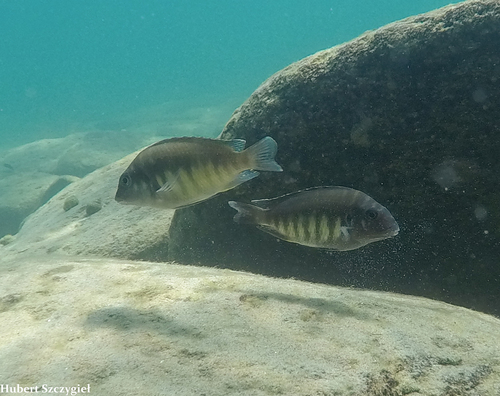
This is a modestly sized Petrochromis. The maximum recorded length is about 6.5 in (16.5 cm) total length, putting it well below the genus's giants, which can exceed 8 in (20 cm). The body is comparatively slender and elongate for the genus, with a compact head, a wide mouth, and thick lips packed with many slender, tricuspid teeth — the scraping toolkit shared across rock-grazing cichlids.
Coloration runs brown to greenish over the body, often with reddish tones in the fins. Mattsson's revision notes blue coloring near the edges of the dorsal and anal fins in males, and counts of 13–15 gill rakers on the lower limb of the first gill arch (reports range as low as 11) help separate it from congeners. Like other Tropheini, males carry egg-spot ocelli on the soft dorsal and anal fins. Sexual dimorphism is the genus norm: dominant, territorial males show the strongest color, while females and subordinate males stay duller. The single most reliable field mark remains the jaw — the even, non-projecting bite that gave the fish its name and distinguishes it from look-alikes such as P. famula (slightly isognathous but deeper-bodied) and the prognathous P. macrognathus.
Range & habitat
Petrochromis orthognathus is a Lake Tanganyika endemic — found nowhere else on Earth. According to the 2025 IUCN assessment (drawing on Konings 2019), it occupies the northern two-thirds of the lake, along the Congolese (DRC) shore south to Tembwe Village and along the Burundian and Tanzanian shores south to roughly Kirando. The type series and Mattsson's revision material came from the lake's northwest, between Luhanga and Lueba. Sources differ on exactly how far south it ranges, which is unsurprising given how easily Petrochromis forms are confused; the safe statement is that it is a northern-basin fish, not a lake-wide one.
It is a shallow rocky-shore specialist. FishBase places adults over rocks, solitary or in loose aggregation, and the revision records the species at depths of roughly 7–33 ft (2–10 m) — the brightly lit, wave-washed zone where algal turf grows thickest on stone. In-situ conditions are those of the lake itself: hard, alkaline water around pH 7.5–9.0, high in dissolved minerals, and warm and remarkably stable at about 75–79°F (24–26°C). This tight coupling to the upper rocky littoral matters for the conservation picture below, because that is precisely the habitat band most exposed to shoreline disturbance.
Ecology & diet
Like the rest of its genus, P. orthognathus is an aufwuchs grazer — it makes its living on the "aufwuchs," the felt of algae, diatoms, and associated micro-organisms that coats sunlit rock. FishBase assigns it a trophic level of 2.0, about as herbivorous as a fish gets, and a correspondingly long gut for fermenting plant material. Feeding is by scraping the biocover from stone with those dense tricuspid tooth pads.
Here the species is quietly interesting. Mattsson observed that its teeth are arranged in regular series rather than the dense, irregular pads of more derived Petrochromis, and read this as a sign that P. orthognathus is less specialized for hard epilithic scraping than relatives like P. famula. In other words, it may take a slightly more generalized share of the algal turf — combing looser material as much as gouging tightly adherent growth. Lake Tanganyika's grazing cichlids partition the rock film finely, and this kind of subtle difference in tooth mechanics is exactly what lets dozens of algae-eaters coexist on the same reef. The work of Yamaoka and others on the lake's aufwuchs-eating guild documents these trophic differences in detail, with dominant grazers actively interfering with the feeding of neighbors over prime turf.
Behavior & breeding
Petrochromis are among Lake Tanganyika's most pugnacious cichlids, and P. orthognathus follows the pattern, if at a smaller scale than the lake's giant forms. Mature males hold and defend feeding territories on rock, driving off both their own kind and other grazers; the aggression is bound up with feeding, since a defended patch of turf is also a larder. Outside of those territories, fish are seen singly or in loose groups over the rocks.
Reproduction is maternal mouthbrooding, the Tropheini default. Spawning takes place on the substrate within a male's territory; the female takes the eggs into her mouth, often using the male's fin egg-spots to ensure fertilization, then withdraws to brood the clutch alone. FishBase records eggs from the cleavage stage through larvae up to about 0.7 in (1.76 cm) total length carried by brooding females of 3.7–4.2 in (9.3–10.7 cm) standard length — confirming a comparatively small adult size and a low-fecundity, high-investment strategy. Broods are small and the fry are large and well-developed at release, a trade-off typical of the lake's rock-dwellers, where parental care substitutes for numbers.
In the aquarium
True P. orthognathus is uncommon in the hobby; much of what circulates as "orthognathus" is a regional Petrochromis variant, so verify provenance before buying. That said, the keeping rules are the genus rules, and they are demanding. Across cichlid forums, keepers consistently report two things about Petrochromis: they are relentlessly aggressive, and they are heavy, constant grazers that need frequent feeding to stay in condition. Both have direct consequences for tank design.
Plan for a long tank — experienced Tanganyikan keepers point to roughly 125 gallons (around 500 L) as a practical floor for a group, with more being better — aquascaped with heavy rockwork to break sightlines and a sandy base, plus strong filtration and oxygenation to match the fish's clean, high-flow native zone. Water should be hard and alkaline (pH near 8) at about 75–79°F (24–26°C), with bright lighting to encourage the algal film they graze. Diet must stay vegetable-based — spirulina-rich foods, low protein — because these long-gutted herbivores are prone to bloat when overfed rich, meaty fare. A recurring forum lesson is the mismatch with Tropheus: kept together, Petrochromis tend to dominate the best territories, slow or stop Tropheus breeding, and outcompete them at feeding, with the larger Petrochromis occasionally killing tankmates outright. The honest summary: this is an advanced, space-hungry, aggressive grazer, not a community fish.
Conservation
The IUCN Red List assessed Petrochromis orthognathus as Least Concern in its 2025 update (assessor L. Mabo, reviewed by A. Konings; assessment e.T60653A47206198, dated 27 February 2025), reaffirming an earlier Least Concern listing from 2006. The rationale is straightforward: it is a widespread, locally common species across the northern lake with no major lake-wide threat. The population trend is formally listed as unknown. The assessment does flag two species-relevant pressures — indiscriminate fishing and siltation — and as a shallow rocky-shore grazer, P. orthognathus is squarely in the habitat band that sedimentation harms, since silt smothers the very algal turf it feeds on.
That reassuring status sits inside a strained lake. Lake Tanganyika is warming, and the warming is reorganizing the ecosystem from the bottom up. O'Reilly and colleagues (2003, Nature) used sediment-core records to show that rising temperatures have strengthened stratification and weakened the seasonal mixing that lifts nutrients to the surface, implying a primary-productivity decline on the order of 20% and a roughly 30% drop in potential fish yields. Cohen and colleagues (2016, PNAS) added a habitat dimension, estimating that warming has cost the lake roughly 38% of its oxygenated benthic habitat as deep waters lose oxygen — a squeeze on bottom-dwelling life and, by extension, on the productivity that feeds the whole basin. Layered on top are sedimentation and nutrient loading from deforestation and shoreline development, which degrade the rocky littoral directly, and an intense pelagic fishery for clupeids (Stolothrissa and Limnothrissa) and their Lates predators that feeds millions of people across Tanzania, the DRC, Burundi, and Zambia and is managed jointly through the four-nation Lake Tanganyika Authority. None of this targets P. orthognathus specifically, and it is right to say so plainly: the species itself is Least Concern. But a rock-grazing endemic tied to a few meters of sunlit shoreline has nowhere to retreat if that shoreline silts up or warms, which is why a healthy species can still be a bellwether for a lake under pressure.
Sources
- Catalog of Fishes (Eschmeyer) — Petrochromis orthognathus species record
- FishBase — Petrochromis orthognathus summary (SpecCode 8805)
- FishBase — Petrochromis identification / species list
- GBIF — Petrochromis orthognathus occurrence and taxonomy
- Mattsson, C. — A morphological and molecular analysis of the species diversity of the cichlid genus Petrochromis from Lake Tanganyika (bioRxiv preprint)
- Ronco et al. — The taxonomic diversity of the cichlid fish fauna of ancient Lake Tanganyika (J. Great Lakes Research)
- Ecophysiology of Aufwuchs-eating cichlids in Lake Tanganyika (Springer)
- Interspecific relationships of aufwuchs-eating fishes in Lake Tanganyika (ResearchGate)
- Diet predicts intestine length in Lake Tanganyika's cichlid fishes (Functional Ecology)
- tanganyika.si — Petrochromis genus keeping notes (biotope, diet, aggression, breeding)
- Practical Fishkeeping — Tropheus and the Petrochromis grazing relationship
- Fishipedia — Petrochromis orthognathus profile
- IUCN Red List — Petrochromis orthognathus (e.T60653A47206198, 2025)
- O'Reilly et al. 2003 — Climate change decreases aquatic ecosystem productivity of Lake Tanganyika (PubMed)
- Cohen et al. 2016 — Climate warming reduces fish production and benthic habitat in Lake Tanganyika (PNAS)
- Cichlid Forum — Keeping Petrochromis and Tropheus in the same tank (keeper experience) — community/anecdotal