Taxonomy & naming
Petrochromis trewavasae was described in 1948 by the Belgian ichthyologist Max Poll, who worked extensively on the fishes collected during the Belgian hydrobiological exploration of Lake Tanganyika in 1946–47. The species epithet honors Dr. Ethelwynn Trewavas (1900–1993), the long-serving curator of fishes at the British Museum (Natural History) and one of the twentieth century's foremost authorities on African cichlids. The genus name pairs the Greek-Latin elements petra, "stone," with chromis, an old name for a perch-like fish — a fitting label for a lineage glued to rocky substrate.
The genus Petrochromis is a small radiation of dedicated rock-grazing cichlids endemic to Lake Tanganyika, the petrochromine counterpart to the better-known Tropheus with which it shares both habitat and feeding habits. Within that group, P. trewavasae sits among species defined largely by their dentition and feeding mechanics rather than by flashy color. The trade and hobby world recognizes a few regional populations by collection locality — "Moliro" being the most commonly seen name attached to imported and farmed stock — but these are color variants rather than separate species. There are no widely used junior synonyms for the species itself; taxonomic authorities including FishBase and Eschmeyer's Catalog of Fishes carry it as a valid species under Poll's original name.
Appearance
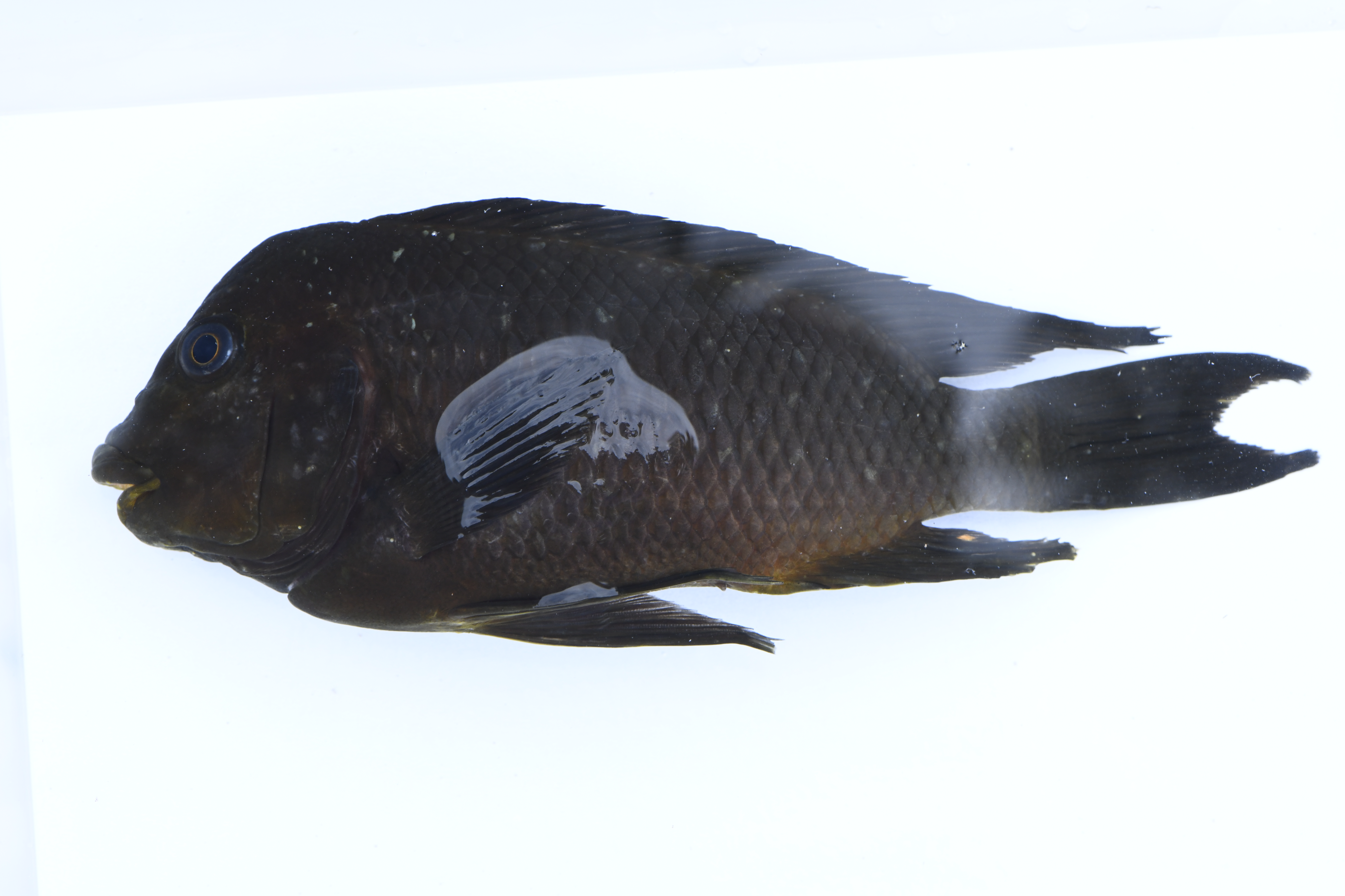
This is a medium-large Tanganyikan cichlid. FishBase gives a maximum of about 7 in (18 cm) total length, and hobby sources note that dominant males can push toward 8 in (20 cm); females run noticeably smaller. The body is elongate-ovoid and powerfully built, with the deep head and prominent, downturned mouth typical of the genus — the lips are thick and rubbery, an adaptation for sealing against rock while the fish rasps. One author memorably compared a male's blunt, battered-looking face to a knocked-out boxer.
The feature that names the fish is its dorsal fin: the soft rays at the rear trail off into fine filaments, and the anal fin is similarly extended in mature males, giving the threadfin its common names (it has also gone by "filament-finned petrochromis"). Base coloration is a muted brown to grayish-yellow that does little to advertise itself against the rocks; intensity varies with mood, dominance, and locality. Sexual dimorphism is subtle and a recurring frustration for keepers. Beyond their larger size and longer fin filaments, males of the wild-type form can often be told from females by the females' smaller stature and a pale or whitish band along the dorsal and anal fins. Because the differences are slight, sexing a young group reliably usually means waiting for behavior and growth to sort the fish out.
Range & habitat
Petrochromis trewavasae is a Lake Tanganyika endemic with a notably restricted distribution: it is confined to the southwestern part of the lake, with sources placing its range between Kapampa in the Democratic Republic of the Congo and Cape Kachese (near Cape Chipimbi) in Zambia. This is a much narrower range than that of widespread congeners, and the IUCN assessment treats the species as restricted to that southwestern shore.
The fish is a creature of the shallow rocky littoral — the boulder-strewn, sunlit zone where epilithic algae grow thickest. Adults hold feeding territories over rock in the first few meters of water; juveniles tend to keep to the somewhat cryptic, shaded crevices among rocks and boulders one to two meters down, where wave action is gentler but algal growth is poorer. Like the rest of the rift-lake rocky-shore community, it lives in hard, alkaline water. In-situ and aquarium-reference conditions cluster around pH 7.5–8.8, moderate to high hardness (roughly 10–25 dGH), and warm temperatures of about 73–82°F (23–28°C). The species is described as shy and is usually encountered in small groups working the same stretch of reef.
Ecology & diet
Petrochromis trewavasae is a trophic specialist: an algae grazer that scrapes the "biocover" of the rocks — the aufwuchs, a felt of filamentous algae, attached diatoms, and associated micro-organisms. The genus does this with a distinctive technique documented by Kohei Yamaoka's field and dental-morphology studies on Tanganyikan algae-scrapers. A Petrochromis opens its mobile mouth, presses thick lips lined with many small tricuspid teeth flat against the rock, and works the jaws through repeated open-and-close cycles, combing unicellular diatoms off the filamentous mat much as a thresher strips grain. A long, coiled intestine — a hallmark of the genus — handles this fibrous, low-nutrient diet.
Within that feeding guild, P. trewavasae stands out. Across its entire growth series, Yamaoka rated it as superficially the best-adapted of the Petrochromis for combing epilithic algae, distinguished by high "successive repeated times" of grazing — many rasping strokes per mouth contact. In the wild it shares the rocky shore with the dominant grazer P. polyodon and the browser Tropheus moorii, and the species partition the habitat: dominant adults of P. trewavasae and P. polyodon hold the prime, well-lit feeding territories, while smaller, non-territorial fish are pushed into more crowded or shaded ground and grazed for shorter, harried bouts. Its niche, in short, is defined by both a refined scraping apparatus and the constant jostle for the best-lit rock.
Behavior & breeding
Socially, this is a territorial, hierarchical fish. Groups organize around dominant individuals, and dominant males in particular do not tolerate one another — confrontations between two are intense and can end in the submission or death of the loser. That intolerance is the defining behavioral fact of the species and shapes everything about keeping it. Toward other species it is also assertive, defending its patch of rock and chasing off intruders.
Reproduction follows the Tanganyikan rock-cichlid template: P. trewavasae is a maternal mouthbrooder. Dominant males are polygynous, spawning with several females in season. The female takes the eggs into her mouth almost as she lays them and broods the developing young there for several weeks, a strategy that trades large clutch size for the protection of each egg and fry. Brood sizes are modest — one keeper recorded eleven well-formed fry of about half an inch from a single successful spawning. As is typical of mouthbrooders, the brooding female does not feed while holding, and newly released fry are precocious and immediately competitive: the same observer noted that the juveniles began terrorizing one another almost at once, in the same temper as their parents.
In the aquarium
Among advanced Tanganyika keepers, Petrochromis are regarded as a step up in difficulty from the already-demanding Tropheus, and P. trewavasae is frequently called one of the hardest African cichlids to keep — for two linked reasons: diet and aggression. The diet is the first trap. These are herbivores with long guts built for algae, and they are highly prone to "bloat" (a often-fatal digestive disorder) when fed protein-rich foods. Experienced keepers feed a spirulina- and vegetable-based diet of quality flakes and pellets, kept lean, and treat any high-protein input with caution. The fish will also strip and uproot plants, so a planted aquascape is not realistic; the standard setup is sand with a substantial pile of rock providing territories and broken sight lines.
The second trap is aggression, and it dictates tank size. This is not a small-tank fish. Specialist references suggest very large volumes — on the order of 400 gallons (around 1,500 L) for a proper group — and the recurring picture from hobbyist forums is of these fish kept in six-foot, 300-gallon-class systems, often alongside Tropheus colonies that share their diet and temperament. The common strategy is to keep a single male with several females (a ratio around 1:3 is often cited) and to overstock the supporting cast to diffuse aggression across many targets rather than concentrate it on one. Multiple dominant males in a typical tank is a recipe for casualties. Captive breeding is achievable and farmed "Moliro" stock circulates, but between the bloat risk, the space requirement, and the relentless intraspecific conflict, this is firmly an experienced-keeper species, not a community fish.
Conservation
The IUCN Red List assessed Petrochromis trewavasae as Least Concern in 2025 (assessment dated 27 February 2025, reviewed by Ad Konings), reaffirming an earlier Least Concern listing from 2006. The justification is straightforward: the species is endemic to Lake Tanganyika but reasonably widespread across the southwestern shore, and no major lake-wide threat specific to it has been identified, though the population trend is recorded as unknown. The assessors do note two pressures that bear on it locally — harvesting (both as food and for the aquarium trade) and siltation from soil erosion degrading its rocky habitat.
Those local threats sit inside a basin under real strain. Lake Tanganyika has been warming, and that warming strengthens the lake's vertical stratification and shrinks the mixing that lifts nutrients from the depths: O'Reilly and colleagues (2003, Nature) inferred from sediment records that primary productivity may have fallen by roughly 20%, implying on the order of a 30% decline in fish yields. Cohen and colleagues (2016, PNAS) found that reduced mixing had depressed algal production and shrunk the oxygenated benthic habitat by about 38% in their study areas since the mid-twentieth century, with measurable declines in commercially important fishes and endemic molluscs. Sedimentation from catchment deforestation degrades the rocky littoral itself (Cohen et al. 1993), and a commercial pelagic fishery built on clupeids (Stolothrissa and Limnothrissa) and the predatory Lates feeds four bordering nations, whose shared stewardship runs through the Lake Tanganyika Authority. For a shallow rocky-shore grazer like P. trewavasae, the most direct of these pressures is sedimentation: silt smothers the algae-coated rock its whole way of life depends on. The honest summary is that the species itself is not currently threatened, but it is a narrow-range specialist tied to exactly the inshore rocky habitat that lake-wide warming and shoreline erosion are most likely to erode.
Sources
- Petrochromis trewavasae (Threadfin cichlid) — FishBase species summary
- Petrochromis trewavasae — FishBase Field Guide (size, distribution, IUCN line)
- Eschmeyer's Catalog of Fishes — California Academy of Sciences (valid name, authority)
- Petrochromis trewavasae — GBIF taxon page
- The ETYFish Project — etymology of Petrochromis trewavasae (eponymy: Ethelwynn Trewavas)
- Yamaoka, K. (1983/1986), Feeding Behaviour and Dental Morphology of Algae Scraping Cichlids in Lake Tanganyika — African Study Monographs (PDF)
- Takamura, K. — Interspecific relationships of aufwuchs-eating fishes in Lake Tanganyika (ResearchGate)
- O'Reilly, C.M. et al. (2003), Climate change decreases aquatic ecosystem productivity of Lake Tanganyika — Nature (PDF)
- Cohen, A.S. et al. (2016), Climate warming reduces fish production and benthic habitat in Lake Tanganyika — PNAS
- Lake Tanganyika: Status, challenges, and opportunities for research — ScienceDirect (basin review)
- Petrochromis trewavasae — IUCN Red List (Least Concern, assessed 27 Feb 2025)
- Bergstrom, U. (1996), Petrochromis trewavasae, 'The Velcro closing syndrome' — Cichlid Room Companion
- Threadfin cichlid (Petrochromis trewavasae) — Fishipedia species sheet
- Keeping Tropheus and Petrochromis (incl. P. trewavasae): a keeper's basics — HoustonFishBox forum — community/anecdotal
- Petrochromis information — keeping experience and difficulty (USA FishBox community thread) — community/anecdotal
- Keeping Petrochromis and Tropheus in the same tank? — Cichlid-Forum community thread — community/anecdotal
- What's the smallest tank that's able to house Tropheus? (P. trewavasae keepers) — Cichlid-Forum thread — community/anecdotal