Taxonomy & naming
Petrotilapia flaviventris was formally described in 2011 by Mary Lundeba, Jay R. Stauffer Jr., and Ad Konings, in a single paper that added five new species to the genus at once (Ichthyological Exploration of Freshwaters 22(2): 149–168). The holotype, an adult male of 110.9 mm standard length, was collected at Same Bay on Chizumulu Island, in the lake's central island group. The generic name Petrotilapia joins the Latin petra (stone) to a southern African word for fish, an apt label for a genus of rock specialists; the epithet flaviventris combines flavus (yellow) and venter (belly), pointing straight at the species' yellow underside. Before the description, aquarists and field workers knew it informally as Petrotilapia sp. 'yellow ventral.'
Petrotilapia is one of roughly a dozen genera of mbuna, the small rock-dwelling haplochromine cichlids that make up much of Lake Malawi's celebrated species flock. Within the genus, biologists recognize three habitat-linked species groups, named for typical members: the P. tridentiger group of the wave-washed surf zone, the P. genalutea group of sediment-rich intermediate ground, and the larger P. nigra group bound to somewhat deeper rock. P. flaviventris belongs to the P. nigra group. A striking feature of the whole genus is that no species spans the entire lake; most rocky shores instead host three different Petrotilapia, each in its own sub-habitat, so the genus is best understood as a mosaic of geographically isolated forms rather than a few wide-ranging species.
Appearance
This is a moderately sized, deep-bodied mbuna. The type series tops out at about 11.1 cm (4.4 in) standard length; including the tail, mature males in the lake reach roughly 15–16 cm (6 in) total length, with females staying smaller at around 12–13 cm (5 in). Reports of larger aquarium fish, up to about 18 cm (7 in), almost certainly reflect heavy feeding rather than natural size. The body depth runs to roughly 36–39% of standard length, and the head profile is gently concave above the eye.
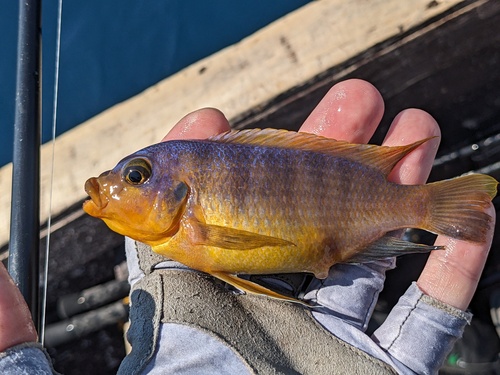
Male color is the easiest field mark. The ventral and mid-flank are yellow with each scale rimmed in blue, the cheeks and throat glow yellow to orange, and the upper third of the body shifts to blue-gray with yellow and orange highlights. Crucially for identification, the dorsal fin lacks the dark submarginal band carried by several look-alike congeners (P. microgalana, P. genalutea, P. nigra, P. chrysos, P. mumboensis, and P. pyroscelos), which is the single cleanest way to separate the species. Males show eight or nine dark vertical bars that fade out when the fish is dominant or in spawning mood. Females are quieter: yellow-brown with interrupted black horizontal stripes, faint vertical barring, and a background darkening toward brown on the back. Male coloration varies geographically across the range — many populations are blue-bodied with a yellow belly, while at Cobwé and Lumbaulo males can be almost entirely yellow. The mouth is unmistakable: thickened lips and isognathous (evenly aligned) jaws bearing ten to eighteen rows of slender, tricuspid teeth visible even when closed.
Range & habitat
Petrotilapia flaviventris is endemic to Lake Malawi — found nowhere else on Earth. Its type population lives at Chizumulu Island, and what appears to be the same species has been recorded along the lake's eastern shore between Mbweca Rocks in Mozambique and Undu Point in Tanzania, so its confirmed range straddles all three countries that share the lake. Within that range it is strictly a rock dweller, but a particular kind of rock dweller: as a member of the P. nigra group it favors the somewhat deeper, sediment-richer rocky stretches rather than the pounding surf zone up top. It is most common between about 5 and 10 m (16–33 ft) depth, though it will move shallower into intermediate rock-and-sand habitat near the surface.
The eastern shoreline between Mbweca and Undu Point is telling about the fish's preferences. That coast has comparatively little steep rocky habitat and is, in places, distinctly sediment-laden; only at a few spots such as Lumbaulo is the rock described as sediment-free. P. flaviventris persists there anyway, consistent with a species that tolerates — even favors — a dusting of sediment over its grazing rock. Lake Malawi itself is hard, alkaline, and warm: shallow water typically sits around pH 7.7–8.6 and the surface layer hovers near 24–28 °C (75–82 °F), the conditions this fish is adapted to.
Ecology & diet
Like every Petrotilapia, this species is a specialized aufwuchs grazer — aufwuchs being the felt-like mat of algae, diatoms, and small invertebrates that coats sunlit lake rock. The feeding apparatus is the defining genus trait: broad fleshy lips are pressed flat against the substrate, and the dense brushes of long, flexible, tricuspid teeth comb through the algal turf, raking loose filaments and diatoms (and, on sediment-rich rock, a share of fine sediment) into the mouth. The bulk of the diet is plant material, and FishBase places the species at a trophic level near 3.4, reflecting the small animal fraction that comes along with the algae.
That grazing mode makes P. flaviventris part of the dense guild of mbuna that crop Lake Malawi's rocky reefs. Competition for grazing turf is intense on these shores — it is precisely the pressure that, over evolutionary time, has helped partition Petrotilapia and its neighbors into finely divided sub-habitats. By favoring deeper, sediment-tinged rock, P. flaviventris sidesteps the surf-zone specialists and the shallow open-rock grazers, occupying a band of the reef that not every mbuna will work.
Behavior & breeding
P. flaviventris is a maternal mouthbrooder with a polygynous, harem-style mating system, the standard mbuna pattern. In the lake, a sexually active male holds a sizable territory — on the order of 4 m (13 ft) across — centered on a spawning site, usually a small cave among rocks or the shelter beneath an overhanging boulder. Females are not tied to a single male; a ripe female may tour several territories before spawning. Courtship runs through the familiar mbuna choreography: the male flares his fins, quivers, and leads the female to his cave, where eggs are laid and fertilized in turn and immediately taken up into her mouth.
The female then withdraws to incubate alone, sheltering among rocks in shallower intermediate habitat. Incubation lasts roughly three weeks (about 19–21 days), during which she does not feed; the fry are released and then left to fend for themselves, grazing algae soon after. Territorial males are strongly aggressive, both toward rival males and toward similar-looking species — particularly anything that resembles their own breeding colors, which they read as competition.
In the aquarium
This is not a beginner mbuna, and it is not common in the hobby. Experienced keepers describe Petrotilapia as among the more aggressive mbuna — one long-time keeper rated their temperament alongside the notoriously truculent Melanochromis chipokae, and cautioned against the "gentle giant" label that occasionally gets pinned on the genus. The practical consequence is space and structure: plan for a tank of at least 150 cm (5 ft), and ideally 180–200 cm (6–6.5 ft) and around 600 L (160 US gal), aquascaped with heavy rockwork stacked nearly to the surface so sightlines break up and subordinate fish can claim retreats. Keep a single male with a group of females; a second male is a recipe for a dead male, and tankmates that mimic the breeding coloration invite trouble.
Water should match the lake: hard and alkaline (pH roughly 7.8–8.5, high carbonate hardness) at about 24–26 °C (75–79 °F). Diet matters more than for many fish, because this is a dedicated algae grazer. Feed a vegetable-forward menu — spirulina and other plant-based flakes or pellets — and treat animal foods as occasional extras. A consistent piece of mbuna lore, corroborated across keeper communities, is to avoid tubifex and bloodworm: the rich, protein-heavy foods that herbivorous Malawi cichlids handle poorly are widely linked to "Malawi bloat," a digestive disorder that can kill quickly. The common keeper mistakes with a fish like this are predictable — too small a tank, too little rock, too few females per male, and pairing it with passive species it will simply bully.
Conservation
The IUCN Red List assesses Petrotilapia flaviventris as Least Concern (assessment by Konings & the FishBase team at the RMCA, dated 22 June 2018, with a stable population trend). The assessors note no major widespread threats and describe the fish as a common cichlid of the intermediate habitat within its range. The two pressures they flag specifically are sedimentation and irregular collection for the aquarium trade; because the species is exported only sporadically and in small numbers, trade is judged a potential rather than active threat. As a narrow-range, deeper-rock endemic, however, it is the kind of fish that a localized habitat change could affect more than a lake-wide species would suffer.
That species-level calm sits inside a lake under real and growing strain. The Chavula et al. (2023) basin review of Lake Malawi/Niassa/Nyasa (Journal of Great Lakes Research 49(6):102241) catalogs the pressures: heavy and partly unregulated fishing that has driven the collapse of the once-abundant chambo (Oreochromis) fishery; sediment and nutrient loading washing off deforested, farmed catchments; an observed warming of the shallow water (on the order of +0.7 °C) that strengthens the lake's stratification and suppresses the nutrient mixing that feeds primary production; and the looming risk of invasive species. For a sediment-tolerant rock grazer like P. flaviventris, the most direct of these is sedimentation: the algal turf it scrapes from rock thins and is smothered where catchment erosion buries reefs in silt, and its preferred deeper-rock band is exactly where light and aufwuchs growth are already marginal. Warming-driven productivity loss tightens the same screw across the whole reef community. The honest summary is that the species itself is not currently threatened, but the rocky-shore habitat it depends on is being quietly degraded by basin-scale pressures — a reason to track it rather than to assume it is safe.
Sources
- Petrotilapia flaviventris — FishBase summary
- Catalog of Fishes (Eschmeyer/CAS) — Petrotilapia flaviventris
- EOL — Petrotilapia flaviventris Lundeba, Stauffer & Konings 2011
- Lundeba, Stauffer & Konings (2011), Five new species of the genus Petrotilapia, Ichthyol. Explor. Freshwat. 22(2):149–168
- Practical Fishkeeping — Five new species of Petrotilapia cichlid described
- malawi.si — Petrotilapia flaviventris 'Chiteko'
- AquaInfo — Petrotilapia flaviventris
- Cichlid Room Companion / Konings, Malawi cichlids in their natural habitat (cited in IUCN & FishBase)
- Cichlid-Forum.com — Petrotilapia (keeper thread on temperament & care) — community/anecdotal
- Reddit r/Cichlid — Housing mbuna with other cichlids: dietary/Malawi bloat concerns — community/anecdotal
- Aquarium Science — Food and Malawi Bloat
- IUCN Red List — Petrotilapia flaviventris (Least Concern, 2018)
- Chavula et al. (2023), Lake Malawi/Niassa/Nyasa basin: Status, challenges, and research needs, J. Great Lakes Res. 49(6):102241
- Ribbink et al. (1983), A preliminary survey of the cichlid fishes of rocky habitats in Lake Malawi, S. Afr. J. Zool. 18:149–310 (genus ecology, cited in IUCN)
- FishBase identification list — genus Petrotilapia (size/meristics)